Archive for category events
What is the longest path though Six Degrees of Black Sabbath?
Posted by Paul in events, fun, Music, The Echo Nest on May 25, 2010
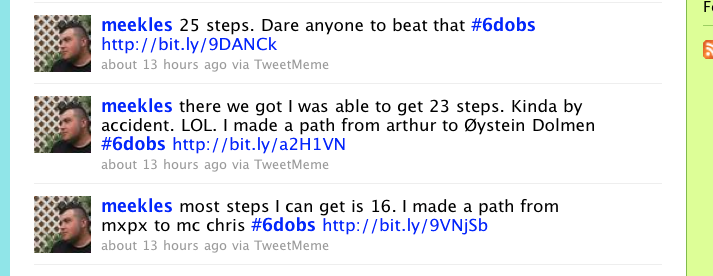
[tweetmeme source= ‘plamere’ only_single=false] @meekles tweeted yesterday that he had found a 25 step path through Six Degrees of Black Sabbath and challenged anyone to find a longer path that his Path from Arthur to Eivind Fjoseide.
To sweeten the challenge, I’ll offer a prize of a coveted Echo Nest Tee Shirt for each new longest path found. Here are the rules:
- When you find a path that you think is longer than any found so far, tweet the path with its length and the hashtags #6dobs and #longest. For example: I made a 25 step path from arthur to Eivind Fjoseide #6dobs #longest http://bit.ly/9DANCk
- No skipping allowed in longest paths
- Only one tee-shirt given per milestone – so if 5 people find a 27 step path, only the first who finds it gets the tee-shirt
- Only one tee-shirt per person
- You are not eligible if you work for the Echo Nest, or if your name is Kurt Jacobson
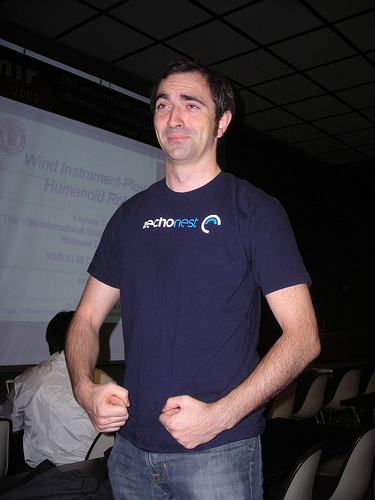
The Echo Nest tee-shirt will turn you into a music metadata superhero
Have fun finding those paths!
Update: Great work finding paths of at least 40 artists long. Tee-shirt give away ends tonight (May 25) at midnight EDT!
Six Degrees of Black Sabbath
[tweetmeme source= ‘plamere’ only_single=false] My hack at last week’s Music Hack Day San Francisco was Six Degrees of Black Sabbath – a web app that lets you find connections between artists based on a wide range of artist relations. It is like The Oracle of Bacon for music.
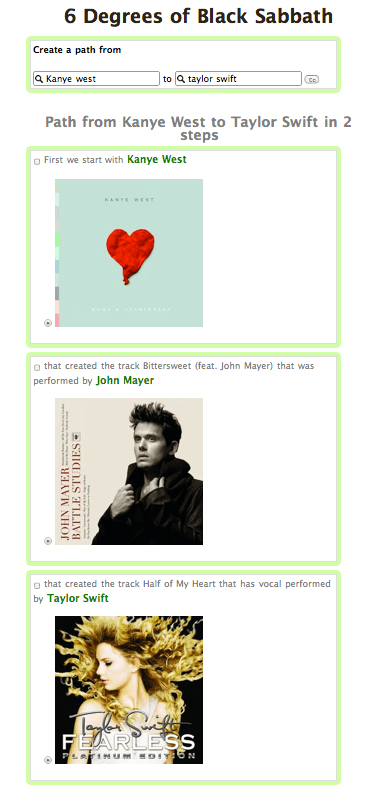
To make the connections between the artists I rely on the relation data from MusicBrainz. MusicBrainz has lots of deep data about how various artists are connected. For instance there are about 130,000 artist-to-artist connections – connections such as:
- member of band
- is person
- personal relationship
- parent
- sibling
- married
- involved with
- collaboration
- supporting musician
- vocal supporting musician
- instrumental supporting musician
- catalogued
So from this data we know that George Harrison and Paul McCartney are related because each was a ‘member of the band’ of The Beatles. In addition to the artist-to-artist data MusicBrainz has artist-track relations (Eric Clapton played on ‘While My Guitar Gently Weeps’), artist-album (Brian Eno produced U2’s Joshua Tree), track-track (Girl Talk samples ‘Rock You Like A Hurricane’ by the Scorpions for the track ‘Girl Talk Is Here’). All told there are about 130 different types of relations that can connect two artists.
Not all of these relationships are equally important. Two artists that are members of the same band have a much stronger relationship than an artist that covers another artist. To accommodate this I assign weights to the various different types of relationships – this was perhaps the most tedious and subjective part of building this app.
Once I have all the different types of relations I created a directed graph connecting all of the artists based upon these weighted relationships. The resulting graph has 220K artists connected by over a million edges. Finding a path between a pair of artists is a simple matter of finding the shortest weighted path through the graph.
We can learn a little bit about music by looking at some of the properties of the graph. First of all, the average distance in the graph between any two artists in the graph chosen at random is 7. Some of the top most connected artists along with the number of connections:
-
- 5372 Various Artists
- 1604 Wolfgang Amadeus Mozart
- 1275 Johann Sebastian Bach
- 905 Ludwig van Beethoven
- 696 Linda Ronstadt
- 611 Diana Ross
- 560 [traditional]
- 538 Antonio Vivaldi
- 534 Jay-Z
- 528 Georg Friedrich Händel
- 494 Giuseppe Verdi
- 491 Johannes Brahms
- 490 Bob Dylan
- 465 The Beatles
- 442 Aaron Neville
Here we see some of the anomalies in the connection data – any classical performer who performs a piece by Mozart is connected to Mozart – thus the high connectivity counts for classical composers. A more interesting metric is the ‘betweeness centrality’ – artists that occur on many shortest paths between other artists have higher betweenness than those that do not. Artists with high betweenness centrality are the connecting fibers of the music space. Here are the top connecting artists:
-
- 565 Pigface
- 312 Various Artists
- 135 Mick Harris
- 122 Black Sabbath
- 120 The The
- 115 Youth
- 93 Bill Laswell
- 79 J.G. Thirlwell
- 74 Painkiller
- 72 F.M. Einheit
- 71 Napalm Death
- 63 Paul McCartney
- 63 Flea
- 60 Material
- 60 Andrew Lloyd Webber
- 57 Luciano Pavarotti
- 57 Raimonds Macats
- 56 Ginger Baker
- 56 Mike Patton
- 54 Johnny Marr
- 54 Paul Raven
- 53 Brian Eno
I had never heard of Pigface before I started this project – and was doubtful that they could really be such a connecting node in the world of music – but a look a their wikipedia page makes it instantly clear why they are such a central node – they’ve had well over a hundred members in the band over their history. Black Sabbath, while not at the top of the list is still extremely well connected.
I wrote the app in python, relying on networkx for the graph building and path finding. The system performs well, even surviving an appearance on the front page of Reddit. It was a fun app to write – and I enjoy seeing all the interesting pathways people have found through the artist space.
Earworm and Capsule at Music Hack Day San Francisco
Posted by Paul in events, Music, remix, The Echo Nest, web services on May 14, 2010
[tweetmeme source= ‘plamere’ only_single=false] This weekend The Echo Nest is releasing some new remix functionality – Earworm and Capsule. Earworm lets you create a new version of a song that is any length you want. Would you like 2 minute version of Stairway to Heaven? Or a 3 hour version of Freebird? Or an Infinitely long version of Sex Machine? Earworm can do that. Here’s a 60 minute version of a little Rolling Stones ditty:
Capsule takes a list of tracks and optimizes the song transitions by reordering them and applying automatic beat matching and cross fading to give you a seamless playlist. It is really neat stuff. Here’s an example of a capsule between two Bob Marley songs:
It makes a nice little Bob Marley medley.
Jason writes about Capsule and Earworm and some other new features in remix in his new (and rather awesome) blog: Running With Data – Earworm and Capsule. Check it out.
On more reason to go to Music Hack Day San Francisco
Posted by Paul in events, Music, The Echo Nest on May 5, 2010

Boxee is coming to Music Hack Day San Francisco – and they will be bringing along a Boxee Box to be given to the best music application that runs on the Boxee. Boxee is a really cool environment for writing music apps – they have a nifty Python API that gives you all sorts of control over the device. It also means that you can easily write apps on Boxee that take advantage of The Echo Nest APIs giving you world class music recommendations, detailed info about artists such as news, reviews, blogs, audio and video and even the ability to algorithmically remix music. Best of all, Boxee puts music apps right where they should be – in the living room. Imagine the kind of music app that you’d want to have running on your 48″ living room TV – something that you’d use when sitting on the couch, or when you have a party, or when the gang is getting tired of Guitar hero. What I’d love to have running in my living room is a Pandora-style radio, running on my TV, but instead of seeing static album art, I’d like the app to show artist images or images that match the mood or the theme of the music. Ken Burns meets my favorite music. The cool thing is, this is exactly the type of app that can be written in a weekend at the Music Hack Day. Can’t wait.
Link dump from the Amsterdam music hackday
Posted by Paul in events, Music, The Echo Nest on April 25, 2010
Some of my favorite things from the AMS MHD
- http://clusterfm.appspot.com/randommap/
- http://www.flickr.com/photos/blueace/4550191863/sizes/l/
- http://www.youtube.com/watch?v=aD9GrKhEzqQ
- http://www.twerff.nl/friends.swf
- http://rockitbaby.de/projects/charting/
- http://teatracks.com/gliss/
- http://github.com/alastair/echonest-albumidentify
- http://scrobarcode.com/browse?user=lamere
Music Hack Days are awesome
Posted by Paul in events, Music, The Echo Nest on April 10, 2010

Flickr photo by paulamarttila
There are now two Music Hack Days on the calendar for the next month: Amsterdam on April 24th, 25th and San Francisco on May 15th, 16th.
The Echo Nest will be participating in both. We just love music hack days – the amount of creativity that gets packed into one room during a hack day is just amazing. Plus it is a great way to meet developers face-to-face to see how they use are stuff. Brian will be representing at the Amsterdam event (I think Brian really likes Amsterdam). He’ll be showing off some new APIs that we are all really excited about – plus we’ll be giving our new API infrastructure a workout – everything will (hopefully) be faster, more reliable, better documented.
Right on the heals of the Amsterdam event is the San Francisco Hack Day. It is being hosted at the Automattic Lounge on Pier 38 right in the city. The event is filling up really fast – there’s lots of pent up demand for a hack day in SF – and the mention in Techcrunch didn’t hurt. At the SF hack day if the stars align we’ll be releasing another new API feature – one that is perhaps the most requested feature of our APIs. Can’t wait. Oh and the SF Music Hack Day is right between two other cool music events: The Bay Area Computer Music Technology Group (BArCMuT) meetup on Thursday May 13, and the SF Music Tech Summit on Monday May 17th.
Wondering what a music hack day is like? Check out these photos: Flickr Slide show of Music Hack days past
Bad Romance – the memento edition
Posted by Paul in code, events, remix, The Echo Nest on March 18, 2010
At SXSW I gave a talk about how computers can help make remixing music easier. For the talk I created a few fun remixes. Here’s one of my favorites. It’s a beat-reversed version of Lady Gaga’s Bad Romance. The code to create it is here: vreverse.py
Unofficial Artist Guide to SXSW
Posted by Paul in events, Music, recommendation, The Echo Nest on March 4, 2010
I’m excited! Next week I travel to Austin for a week long computer+music geek-fest at SXSW. A big part of SXSW is the music – there are nearly 2,000 different artists playing at SXSW this year. But that presents a problem – there are so many bands going to SXSW (many I’ve never heard of) that I find it very hard to figure out which bands I should go and see. I need a tool to help me find sift through all of the artists – a tool that will help me decide which artists I should add to my schedule and which ones I should skip. I’m not the only one who was daunted by the large artist list. Taylor McKnight, founder of SCHED*, was thinking the same thing. He wanted to give his users a better way to plan their time at SXSW. And so over a couple of weekends Taylor built (with a little backend support from us) The Unofficial Artist Discovery Guide to SXSW.
The Unofficial Artist Discovery Guide to SXSW is a tool that allows you to explore the many artists attending this year’s SXSW. It lets you search for artists, browse popularity, music style, ‘buzzworthiness’, or similarity to your favorite artists – and it will make recommendations for you based on your music taste (using your Last.fm, Sched* or Hype Machine accounts) . The Artist Guide supplies enough context (bios, images, music, tag clouds, links) to help you decide if you might like an artist.
Here’s the guide:
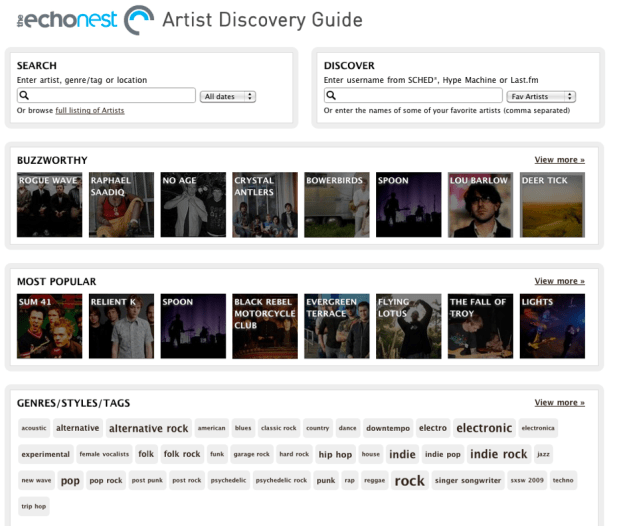
Here’s a quick tour of some of the things you can do with the guide. First off, you can Search for artists by name, genre/tag or location. This helps you find music when you know what you are looking for.
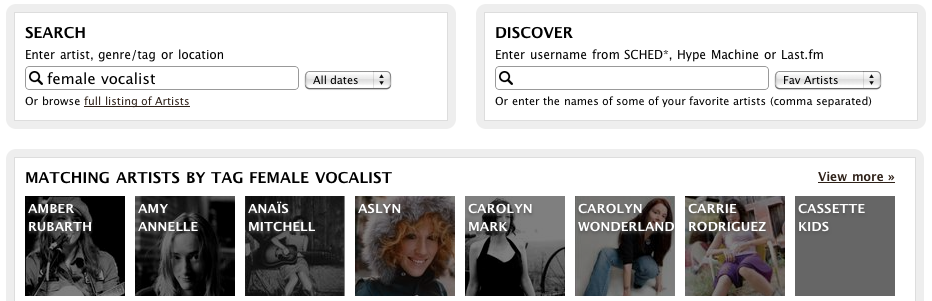
However, you may not always be sure what you are looking for – that’s where you use Discover. This gives you recommendations based on the music you already like. Type in the name of a few artists (even artists that are not playing at SXSW) or your SCHED*, Hype Machine or Last.fm user name, and ‘Discover’ will give you a set of recommendations for SXSW artists based on your music taste. For example, I’ve been listening to Charlotte Gainsbourg lately so I can use the artist guide to help me find SXSW artists that I might like:
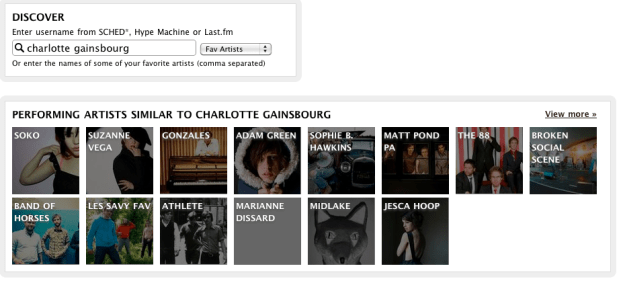
If I see an artist that looks interesting I can drill down and get more info about the artist:
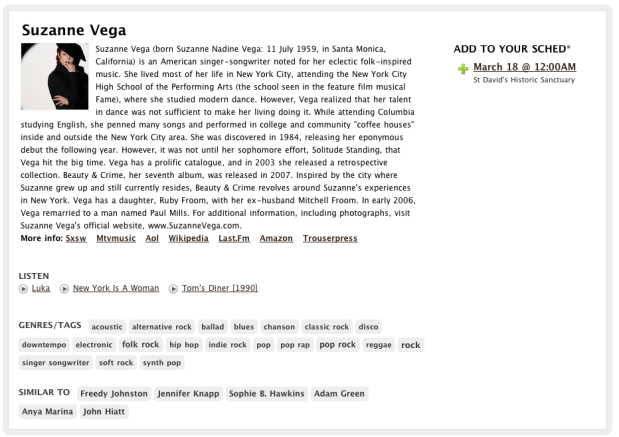 From here I can read the artist bio, listen to some audio, explore other similar SXSW artists or add the event to my SCHED* schedule.
I use Last.fm quite a bit, so I can enter my Last.fm name and get SXSW recommendations based upon my Last.fm top artists. The artist guide tries to mix things up a little bit so if I don’t like the recommendations I see, I can just ask again and I can get a different set. Here are some recommendations based on my recent listening at Last.fm:
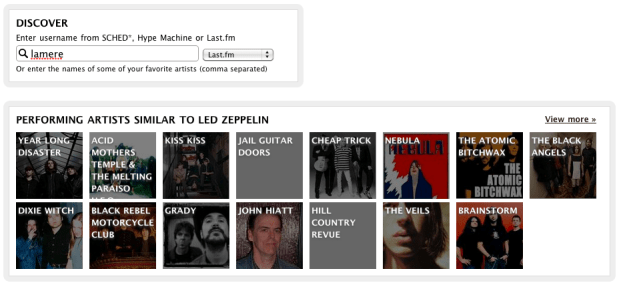
If you’ve been using the wonderful SCHED* to keep track of your SXSW calendar you can use the guide to get recommendations based on artists that you’ve already added to your SXSW calendar.
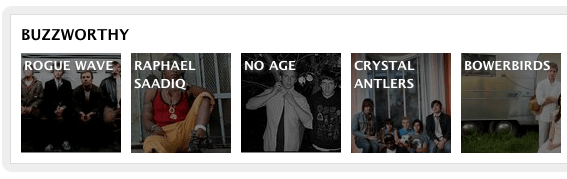
In addition to search and discovery, the guide gives you a number of different ways to browse the SXSW Artist space. You can browse by ‘buzzworthy’ artists – these are artists that are getting the most buzz on the web:
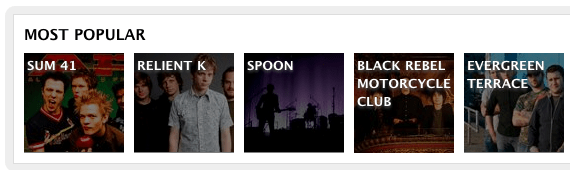
Or the most well-known artists:
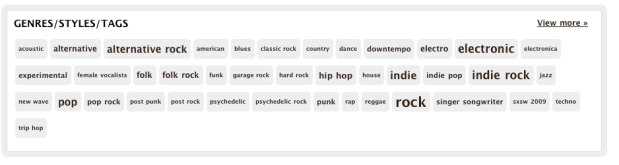
You can browse by the style of music via a tag cloud:
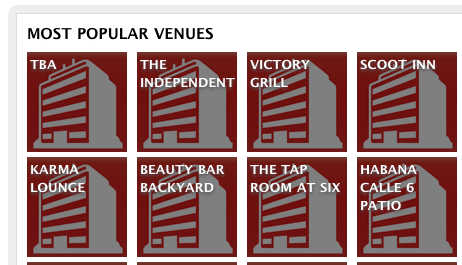
And by venue:
Building the guide was pretty straightforward. Taylor used the Echo Nest APIs to get the detailed artist data such as familiarity, popularity, artist bios, links, images, tags and audio. The only data that was not available at the Echo Nest was the venue and schedule info which was provided by Arkadiy (one of Taylor’s colleagues). Even though SXSW artists can be extremely long tail (some don’t even have Myspace pages), the Echo Nest was able to provide really good coverage for these sets (There was coverage for over 95% of the artists). Still there are a few gaps and I suspect there may be a few errors in the data (my favorite wrong image is for the band Abe Vigoda). If you are in a band that is going to SXSW and you see that we have some of your info wrong, send me an email (paul@echonest.com) and I’ll make it right.
We are excited to see the this Artist Discovery guide built on top of the Echo Nest. It’s a great showcase for the Echo Nest developer platform and working with Taylor was great. He’s one of these hyper-creative, energetic types – smart, gets things done and full of new ideas. Taylor may be adding a few more features to the guide before SXSW, so stay tuned and we’ll keep you posted on new developments.
Roundup of Echo Nest hacks at Stockholm Music Hack Day
Posted by Paul in events, Music, The Echo Nest on February 1, 2010
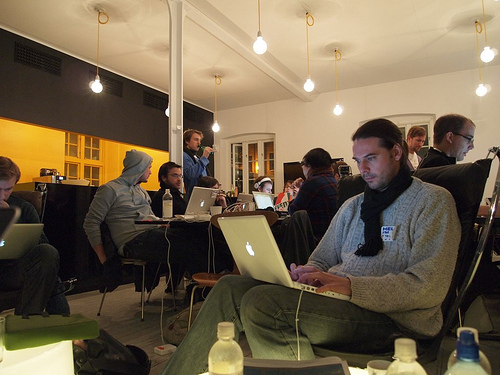
Tristan at the Stockholm Hackday
The first music hack day of the new decade is in the can. There were lots of great hacks produced over the weekend. Here are some of the hacks that used the Echo Nest APIs”
- Proxim.fm – PresentRadio is a QT4 application using the open source Last.fm libraries, it has metadata views and muchos dataporn provided by Echonest. It looks out for local bluetooth devices and will seamlessly switch to the new station when new people arrive/leave without interrupting the track.
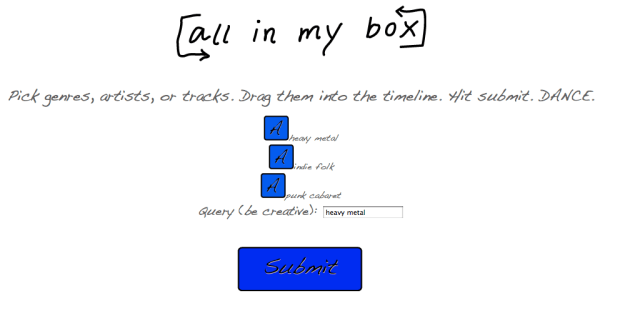
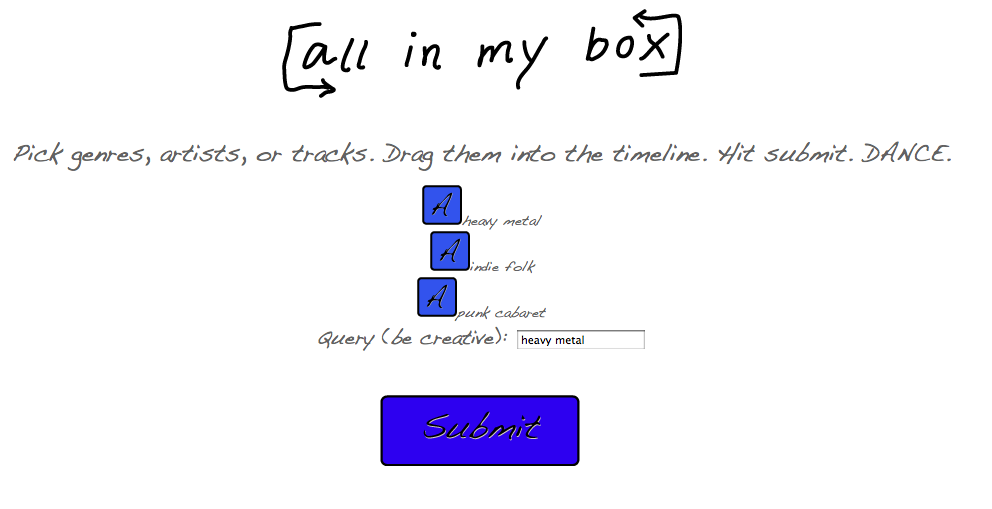
- All In My Box – Allows non-djs to whip up sweet 1 hour mixes in seconds (err, minutes, considering the time to actually beat-match the songs on the server). The drag and drop interface allows users to choose genres and artists and drop them onto a timeline. We use the Echo Nest api to get tracks from the selected genres and artists and stitch them together to create a mix that flows from artist to genre and back again. Echo Nest Prize Winner
- Echo Nest Midi Player – The Echo Nest Midi Player is a small box you plug into your music instrument (with midi protocol), and on the internet. In real time it plays tracks analysed on the Echo Nest. Echo Nest Prize Winner

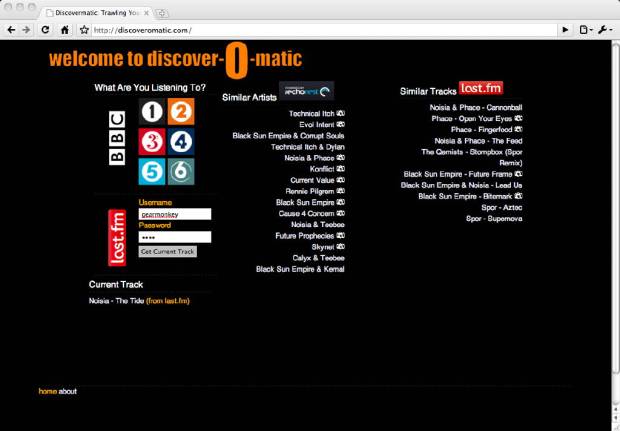
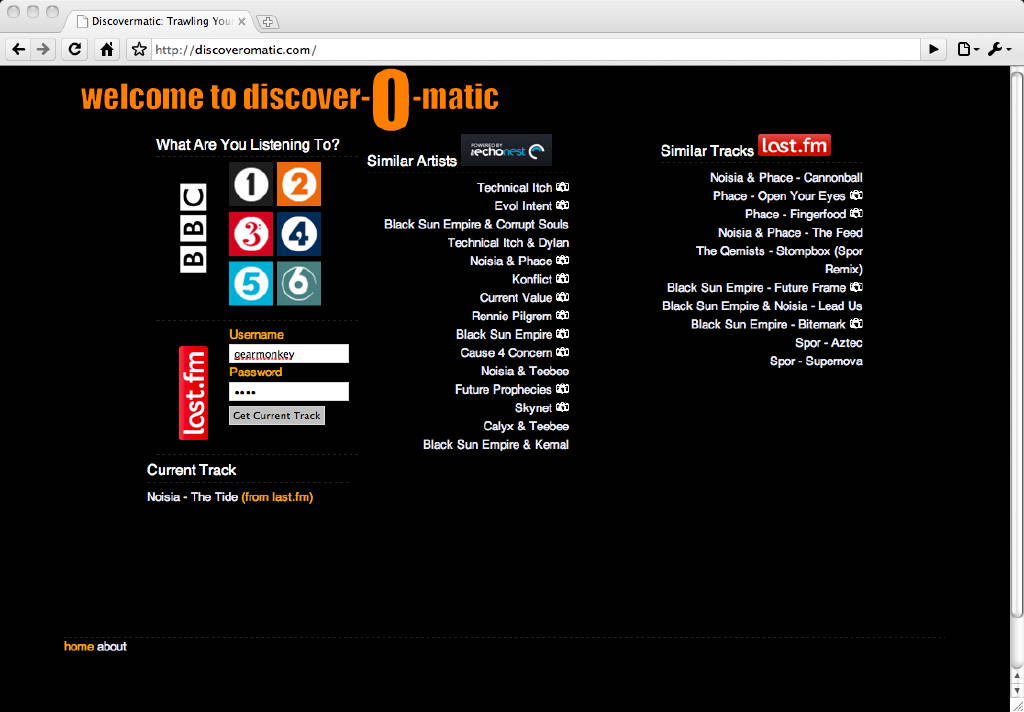
- discoveOMatic – discoverOmatic allows you to discover new artists and tracks while listening to the radio or even your own collection. Simply select the radio station you’re currently listening to (currently on BBC brands supported) and we’ll do the rest. If you’re listening to music through other means and scrobbling to last.fm we can provide recommendation based on your currently playing or most recently scrobbled track as well. Discover the great music while listening to what you like with the discoverOmatic!
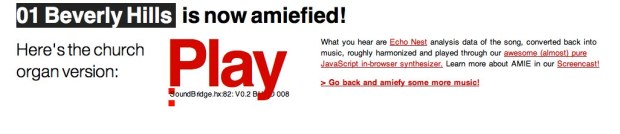
- All Music Is Equal – Take any piece of music and turn it into a “music pupil plays church organ, using a slightly stumbling metronome” version!
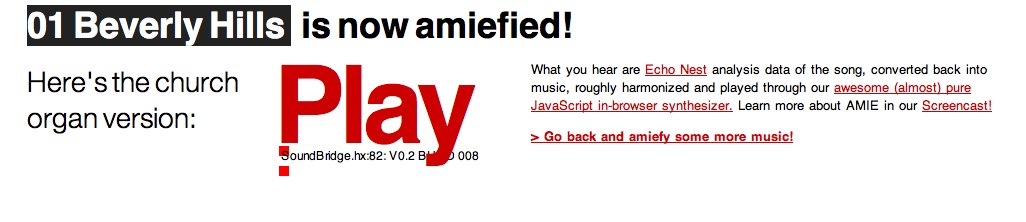
Screencast:
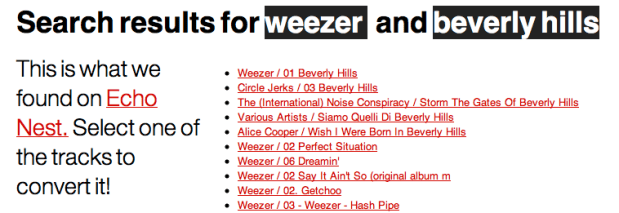
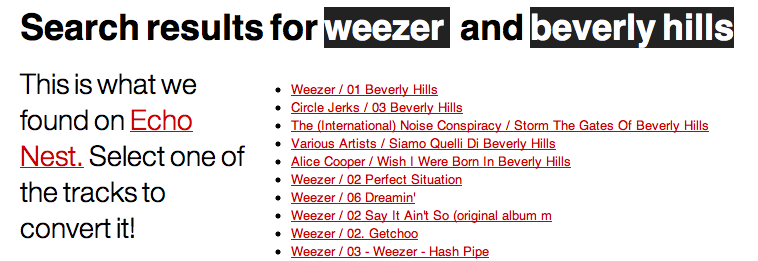
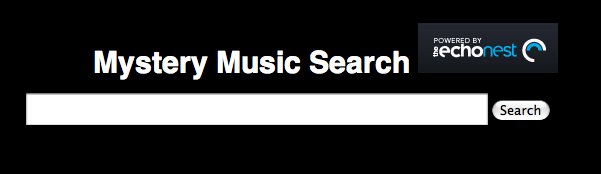
- Mystery Music Search – Mystery Music Search gives you the results for whatever the person before you searched for. Heavily inspired by mysterygoogle.com, and using the new Echonest search_tracks api. Echo Nest Prize Winner
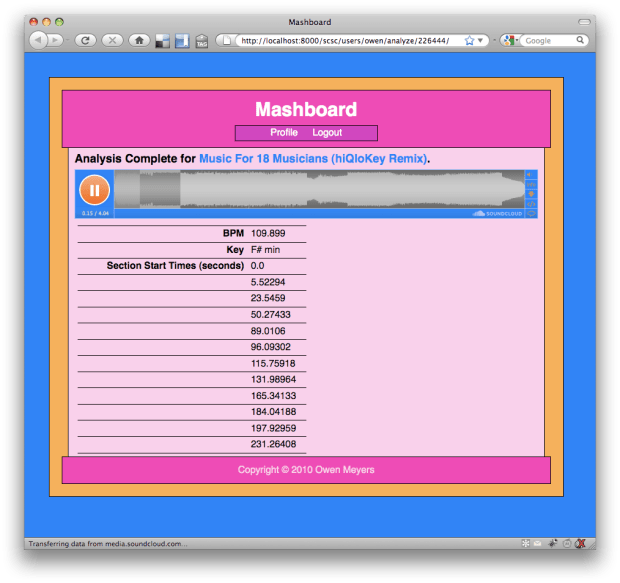
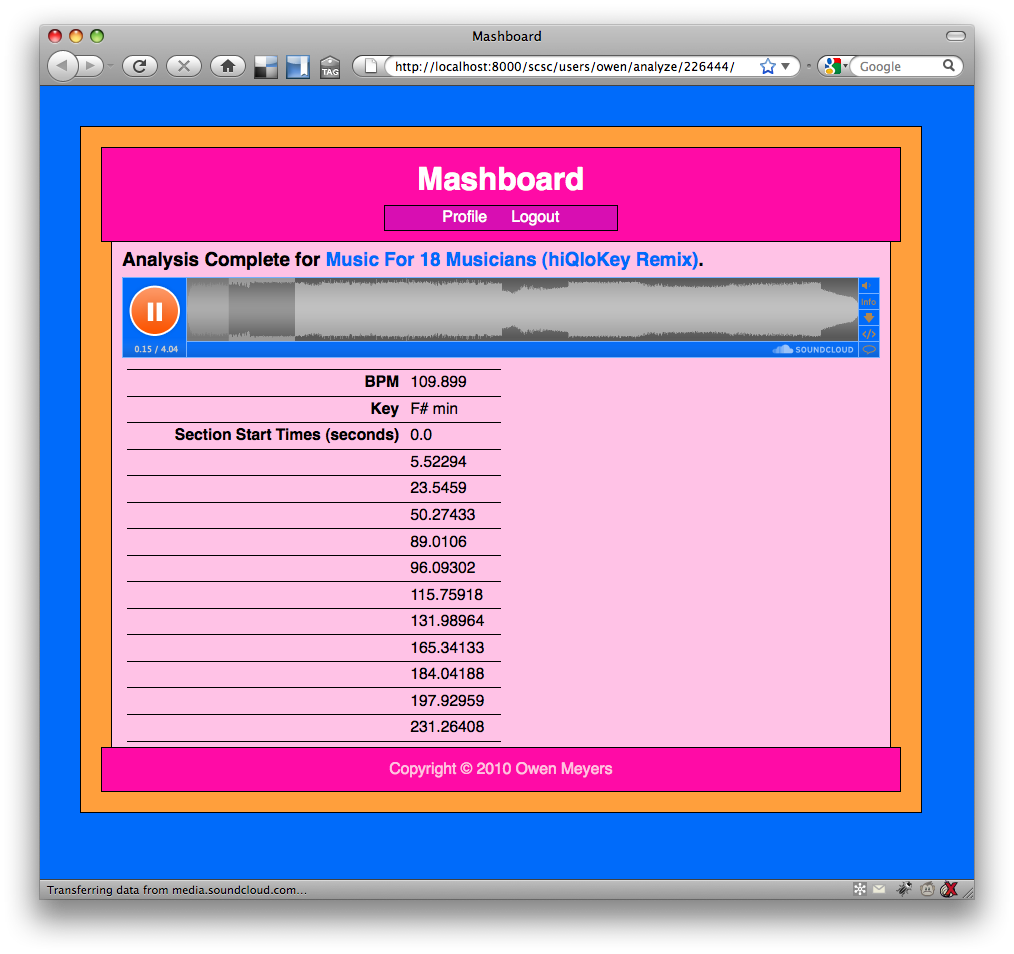
- Mashboard – Mashboard is a simple dashboard for your SoundCloud tracks. You can analyze the tracks using the EchoNest analysis API, returning Key/Mode, BPM, and song section information that is written to the appropriate metadata fields in the SoundCloud track. What’s more, you can scrobble your tracks to your Last.fm profile while listening on your Mashboard profile page. Last, but certainly not least, you can trade your SoundCloud tracks on TuneRights by making and accepting offers from other users, managing the shareholders of your tracks, and bidding on other tracks in the TuneRights system. Echo Nest Prize Winner
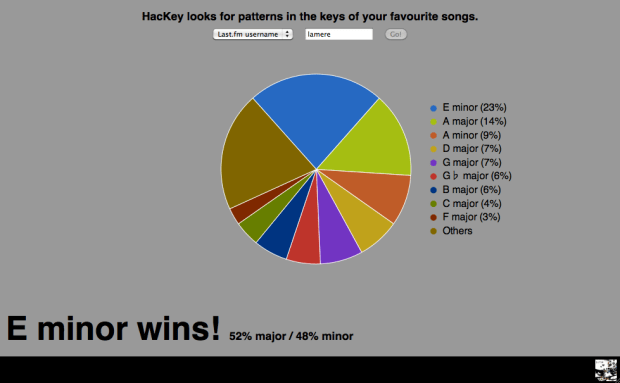
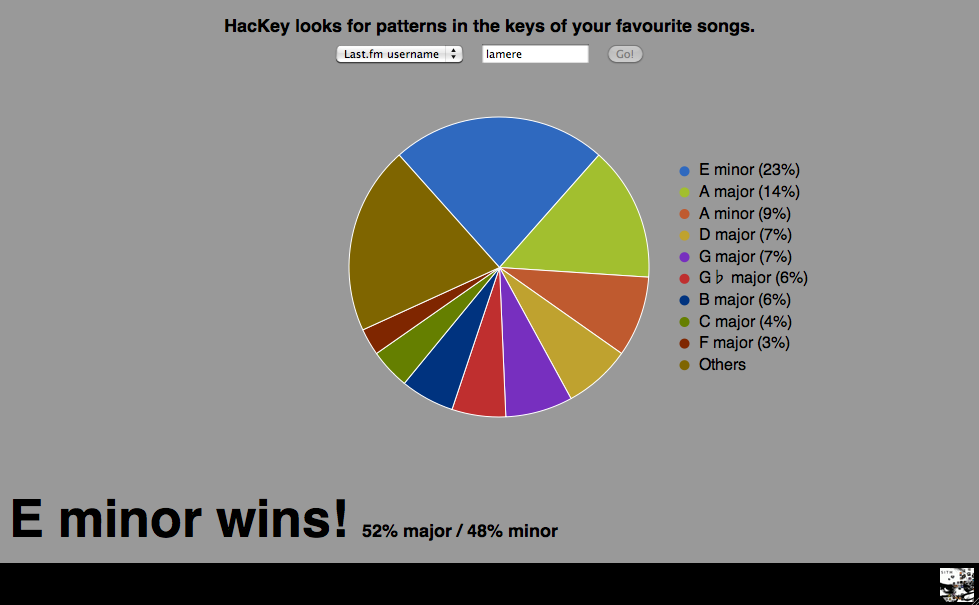
- HacKey – This hack looks gives you a chart that shows you the keys of your most listened to songs in your last.fm profile. (Read more about HacKey in this post).
Echo Nest Prize Winner
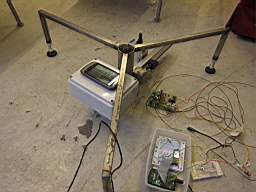
- AlbexOne – A mechanical device that creates unique visual patterns of the songs you are listening to! – Echo Nest Prize Winner
Congrats to all the winners and thanks to all for making cool stuff with the Echo Nest!
 Music Machinery