Paul

I'm the Director of Developer Community at The Echo Nest, a research-focused music intelligence startup that provides music information services to developers and partners through a data mining and machine listening platform. I am especially interested in hybrid music recommenders and using visualizations to aid music discovery.
Keith Moon meets Animal
Posted in code, fun, remix, The Echo Nest, video on July 22, 2010
Another vafromb.py masterpiece from joshmillard.
Echo Nest Remix at the Boston Python Meetup Group
Posted in events, remix, The Echo Nest on July 15, 2010
Next week I’ll be giving a talk about remixing music with Echo Nest remix at the Boston Python Meetup Group. If you are in the Boston / Cambridge area next week, be sure to come on by and say ‘hi’. Info and RSVP for the talk are here: The Boston Python Meetup Group on Meetup.com
Here’s the abstract for the talk:
Paul Lamere will tell us about Echo Nest remix. Remix is an open source Python library for remixing music. With remix you can use Python to rearrange a track, combine it with others, beat/pitch shift it etc. – essentially it lets you treat a song like silly putty.
The Swinger is an interesting example of what it can do that made the rounds of the blogosphere: it morphs songs to give them a swing rhythm.
For more details about the type of music remixing you can do with remix, feel free to read: http://musicmachinery…
Some NameDropper stats
Posted in code, fun, Music, The Echo Nest on July 11, 2010
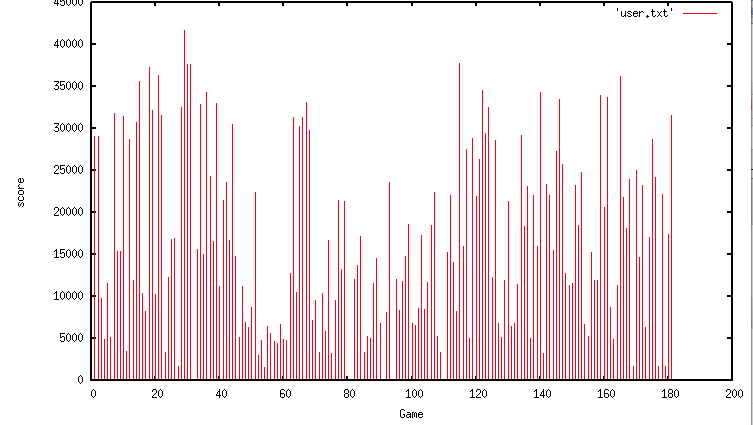
The NameDropper has been live for less than a day and already I ‘ve collected some good data from the game play. Here are some stats:
Total games played: 1841
Total unique players: 462
Total play time: 30hrs, 20mins, 36 seconds
The artists that were most frequently confused with fake artists were:
The Name Dropper
Posted in data, fun, Music, The Echo Nest, web services on July 10, 2010
[tweetmeme source= ‘plamere’ only_single=false]
TL;DR; I built a game called Name Dropper that tests your knowledge of music artists.
One bit of data that we provide via our web APIs is Artist Familiarity. This is a number between 0 and 1 that indicates how likely it is that someone has heard of that artists. There’s no absolute right answer of course – who can really tell if Lady Gaga is more well known than Barbara Streisand or whether Elvis is more well known than Madonna. But we can certainly say that The Beatles are more well known, in general, than Justin Bieber.
To make sure our familiarity scores are good, we have a Q/A process where a person knowledgeable in music ranks our familiarity score by scanning through a list of artists ordered in descending familiarity until they start finding artists that they don’t recognize. The further they get into the list, the better the list is. We can use this scoring technique to rank multiple different familiarity algorithms quickly and accurately.
One thing I noticed, is that not only could we tell how good our familiarity score was with this technique, this also gives a good indication of how well the tester knows music. The further a tester gets into a list before they can’t recognize artists, the more they tend to know about music. This insight led me to create a new game: The Name Dropper.
The Name Dropper is a simple game. You are presented with a list of dozen artist names. One name is a fake, the rest are real.
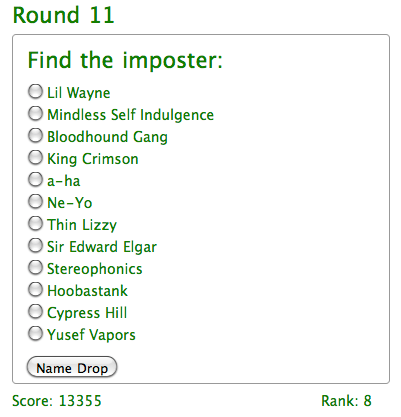
If you find the fake, you go onto the next round, but if you get fooled, the game is over. At first, it is pretty easy to spot the fakes, but each round gets a little harder, and sooner or later you’ll reach the point where you are not sure, and you’ll have to guess. I think a person’s score is fairly representative of how broad their knowledge of music artists are.
The biggest technical challenge in building the application was coming up with a credible fake artist name generator. I could have used Brian’s list of fake names – but it was more fun trying to build one myself. I think it works pretty well. I really can’t share how it works since that could give folks a hint as to what a fake name might look like and skew scores (I’m sure it helps boost my own scores by a few points). The really nifty thing about this game is it is a game-with-a-purpose. With this game I can collect all sorts of data about artist familiarity and use the data to help improve our algorithms.
So go ahead, give the Name Dropper a try and see if you can push me out of the top spot on the leaderboard:

Play the Name Dropper
Some preliminary Playlist Survey results
[tweetmeme source= ‘plamere’ only_single=false] I’m conducting a somewhat informal survey on playlisting to compare how well playlists created by an expert radio DJ compare to those generated by a playlisting algorithm and a random number generator. So far, nearly 200 people have taken the survey (Thanks!). Already I’m seeing some very interesting results. Here’s a few tidbits (look for a more thorough analysis once the survey is complete).
People expect human DJs to make better playlists:
The survey asks people to try to identify the origin of a playlist (human expert, algorithm or random) and also rate each playlist. We can look at the ratings people give to playlists based on what they think the playlist origin is to get an idea of people’s attitudes toward human vs. algorithm creation.
  Predicted Origin  Rating
  ----------------   ------
  Human expert      3.4
  Algorithm         2.7
  Random            2.1
We see that people expect humans to create better playlists than algorithms and that algorithms should give better playlists than random numbers. Not a surprising result.
Human DJs don’t necessarily make better playlists:
Now lets look at how people rated playlists based on the actual origin of the playlists:
  Actual Origin     Rating
  -------------     ------
  Human expert      2.5
  Algorithm         2.7
  Random            2.6
These results are rather surprising. Algorithmic playlists are rated highest, while human-expert-created playlists are rated lowest, even lower than those created by the random number generator. There are lots of caveats here, I haven’t done any significance tests yet to see if the differences here really matter, the survey size is still rather small, and the survey doesn’t present real-world playlist listening conditions, etc. Nevertheless, the results are intriguing.
I’d like to collect more survey data to flesh out these results. So if you haven’t already, please take the survey:
The Playlist Survey
Thanks!
The Playlist Survey
Posted in events, Music, playlist, recommendation, research on June 18, 2010
[tweetmeme source= ‘plamere’ only_single=false] Playlists have long been a big part of the music experience. But making a good playlist is not always easy. We can spend lots of time crafting the perfect mix, but more often than not, in this iPod age, we are likely to toss on a pre-made playlist (such as an album), have the computer generate a playlist (with something like iTunes Genius) or (more likely) we’ll just hit the shuffle button and listen to songs at random. I pine for the old days when Radio DJs would play well-crafted sets – mixes of old favorites and the newest, undiscovered tracks – connected in interesting ways. These professionally created playlists magnified the listening experience. The whole was indeed greater than the sum of its parts.

The tradition of the old-style Radio DJ continues on Internet Radio sites like Radio Paradise. RP founder/DJ Bill Goldsmith says of Radio Paradise: “Our specialty is taking a diverse assortment of songs and making them flow together in a way that makes sense harmonically, rhythmically, and lyrically — an art that, to us, is the very essence of radio.” Anyone who has listened to Radio Paradise will come to appreciate the immense value that a professionally curated playlist brings to the listening experience.
I wish I could put Bill Goldsmith in my iPod and have him craft personalized playlists for me – playlists that make sense harmonically, rhythmically and lyrically, and customized to my music taste, mood and context . That, of course, will never happen. Instead I’m going to rely on computer algorithms to generate my playlists. But how good are computer generated playlists? Can a computer really generate playlists as good as Bill Goldsmith, with his decades of knowledge about good music and his understanding of how to fit songs together?
To help answer this question, I’ve created a Playlist Survey – that will collect information about the quality of playlists generated by a human expert, a computer algorithm and a random number generator. The survey presents a set of playlists and the subject rates each playlist in terms of its quality and also tries to guess whether the playlist was created by a human expert, a computer algorithm or was generated at random.

Bill Goldsmith and Radio Paradise have graciously contributed 18 months of historical playlist data from Radio Paradise to serve as the expert playlist data. That’s nearly 50,000 playlists and a quarter million song plays spread over nearly 7,000 different tracks.
The Playlist Survey also servers as a Radio DJ Turing test. Can a computer algorithm (or a random number generator for that matter) create playlists that people will think are created by a living and breathing music expert? What will it mean, for instance, if we learn that people really can’t tell the difference between expert playlists and shuffle play?
Ben Fields and I will offer the results of this Playlist when we present Finding a path through the Jukebox – The Playlist Tutorial – at ISMIR 2010 in Utrecth in August. I’ll also follow up with detailed posts about the results here in this blog after the conference. I invite all of my readers to spend 10 to 15 minutes to take The Playlist Survey. Your efforts will help researchers better understand what makes a good playlist.
Take the Playlist Survey
MeToo – a scrobbler for the room
Posted in code, fun, Music, The Echo Nest, web services on June 11, 2010
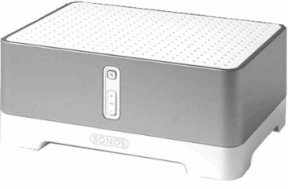 [tweetmeme source= ‘plamere’ only_single=false] One of the many cool things about working at the Echo Nest is that we have an Sonos audio system with single group playlist for the office. Anyone from the CEO to the greenest intern can add music to the listening queue for everyone to listen to. The office, as a whole has a rather diverse taste in music and as a result I’ve been exposed to lots of interesting music. However, the downside of this is that since I’m not listening to music being played on my personal computer, every day I have 10 hours of music listening that is never scrobbled, and as they say, if it doesn’t scrobble, it doesn’t count. Sure the Sonos system scrobbles all of the plays to the Echo Nest account on Last.fm but I’d also like it to scrobble it to my account so I can use nifty apps like Lee Byron’s Last.fm Listening History or Matt Ogle’s Bragging Rights on my own scrobbles.
This morning while listening to that nifty Emeralds album, I decided that I’d deal with those scrobble gaps once and for all. So I wrote a little python script called MeToo that keeps my scrobbles up to date. It’s really quite simple. Whenever I’m in the office, I fire up MeToo. MeToo watches the most recent tracks played on The Echo Nest account and whenever a new track is played, it scrobbles it to my personal account. In effect, my scrobbles will track the office scrobbles. When I’m not listening I just close my laptop and the scrobbling stops.
The script itself is pretty simple – I used pylast to do interfacing to Last.fm – the bulk of the logic is less than 20 lines of code. I start the script like so:
% python metoo.py TheEchoNest lamere
when I do that, MeToo will continuously monitor most recently played tracks on TheEchoNest and scrobble the plays on my account. When I close my laptop, the script is naturally suspended – so even though music may continue to play in the office, my laptop won’t scrobble it.
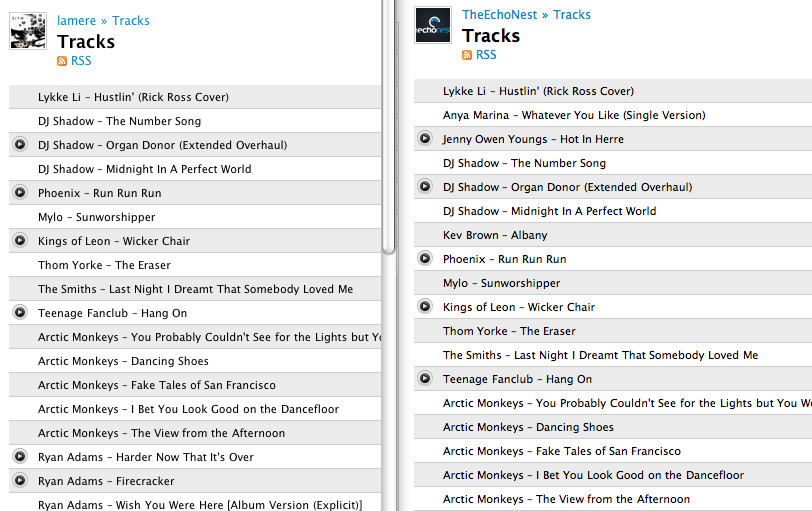
My scrobbles and Echo Nest scrobbles
I suspect that this use case is relatively rare, and so there’s probably not a big demand for something like MeToo, but if you are interested in it, leave a comment. If I see some interest, I’ll toss it up on google code so anyone can use it.
It feels great to be scrobbling again!
We swing both ways
Posted in code, fun, Music, remix, The Echo Nest on June 7, 2010
 Perhaps one of the most frequently asked questions about Tristan’s Swinger is whether it can be used to ‘Un-swing’ a song. Can you take a song that already swings and straighten it out? Indeed, the answer is yes – we can swing both ways – but it is harder to unswing than it is to swing. Ammon on Happy Blog, the Happy Blog has given de-swinging a go with some success with his de-swinging of Revolution #1. Read his post and have a listen at Taking the swing out of songs. I can’t wait for the day when we can turn on the TV to watch and listen to MTV-Unswung.
Frasier does Nine Inch Nails
Posted in code, fun, remix, The Echo Nest on June 5, 2010

Oh My – Musician Josh Millard has recreated The Downward Spiral using nothing but audio from the NBC sitcom Frasier. So wrong, and yet, so right. Josh has the whole remixed album plus a video on his blog:
Is Music Recommendation Broken? How can we fix it?
Posted in events, Music, recommendation, research on June 1, 2010

Save the date: 26th September 2010 for The Workshop on Music Recommendation and Discovery being held in conjunction with ACM RecSys in Barcelona, Spain. At this workshop, community members from the Recommender System, Music Information Retrieval, User Modeling, Music Cognition, and Music Psychology can meet, exchange ideas and collaborate.
Topics of interest
Topics of interest for Womrad 2010 include:
- Music recommendation algorithms
- Theoretical aspects of music recommender systems
- User modeling in music recommender systems
- Similarity Measures, and how to combine them
- Novel paradigms of music recommender systems
- Social tagging in music recommendation and discovery
- Social networks in music recommender systems
- Novelty, familiarity and serendipity in music recommendation and discovery
- Exploration and discovery in large music collections
- Evaluation of music recommender systems
- Evaluation of different sources of data/APIs for music recommendation and exploration
- Context-aware, mobile, and geolocation in music recommendation and discovery
- Case studies of music recommender system implementations
- User studies
- Innovative music recommendation applications
- Interfaces for music recommendation and discovery systems
- Scalability issues and solutions
- Semantic Web, Linking Open Data and Open Web Services for music recommendation and discovery
More info: Wormrad 2010 Call for papers

