How the Bonhamizer works
Posted by Paul in code, fun, The Echo Nest on February 21, 2013
I spent this weekend at Music Hack Day San Franciso. Music Hack Day is an event where people who are passionate about music and technology get together to build cool, music-related stuff. This San Francisco event was the 30th Music Hack Day with around 200 hackers in attendance. Many cool hacks were built. Check out this Projects page on Hacker League for the full list.
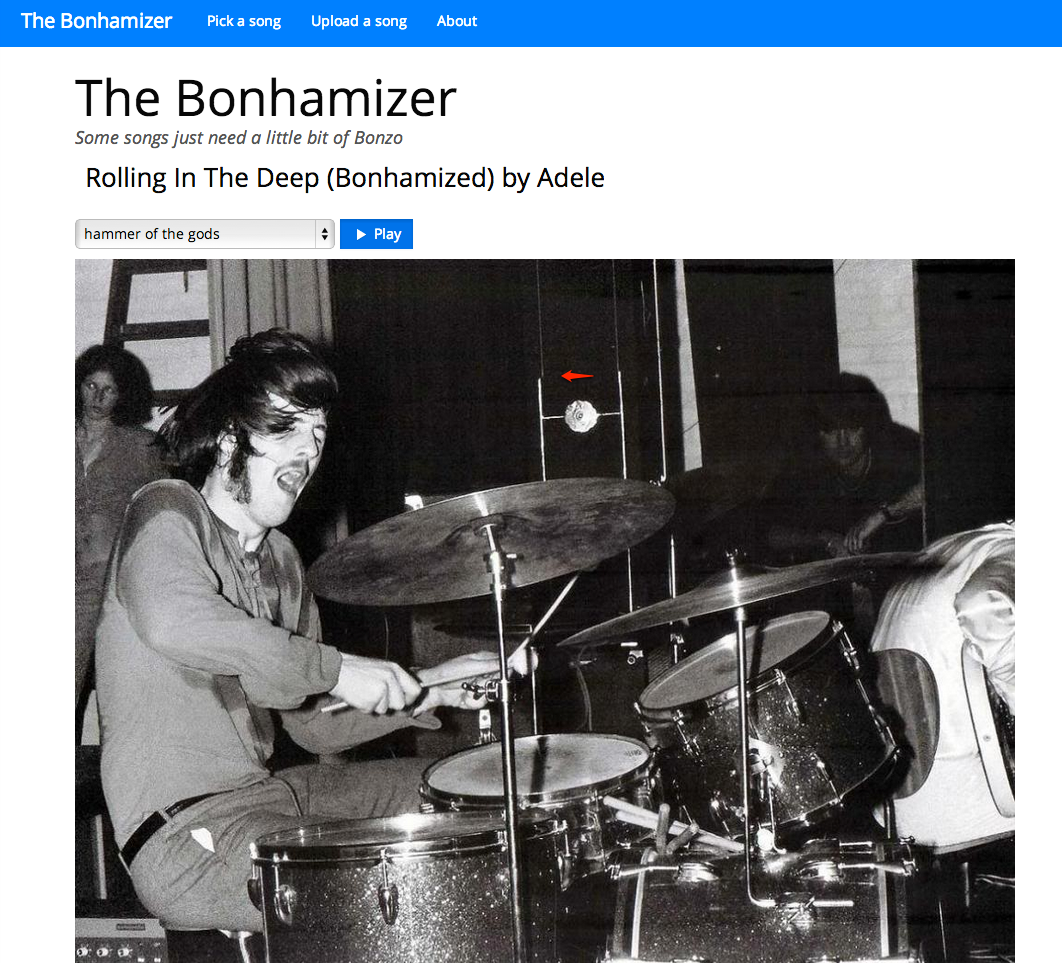
My weekend hack is called The Bonhamizer. It takes just about any song and re-renders it as if John Bonham was playing the drums on the track. For many tracks it works really well (and others not so much). I thought I’d give a bit more detail on how the hack works.
Data Sources
For starters, I needed some good clean recordings of John Bonham playing the drums. Luckily, there’s
set of 23 drum out takes from the “In through the out door” recording session. For instance, there’s
this awesome recording of the drums for “All of my Love”. Not only do you get the sound of Bonhmam
pounding the crap out of the drums, you can hear him grunting and groaning. Super stuff. This particular
recording would become the ‘Hammer of the Gods’ in the Bonhamizer.
From this set of audio, I picked four really solid drum patterns for use in the Bonhamizer.
Of course you can’t just play the drum recording and any arbitrary song recording at the same time and expect the drums to align with the music. To make the drums play well with any song a number of things need to be done (1) Align the tempos of the recordings, (2) Align the beats of the recordings, (3) Play the drums at the right times to enhance the impact of the drums.
To guide this process I used the Echo Nest Analyzer to analyze the song being Bonhamized as well as the Bonham beats. The analyzer provides a detailed map for the beat structure and timing for the song and the beats. In particular, the analyzer provides a detailed map of where each beat starts and stops, the loudness of the audio at each beat, and a measure of the confidence of the beat (which can be interpreted as how likely the logical beat represents a real physical beat in the song).
Aligning the tempos (We don’t need no stinkin’ time stretcher)
Perhaps the biggest challenge of implementing the Bonhamizer is to align the tempo of the song and the Bonham beats. The tempo of the ‘Hammer of the Gods’ Bonham beat is 93 beats per minute. If fun.’s Some Nights is at 107 beats per minute we have to either speed Bonham up or slow fun. down to get the tempos to match.
Since the application is written in Javascript and intended to run entirely in the browser, I don’t have access to server side time stretching/shifting libraries like SoundTouch or Dirac. Any time shifting needs to be done in Javascript. Writing a real-time (or even an ahead-of-time) time-shifter in Javascript is beyond what I could do in a 24 coding session. But with the help of the Echo Nest beat data and the Web Audio API there’s a really hacky (but neat) way to adjust song tempos without too many audio artifacts.
The Echo Nest analysis data includes the complete beat timing info. I know where every beat starts and how long it is. With the Web Audio API I can play any snippet of audio from an MP3, with millisecond timing accuracy. Using this data I can speed a song up by playing a song beat-by-beat, but adjusting the starting time and duration of each beat to correspond to the desired tempo. If I want to speed up the Bonham beats by a dozen beats per minute, I just play each beat about 200 ms shorter than it should be. Likewise, if I need to slow down a song, I can just let each beat play for longer than it should before the next beat plays. Yes, this can lead to horrible audio artifacts, but many of the sins of this hacky tempo adjust will be covered up by those big fat drum hits that will be landing on top of them.
I first used this hacky tempo adjustment in the Girl Talk in a Box hack. Here’s a few examples of songs with large tempo adjustments. In this example, AWOLNation’s SAIL is sped up by 25% you can hear the shortened beats.
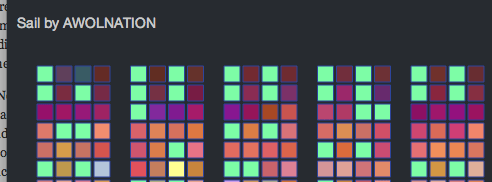
And in this example with Sail slowed down by 25% you can hear double strikes for each beat.
I use this hacky tempo adjust to align the tempo of the song and the Bonham beats, but since I imagine that if a band had John Bonham playing the drums they would be driven to play a little faster, so I make sure that I speed on the song a little bit when I can.
Speeding up the drum beats by playing each drum beat a bit shorter than it is supposed to play gives pretty good audio results. However, using the technique to slow beats down can get a bit touchy. If a beat is played for too long, we will leak into the next beat. Audibly this sounds like a drummer’s flam. For the Bonhamizer this weakness is really an advantage. Here’s an example track with the Bonham beats slowed down enough so that you can easily hear the flam.
When to play (and not play) the drums
If the Bonhamizer overlaid every track with Bonham drums from start to finish, it would not be a very good sounding app. Songs have loud parts and soft parts, they have breaks and drops, they have dramatic tempo changes. It is important for the Bonhamizer to adapt to the song. It is much more dramatic for drums to refrain from striking during the quiet a capella solos and then landing like the Hammer of the Gods when the full band comes in as in this fun. track.
There are a couple of pieces of data from the Echo Nest analysis that I can use to help decide when to the drums should play. First, there’s detailed loudness info. For each beat in the song I retrieve information on how loud the beat is. I can use this info to find the loud and the quiet parts of the song and react accordingly. The second piece of information is the beat confidence. Each beat is tagged with a confidence level by the Echo Nest analyzer. This is an indication of how sure the analyzer is that a beat really happened there. If a song has a very strong and steady beat, most of the beat confidences will be high. If a song is frequently changing tempo, or has weak beat onsets then many of the beat confidence levels will be low, especially during the tempo transition periods. We can use both the loudness and the confidence levels to help us decide when the drums should play.
For example, here’s a plot that shows the beat confidence level for the first few hundred beats of Some Nights.
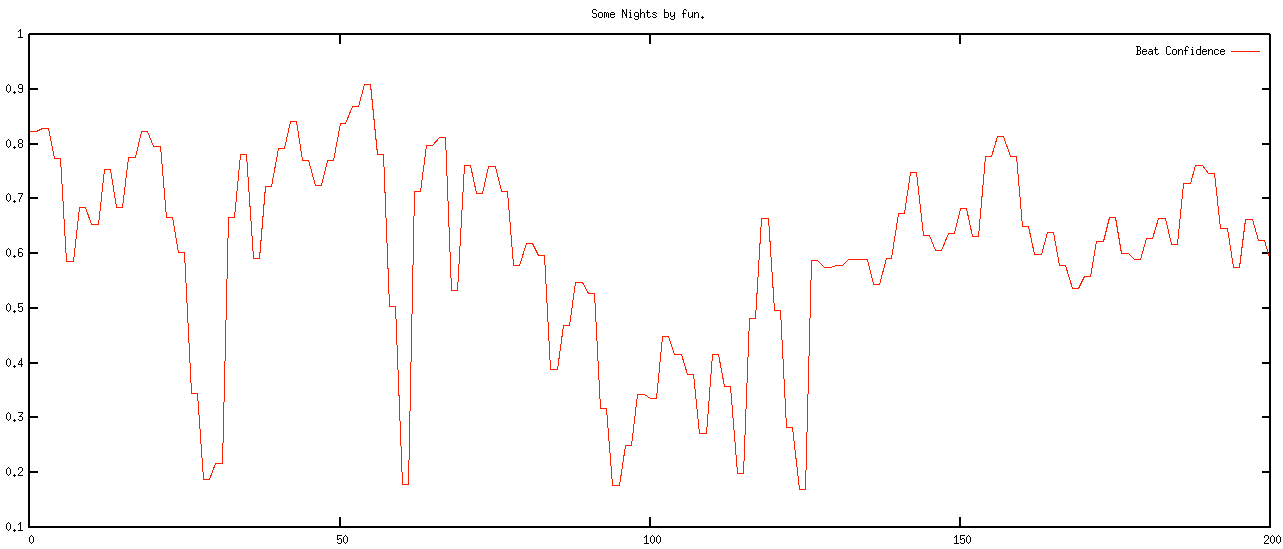
The red curve shows the confidence level of the beats. You can see that the confidence ebbs and flows in the song. Likewise we can look at the normalized loudness levels at the beat level, as shown by the green curve in the plot below:
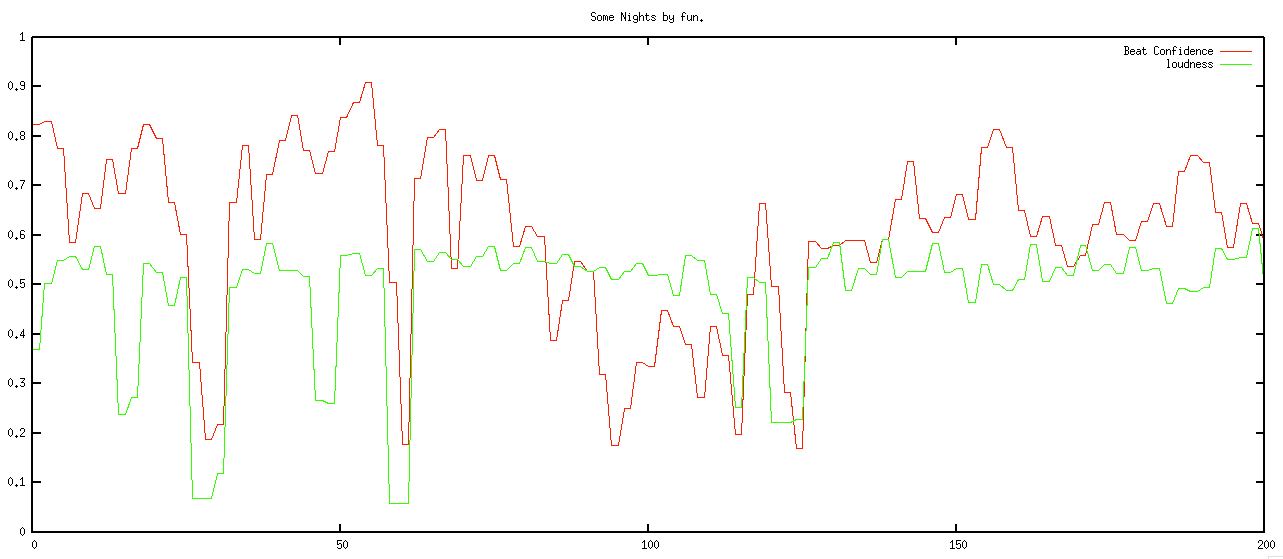
We want to play the drums during the louder and high confidence sections of the song, and not play them otherwise. However, if just simply match the loudness and confidence curves we will have drums that stutter start and stop, yielding a very unnatural sound. Instead, we need to filter these levels so that we get a more natural starting and stopping of the drums. The filter needs to respond quickly to changes – so for instance, if the song suddenly gets loud, we’d like the drums to come in right away, but the filter also needs to reject spurious changes – so if the song is loud and confident for only a few beats, the drums should hold back. To implement this I used a simple forward looking runlength filter. The filter looks for state changes in the confidence and loudness levels. If it sees one and it looks like the new state is going to be stable for the near future, then the new state is accepted, otherwise it is rejected. The code is simple:
This file contains hidden or bidirectional Unicode text that may be interpreted or compiled differently than what appears below. To review, open the file in an editor that reveals hidden Unicode characters.
Learn more about bidirectional Unicode characters
| function runLength(quanta, confidenceThreshold, loudnessThreshold, lookAhead, lookaheadMatch) { | |
| var lastState = false; | |
| for (var i = 0; i < quanta.length; i++) { | |
| quanta[i].needsDrums = false; | |
| } | |
| for (var i = 0; i < quanta.length -1; i+=2) { | |
| var newState = getState(quanta[i], confidenceThreshold, loudnessThreshold); | |
| if (newState != lastState) { | |
| // look ahead | |
| var matchCount = 0 | |
| var curCount = 0; | |
| for (var j = i + 1; j < quanta.length && j <= i + lookAhead; j++) { | |
| var q = quanta[j]; | |
| var nstate = getState(q, confidenceThreshold, loudnessThreshold); | |
| if (nstate == newState) { | |
| matchCount++; | |
| } | |
| curCount++; | |
| } | |
| if (matchCount > lookaheadMatch) { | |
| curState = newState; | |
| } else { | |
| curState = lastState; | |
| } | |
| } else { | |
| curState = newState; | |
| } | |
| quanta[i].needsDrums = curState; | |
| quanta[i+1].needsDrums = curState; | |
| lastState = curState; | |
| } | |
| } | |
| function getState(q, confidenceThreshold, loudnessThreshold) { | |
| var conf = q.confidence; | |
| var volume = q.oseg.loudness_max; | |
| var nstate = conf >= confidenceThreshold && volume > loudnessThreshold; | |
| return nstate; | |
| } |
When the filter is applied we get a nice drum transitions – they start when the music gets louder and the tempo is regular and they stop when its soft or the tempo is changing or irregular:
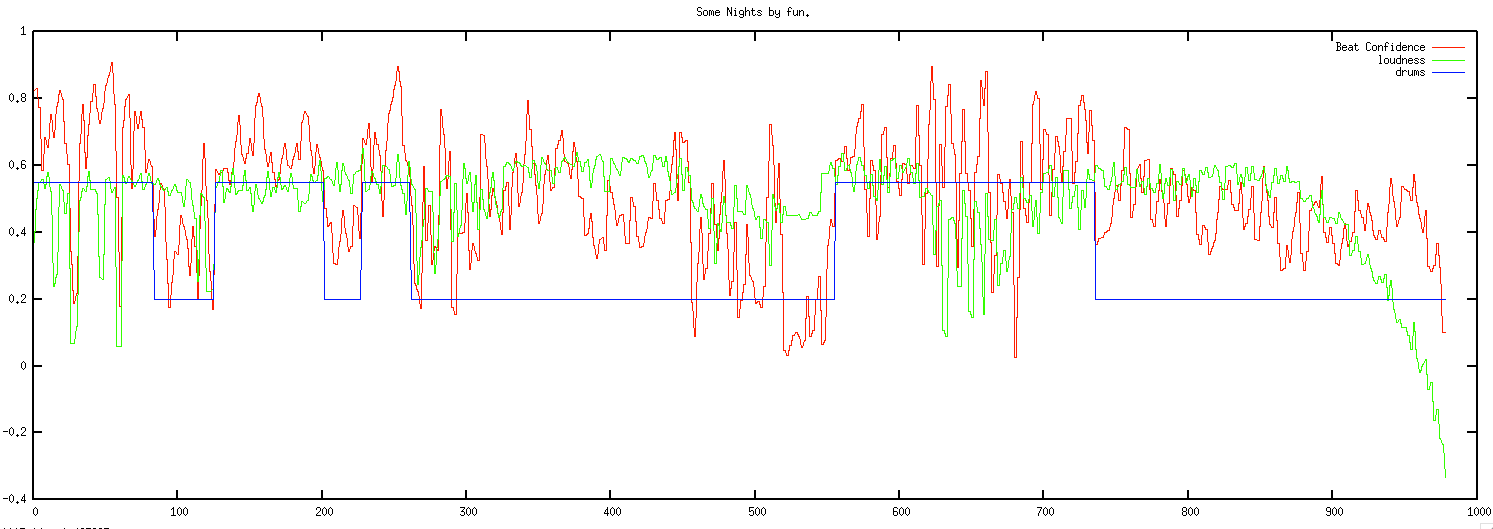
This above plot shows the confidence and loudness levels for the Some Nights by Fun. The blue curve shows when the drums play. Here’s a detailed view of the first 200 beats:
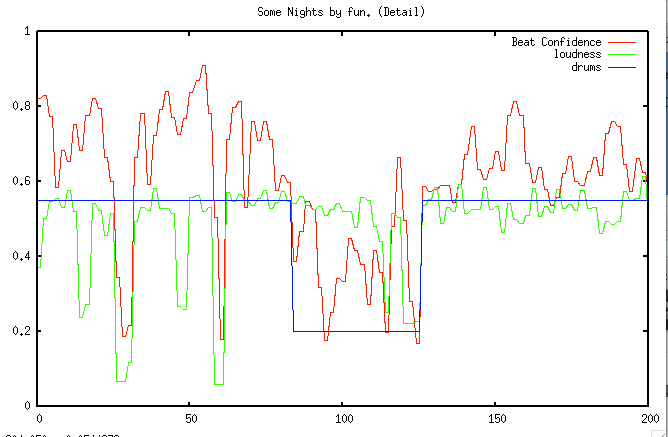
You can see how transient changes in loudness and confidence are ignored, while longer term changes trigger state changes in the drums.
Note that some songs are always too soft or most of the beats are not confident enough to warrent adding drums. If the filter rejects 80% of the song, then we tell the user that ‘Bonzo doesn’t really want to play this song’.
Aligning the song and the beats
At this point we now have tempo matched the song and the drums and have figured out when to and when not to play the drums. There’s just a few things left to do. First thing, we need to make sure that each of the song and drum beats in a bar lines up so the both the song and drums are playing the same beat within a bar (beat 1, beat 2, beat 3, beat 4, beat 1 …). This is easy to do since the Echo Nest analysis provides bar info along with the beat info. We align the beats by finding the bar position of the starting beat in the song and shifting the drum beats so that the bar position of the drum beats align with the song.
A seemingly more challenging issue is to deal with mismatched time signatures. All of the Bonham beats are in 4-4 time, but not all songs are in 4. Luckily, the Echo Nest analysis can tell us the time signature of the song. I use a simple but fairly effective strategy. If a song is in 3/4 time I just drop one of the beats in the Bonham beat pattern to turn the drumming into a matching 3/4 time pattern. It is 4 lines of code:
if (timeSignature == 3) {
    if (drumInfo.cur % 4 == 1) {
        drumInfo.cur+=1;
    }
 }
Here’s an example with Norwegian Wood (which is in 3/4 time). This approach can be used for more exotic time signatures (such as 5/4 or 7/4) as well. For songs in 5/4, an extra Bonham beat can be inserted into each measure. (Note that I never got around to implementing this bit, so songs that are not in 4/4 or 3/4 will not sound very good).
Playing it all
Once we have aligned tempos, filtered the drums and aligned the beats, it is time to play the song. This is all done with the Web Audio API, which makes it possible for us to play the song beat by beat with fine grained control of the timing.
Issues + To DOs
There are certainly a number of issues with the Bonhamizer that I may address some day.
I’d like to be able to pick the best Bonham beat pattern automatically instead of relying on the user to pick the beat. It may be interesting to try to vary the beat patterns within a song too, to make things a bit more interesting. The overall loudness of the songs vs. the drums could be dynamically matched. Right now, the songs and drums play at their natural volume. Most times that’s fine, but sometimes one will overwhelm the other. As noted above, I still need to make it work with more exotic time signatures too.
Reception
The Bonhamizer has been out on the web for about 3 days but in that time about 100K songs have been Bonhamized. There have been positive articles in The Verge, Consequence of Sound, MetalSucks, Bad Ass Digest and Drummer Zone. It is big in Japan. Despite all its flaws, people seem to like the Bonhamizer. That makes me happy. One interesting bit of feedback I received was from Jonathan Foote (father of MIR). He pointed me to Frank Zappa and his experiments with xenochrony The mind boggles. My biggest regret is the name. I really should have called it the autobonhamator. But it is too late now … sigh.
All the code for the Bonhamizer is on github. Feel free to explore it, fork and it make your own Peartifier or Moonimator or Palmerizer.

The Bonhamizer
Here’s my Music Hack Day San Francisco hack: The Bonhamizer. This hack lets you hear what it would be like if John Bonham was in your favorite band.
It works pretty well on many songs, and not so well on others. I hope to smooth out the rough edges in the next few days. Here are some of my favorites:
The code for this hack is on github at github/echonest/bonhamizer
SF Music Hack Day 2013
Mark your calendars. The 4th annual Music Hack Day SF will be held on February 16 and 17 at Tokbox HQ in lovely San Francisco. Music Hack Day is a 24 hour hacking event where folks who are passionate about music and technology get together to build music stuff.

Photo by Thomas Bonte
The SF Music Hack Day is conveniently scheduled the weekend before the SF MusicTech Summit – where a 1,000 leaders at the convergence of music and tech will gather to “do business and discuss, in a proactive, conducive to dealmaking environment”.
Music hack days are fun. If you haven’t been to one and you in the bay area, sign up before all the seats are gone.
MIDEM Hack Day recap
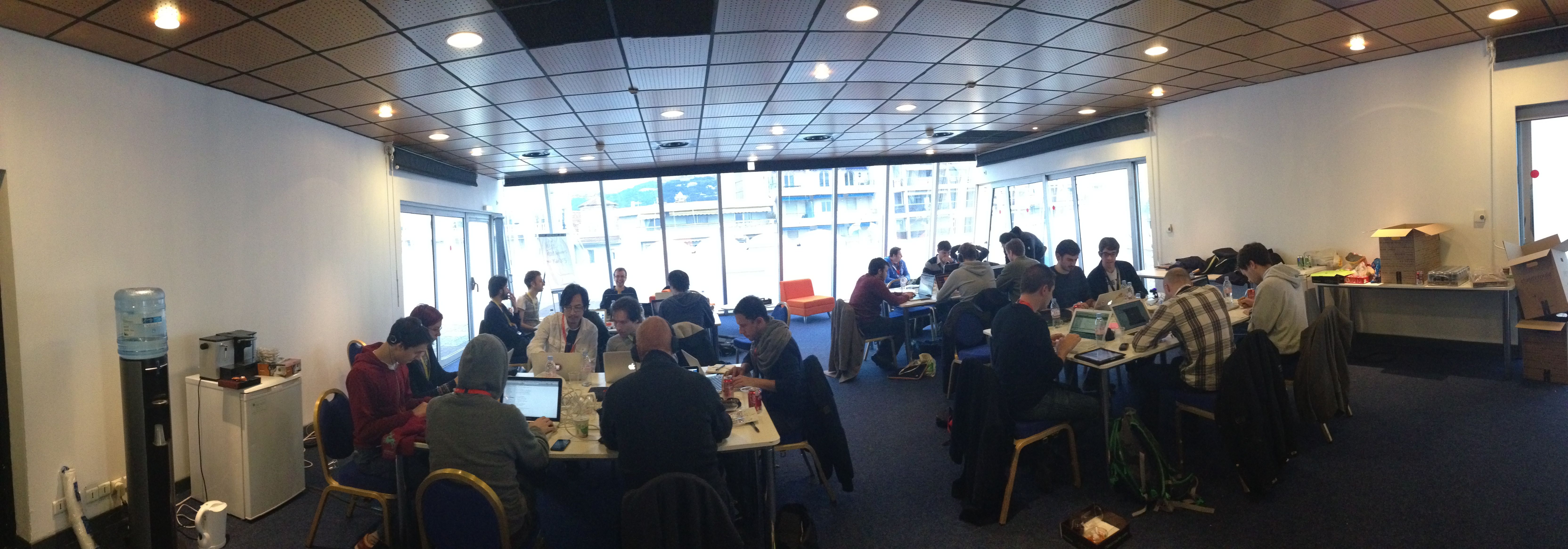
What better way to spend a weekend on the French Riviera then in a conference room filled with food, soda, coffee and fellow coders and designers hacking on music! That’s what I and 26 other hackers did at the MIDEM Music Hack Day. Hackers came from all over the world to attend and participate in this 3rd annual hacking event to show what kind of of creative output can flow from those that are passionate about music and technology.
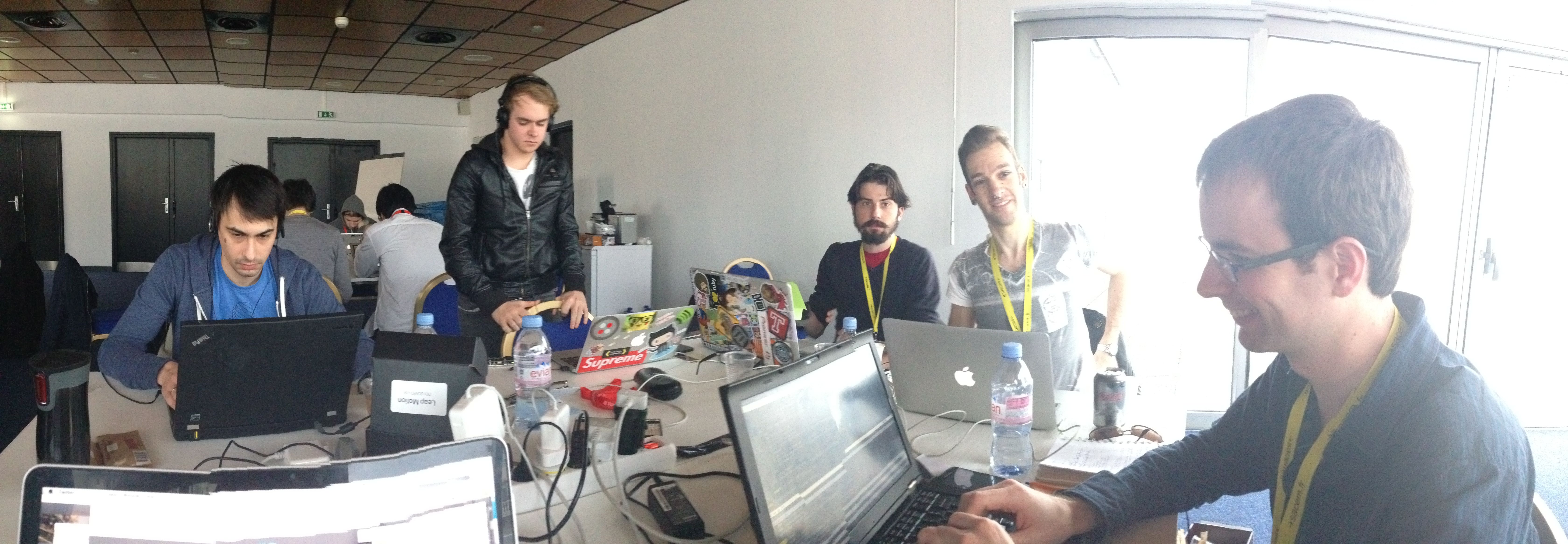
Unlike a typical Music Hack Day, this hack day has very limited space so only those with hardcore hacking cred were invited to attend. Hackers were from a wide range of companies and organizations including SoundCloud, Songkick, Gracenote, Musecore, We Make Awesome Sh.t, 7Digital, Reactify, Seevl, Webdoc, MuseCore, REEA, MTG-UPF, and Mint Digital and The Echo Nest. Several of the hackers were independent. The event was organized by Martyn Davies of Hacks & Bants along with help from the MIDEM organizers.
The hacker space provided for us is at the top of the Palais – which is the heart of MIDEM and Cannes. The hacking space has a terrace that overlooks the city, giving an excellent place to unwind and meditate while trying to figure out how to make something work.

Hacker-eye view of Cannes
The hack day started off with a presentation by Martyn explaining what a Music Hack Day is for the general MIDEM crowd. After which, members of the audience (the Emilys and Amelies) offered some hacking ideas in case any of the hyper-creative hackers attending the Hack Day were not able to come up with their own ideas.

After that, hacking started in force. Coders and designers paired up, hacking designs were sketched and github repositories were pulled and pushed.
The MIDEM Hack Day is longer than your usual Music Hack Day. Instead of the usual 24 hours, hackers have 45 hour to create their stuff. The extra time really makes a difference (especially if you hack like you only have 24 hours).
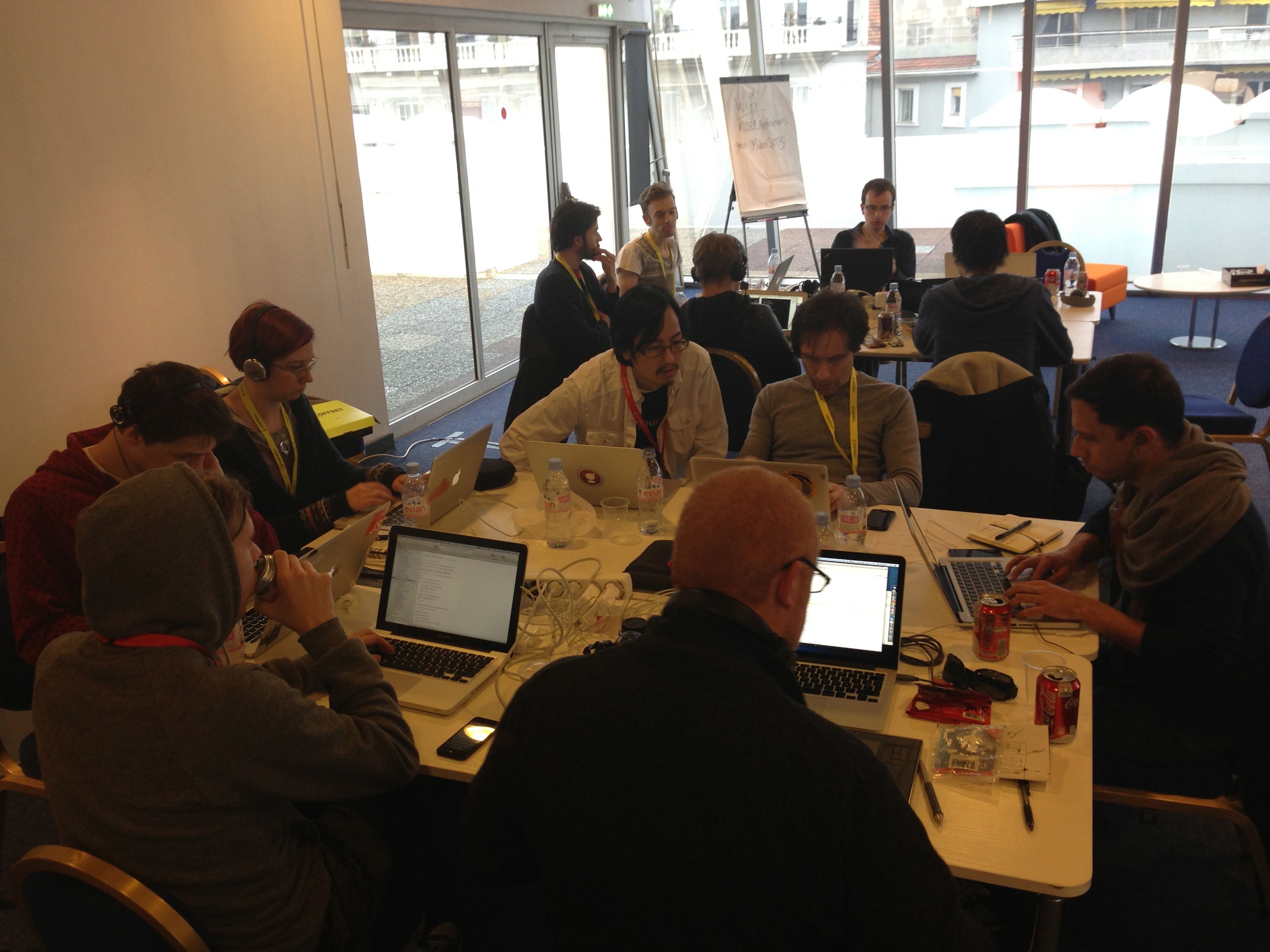
Late afternoon hacking
We had a few visitors during the course of the weekend. Perhaps the most notable was Robert Scoble. We gave him a few demos. My impression (based upon 3 minutes of interaction, so it is quite solid), is that Robert doesn’t care too much about music. (While I was giving him a demo of a very early version of Girl Talk in a Box, Robert reached out and hit the volume down key a few times on my computer. The effrontery of it all!). A number of developers gave Robert demos of their in-progress hacks, including Ben Fields, who at the time, didn’t know he was talking to someone who was Internet-famous.
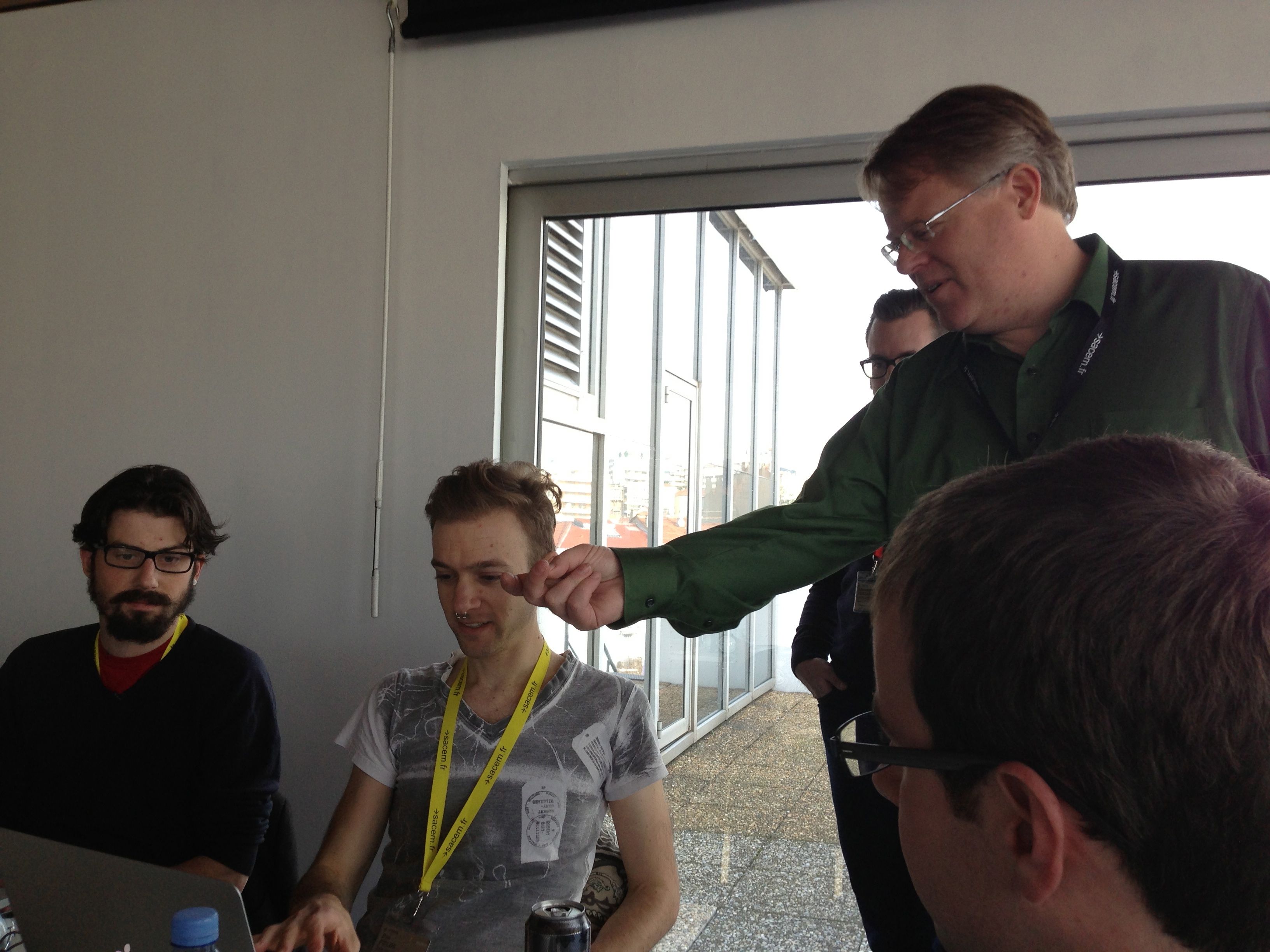
Ben gives a demo to some random guy who later turns out to be Robert Scoble
As day turned to evening, the view from our terrace got more exciting. The NRJ Awards show takes place in the Palais and we had an awesome view of the red carpet. For 5 hours, the sounds of screaming teenagers lining the red carpet added to our hacking soundtrack. Carly Rae, Taylor Swift, One Direction and the great one (Psy) all came down the red carpet below us, adding excitement (and quite a bit of distraction) to the hack.
[youtube http://www.youtube.com/watch?v=OUkLAsphZDM]Yes, Psy did the horsey dance for us. Life is complete.
Finally, after 45 hours of hacking, we were ready to give our demos to the MIDEM audience.
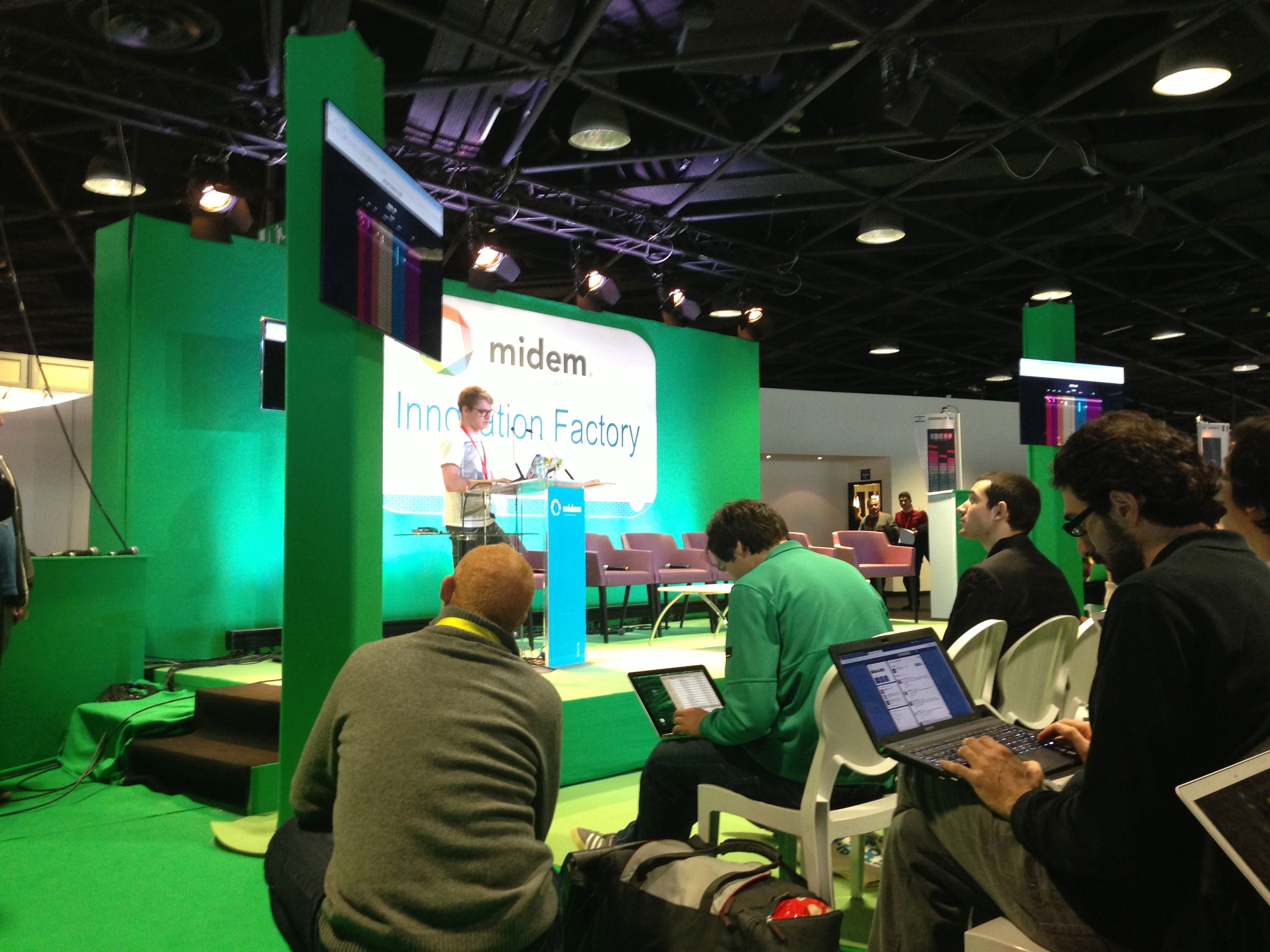
Adam Howard (aka @skattyadz) gives good demo.
There were 18 hacks created during the weekend. Check out the full list of hacks. Some of my favorites were:
- VidSwapper by Ben Fields. – swaps the audio from one video into another, syncronizing with video hit points along the way.
- RockStar by Pierre-loic Doulcet – RockStar let you direct a rockstar Band using Gesture.
- Miri by Aaron Randal – Miri is a personal assistant, controlled by voice, that specialises in answering music-related questions
- Ephemeral Playback by Alastair Porter – Ephemeral Playback takes the idea of slow music and slows it down even further. Only one song is active at a time. After you have listened to it you must share it to another user via twitter. Once you have shared it you can no longer listen to it.
- Music Collective by the Reactify team – A collaborative music game focussing on the phenomenon of how many people, when working together, form a collective ‘hive mind’.
- Leap Mix by Adam Howard – Control audio tracks with your hands.
It was fun demoing my own hack: Girl Talk in a Box – it is not everyday that a 50 something guy gets to pretend he’s Skrillex in front of a room full of music industry insiders.
All in all, it was a great event. Thanks to Martyn and MIDEM for making us hackers feel welcome at this event. MIDEM is an interesting place, where lots of music business happens. It is rather interesting for us hacker-types to see how this other world lives. No doubt, thanks to MIDEM Music Hack Day synergies were leveraged, silos were toppled, and ARPUs were maximized. Looking forward to next year!
Girl Talk in a Box
Here’s my music hack from Midem Music Hack Day: Girl Talk in a Box. It continues the theme of apps like Bohemian Rhapsichord and Bangarang Boomerang. It’s an app that lets you play with a song in your browser. You can speed it up and slow it down, you can skip beats, you can play it backwards, beat by beat. You can make it swing. You can make breaks and drops. It’s a lot of fun. With Girl Talk in a Box, you can play with any song you upload, or you can select songs from the Gallery.
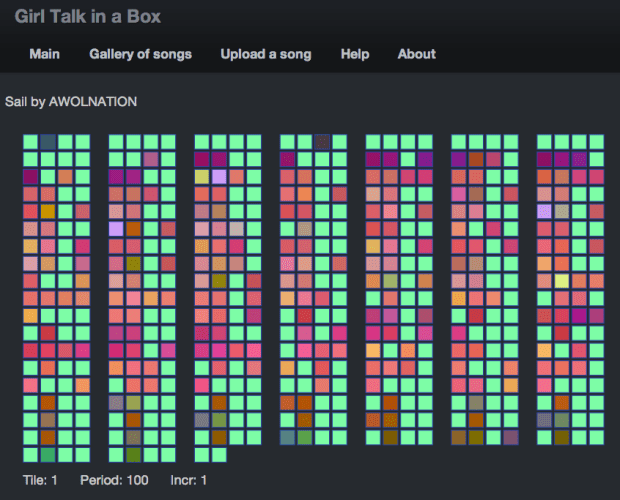
My favorite song to play with today is AWOLNATION’s Sail. Have a go. There’s a whole bunch of keyboard controls (that I dedicate to @eelstretching). When you are done with that you can play with the code.
The Stockholm Python User Group
Posted by Paul in code, data, events, The Echo Nest on January 25, 2013
In a lucky coincidence I happened to be in Stockholm yesterday which allowed me to give a short talk at the Stockholm Python user Group. About 80 or so Pythonistas gathered at Campanja to hear talks about Machine Learning and Python. The first two talks were deep dives into particular aspects of machine learning and Python. My talk was quite a bit lighter. I described the Million Song Data Set and suggested that it would be a good source of data for anyone looking for a machine learning research. I then went on to show a half a dozen or so demos that were (or could be) built on top of the Million Song Data Set. A few folks at the event asked for links, so here you go:
Core Data: Echo Nest analysis for a million songs
Complimentary Data
- Second Hand Songs – 20K cover songs
- MusixMatch – 237K bucket-of-words lyric sets
- Last.fm tags – song level tags for 500K tracks. plus 57 million sim. track pairs
- Echo Nest Taste profile subset – 1M users, 48M user/song/play count triples
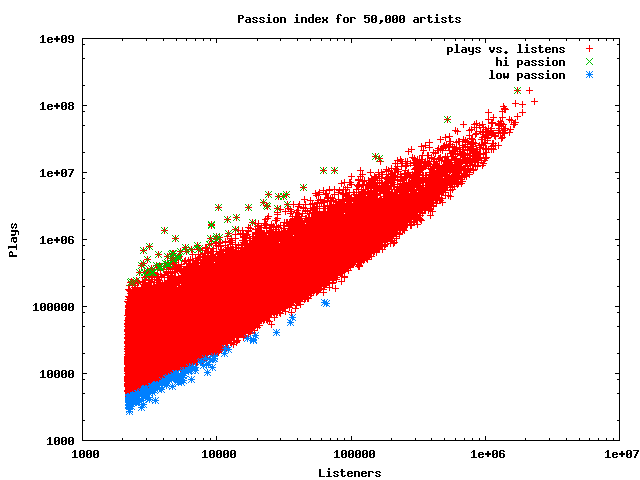
Data Mining Listening Data: The Passion Index
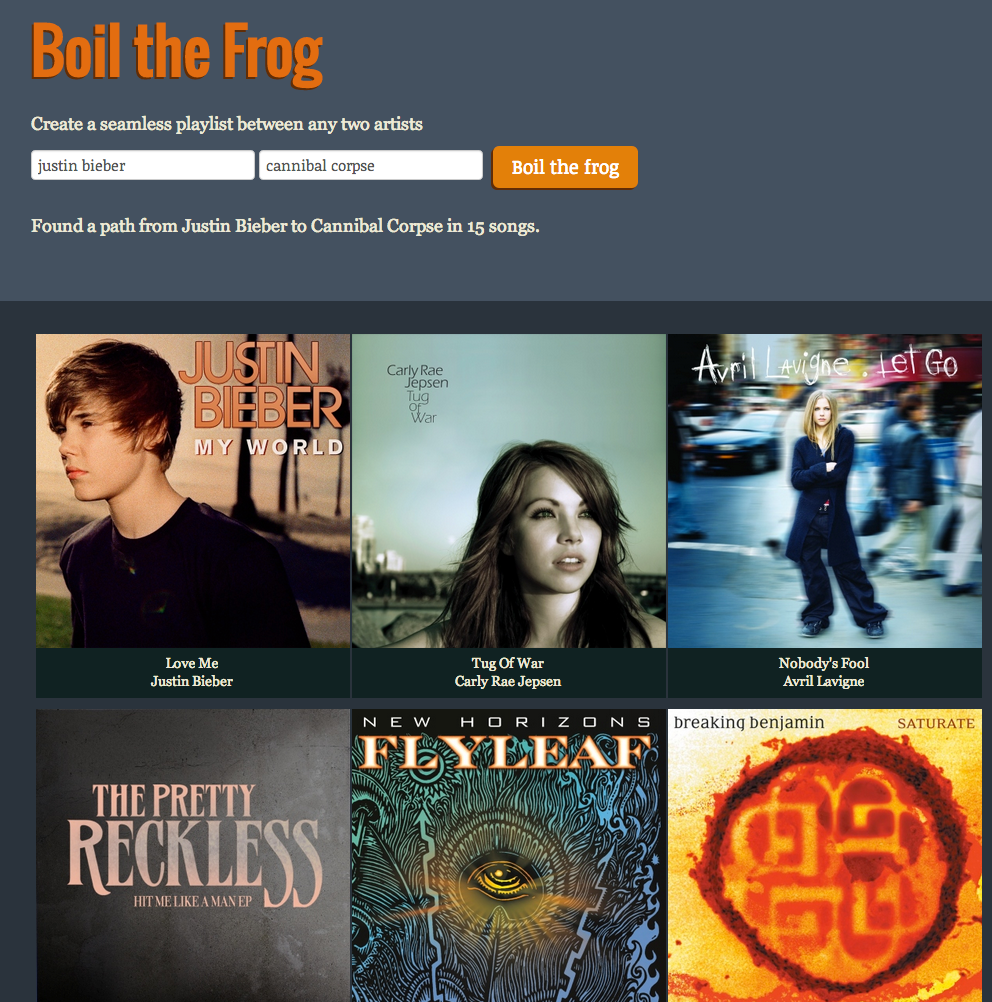
Fun with Artist Similarity Graphs: Boil the Frog
Post about In Search of the Click Track and a web app for exploring click tracks

Turning music into silly putty – Echo Nest Remix
[youtube http://www.youtube.com/watch?v=2oofdoS1lDg]Interactive Music
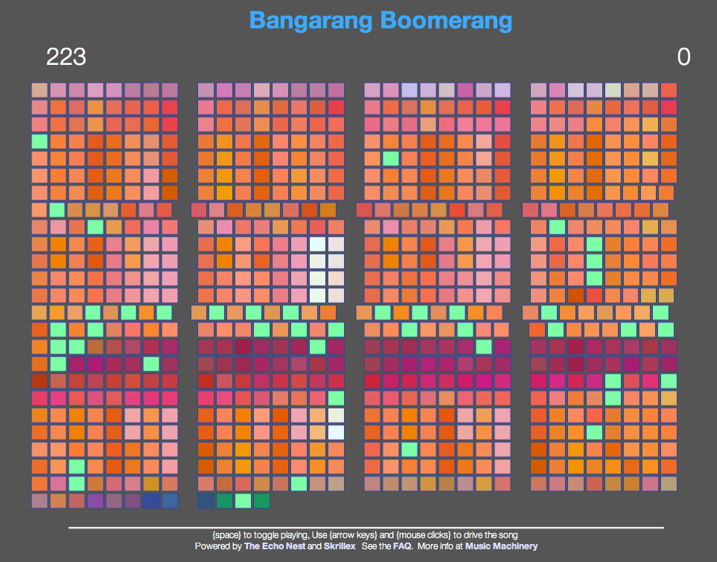
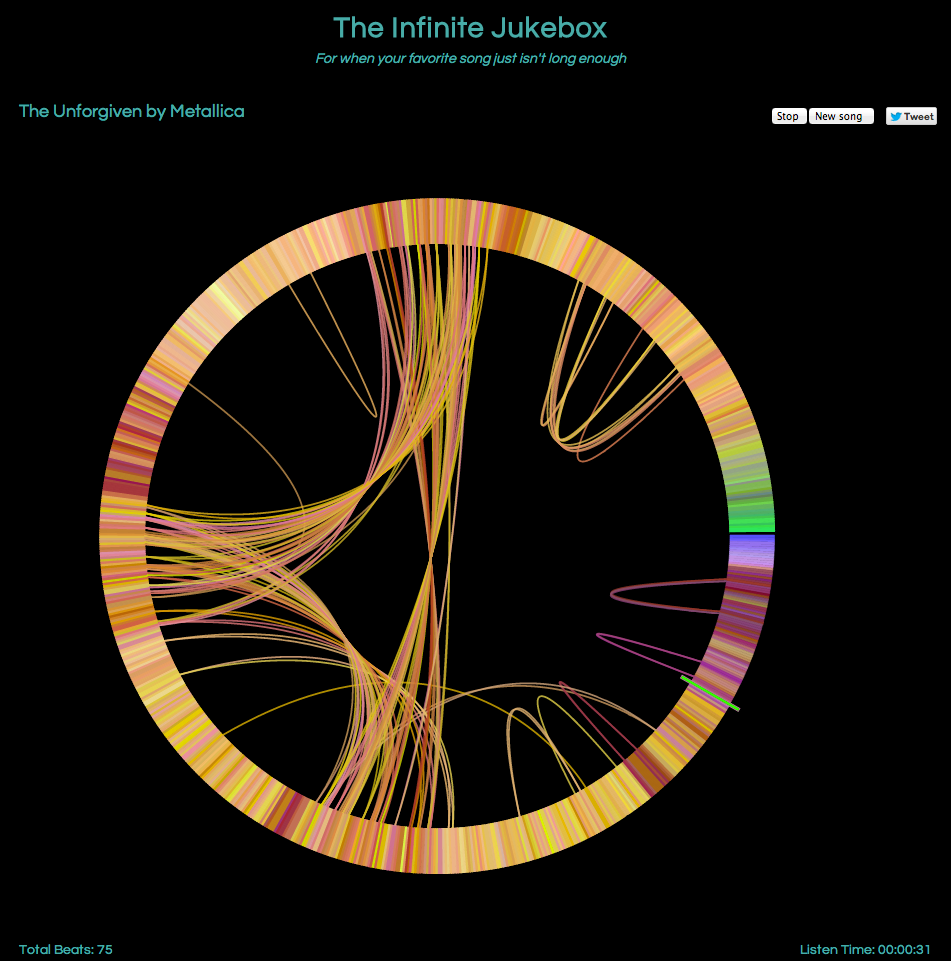
I really enjoyed giving the talk. The audience was really into the topic and remained engaged through out. Afterwards I had lots of stimulating discussions about the music tech world. The Stockholm Pythonistas were a very welcoming bunch. Thanks for letting me talk. Here’s a picture I took at the very end of the talk:

Joco vs. Glee
With all the controversy surrounding Glee’s ripoff of Jonathan Coulton’s Baby Got back I thought I would makes a remix that combines the two versions. The remix alternates between the two songs, beat by beat.
[audio http://static.echonest.com.s3.amazonaws.com/audio/combo.mp3]At first I thought I had a bug and only one of the two songs was making it into the output, but nope, they are both there. To prove it I made another version that alternates the same beat between the two songs – sort of a call and answer. You can hear the subtle differences, and yes, they are very subtle.
[audio http://static.echonest.com.s3.amazonaws.com/audio/combo-t1.mp3]The audio speaks for itself.
Here’s the code.
[gist https://gist.github.com/4632416]Music Hack Day Stockholm
This weekend I was in Stockholm, participating in, and representing The Echo Nest at the Stockholm Music Hack Day held at Spotify HQ. It was quite an impressive event. Hundreds of hackers from all over Sweden and many others from all around the world joined together for 24 hours of hard core music hacking. Spotify did an excellent job hosting the event. The space was ideal for hacking – rock solid wifi with lots of bandwidth, an endless supply of caffeinated beverages, comfortable seating, and great audio/visual facilities for demos.
(photos by johncb1973)

There were a whole lot of music tech companies there too, showing off their technology. Such as:
 The Echo Nest
 ShareMyPlaylists
 Songkick
 Open EMI
 SoundCloud
 Soundrop
 Musixmatch
 Deezer
 Rdio
Rdio Gracenote
 Universal Music
 Musicmetric


Some hackers built their own musical instruments.


There were over 60 hacks demonstrated in a 3 hour period. Kudos to Andrew to keeping things moving along. There was very little demo fail – thanks to the good A/V and support from Andrew and his team.


While each team gave their demo, 100s of fellow hackers and guests watched, laughed, cried and celebrated the wonder of the music hacks.

There were all kinds of hacks: interactive games, music exploration and discovery, playlisting, remixing, sequencing. The hacks were incredibly creative, and despite the demo session being 3 hours long, the time just flew by. Be sure to check out the entire list of hacks.

We got to listen to much good music, from Oscar’s Flamenco guitar to creative remixing of the Blue Note Catalog.

I was quite pleased to see the number of hacks that took advantage of Echo Nest data to remix music. All of them were quite unique and clever uses of our API.

Stealing Feeling was one of my favorites of the Remix apps. They use the Echo Nest API to extract the rhythmic feeling of a song and used it to turn the output of a sterile drum machine beat into a living, breathing, human sounding rhythm.

My own demo was called Going Undercover. I used cover song data from SecondHandSongs to make music discovery playlists.

There were lots of Echo Nest based hacks. We originally planned to give out 2 prizes, but after seeing so many extremely high quality Echo Nest hacks we doubled the number of iPads we were giving out. The Echo Nest prize winners are:
The Sampler formerly known as Magnum Infinitity – TSFKAMI, is a musical instrument which creates patches from any sound or music you supply to it. Specify any directory with music or sounds on your hard drive and the contents will be uploaded to the EchoNest, which scans each file for short snippets with a pure(ish) pitch. The soundfiles are then chopped up and the desired snippets sorted by musical note and timbre and delivered to the sampler for that velvety smooth sounding goodness. https://www.hackerleague.org/hackathons/music-hack-day-stockholm-13/hacks/the-sampler-formerly-known-as-magnum-infinity
Super Mutroid – A music/rhythm platform game with a Super Metroid theme. – Plays a song through Libspotify and downloads song data from EchoNest. Generates obstacles based on the beats in the song. – https://www.hackerleague.org/hackathons/music-hack-day-stockholm-13/hacks/super-mutroid


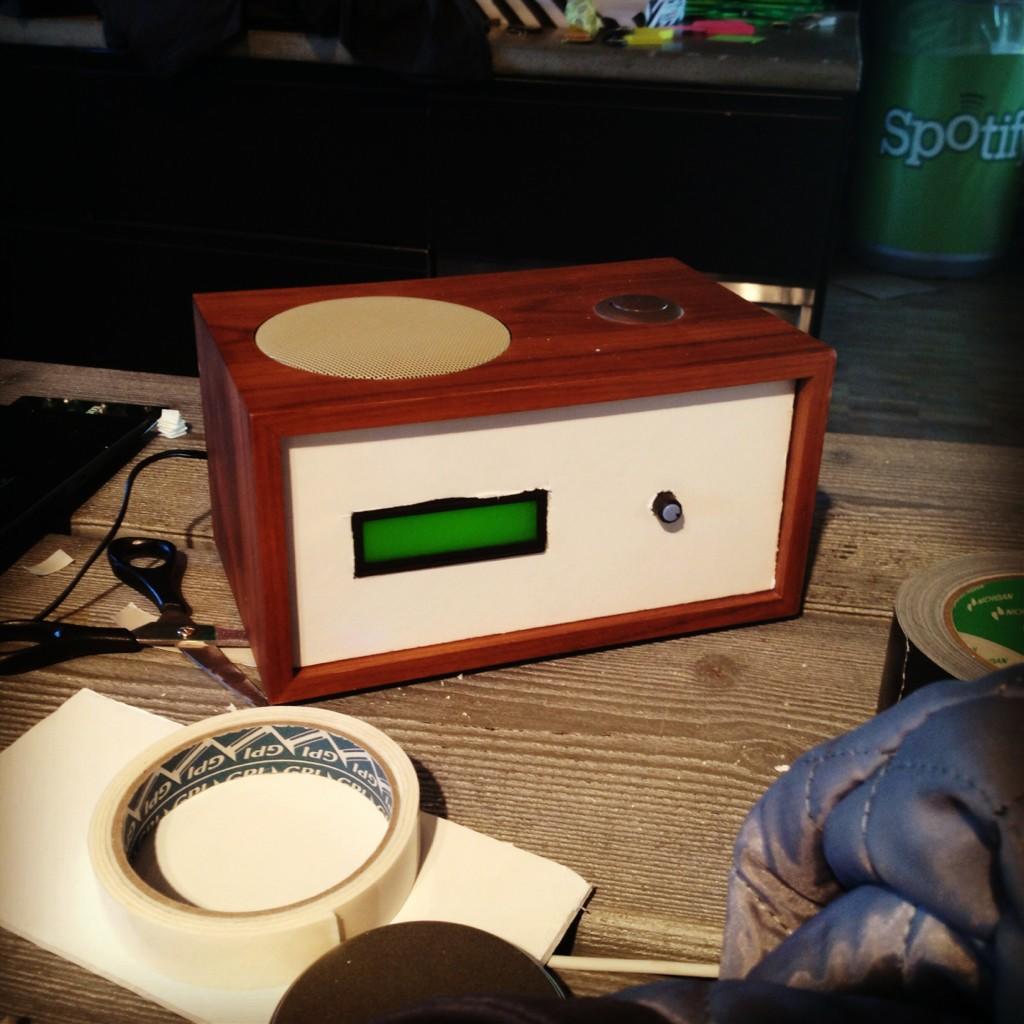
Pimp My Radio – A physical standalone radio that connects to a WiFi network and plays music from Spotify based on your daily moments (wakeup, relax, work out, romance, party ). The radio has a knob control for setting the situation you want and also an lcd screen for showing the lyrics of the current song in sync with the time. https://www.hackerleague.org/hackathons/music-hack-day-stockholm-13/hacks/pimp-my-radio
Stealing Feeling Based around a 16 step javascript sequencer which a user can program to run a drumkit generated in web audio, or to trig analog synths.Then, apply the swing from Aretha Franklin or Squarepusher on your song. https://www.hackerleague.org/hackathons/music-hack-day-stockholm-13/hacks/stealing-feeling

Other notable EN hacks
- Curadio – (another) physical radio with fancy playlists – https://www.hackerleague.org/hackathons/music-hack-day-stockholm-13/hacks/curadio
- Shutupcloud – filters soundcloud playlists to remove spoken word tracks (using speechiness)- https://www.hackerleague.org/hackathons/music-hack-day-stockholm-13/hacks/shutupcloud
- Discofy–MHD – light show synced to beats – https://www.hackerleague.org/hackathons/music-hack-day-stockholm-13/hacks/discofy-mhd

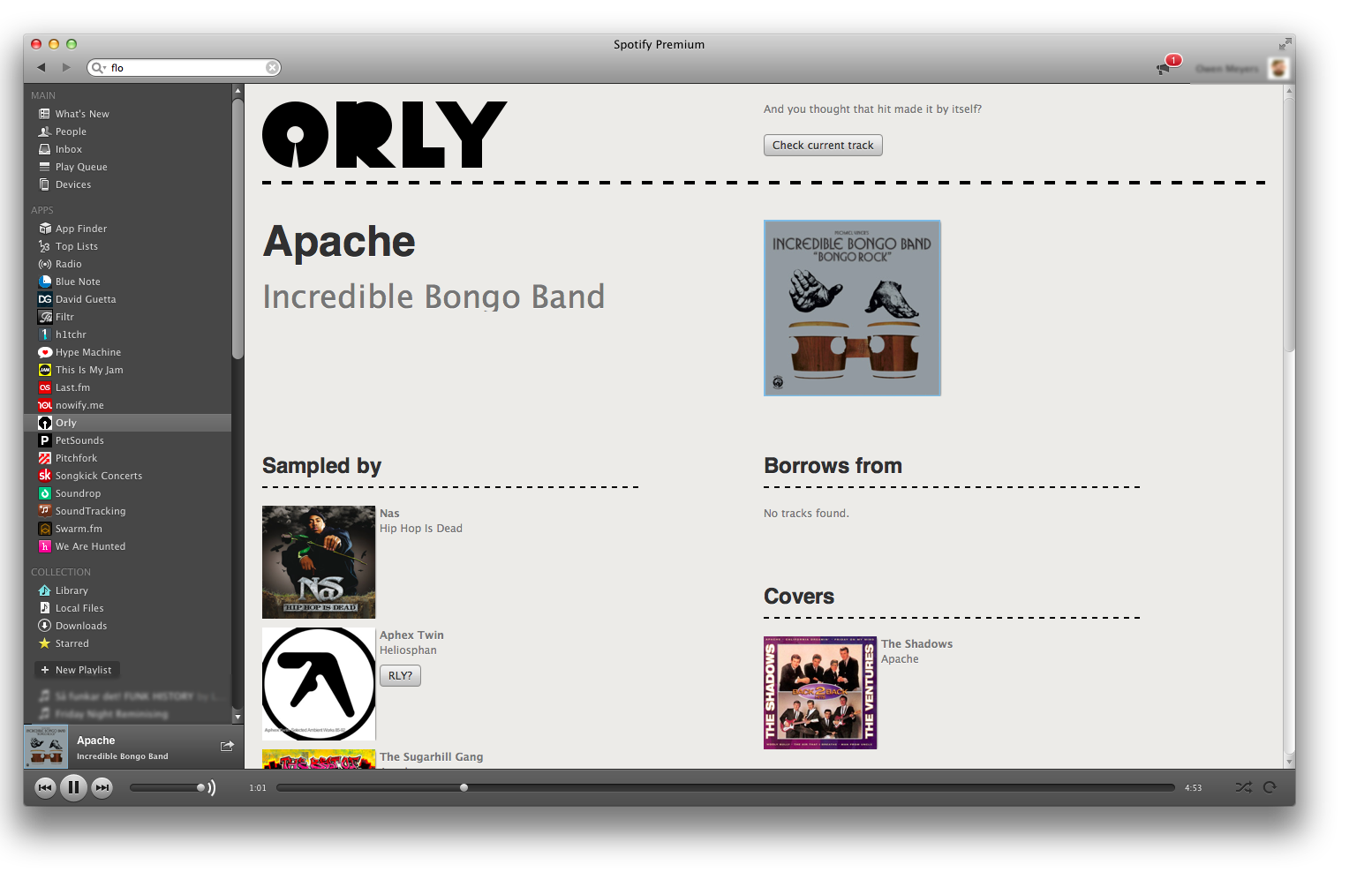
- Orly – used Whosampled rostta stone to make an in-spotify who-sampled explorer (this is a really neat app) – https://github.com/circuitflow/orly
- Blue Note Beat Builder – winner of the Open EMI prize – really cool! – Find classic break beats and jazz samples from the Blue Note catalog and create your own beat, or try to re-create another famous beat from scratch. –https://www.hackerleague.org/hackathons/music-hack-day-stockholm-13/hacks

- Dubthoven – remixing skrillex with strings https://www.hackerleague.org/hackathons/music-hack-day-stockholm-13/hacks/dubthoven
It was a fantastic weekend. Thanks to Andrew and the rest of the Spotify crew for hosting the event, and thanks to all the hackers who brought your passion for music and technology to the event and build some incredible stuff.

Special thanks to Johncb1973 who took most of these pictures.
The work of an Executive, International Music Hacker is never done. This weekend I’ll be traveling to Cannes for the Midem Music Hack Day. Life is good.
Going Undercover
My Music Hack Day Stockholm hack is ‘Going Undercover‘. This hack uses the extensive cover song data from SecondHandSongs to construct paths between artists by following chains of cover songs. Type in the name of a couple of your favorite artists and Going Undercover will try to find a chain of cover songs that connects the two artists. The resulting playlist will likely contain familiar songs played by artists that you never heard of before. Here’s a Going Undercover playlist from Carly Rae Jepsen to Johnny Cash:
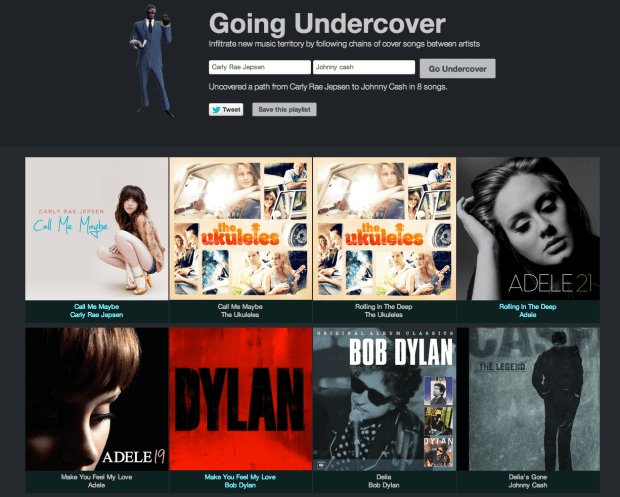
For this hack I stole a lot of code from my recent Boil the Frog hack, and good thing I could do that otherwise I would never have finished the hack in time. I spent many hours working to reconcile the Second Hand Songs data with The Echo Nest and Rdio data (Second Hand Songs is not part of Rosetta stone, so I had to write lots of code to align all the IDs up). Even with leveraging the Boil the Frog code, I had a very late night trying to get all the pieces working (and of course, the bug that I spent 2 hours banging my head on at 3AM was 5 minutes of work after a bit of sleep).
I am pretty pleased with the results of the hack. It is fun to build a path between a couple of artists and listen to a really interesting mix of music. Cover songs are great for music discovery, they give you something familiar to hold on to while listening to a new artist.
 Music Machinery