Archive for category The Echo Nest
SoundEchoCloudNest
Posted by Paul in code, data, events, Music, The Echo Nest, web services on September 28, 2009
At the recent Berlin Music Hackday, developer Hannes Tydén developed a mashup between SoundCloud and The Echo Nest, dubbed SoundCloudEchoNest. The program uses the SoundCloud and Echo Nest APIs to automatically annotate your SoundCloud tracks with information such as when the track fades in and fades out, the key, the mode, the overall loudness, time signature and the tempo. Also each Echo Nest section is marked. Here’s an example:
This track is annotated as follows:
- echonest:start_of_fade_out=182.34
- echonest:mode=min
- echonest:loudness=-5.521
- echonest:end_of_fade_in=0.0
- echonest:time_signature=1
- echonest:tempo=96.72
- echonest:key=F#
Additionally, 9 section boundaries are annotated.
The user interface to SoundEchoCloudNest is refreshly simple, no GUIs for Hannes:

Hannes has open sourced his code on github, so if you are a Ruby programmer and want to play around with SoundCloud and/or the Echo Nest, check out the code.
Machine tagging of content is becoming more viable. Photos on Flicker can be automatically tagged with information about the camera and exposure settings, geolocation, time of day and so on. Now with APIs like SoundCloud and the Echo Nest, I think we’ll start to see similar machine tagging of music, where basic info such as tempo, key, mode, loudness can be automatically attached to the audio. This will open the doors for all sorts of tools to help us better organize our music.
Tour of the Music Hackday Boston site
Posted by Paul in code, events, fun, Music, The Echo Nest, web services on September 24, 2009
The Boston Music Hackday is being held at Microsoft’s New England Research and Development Center (aka The NERD). Jon, Elissa and I took a tour of the space on Tuesday, and I must say I was very impressed. The place is tailor made for hacking. There’s open space big enough for 300 hackers to gather to show their demos, there’s plenty of informal space for hacking, there are small and large conference rooms for break out sessions, there’s wireless, there are plenty of power outlets, kitchen facilities, soda coolers and great views of Boston. This space is being donated by Microsoft – and I must say that my opinion of Microsoft has gone up substantially after I’ve seen how generous they’ve been with the space. Plus, the space is simply beautiful.

Informal hacking space at the NERD

More hacking space at the NERD
This hackday is shaping up to be something special. I’m pretty sure that we’ll hit our 300 person capacity, so register soon if you want to guarantee a spot.

Hacking space at the NERD

Open space at the NERD
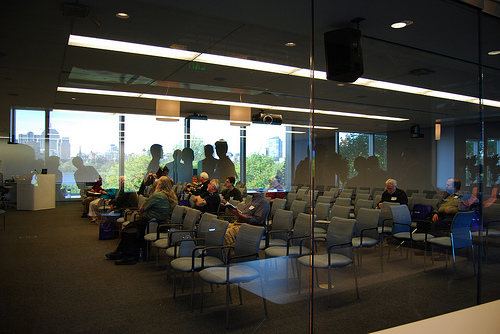
Meeting space at the NERD

Boston view from the NERD
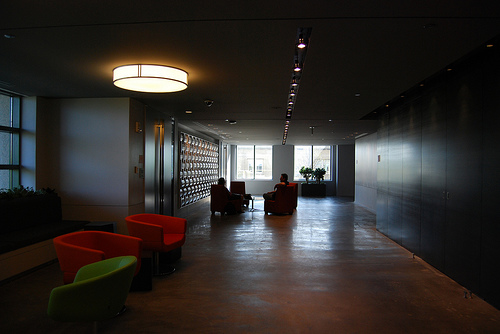
More hacking and chilling for the Hackday
Photos from Berlin Music Hackday
Posted by Paul in code, events, The Echo Nest on September 19, 2009

"I am a jelly roll"
There are some nifty photos coming of the the Berlin Music Hackday. Here’s a slide show.
What is a Music Hackday?
Hernik Berggren put together a nifty slide deck along with some video to show people what a Music Hackday is all about. Check it out on Henrik’s blog: Music Hackday Revisited.
Hacking on the Echo Nest at the Berlin Music Hackday
Posted by Paul in code, data, events, remix, The Echo Nest, web services on September 16, 2009
The Berlin Music Hackday is nearly upon us. Ben Lacker (a.k.a. DJ API) will be representing the Echo Nest at this wonderful event. If you want to maximize your hacking time during the hackday there are a few things that you can do in advance to get ready to hack on the Echo Nest APIs:
- Get an Echo Nest API Key – If you are going to be using the API, you need to get a key. You can get one for free from: developer.echonest.com
- Read the API overview – The overview gives you a good idea of the capabilities of the API. If you are thinking of writing a remix application, be sure to read Adam Lindsay’s wonderful remix tutorial.
- Pick a client library – There are a number of client libraries for The Echo Nest – select one for your language of choice and install it.
- Think of a great application – easier said than done. If you are looking for some inspiration, checkout these examples: morecowbell, donkdj, Music Explorer FX, and Where’s the Pow? . You’ll find more examples in the Echo Nest gallery of Showcase Apps. If you are stuck for an idea ask me (paul@echonest.com) or Ben – we have a list of application ideas that we think would be fun to write.
At the end of the hackday, Ben will choose the Most Awesome Echo Nest Hackday Application. The developer of this application will go home a shiny new iPod touch. If you want your application to catch Ben’s eye write an Echo Nest application that makes someone say “woah! how did you do that!”, extra points if its an application with high viral potential. Check out the list of hacks created at the London Music Hackday to get inspiration.
The Music Hackday Comes to Boston
Posted by Paul in code, events, fun, Music, startup, The Echo Nest, web services on September 11, 2009
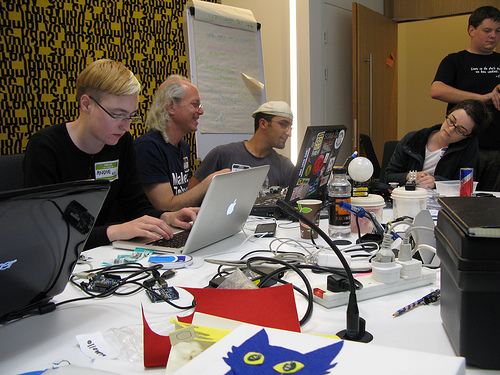
<W00T!> -The Music Hackday is coming to Boston. Set aside the weekend of November 21 and 22 for the Boston Music Hackday being held at the Microsoft New England Research and Develpment Center (aka NERD). The Music Hackday is a place where folks can gather for a weekend of nearly uninterrupted hacking on music. Expect to see (and hear) all kinds of music hacks: from web-hacks, iPhone apps, analog noisemakers to cool visualizations. Anything goes as long as it is music related. The Boston hackday is being organized by Dave Haynes (SoundCloud), Jon Pierce (Betahouse) and myself (The Echo Nest). We here at the Echo Nest are pretty excited to be involved. It should be really fun.
If you hack music and are going to be within a day’s drive of Boston on the weekend before Thanksgiving, you really should be planning to attend the hackday. Registration is free, but space is limited. To guarantee a spot register early and be sure you tell us how you want to hack music (because of the limited number of slots, we give preference to music hackers).
Event: Boston Music Hackday
When: November 21, 22
Where: NERD
PRICE: $FREE
Register: http://musichackdayboston.eventbrite.com/
Looking for hacking inspiration? Check out all of the music hacks that were built during the London Music Hackday:
- LonelyHarps won 7digital prize
- Music Zeitgeist won BBC prize
- iPhone Music Visualiser won The Echo Nest prize
- pythoniphication of SoundCloud API won Gigulate prize
- MusicBore won Last.fm and Be Broadband Overall prize
- trackmap won Songkick prize
- SoundCloud playlist sampler won SoundCloud prize
- Percussion Machine won RjDj and Tinker it! prize
- SpaceBass won LOLCODE prize
- TrippyAudioWaves
- Music Feeds
- Record Label Website and Data Access
- Cantarino
- Danzen Party MIX!!!
- iPhone Music Visualiser
- Pix n Mixer
- IRC Duckestra
- BotTalk
- SoundCloud AS3 Wrapper
- TwinkleStarduino
- Music Price Comparison
- Outcast
- CloudPost
- Gig news
- LONCYN
- MP3 music news blog plugin
- last.fm Events on iPhone
- SoundCloud Dropbox Manager
- MakeMyMixtape
- Bass Race RjDj Scene
- 7digital and Guardian news mashup
- YouLoop
- CitySounds.fm
- RFID objects with a taste in music
- Amenator
- Theremag
- ookoi_ShakeNRoll
- Soup.io SoundCloud import & Radio alpha
- Bass Race RjDj Scene
- JAEZZESiZER
Music Hack Day Berlin
Posted by Paul in code, data, Music, The Echo Nest on September 1, 2009
On the heals of the very successful London Music Hackday, comes the Berlin Music Hackday which will be held on September 18/19/20 at the very cool Radialsystem V in Berlin Germany.

Site of the Berlin Music Hacday
The hackday is totally free for participants but is limited to 150 participants. (and if this is organized like the London hackday, if you want to attend, be prepared to describe how you hack hardware, software or music – not just anyone can fill one of the 150 slots).
The London hackday was such a great event, I’m glad to see that it is being repeated in different parts of the world. Look for more Music Hackdays coming to a city near you.

Hacking music at the London Music Hackday
Uh oh. The celestial jukebox has arrived
Posted by Paul in Music, playlist, The Echo Nest on August 28, 2009
The Spotify iPhone app has been approved. With this app, I will now be able to carry 5 million songs in my pocket, and every week thousands more songs will be added to my collection automatically. This is the proverbial celestial jukebox – the great jukebox in the cloud that lets me listen to any song I want to hear. This is going to change how we listen to music. When we can listen to any song, anywhere, any time and on any device our current ways of interacting with music will be woefully inadequate. Shuffle play with 5 million songs just won’t work. Listener’s paralyzed by too much choice will just go back to the Eagles greatest hits album because its easier and safer than trying to find something new. People will start to wonder “What good are 5 million songs if I only listen to the 100 that I listened to in high school?” The new challenge that these next generation music services face is helping their listeners find new and interesting music. Tools for music discovery will be key to keeping listener’s coming back. Five years from now, the most successful music sites will be the ones that have figured out how to help people find new music.
What will music discovery look like in 5 years? I don’t know for sure, but I do know that it will go way beyond the ‘artist radio’ approach that we see now. I suspect that at the core of music discovery will be a smart, personalized, context-aware playlist engine that will give you a continuous stream of interesting music. The engine will know kind of music you like and don’t like, the kind of music you like to listen to when you are driving vs. working vs. relaxing, the music taste of the people you are with, your sense of musical adventure, what your friends are listening to, what songs were played on the TV shows you watched last night, what song fits well with the last song that was played, what artists are in the news, what artists are coming to town in the next few weeks, what artists have new albums coming out. The list goes on and on. It is hard to predict what will happen in 5 years, but I wouldn’t be too surprised if we see something that looks like this: 
(Image courtesy of David Jennings)
Remixing for the masses at SXSW 2010
Posted by Paul in code, The Echo Nest on August 25, 2009
 We are hoping to be able to present a panel on Echo Nest remix at next year’s SXSW interactive. We want to show lots of rather nifty ways that one can use Echo Nest remix to manipulate music – lots of code plus lots of music and video remix examples. What could be more fun? To actually get to present the panel we have to make it through the SXSW panel picking process. If you think this might be a good panel, head on over to our panel proposal page and vote for our panel called ‘remixing for the masses‘.
The Stairway Detector
Posted by Paul in data, fun, Music, playlist, The Echo Nest, web services on August 17, 2009
Last night I was watching the pilot for Glee (a snarky TV version of High school musical) with my 3 teenage daughters. I was surprised to hear the soundtrack filled with songs by the band Journey, songs that brought me back to my own high school years. The thing that I like the most about Journey is that many of their songs have this slow and gradual build up over the course of the whole song as in this song Lovin Touchin Squeezin:
A number of my favorite songs have this slow build up. The canonical example is Zep’s ‘Stairway to Heaven’ – it starts with a slow acoustic guitar and over the course of 8 minutes builds to metal frenzy. I thought it would be fun to see if I could write a bit of software that could find the songs that have the same arc as ‘Stairway to Heaven’ or ‘Lovin, Touchin Squeezin’ – songs that have this slow build. With this ‘stairway detector’ I could build playlists filled with the songs that fire me up.
The obvious place to start with is to look how the loudness of a song changes overtime. To do this I used the Echo Nest developer API to extract the loudness as a function of time for Journey’s Lovin, Touchin Squeezin:
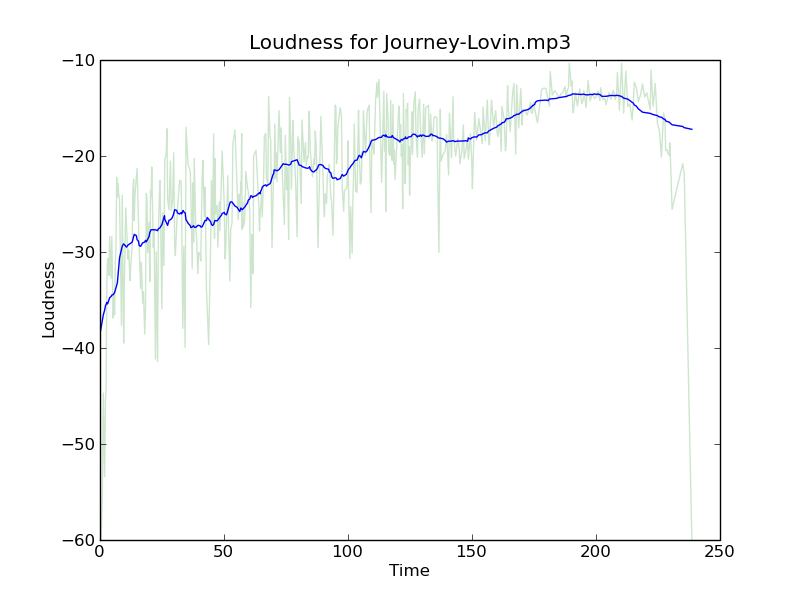 In this plot the light green curve is the loudness, while the blue line is a windowed average of the loudness. This plot shows a nice rise in the volume over the course of the song. Compared to a song like the Beatles ‘Ticket to Ride’ that doesn’t have this upward slope:
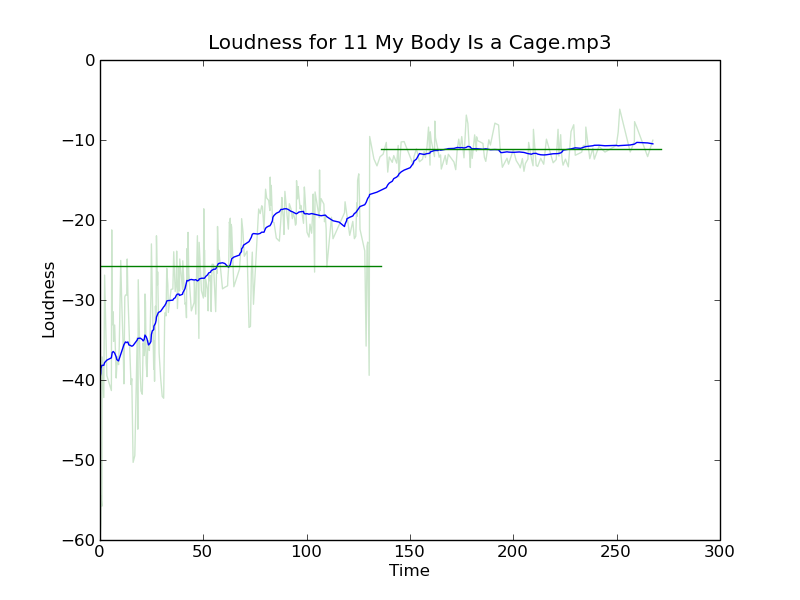
 From these two examples, it is pretty clear that we can build our stairway-detector just by looking at the average slope of the volume. The higher the slope, the bigger the build. Now, I suspect that there’s lots of ways to find the average slope of a bumpy line – but I like to always try the simplest thing that could possibly work first – and for me the simplest thing was to just divide the average loudness of the second half of the song by the average loudness of the first half of the song. So for example, with the Journey song the average loudness of the second half of the song is -15.86 db and the average of the first half of the song is -24.37 db. This gives us a ratio of 1.54, while ‘Ticket to ride’ gets a ratio of 1.06. Here’s the Journey song with averages shown:
 Here are a few more songs that fit the ‘slow build’ profile:
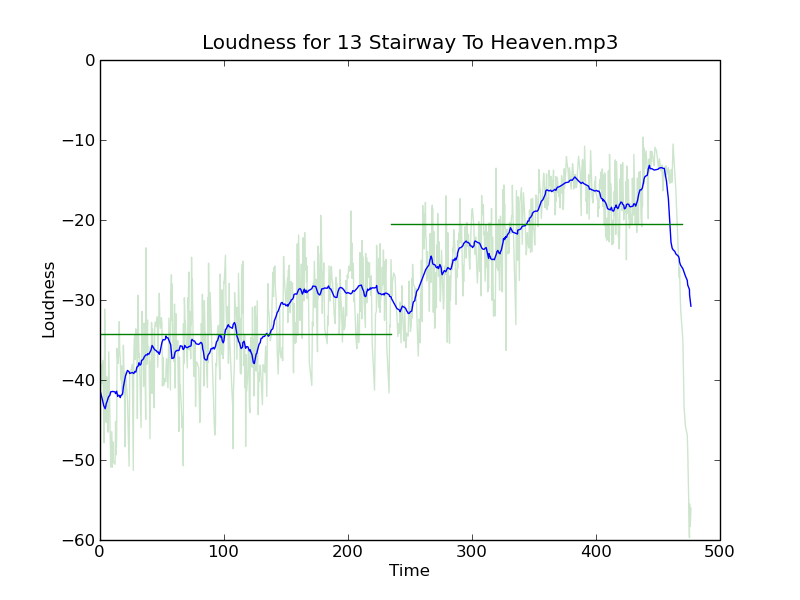 ‘Stairway to Heaven’ has a score of 1.6 so it has a bigger build than Journey’s Lovin’.
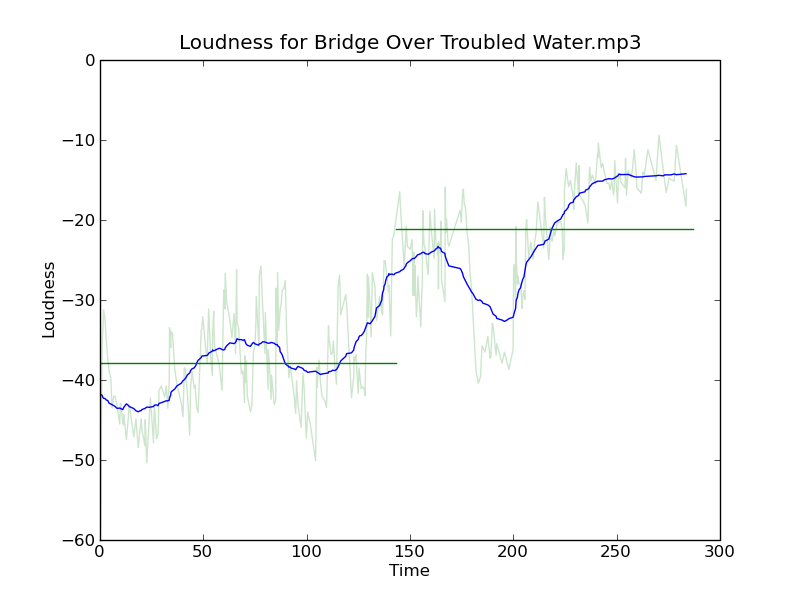 Simon and Garfunkle’s ‘Bridge over troubled water’ has an even bigger build with a score of 1.7.
 Also sprach Zarathustra has a more modest score of 1.56
With this new found metric I analyzed a few thousand of the tracks in my personal collection to find the songs with the biggest crescendos. The biggest of all was this song by Muse with a whopping score of 3.07:
 Another find is Arcade Fire’s “My Body is a Cage” with a score of 2.32.
The metric isn’t perfect. For instance, I would have expected Postal Services ‘Natural Anthem’ to have a high score because it has such a great build up, but it only gets a score of 1.19. Looking at the plot we can see why:
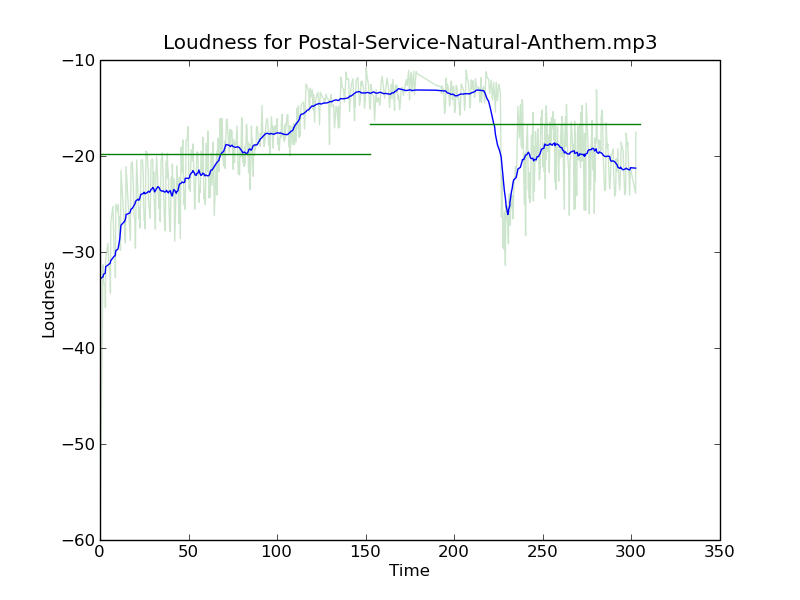 After the initial build up, there’s a drop an energy for that last quarter of the song, so even though the song has a sustained crescendo for 3 minutes it doesn’t get a high score due to this drop.
Of course, we can use this ratio to find tracks that go the other way, to find songs that gradually wind down. These seem to occur less frequently than the songs that build up. One example is Neutral Milk Hotel’s Two Headed Boy:

Despite the fact that I’m using a very naive metric to find the loudness slope, this stairway detector is pretty effective in finding songs that have that slow build. It’s another tool that I can use for helping to build interesting playlists. This is one of the really cool things about how the Echo Nest approaches music playlisting. By having an understanding of what the music actually sounds like, we can build much more interesting playlists than you get from genius-style playlists that only take into account artists co-occurrence.

