Using Visualizations for Music Discovery
Posted by Paul in music information retrieval, research, tags, visualization on March 28, 2009
As Ben pointed out last week, the ISMIR site has posted the tutorial schedule for ISMIR 2009. I’m happy to see that the tutorial that Justin Donaldson and I proposed was accepted. Our tutorial is called Using Visualizations for Music Discovery. Here’s the abstract:
As the world of online music grows, tools for helping people find new and interesting music in these extremely large collections become increasingly important. In this tutorial we look at one such tool that can be used to help people explore large music collections: data visualization. We survey the state-of-the-art in visualization for music discovery in commercial and research systems. Using numerous examples, we explore different algorithms and techniques that can be used to visualize large and complex music spaces, focusing on the advantages and the disadvantages of the various techniques. We investigate user factors that affect the usefulness of a visualization and we suggest possible areas of exploration for future research.
I’m excited about this tutorial – mainly because I get to work with Justin on it. He’s a really smart guy who really knows the state-of-the-art in visualizations. I’ll just be tagging along for the ride.
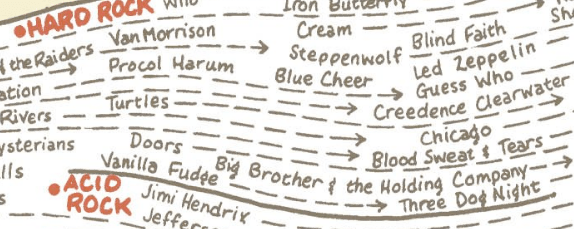
Detail from Genealogy of Pop/Rock Music
We are in the survey phase of talk preparation now. We’ve been gathing info on various types of visualizations and tagging them with the delicious tag MusicVizIsmir2009. Feel free to tag along (pun intended) with us and tag items that you encounter that you feel may be particularly interesting, unique or salient.
Help! My iPod thinks I’m emo – Part 1
Posted by Paul in Music, recommendation, research, The Echo Nest on March 26, 2009

At SXSW 2009, Anthony Volodkin and I presented a panel on music recommendation called “Help! My iPod thinks I’m emo”. Anthony and I share very different views on music recommendation. You can read Anthony’s notes for this session at his blog: Notes from the “Help! My iPod Thinks I’m Emo!” panel. This is Part 1 of my notes – and my viewpoints on music recommendation. (Note that even though I work for The Echo Nest, my views may not necessarily be the same as my employer).
The SXSW audience is a technical audience to be sure, but they are not as immersed in recommender technology as regular readers of MusicMachinery, so this talk does not dive down into hard core tech issues, instead it is a lofty overview of some of the problems and potential solutions for music recommendation. So lets get to it.
Music Recommendation is Broken.

Even though Anthony and I disagree about a number of things, one thing that we do agree on is that music recommendation is broken in some rather fundamental ways. For example, this slide shows a recommendation from iTunes (from a few years back). iTunes suggests that if I like Britney Spears’ “Hit Me Baby One more time” that I might also like the “Report on Pre-War Intelligence for the Iraq war”.
Clearly this is a broken recommendation – this is a recommendation no human would make. Now if you’ve spent anytime visiting music sites on the web you’ve likely seen recommendations just as bad as this. Sometimes music recommenders just get it wrong – and they get it wrong very badly. In this talk we are going to talk about how music recommenders work, why they make such dumb mistakes, and some of the ideas coming from researchers and innovators like Anthony to fix music discovery.
Why do we even care about music recommendation and discovery?
The world of music has changed dramatically. When I was growing up, a typical music store had on the order of 1,000 unique artists to chose from. Now, online music stores like iTunes have millions of unique songs to chose from. Myspace has millions of artists, and the P2P networks have billions of tracks available for download. We are drowning in a sea of music. And this is just the beginning. In a few years time the transformation to digital, online music will be complete. All recorded music will be online – every recording of every performance of every artist, whether they are a mainstream artist or a garage band or just a kid with a laptop will be uploaded to the web. There will be billions of tracks to chose from, with millions more arriving every week. With all this music to chose from, this should be a music nirvana – we should all be listening to new and interesting music.

With all this music, classic long tail economics apply. Without the constraints of physical space, music stores no longer need to focus on the most popular artists. There should be less of a focus on the hits and the megastars. With unlimited virtual space, we should see a flattening of the long tail – music consumption should shift to less popular artists. This is good for everyone. It is good for business – it is probably cheaper for a music store to sell a no-name artist than it is to sell the latest Miley Cyrus track. It is good for the artist – there are millions of unknown artists that deserve a bit of attention, and it is good for the listener. Listeners get to listen to a larger variety of music, that better fits their taste, as opposed to music designed and produced to appeal to the broadest demographics possible. So with the increase in available music we should see less emphasis on the hits. In the future, with all this music, our music listening should be less like Walmart and more like SXSW. But is this really happening? Lets take a look.

The state of music discovery
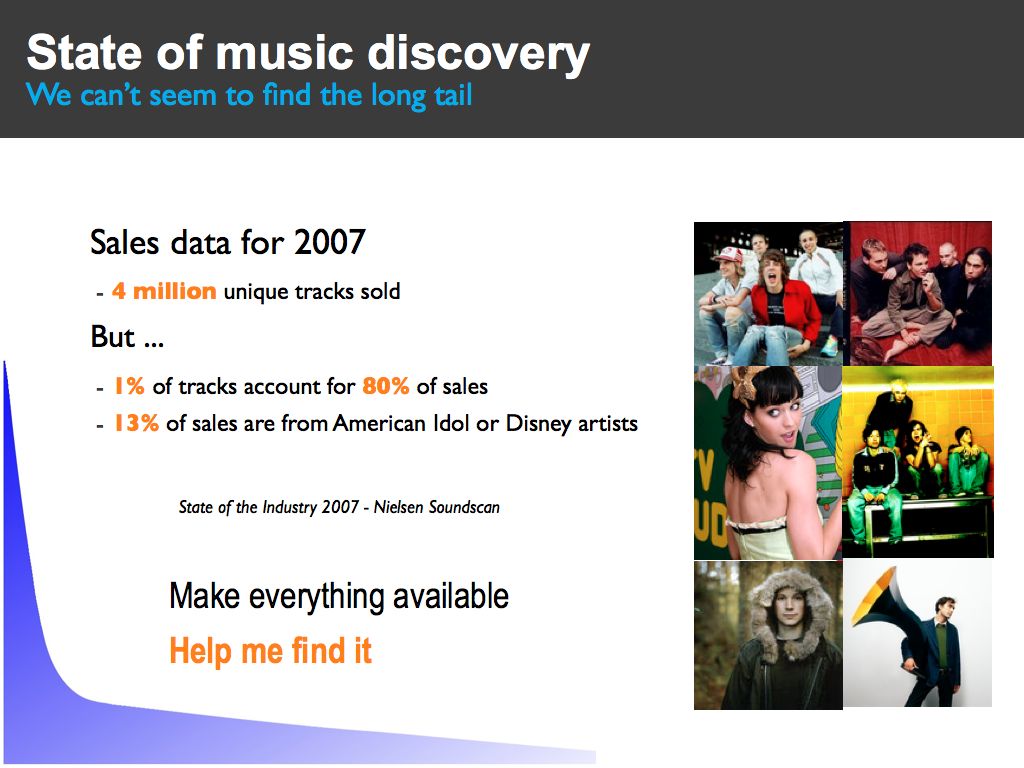
If we look at some of the data from Nielsen Soundscan 2007 we see that although there were more than 4 million tracks sold only 1% of those tracks accounted for 80% of sales. What’s worse, a whopping 13% of all sales are from American Idol or Disney Artists. Clearly we are still focusing on the hits. One must ask, what is going on here? Was Chris Anderson wrong? I really don’t think so. Anderson says that to make the long tail ‘work’ you have to do two things (1) Make everything available and (2) Help me find it. We are certainly on the road to making everything available – soon all music will be online. But I think we are doing a bad job on step (2) help me find it. Our music recommenders are *not* helping us find music, in fact current music recommenders do the exact opposite, they tend to push us toward popular artists and limit the diversity of recommendations. Music recommendation is fundamentally broken, instead of helping us find music in the long tail they are doing the exact opposite. They are pushing us to popular content. To highlight this take a look at the next slide.
Help! I’m stuck in the head
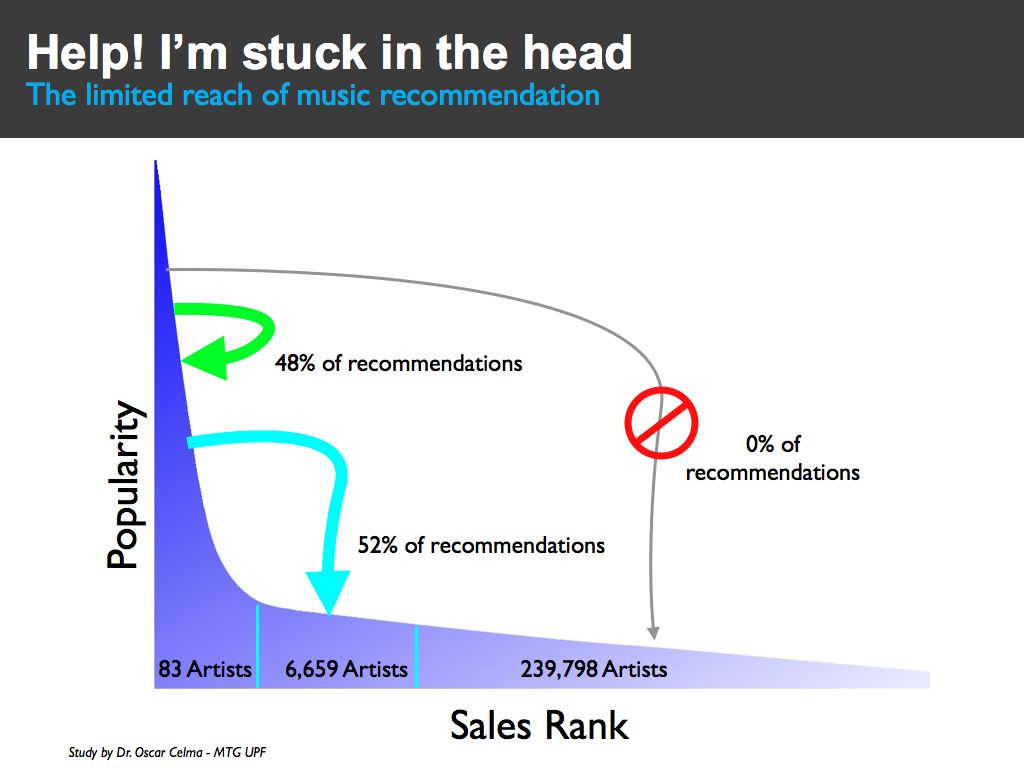
This is a study done by Dr. Oscar Celma of MTG UPF (and now at BMAT). Oscar was interested in how far into the long tail a recommender would get you. He divided the 245,000 most popular artists into 3 sections of equal sales – the short head, with 83 artists, the mid tail with 6,659 artists, and the long tail with 239,798 artists. He looked at recommendations (top 20 similar artists) that start in the short head and found that 48% of those recommendations bring you right back to the short head. So even though there are nearly a quarter million artists to chose from, 48% of all recommendations are drawn from a pool of the 83 most popular artists. The other 52% of recommendations are drawn from the mid-tail. No recommendations at all bring you to the long tail. The nearly 240,000 artists in the long tail are not reachable directly from the short head. This demonstrates the problem with commercial recommendation – it focuses people on the popular at the expense of the new and unpopular.
Let’s take a look at why recommendation is broken.
The Wisdom of Crowds
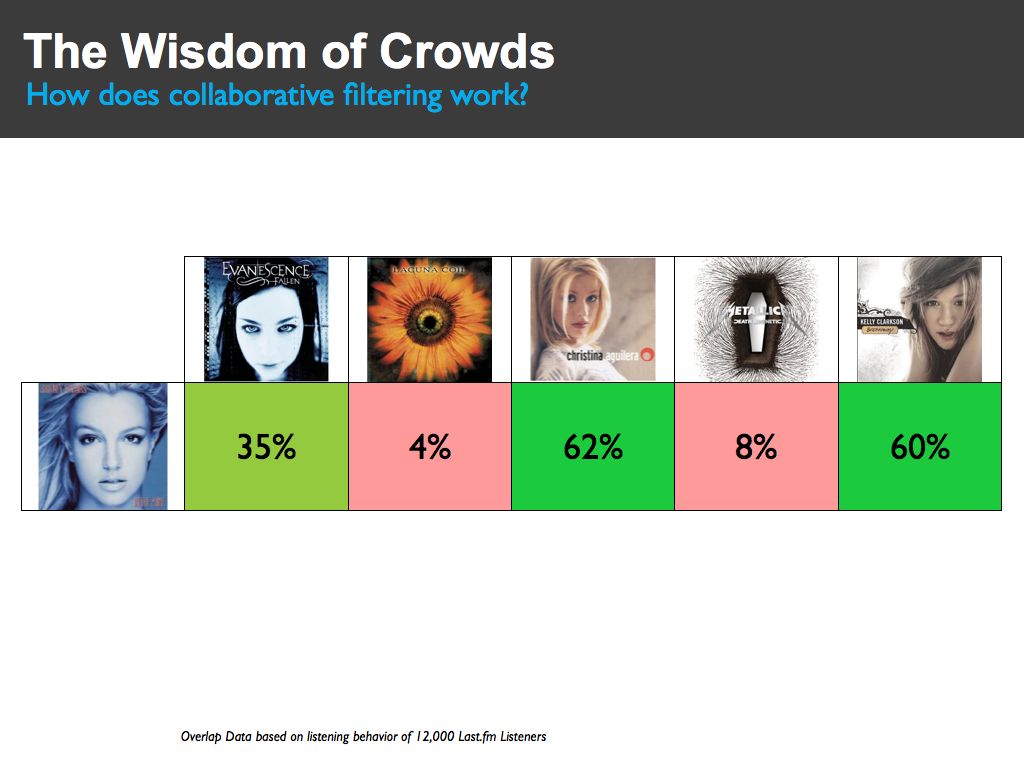
First lets take a look at how a typical music recommender works. Most music recommenders use a technique called Collaborative Filtering (CF). This is the type of recommendation you get at Amazon where they tell you that ‘people who bought X also bought Y’. The core of a CF recommender is actually quite simple. At the heart of the recommender is typically an item-to-item similarity matrix that is used to show how similar or dissimilar items are. Here we see a tiny excerpt of such a matrix. I constructed this by looking at the listening patterns of 12,000 last.fm listeners and looking at which artists have overlapping listeners. For instance, 35% of listeners that listen to Britney Spears also listen to Evancescence, while 62% also listen to Christina Aguilera. The core of a CF recommender is such a similarity matrix constructed by looking at this listener overlap. If you like Britney Spears, from this matrix we could recommend that you might like Christana and Kelly Clarkson, and we’d recommend that you probably wouldn’t like Metallica or Lacuna Coil.
CF recommenders have a number of advantages. First, they work really well for popular artists. When there are lots of people listening to a set of artists, the overlap is a good indicator of overall preference. Secondly, CF systems are fairly easy to implement. The math is pretty straight forward and conceptually they are very easy to understand. Of course, the devil is in the details. Scaling a CF system to work with millions of artists and billions of tracks for millions of users is an engineering challenge. Still, it is no surprise that CF systems are so widely used. They give good recommendations for popular items and they are easy to understand and implement. However, there are some flaws in CF systems that ultimately makes them not suitable for long-tail music recommendation. Let’s take a look at some of the issues.
The Stupidity of Solitude
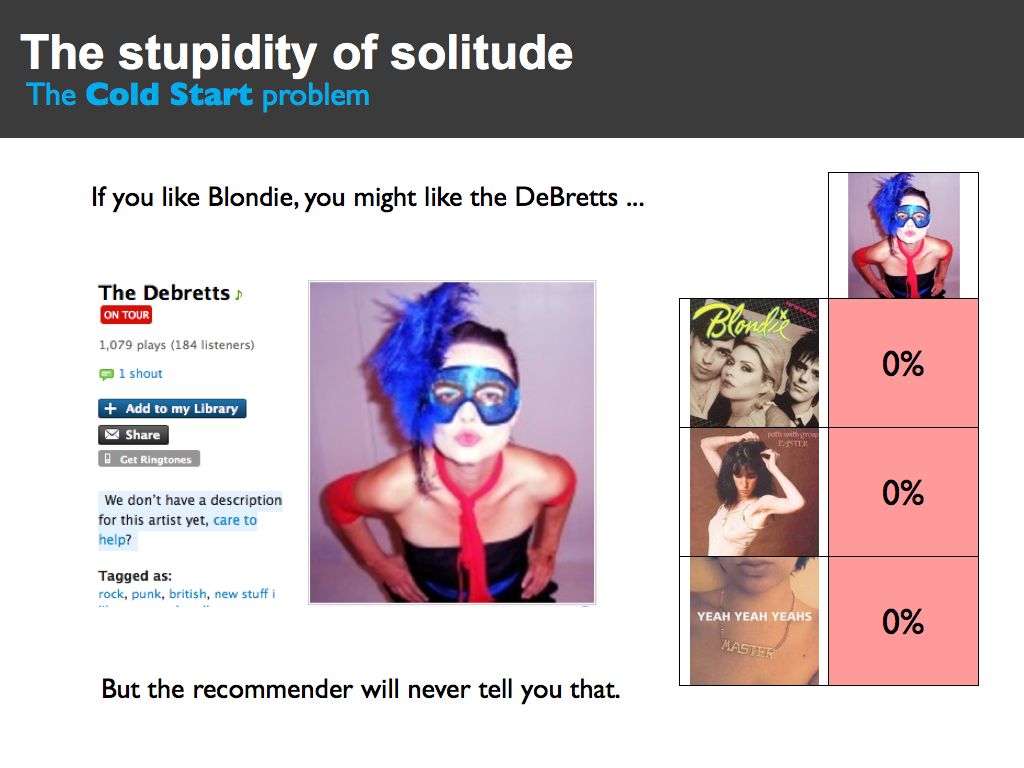
The DeBretts are a long tail artist. They are a punk band with a strong female vocalist that is reminiscent of Blondie or Patti Smith. (Be sure to listen to their song ‘The Rage’) .The DeBretts haven’t made it big yet. At last.fm they have about 200 listeners. They are a really good band and deserve to be heard. But if you went to an online music store like iTunes that uses a Collaborative Filterer to recommend music, you would *never* get a recommendation for the DeBretts. The reason is pretty obvious. The DeBretts may appeal to listeners that like Blondie, but even if all of the DeBretts listeners listen to Blondie the percentage of Blondie listeners that listen to the DeBretts is just too low. If Blondie has a million listeners then the maximum potential overlap(200/1,000,000) is way too small to drive any recommendations from Blondie to the DeBretts. The bottom line is that if you like Blondie, even though the DeBretts may be a perfect recommendation for you, you will never get this recommendation. CF systems rely on the wisdom of the crowds, but for the DeBretts, there is no crowd and without the crowd there is no wisdom. Among those that build recommender systems, this issue is called ‘the cold start’ problem. It is one of the biggest problems for CF recommenders. A CF-based recommender cannot make good recommendations for new and unpopular items.
Clearly we can see that this cold start problem is going to make it difficult for us to find new music in the long tail. The cold start problem is one of the main reasons why are recommenders are still’ stuck in the head’.
The Harry Potter Problem
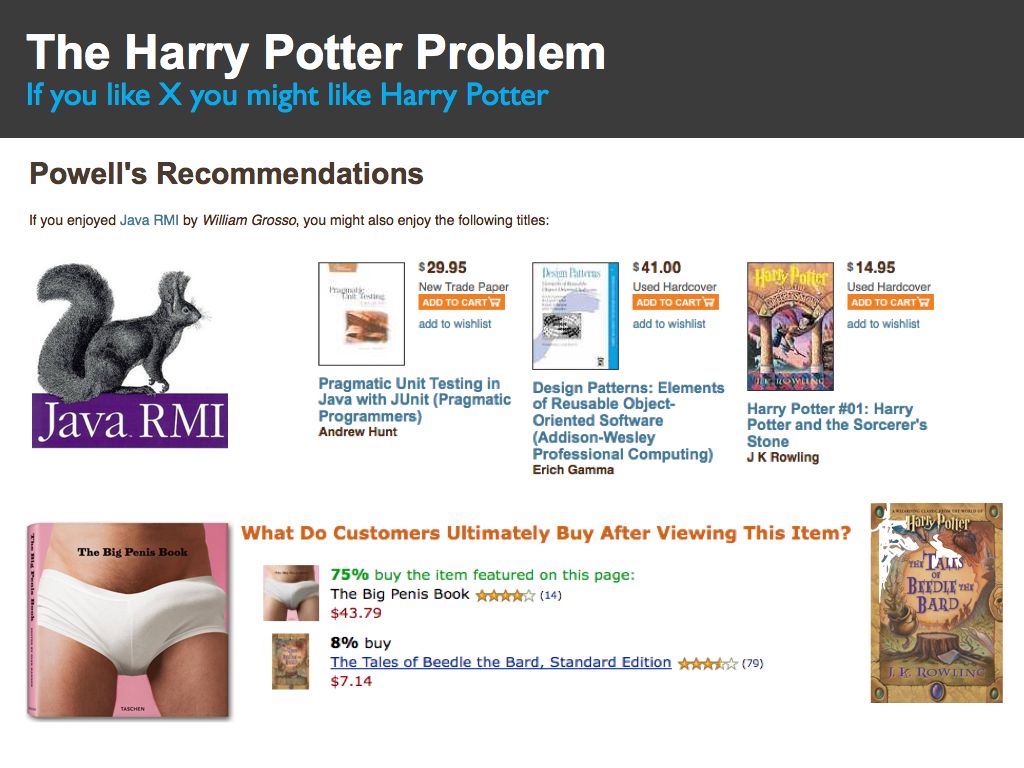
This slide shows a recommendation “If you enjoy Java RMI” you many enjoy Harry Potter and the Sorcerers Stone”. Why is Harry Potter being recommended for a reader of a highly technical programming book?
Certain items, like the Harry Potter series of books, are very popular. This popularity can have an adverse affect on CF recommenders. Since popular items are purchased often they are frequently purchased with unrelated items. This can cause the recommender to associate the popular item with the unrelated item, as we see in this case. This effect is often called the Harry Potter effect. People who bought just about any book that you can think of, also bought a Harry Potter book.
Case in point is the “The Big Penis Book” – Amazon tells us that after viewing “The Big Penis Book” 8% of customers go on to by the Tales of Beedle the Bard from the Harry Potter series. It may be true that people who like big penises also like Harry Potter but it may not be the best recommendation.
(BTW, I often use examples from Amazon to highlight issues with recommendation. This doesn’t mean that Amazon has a bad recommender – in fact I think they have one of the best recommenders in the world. Whenever I go to Amazon to buy one book, I end up buying five because of their recommender. The issues that I show are not unique to the Amazon recommender. You’ll find the same issues with any other CF-based recommender.)
Popularity Bias

One effect of this Harry Potter problem is that a recommender will associate the popular item with many other items. The result is that the popular item tends to get recommended quite often and since it is recommended often, it is purchased often. This leads to a feedback loop where popular items get purchased often because they are recommended often and are recommended often because they are purchased often. This ‘rich-get-richer’ feedback loop leads to a system where popular items become extremely popular at the expense of the unpopular. The overall diversity of recommendations goes down. These feedback loops result in a recommender that pushes people toward more popular items and away from the long tail. This is exactly the opposite of what we are hoping that our recommenders will do. Instead of helping us find new and interesting music in the long tail, recommenders are pushing us back to the same set of very popular artists.
Note that you don’t need to have a fancy recommender system to be susceptible to these feedback loops. Even simple charts such as we see at music sites like the hype machine can lead to these feedback loops. People listen to tracks that are on the top of the charts, leading these songs to continue to be popular, and thus cementing their hold on the top spots in the charts.
The Novelty Problem
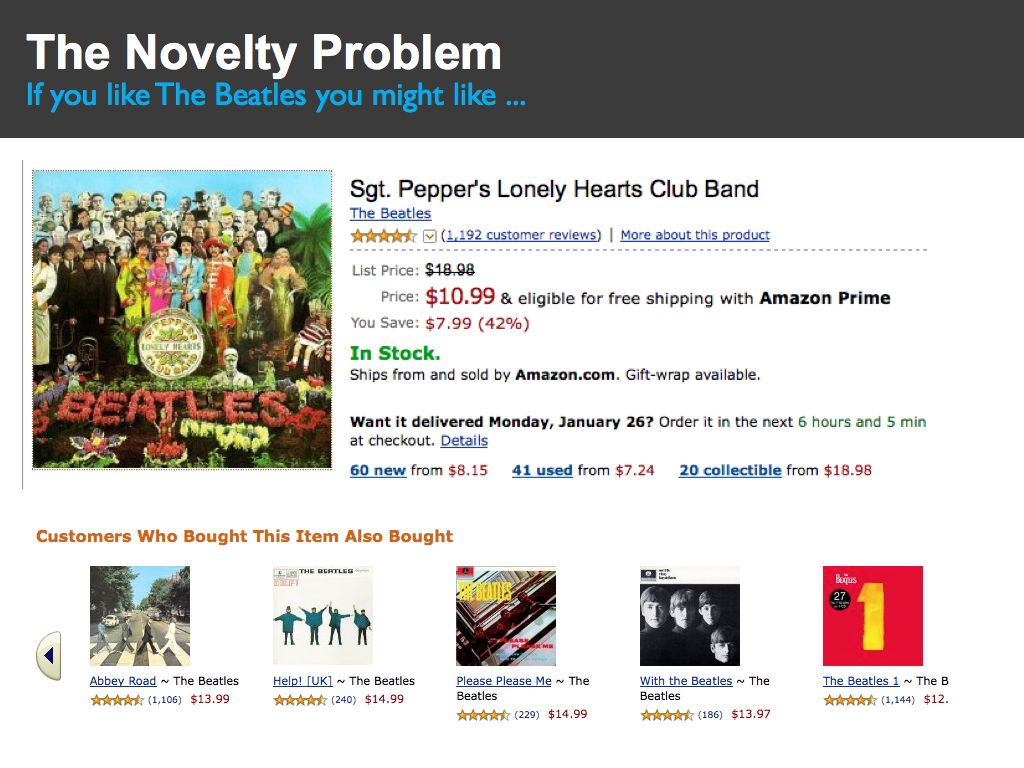
There is a difference between a recommender that is designed for music discovery and one that is designed for music shopping. Most recommenders are intended to help a store make more money by selling you more things. This tends to lead to recommendations such as this one from Amazon – that suggests that since I’m interested in Sgt. Pepper’s Lonely Hearts Club Band that I might like Abbey Road and Please Please Me and every other Beatles album. Of course everyone in the world already knows about these items so these recommendations are not going to help people find new music. But that’s not the point, Amazon wants to sell more albums and recommending Beatles albums is a great way to do that.
One factor that is contributing to the Novelty Problem is high stakes evaluations like the Netflix prize. The Netflix prize is a competition that offers a million dollars to anyone that can improve the Netflix movie recommender by 10%. The evaluation is based on how well a recommender can predict how a movie viewer will rate a movie on a 1-5 star scale. This type of evaluation focuses on relevance – a recommender that can correctly predict that I’ll rate the movie ‘Titanic’ 2.2 stars instead of 2.0 stars – may score well in this type of evaluation, but that probably hasn’t really improved the quality of the recommendation. I won’t watch a 2.0 or a 2.2 star movie, so what does it matter. The downside of the Netflix prize is that only one metric – relevance – is being used to drive the advancement of recommender state-of-the-art when there are other equally import metrics – novelty is one of them.
The Napoleon Dynamite Problem
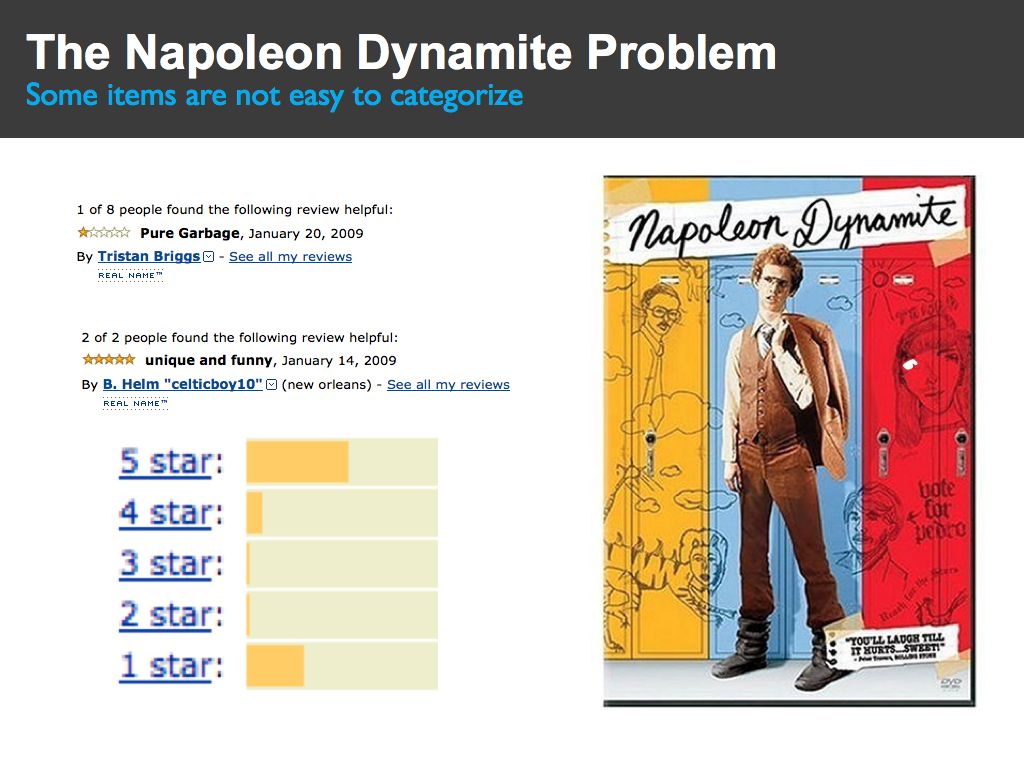
Some items are not always so easy to categorize. For instance, if you look at the ratings for the movie Napoleon Dynamite you see a bimodal distribution of 5 stars and 1 stars. People either like it or hate it, and it is hard to predict how an individual will react.
The Opacity Problem
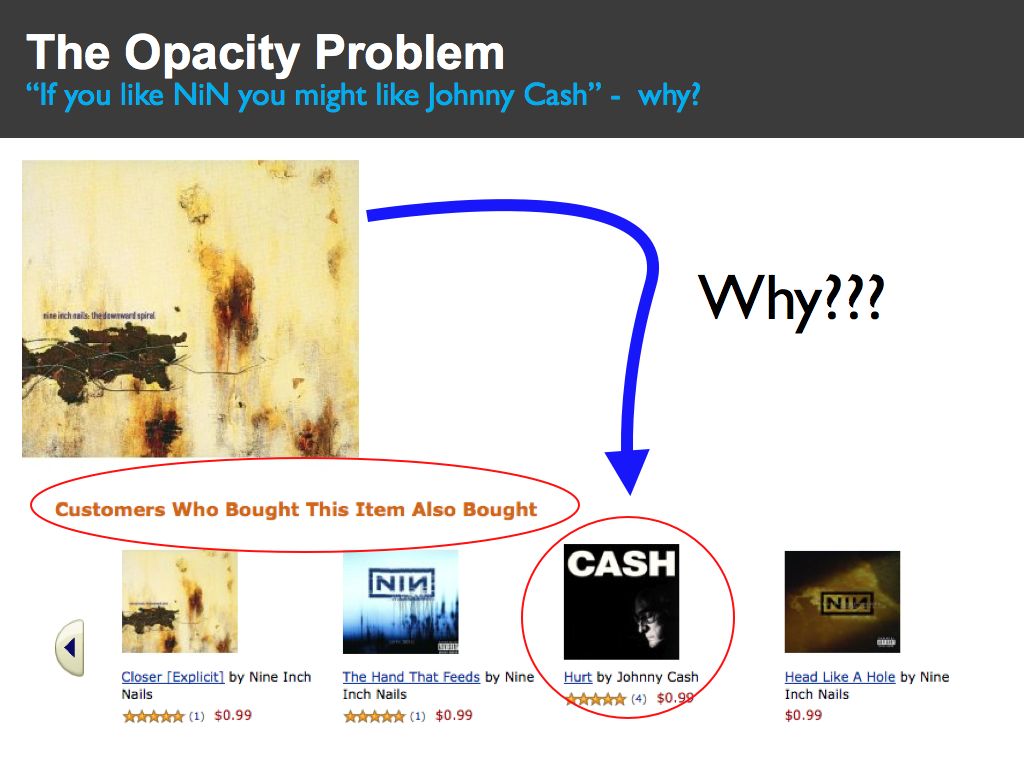
Here’s an Amazon recommendation that suggests that if I like Nine Inch Nails that I might like Johnny Cash. Since NiN is an industrial band and Johnny Cash is a country/western singer, at first blush this seems like a bad recommendation, and if you didn’t know any better you may write this off as just another broken recommender. It would be really helpful if the CF recommender could explain why it is recommending Johnny Cash, but all it can really tell you is that ‘Other people who listened to NiN also listened to Johnny Cash’ which isn’t very helpful. If the recommender could give you a better explanation of why it was recommending something – perhaps something like “Johnny Cash has an absolutely stunning cover of the NiN song ‘hurt’ that will make you cry.” – then you would have a much better understanding of the recommendation. The explanation would turn what seems like a very bad recommendation into a phenomenal one – one that perhaps introduces you to whole new genre of music – a recommendation that may have you listening ‘Folsom Prison’ in a few weeks.
Hacking the Recommender
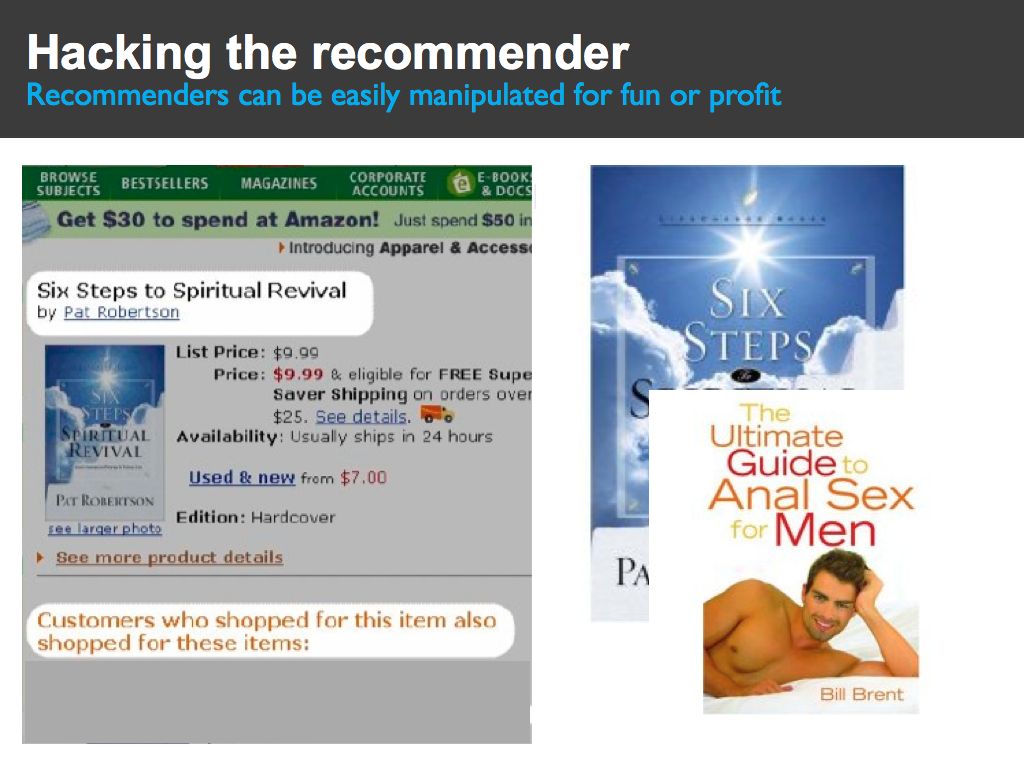
Here’s a recommendation based on a book by Pat Robertson called Six Steps to Spiritual Revival (courtesy of Bamshad Mobasher). This is a book by notorious televangelist Pat Roberston that promises to reveal “Gods’s Awesome Power in your life.” Amazon offers a recommendation suggesting that ‘Customers who shopped for this item also shopped for ‘The Ultimate Guide to Anal Sex for Men’. Clearly this is not a good recommendation. This bad recommendation is the result of a loosely organized group who didn’t like Pat Roberston, so they managed to trick the Amazon recommender into recommending a rather inappropriate book just by visiting the Amazon page for Robertson’s book and then visiting the Amazon page for the sex guide.
This manipulation of the Amazon recommender was easy to spot and can be classified as a prank, but it is not hard to image that an artist or a label may use similar techniques, but in a more subtle fashion to manipulate a recommender to promote their tracks (or to demote the competition). We already live in a world where search engine optimization is an industry. It won’t be long before recommender engine optimization will be an equally profitable (and destructive) industry.
Wrapping up
This is the first part of a two part post. In this post I’ve highlighted some of the issues in traditional music recommendation. Next post is all about how to fix these problems. For an alternative view be sure to visit Anthony Volodkin’s blog where he presents a rather different viewpoint about music recommendation.
boston area music tech meetup
Monday, March 30th I’ll be heading down to the Miracle of Science (a watering hole near MIT) to attend the first official zed equals zee Happy Hour. If you are interested in joining a mix of music techies, music bloggers and music makers for a few hours, to talk about music and technology feel free to join us. RSVP here at zed equals zee.
Put a DONK on it
Posted by Paul in code, fun, Music, The Echo Nest on March 25, 2009
rfwatson has just released a site called donkdj that will ‘remix your favourite song into a bangin’ hard dance anthem‘. You upload a track and donkdj turns it into a dance remix. The results are just brilliant. Here are a few examples:
The site uses The Echo Nest Remix API to do all of the heavy lifting – adding a kick, snap, claps and the infamous donk (I had to look it up … a donk is a a pipe/plank-sound, that is used in Bouncy/scouse house/NRG music). What is doubly cool is rfwatson has open sourced his remix code so you can look under the hood and see how it works and adapt it for your own use. The core of this remix is done in just 200 lines of python code.
donkdj is really cool – the results sound fantastic and the open sourcing of the code makes it easy for anyone else to make their own remixer. I can’t wait to see it when someone makes an automatic Stephen Colbert remixer.
Update: Ben showed me this post that points to this video about Donk:
The full series is available here.
The Loudness War Analyzed
Posted by Paul in code, data, fun, Music, research, The Echo Nest, visualization on March 23, 2009
Recorded music doesn’t sound as good as it used to. Recordings sound muddy, clipped and lack punch. This is due to the ‘loudness war’ that has been taking place in recording studios. To make a track stand out from the rest of the pack, recording engineers have been turning up the volume on recorded music. Louder tracks grab the listener’s attention, and in this crowded music market, attention is important. And thus the loudness war – engineers must turn up the volume on their tracks lest the track sound wimpy when compared to all of the other loud tracks. However, there’s a downside to all this volume. Our music is compressed. The louds are louds and the softs are loud, with little difference. The result is that our music seems strained, there is little emotional range, and listening to loud all the time becomes tedious and tiring.
I’m interested in looking at the loudness for the recordings of a number of artists to see how wide-spread this loudness war really is. To do this I used the Echo Nest remix API and a bit of Python to collect and plot loudness for a set of recordings. I did two experiments. First I looked at the loudness for music by some of my favorite or well known artists. Then I looked at loudness over a large collection of music.
First, lets start with a loudness plot of Dave Brubeck’s Take Five. There’s a loudness range of -33 to about -15 dBs – a range of about 18 dBs.
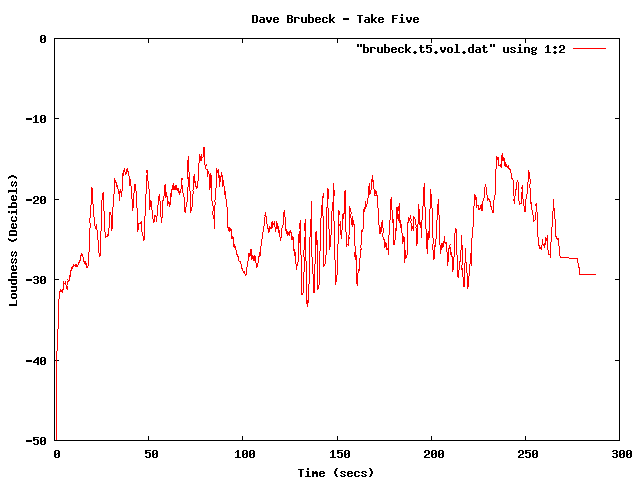
Dave Brubeck - Take Five
Now take a look at a track from the new Metallica album. Here we see a dB range of from about -3 dB to about -6 dB – for a range of about 3 dB. The difference is rather striking. You can see the lack of dynamic range in the plot quite easily.
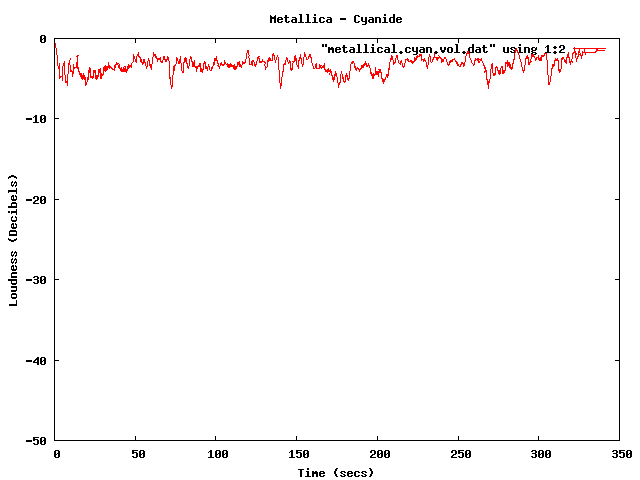
Metallica - Cyanide
Now you can’t really compare Dave Brubeck’s cool jazz with Metallica’s heavy metal – they are two very different kinds of music – so lets look at some others. (One caveat for all of these experiments – I don’t always know the provenance of all of my mp3s – some may be from remasters where the audio engineers may have adjusted the loudness, while some may be the original mix).
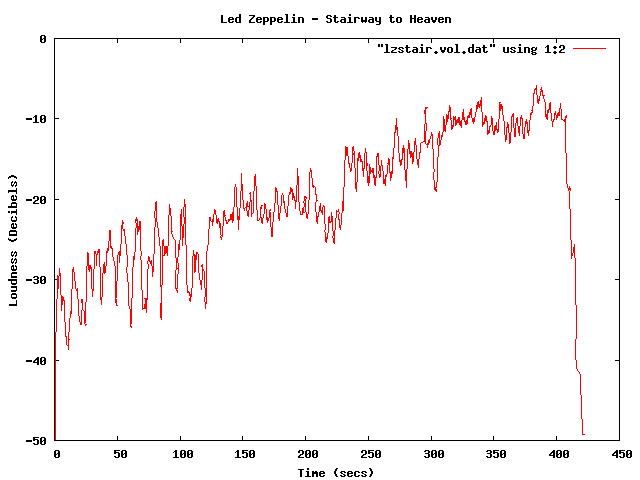
Here’s the venerable Stairway to Heaven – with a dB range of -40 dB to about -5dB for a range of 35 dB. That’s a whole lot of range.
Led Zeppelin - Stairway to Heaven
Compare that to the track ‘supermassive black hole’ – by Muse – with a range of just 4dB. I like Muse, but I find their tracks to get boring quickly – perhaps this is because of the lack of dynamic range robs some of the emotional impact. There’s no emotional arc like you can see in a song like Stairway to Heaven.

Muse - Supermassive Black Hole
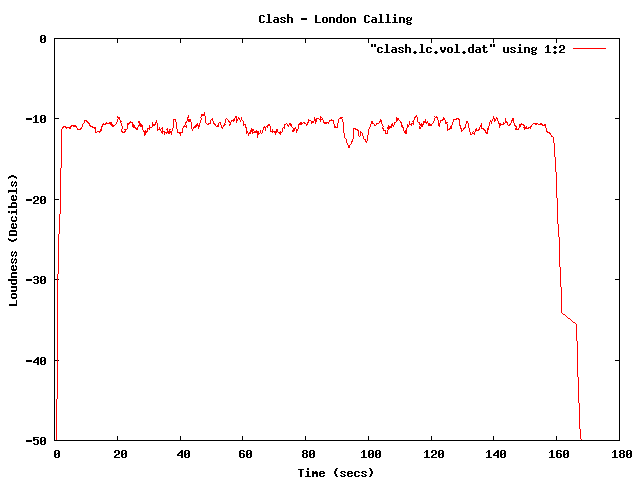
Some more examples – The Clash – London Calling. Not a wide dynamic range – but still not at ear splitting volumes.
Clash - London Calling
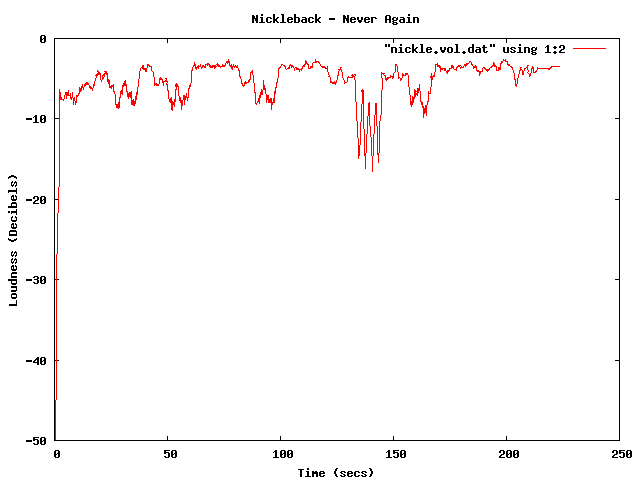
This track by Nickleback is pushing the loudness envelope, but does have a bit of dynamic range.
Nickleback - Never Again
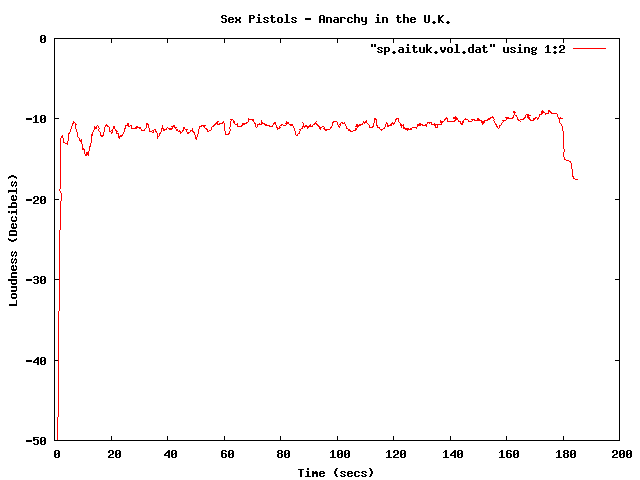
Compare the loudness level to the Sex Pistols. Less volume, and less dynamic range – but that’s how punk is – all one volume.
Sex Pistols - Anarchy in the U.K.
The Stooges – Raw Power is considered to be one of the loudest albums of all time. Indeed, the loudness curve is bursting through the margins of the plot.
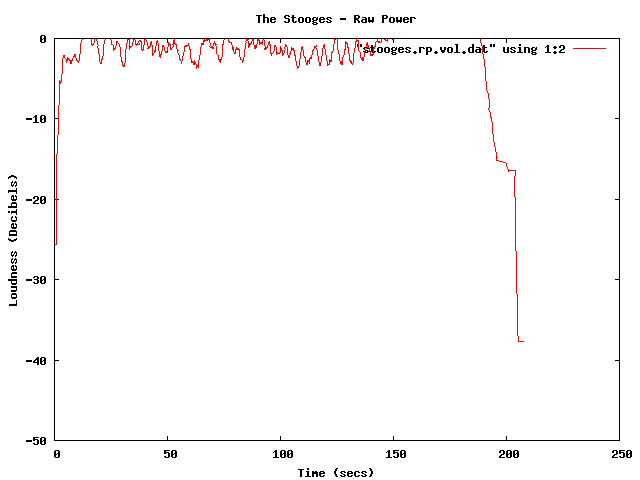
The Stooges - Raw Power
Here in one plot are 4 tracks overlayed – Red is Dave Brubeck, Blue is the Sex Pistols, Green is Nickleback and purple is the Stooges.

Combined plot
There been quite a bit of writing about the loudness war. The wikipedia entry is quite comprehensive, with some excellent plots showing how some recordings have had a loudness makeover when remastered. The Rolling Stone’s article: The Death of High Fidelity gives reactions of musicians and record producers to the loudness war. Producer Butch Vig says “Compression is a necessary evil. The artists I know want to sound competitive. You don’t want your track to sound quieter or wimpier by comparison. We’ve raised the bar and you can’t really step back.”
The loudest artists
I have analyzed the loudness of about 15K tracks from the top 1,000 or so most popular artists. The average loudness across all 15K tracks is about -9.5 dB. The very loudest artists from this set – those with a loudness of -5 dB or greater are:
| Artist | dB |
|---|---|
| Venetian Snares | -1.25 |
| Soulja Boy | -2.38 |
| Slipknot | -2.65 |
| Dimmu Borgir | -2.73 |
| Andrew W.K. | -3.15 |
| Queens of the Stone Age | -3.23 |
| Black Kids | -3.45 |
| Dropkick Murphys | -3.50 |
| All That Remains | -3.56 |
| Disturbed | -3.64 |
| Rise Against | -3.73 |
| Kid Rock | -3.86 |
| Amon Amarth | -3.88 |
| The Offspring | -3.89 |
| Avril Lavigne | -3.93 |
| MGMT | -3.94 |
| Fall Out Boy | -3.97 |
| Dragonforce | -4.02 |
| 30 Seconds To Mars | -4.08 |
| Billy Talent | -4.13 |
| Bad Religion | -4.13 |
| Metallica | -4.14 |
| Avenged Sevenfold | -4.23 |
| The Killers | -4.27 |
| Nightwish | -4.37 |
| Arctic Monkeys | -4.40 |
| Chromeo | -4.42 |
| Green Day | -4.43 |
| Oasis | -4.45 |
| The Strokes | -4.49 |
| System of a Down | -4.51 |
| Blink 182 | -4.52 |
| Bloc Party | -4.53 |
| Katy Perry | -4.76 |
| Barenaked Ladies | -4.76 |
| Breaking Benjamin | -4.80 |
| My Chemical Romance | -4.81 |
| 2Pac | -4.94 |
| Megadeth | -4.97 |
It is interesting to see that Avril Lavigne is louder than Metallica and Katy Perry is louder than Megadeth.
The Quietest Artists
Here are the quietest artists:
| Artist | dB |
|---|---|
| Brian Eno | -17.52 |
| Leonard Cohen | -16.24 |
| Norah Jones | -15.75 |
| Tori Amos | -15.23 |
| Jeff Buckley | -15.21 |
| Neil Young | -14.51 |
| Damien Rice | -14.33 |
| Lou Reed | -14.33 |
| Cat Stevens | -14.22 |
| Bon Iver | -14.14 |
| Enya | -14.13 |
| The Velvet Underground | -14.05 |
| Simon & Garfunkel | -14.03 |
| Pink Floyd | -13.96 |
| Ben Harper | -13.94 |
| Aphex Twin | -13.93 |
| Grateful Dead | -13.85 |
| James Taylor | -13.81 |
| The Very Hush Hush | -13.73 |
| Phish | -13.71 |
| The National | -13.57 |
| Paul Simon | -13.53 |
| Sufjan Stevens | -13.41 |
| Tom Waits | -13.33 |
| Elvis Presley | -13.21 |
| Elliott Smith | -13.06 |
| Celine Dion | -12.97 |
| John Lennon | -12.92 |
| Bright Eyes | -12.92 |
| The Smashing Pumpkins | -12.83 |
| Fleetwood Mac | -12.82 |
| Tool | -12.62 |
| Frank Sinatra | -12.59 |
| A Tribe Called Quest | -12.52 |
| Phil Collins | -12.27 |
| 10,000 Maniacs | -12.04 |
| The Police | -12.02 |
| Bob Dylan | -12.00 |
(note that I’m not including classical artists that tend to dominate the quiet side of the spectrum)
Again, there are caveats with this analysis. Many of the recordings analyzed may be remastered versions that have have had their loudness changed from the original. A proper analysis would be to repeat using recordings where the provenance is well known. There’s an excellent graphic in the wikipedia that shows the effect that remastering has had on 4 releases of a Beatles track.
Loudness as a function of Year
Here’s a plot of the loudness as a function of the year of release of a recording (the provenance caveat applies here too). This shows how loudness has increased over the last 40 years
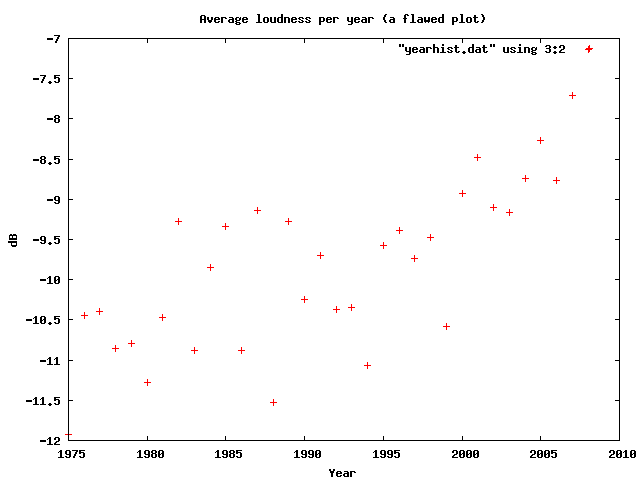
Loudness as a function of year
I suspect that re-releases and re-masterings are affecting the Loudness averages for years before 1995. Another experiment is needed to sort that all out.
Loudness Histogram:
This table shows the histogram of Loudness:
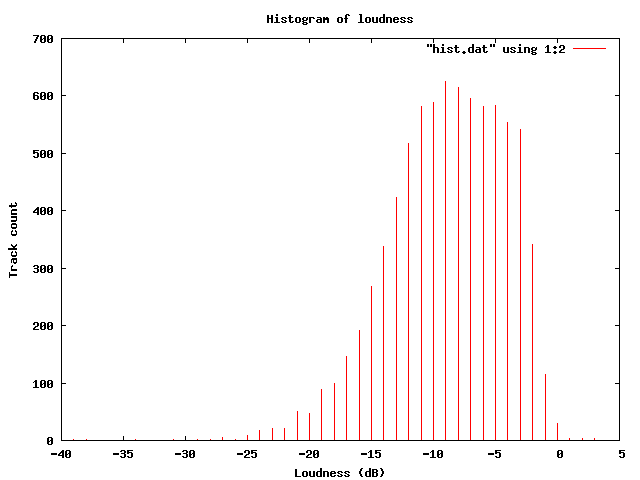
Histogram of loudness
Average Loudness per genre
This table shows the average loudness as a function of genre. No surprise here, Hip Hop and Rock is loud, while Children’s and Classical is soft:
| Genre | dB |
|---|---|
| Hip Hop | -8.38 |
| Rock | -8.50 |
| Latin | -9.08 |
| Electronic | -9.33 |
| Pop | -9.60 |
| Reggae | -9.64 |
| Funk / Soul | -9.83 |
| Blues | -9.86 |
| Jazz | -11.20 |
| Folk, World, & Country | -11.32 |
| Stage & Screen | -14.29 |
| Classical | -16.63 |
| Children’s | -17.03 |
So, why do we care? Why shouldn’t our music be at maximum loudness? This Youtube video makes it clear:
 Luckily, there are enough people that care about this to affect some change. The organization Turn Me Up! is devoted to bringing dynamic range back to music. Turn Me Up! is a non-profit music industry organization working together with a group of highly respected artists and recording professionals to give artists back the choice to release more dynamic records.
If I had a choice between a loud album and a dynamic one, I’d certainly go for the dynamic one.
Update: Andy exhorts me to make code samples available – which, of course, is a no-brainer – so here ya go: volume.py
Help! My iPod thinks I’m emo.
Posted by Paul in Music, recommendation, research, The Echo Nest on March 23, 2009
Here are the slides for the panel “Help! My iPod thinks I’m emo.” that Anthony Volodkin (from The Hype Machine) and I gave at SXSW on music recommendation:
Collaborative Filtering and Diversity
Posted by Paul in recommendation, research, Uncategorized on March 23, 2009
One of the things Anthony and I talked about at our “Help! My iPod thinks I’m emo.” SXSW panel last week is the ‘Harry Potter Effect’ – how popular items in a recommender can lead to (among other things) feedback loops that lead to a situation where the rich get richer. A popular item like that latest Coldplay or Metallica album get purchased often with other albums and therefore end up getting recommended more frequently – and because it gets recommended – it gets purchased more often until it is sitting on the top of the charts. The Harry Potter effect can result in a lowering of the diversity of items consumed.
In his post, Online Monculture and the End of the Niche, Tom Slee over at whimsley has run a simulation that shows how this drop in diversity occurs – and also explains the non-intuitive result that while the use of a recommender can lead to decreased diversity overall, it can lead to increased diversity for an individual. Tom explains this with a metaphor: In the Internet World the customers see further, but they are all looking out from the same tall hilltop. While without a recommender individual customers are standing on different, lower, hilltops. They may not see as far individually, but more of the ground is visible to someone.
As an example of this effect, here’s a recommendation from Amazon that shows how 8% of those that shopped for The Big Penis Book
 went on to buy a Harry Potter book. A recommender that pushes those that are buying books about big penises toward Harry Potter may indeed increase the diversity of those individuals (they may never have considered harry potter before, because of all those penises), but does indeed lower the overall diversity of the community as a whole (everyone is buying harry potter).
It is an interesting post, with charts and graphs and a good comment thread. Worth a read. (Thanks for the tip Jeremy)
Yet another twitter music app – song.ly
song.ly is an app that lets you post songs on twitter. Here’s what you do:
- Go to song.ly
- Search for a song that you want to tweet. The catalog seems pretty big, so you’ll find most popular songs, and many unpopular ones – for instance, I had no problems finding a track by Winter Gloves, an Indie band from Montreal.
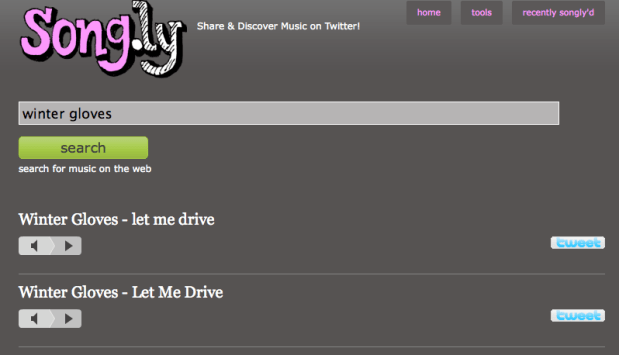
- When you find the song click on ‘tweet’ – you are brought to your twitter page with your status filled in with a tiny url pointing to your song.
- Add whatever words you want to your tweet – and hit update
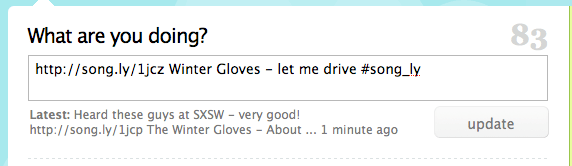
- Anyone can listen to the song by clicking on your tweet

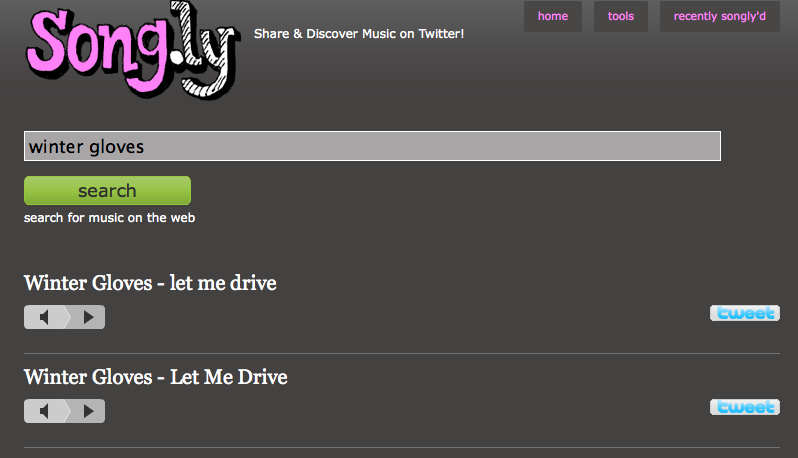
The really neat thing about song.ly is that you don’t have to register or login to do any of this. It just works. There’s also a firefox plugin that lets you share a track with two clicks: right click a music file, select ‘Song.ly: Share this song’ and your are done. Song.ly also has an API that lets you shorten/expand Mp3 urls to the song.ly short form.
I like the low impact model of Song.ly – I don’t have to register or login. If I want to tweet a song I just right click and go. Nice and easy.
Via The Echo Nest
Song Visualizations
Posted by Paul in Music, visualization on March 19, 2009
A couple of people sent me this link today: Song Visualizations with Echo Nest.These are song plots made using the Echo Nest Analyze API. They are quite aesthically pleasing. As the creator, Chris Mueller points out, the plots are similar to those that Anita created with the music box. In addition to the pitch plot, Chris includes a plot of the volume change over the course of the song. (It might be nice to low-pass filter the volume to make it smoother). These are very nice song visualizations. Well done.

Philip Glass String Quartet #5, 2nd Movement
After you check out the Song Visualizations, be sure to check out the rest of the blog. Chris has some great posts about subway maps (little known fact, I have a London Tube map with music artists superimposed on all the stations hanging in my kitchen).

Tube Map of music
(shhh, don’t tell anyone, but a secret spare time project of mine is to recreate this map properly, so that the artist relations reflect reality, and the artist popularity is proportional to a stations popularity … I have all of the artist relation data (thanks to the Echo Nest), I just need the tube connectivity graph and station data).
Overview of the Echo Nest Remix API
Posted by Paul in Uncategorized on March 19, 2009
Adam Lindsay has put together some really nice documentation for the remix API:
- An Overview of the Echo Nest Remix API – This is, as Adam puts it, a “high-level tourist’s guide” to the API. In this guide, Adam walks the reader through the hierarchy of information returned by the API (beats, bars, tatums, sections and segments), and then goes on to describe some of the ways all of this information can be retrieved and manipulated using the remix methods. Adam has put together some rather ingenious classes and patterns that make walking through the information in a song really easy. For instance, to find all of the beats in a song that fall on the first beat of the measure, one could code:
    beats = song.analysis.beats
    ones = beats.that(fall_on_the(1))
I like Adam’s way of thinking about remix: “Remix makes each song its own API: each song offers queries into its own features, and can return any number of transformed versions of itself, all of which are sensitive to the original song’s musical features”
- remix module documentation – Adam has generated some Javadoc style documentation for remix. This lays out all of the classes, building blocks, helper functions and variables that you need to know about to use remix. Until now, it has been necessary to look at code samples or delve into the remix code to see what methods and tools were available. This set of documentation lets you drive the car without having to open the hood to start it. Great stuff.
Thanks much, Adam for providing this documentation. The whole community is benefitting from your work. Awesome!

