Precision Hacking
Posted by Paul in recommendation on April 13, 2009
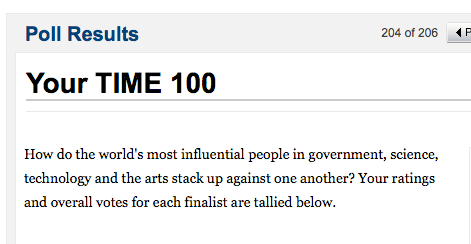
I’ve seen a few examples where recommenders, polls and top-ten lists have been manipulated. Generally a central coordinator sends a message to the hoard that descend on the to-be-hacked site. Ron Paul’s sheeple, or pharyngula‘s followers are prime examples of the type of group that can turn a poll upside down in a matter of minutes.
It has always seemed to me that such coordinating manipulation was a blunt instrument. The commanded horde could push a specific item to the top of a poll faster than a Kansas school board could lose Darwin’s notebook, but the horde lacked any subtlety or finesse. Sure you could promote or demote an individual or issue, but fine tuned manipulation would just be too difficult. Well, I’ve been proved wrong. Take a look at this Time Poll.

Not only has the poll been swamped to promote Moot (the pseudonym of the creator of 4chan, an image board and the birthplace for many internet memes) as the most influential of people, the poll crashers have manipulated the order of all the other nominees so that the first letter of each line spells out ‘marble cake, also the game’ (marble cake is not really a kind of cake btw). This is pretty phenomenal, precision hacking. Precision hacking of an extremely high profile poll run by a top notch media company. Now, imagine if the same energy was put into getting that latest Lordi album to the top of the pop 100 charts. I’m sure it could be done (and I’m already wondering if perhaps it has already been done, and we just don’t know it).
Polls, top-N lists, and recommenders based upon the wisdom of the crowds are susceptible to this type of manipulation. Better defenses are going to be needed otherwise we will all be listening to whatever 4chan wants us to listen to. (via reddit)
Removing accents in artist names
Posted by Paul in code, data, java, Music, The Echo Nest, web services on April 10, 2009
If you write software for music applications, then you understand the difficulties in dealing with matching artist names. There are lots of issues: spelling errors, stop words (‘the beatles’ vs. ‘beatles, the’ vs ‘beatles’), punctuation (is it “Emerson, Lake and Palmer” or “Emerson, Lake & Palmer“), common aliases (ELP, GNR, CSNY, Zep), to name just a few of the issues. One common problem is dealing with international characters. Most Americans don’t know how to type accented characters on their keyboards so when they are looking for Beyoncé they will type ‘beyonce’. If you want your application to find the proper artist for these queries you are going to have deal with these missing accents in the query. One way to do this is to extend the artist name matching to include a check against a version of the artist name where all of the accents have been removed. However, this is not so easy to do – You could certainly build a mapping table of all the possible accented characters, but that is prone to failure. You may neglect some obscure character mapping (like that funny ř in Antonín Dvořák).
Luckily, in Java 1.6 there’s a pretty reliable way to do this. Java 1.6 added a Normalizer class to the java. text package. The Normalize class allows you to apply Unicode Normalization to strings. In particular you can apply Unicode decomposition that will replace any precomposed character into a base character and the combining accent. Once you do this, its a simple string replace to get rid of the accents. Here’s a bit of code to remove accents:
    public static String removeAccents(String text) {
          return Normalizer.normalize(text, Normalizer.Form.NFD)
               .replaceAll("\\p{InCombiningDiacriticalMarks}+", "");
    }
This is nice and straightforward code, and has no effect on strings that have no accents.
Of course ‘removeAccents’ doesn’t solve all of the problems – it certainly won’t help you deal with artist names like ‘KoЯn’ nor will it deal with the wide range of artist name misspellings. If you are trying to deal normalizing aritist names you should read how Columbia researcher Dan Ellis has approached the problem. I suspect that someday, (soon, I hope) there will be a magic music web service that will solve this problem once and for all and you”ll never again have to scratch our head at why you are listening to a song by Peter, Bjork and John, instead of a song by Björk.
The BPM Explorer
Posted by Paul in code, fun, java, processing, startup, tags, The Echo Nest, Uncategorized, visualization, web services on April 9, 2009
Last month I wrote about using the Echo Nest API to analyze tracks to generate plots that you can use to determine whether or not a machine is responsible for setting the beat of a song. I received many requests to analyze tracks by particular artists, far too many for me to do without giving up my day job. To satisfy this pent up demand for click track analysis I’ve written an application called the BPM Explorer that you let you create your own click plots. With this application you can analyze any song in your collection, view its click plot and listen to your music, synchronized with the plot. Here’s what the app looks like:

Check out the application here: The Echo Nest BPM Explorer. It’s written in Processing and deployed with Java Webstart, so it (should) just work.
My primary motiviation for writing this application was to check out the new Echo Nest Java Client to make sure that it was easy to use from Processing. One of my secret plans is to get people in the Processing community interested in using the Echo Nest API. The Processing community is filled with some ultra-creative folks that have have strong artistic, programming and data visualization skills. I’d love to see more song visualizations like this and this that are built using the Echo Nest APIs. Processing is really cool – I was able to write the BPM explorer in just a few hours (it took me longer to remember how to sign jar files for webstart than it did to write the core plotter). Processing strips away all of the boring parts of writing graphic programming (create a frame, lay it out with a gridbag, make it visible, validate, invalidate, repaint, paint arghh!). For processing, you just write a method ‘draw()’ that will be called 30 times a second. I hope I get the chance to write more Processing programs.
Update: I’ve released the BPM Explorer code as open source – as part of the echo-nest-demos project hosted at google-code. You can also browse the read for the BPM Explorer.
New Java Client for the Echo Nest API
Posted by Paul in code, java, The Echo Nest, web services on April 7, 2009
Today we are releasing a Java client library for the Echo Nest developer API. This library gives the Java programmer full access to the Echo Nest developer API. The API includes artist-level methods such as getting artist news, reviews, blogs, audio, video, links, familiarity, hotttnesss, similar artists, and so on. The API also includes access to the renown track analysis API that will allow you to get a detailed musical analysis of any music track. This analysis includes loudness, mode, key, tempo, time signature, detailed beat structure, harmonic content, and timbre information for a track.
To use the API you need to get an Echo Nest developer key (it’s free) from developer.echonest.com. Here are some code samples:
// a quick and dirty audio search engine
   ArtistAPI artistAPI = new ArtistAPI(MY_ECHO_NEST_API_KEY);

   List<Artist> artists = artistAPI.searchArtist("The Decemberists", false);
   for (Artist artist : artists) {
       DocumentList<Audio> audioList = artistAPI.getAudio(artist, 0, 15);
       for (Audio audio : audioList.getDocuments()) {
          System.out.println(audio.toString())
       }
   }
// find similar artists for weezer
   ArtistAPI artistAPI = new ArtistAPI(MY_ECHO_NEST_API_KEY);
   List<Artist> artists = artistAPI.searchArtist("weezer", false);
    for (Artist artist : artists) {
          List<Scored<Artist>> similars = artistAPI.getSimilarArtists(artist, 0, 10);
          for (Scored<Artist> simArtist : similars) {
              System.out.println("   " + simArtist.getItem().getName());
          }
     }

// Find the tempo of a track
    TrackAPI trackAPI = new TrackAPI(MY_ECHO_NEST_API_KEY);
    String id = trackAPI.uploadTrack(new File("/path/to/music/track.mp3"), false);
    AnalysisStatus status = trackAPI.waitForAnalysis(id, 60000);
    if (status == AnalysisStatus.COMPLETE) {
       System.out.println("Tempo in BPM: " + trackAPI.getTempo(id));
    }
There are some nifty bits in the API. The API will cache data for you so frequently requested data (everyone wants the latest news about Cher) will be served up very quickly. The cache can be persisted, and the shelf-life for data in the cache can be set programmatically (the default age is one week). The API will (optionally) schedule requests to ensure that you don’t exceed your call limit. For those that like to look under the hood, you can turn on tracing to see what the method URL calls look like and see what the returned XML looks like.
If you are interested in kicking the tires of the Echo Nest API and you are a Java or Processing programmer, give the API a try.
If you have any questions / comments or problems abut the API post to the Echo Nest Forums.
track upload sample code
Posted by Paul in code, The Echo Nest, web services on April 4, 2009
One of the biggest pain points users have with the Echo Nest developer API is with the track upload method. This method lets you upload a track for analysis (which can be subsequently retrieved by a number of other API method calls such as get_beats, get_key, get_loudness and so on). The track upload, unlike all of the other of The Echo Nest methods requires you to construct a multipart/form-data post request. Since I get a lot of questions about track upload I decided that I needed to actually code my own to get a full understanding of how to do it – so that (1) I could answer detailed questions about the process and (2) point to my code as an example of how to do it. I could have used a library (such as the Jakarta http client library) to do the heavy lifting but I wouldn’t have learned a thing nor would I have some code to point people at. So I wrote some Java code (part of the forthcoming Java Client for the Echo Nest web services) that will do the upload.
You can take a look at this post method in its google-code repository. The tricky bits about the multipart/form-data post is getting the multip-part form boundaries just right. There’s a little dance one has to do with the proper carriage returns and linefeeds, and double-dash prefixes and double-dash suffixes and random boundary strings. Debugging can be a pain in the neck too, because if you get it wrong, typically the only diagnostic one gets is a ‘500 error’ which means something bad happened.
Track upload can also be a pain in the neck because you need to wait 10 or 20 seconds for the track upload to finish and for the track analysis to complete. This time can be quite problematic if you have thousands of tracks to analyze. 20 seconds * one thousand tracks is about 8 hours. No one wants to wait that long to analyze a music collection. However, it is possible to short circuit this analysis. You can skip the upload entirely if we already have performed an analysis on your track of interest. To see if an analysis of a track is already available you can perform a query such as ‘get_duration’ using the MD5 hash of the audio file. If you get a result back then we’ve already done the analysis and you can skip the upload and just use the MD5 hash of your track as the ID for all of your queries. With all of the apps out there using the track analysis API, (for instance, in just a week, donkdj has already analyzed over 30K tracks) our database of pre-cooked analyses is getting quite large – soon I suspect that you won’t need to perform an upload of most tracks (certainly not mainstream tracks). We will already have the data.
Music discovery is a conversation not a dictatorship
Posted by Paul in Music, recommendation, research, tags on April 3, 2009
Two big problems with music recommenders: (1) They can’t tell me why they recommended something beyond the trivial “People who liked X also liked Y” and (2) If I want to interact with a recommender I’m all thumbs – I can usually give a recommendation a thumbs up or thumbs down but there is no way to use steer the recommender (“no more emo please!”). These problems are addressed in The Music Explaura – a web-based music exploration tool just released by Sun Labs.
The Music Explaura lets you explore the world of music artists. If gives you all the context you need – audio, artist bio, videos, photos, discographies to help you decided whether or not a particular artist is interesting. The Explaura also gives you similar-artist style recommendations. For any artist, you are given a list of similar artists for you to explore. The neat thing is, for any recommended artist, you can ask why that artist was recommended and the Explaura will give you an explanation of why that artist was recommended (in the form of an overlapping tag cloud).

The really cool bit (and this is the knock your socks off type of cool) is that you can use an artists tag cloud to steer the recommender. If you like Jimi Hendrix, but want to find artists that are similar but less psychedelic and more blues oriented, you can just grab the ‘psychedelic’ tag with your mouse and shrink it and grab the ‘blues’ tag and make it bigger – you’ll instantly get an updated set of artists that are more like Cream and less like The Doors.

I strongly suggest that you go and play with the Explaura – it lets you take an active role in music exploration. What’s a band that is an emo version of Led Zeppelin? Blue Öyster Cult of course! What’s an artist like Britney Spears but with an indie vibe? Katy Perry! How about a band like The Beatles but recording in this decade? Try The Coral. A band like Metallica but with a female vocalists? Try Kittie. Was there anything like emo in the 60s? Try Leonard Cohen. The interactive nature of the Explaura makes it quite addicting. I can get lost for hours exploring some previously unknown corner of the music world.
Steve (the search guy) has a great post describing the Music Explaura in detail. One thing he doesn’t describe is the backend system architecture. Behind the Music Explaura is a distributed data store with item search and and similarity capabilities built into the core. This makes scaling the system up to millions of items with requests from thousands of simultaneous users possible. It really is a nice system. (Full disclosure here: I spent the last several years working on this project – so naturally I think it is pretty cool).
The Music Explaura gives us a hint of what music discovery will be like in the future. Instead of a world where a music vendor gives you a static list of recommended artists we’ll live in a world where the recommender can tell you why it is recommending an item, and you can respond by steering the recommendations away from things you don’t like and toward the things that you do like. Music discovery will no longer be a dictatorship, it will be a two-way conversation.
Magnatagatune – a new research data set for MIR
Posted by Paul in data, Music, music information retrieval, research, tags, The Echo Nest on April 1, 2009

Edith Law (of TagATune fame) and Olivier Gillet have put together one of the most complete MIR research datasets since uspop2002. The data (with the best name ever) is called magnatagatune. It contains:
- Human annotations collected by Edith Law’s TagATune game.
- The corresponding sound clips from magnatune.com, encoded in 16 kHz, 32kbps, mono mp3. (generously contributed by John Buckman, the founder of every MIR researcher’s favorite label Magnatune)
- A detailed analysis from The Echo Nest of the track’s structure and musical content, including rhythm, pitch and timbre.
- All the source code for generating the dataset distribution
Some detailed stats of the data calculated by Olivier are:
- clips: 25863
- source mp3: 5405
- albums: 446
- artists: 230
- unique tags: 188
- similarity triples: 533
- votes for the similarity judgments: 7650
This dataset is one stop shopping for all sorts of MIR related tasks including:
- Artist Identification
- Genre classification
- Mood Classification
- Instrument identification
- Music Similarity
- Autotagging
- Automatic playlist generation
As part of the dataset The Echo Nest is providing a detailed analysis of each of the 25,000+ clips. This analysis includes a description of all musical events, structures and global attributes, such as key, loudness, time signature, tempo, beats, sections, and harmony. This is the same information that is provided by our track level API that is described here: developer.echonest.com.
Note that Olivier and Edith mention me by name in their release announcement, but really I was just the go between. Tristan (one of the co-founders of The Echo Nest) did the analysis and The Echo Nest compute infrastructure got it done fast (our analysis of the 25,000 tracks took much less time than it did to download the audio).
I expect to see this dataset become one of the oft-cited datasets of MIR researchers.
Here’s the official announcement:
Edith Law, John Buckman, Paul Lamere and myself are proud to announce the release of the Magnatagatune dataset.
This dataset consists of ~25000 29s long music clips, each of them annotated with a combination of 188 tags. The annotations have been collected through Edith’s “TagATune” game (http://www.gwap.com/gwap/gamesPreview/tagatune/). The clips are excerpts of songs published by Magnatune.com – and John from Magnatune has approved the release of the audio clips for research purposes. For those of you who are not happy with the quality of the clips (mono, 16 kHz, 32kbps), we also provide scripts to fetch the mp3s and cut them to recreate the collection. Wait… there’s more! Paul Lamere from The Echo Nest has provided, for each of these songs, an “analysis” XML file containing timbre, rhythm and harmonic-content related features.
The dataset also contains a smaller set of annotations for music similarity: given a triple of songs (A, B, C), how many players have flagged the song A, B or C as most different from the others.
Everything is distributed freely under a Creative Commons Attribution – Noncommercial-Share Alike 3.0 license ; and is available here: http://tagatune.org/Datasets.html
This dataset is ever-growing, as more users play TagATune, more annotations will be collected, and new snapshots of the data will be released in the future. A new version of TagATune will indeed be up by next Monday (April 6). To make this dataset grow even faster, please go to http://www.gwap.com/gwap/gamesPreview/tagatune/ next Monday and start playing.
Enjoy!
The Magnatagatune team
Killer music technology
Posted by Paul in fun, Music, recommendation, The Echo Nest, web services on April 1, 2009
We’ve been head down here at the Echo Nest putting the finishing touches on what I think is a game changer for music discovery. For years, music recommendation companies have been trying to get collaborative filtering technologies to work. These CF systems work pretty well, but sooner or later, you’ll get a bad recommendation. There are just too many ways for a CF recommender to fail. Here at the ‘nest we’ve decided to take a completely different approach. Instead of recommending music based on the wisdom of the crowds or based upon what your friends are listening to, we are going to recommend music just based on whether or not the music is good. This is such an obvious idea – recommend music that is good, and don’t recommend music that is bad – that it is a puzzle as to why this approach hasn’t been taken before. Of course deciding which music is good and which music is bad can be problematic. But the scientists here at The Echo Nest have spent years building machine learning technologies so that we can essentially reproduce the thought process of a Pitchfork music critic. Think of this technology as Pitchfork-in-a-box.
Our implementation is quite simple. We’ve added a single API method ‘get_goodness’ to our set of developer offerings. You give this method an Echo Nest artist ID (that you can obtain via an artist search call) and get_goodness returns a number between zero and one that indicates how good or bad the artist is. Here’s an example call for radiohead:
http://developer.echonest.com/api/get_goodness?api_key=EHY4JJEGIOFA1RCJP&id=music://id.echonest.com/~/AR/ARH6W4X1187B99274F&version=3

The results are:

<response version="3">
   <status>
     <code>0</code>
      <message>Success</message>
   </status>
   <query>
    <parameter name="api_key">EHY4JJEGIOFA1RCJP</parameter>
    <parameter name="id">music://id.echonest.com/~/AR/ARH6W4X1187B99274F</parameter>
  </query>
  <artist>
    <name>Radiohead</name>
    <id>music://id.echonest.com/~/AR/ARH6W4X1187B99274F</id>
    <goodness>0.47</goodness>
    <instant_critic>More enjoyable than Kanye bitching.</instant_critic>
  </artist>
</response>
We also include in the response, a text string that indicates how you should feel about this artist. This is just the tip of the iceberg for our forthcoming automatic music review technology that will generate blog entries, amazon reviews, wikipedia descriptions and press releases automatically, just based upon the audio.
We’ve made a web demo of this technology that will allow you try out the goodness API. Check it out at: demo.echonest.com.
We’ve had lots of late nights in the last few weeks, but now that this baby is launched, time to celebrate (briefly) and then on to the next killer music tech!
Something is fishy with this recommender
Posted by Paul in Music, recommendation, research, The Echo Nest on April 1, 2009
 In my rather long winded post on the problems with current music recommenders, I pointed out the Harry Potter Effect. Collaborative Filtering recommenders tend to recommend things that are popular which makes those items even more popular, creating a feedback loop – (or as the podcomplex calls it – the similarity vortex) that results in certain items becoming extremely popular at the expense of overall diversity. (For an interesting demonstration of this effect, see ‘Online monoculture and the end of the niche‘).
Oscar sent me an example of this effect. At the popular British online music store HMV, a rather large fraction of artists recommendations point to the Kings of Leon. Some examples:
- PJ Harvey
- U2
- The Beatles
- Franz Ferdinand
- Amy Winehouse
- The Rolling Stones
- Fratellis
- Last Shadow of Puppets
- Fleet Foxes
- Roxy Music
- Green Day
- Newton Faulkner
- Paul Weller
- Guns’N’Roses
- Quireboys
- Nickelback
- Bon Iver
- Emerson, Lake and Palmer
- Miley Cyrus
- Nirvana
- Led Zeppelin
Oscar points out that even for albums that haven’t been released, HMV will tell you that ‘customers that bought the new unreleased album by Depeche Mode also bought the Kings of Leon’. Of course it is no surprise that if you look at the HMV bestsellers, The Kings Of Leon is way up there at position #3.
At first blush, this does indeed look like a classic example of the Harry Potter Effect, but I’m a bit suspicious that what we are seeing is not an example of a feedback loop, but is an example of shilling – using the recommender to explicitly promote a particular item. It may be that HMV has decided to hardwire a slot in their ‘customers who bought this also bought’ section to point to an item that they are trying to promote – perhaps due to a sweetheart deal with a music label. I don’t have any hard evidence of this, but when you look at the wide variety of artists that point to Kings of Leon – from Miley Cyrus, to Led Zeppelin and Nirvana it is hard to imagine that this is a result of natural collaborative filtering. Music promotion that disguises itself as music recommendation has been around for about as long as there have been people looking for new music. Payola schemes have dogged radio for decades. It is not hard to believe that this type of dishonest marketing will find its way into recommender systems. We’ve already seen the rise of ‘search engine optimization’ companies that will get your web site on the first page of google search results – it won’t be long before we see a recommender engine optimizer industry that will promote your items by manipulating recommenders. It may already be happening now, and we just don’t know about it. The next time you get a recommendation for The Kings of Leon because you like The Rolling Stones, ask yourself if this is a real and honest recommendation or are they just trying to sell you something.
Using Visualizations for Music Discovery
Posted by Paul in music information retrieval, research, tags, visualization on March 28, 2009
As Ben pointed out last week, the ISMIR site has posted the tutorial schedule for ISMIR 2009. I’m happy to see that the tutorial that Justin Donaldson and I proposed was accepted. Our tutorial is called Using Visualizations for Music Discovery. Here’s the abstract:
As the world of online music grows, tools for helping people find new and interesting music in these extremely large collections become increasingly important. In this tutorial we look at one such tool that can be used to help people explore large music collections: data visualization. We survey the state-of-the-art in visualization for music discovery in commercial and research systems. Using numerous examples, we explore different algorithms and techniques that can be used to visualize large and complex music spaces, focusing on the advantages and the disadvantages of the various techniques. We investigate user factors that affect the usefulness of a visualization and we suggest possible areas of exploration for future research.
I’m excited about this tutorial – mainly because I get to work with Justin on it. He’s a really smart guy who really knows the state-of-the-art in visualizations. I’ll just be tagging along for the ride.
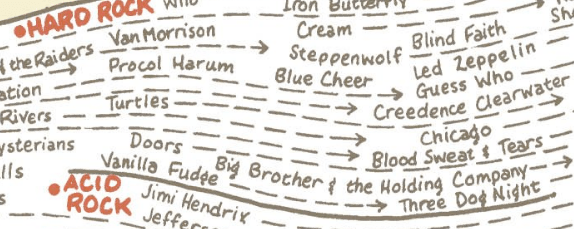
Detail from Genealogy of Pop/Rock Music
We are in the survey phase of talk preparation now. We’ve been gathing info on various types of visualizations and tagging them with the delicious tag MusicVizIsmir2009. Feel free to tag along (pun intended) with us and tag items that you encounter that you feel may be particularly interesting, unique or salient.
 Music Machinery
