Music Playlist quiz
Posted by Paul in fun, Music, playlist, The Echo Nest on October 9, 2009
Here’a a quiz for you music junkies. For the following playlist, pick a good next song for the playlist. Hint, there’s some aspect of each of the songs that is similar.
- Made to measure – Umphrey’s McGee
- Diablo Rojo – Rodrigo Y Gabriella
- Livin’ Thing – Electric Light Orchestra
- Two Step – Dave Matthew’s Band
- Vortex – Burst
- Almost Honest – Megadeth
No help from Echo Nesters please
There must be 85 ways to visualize your music
Posted by Paul in Music, research, visualization on October 2, 2009

Justin and I have been working hard, preparing our tutorial: Using Visualizations for Music Discovery being presented at ISMIR 2009 in Kobe Japan. Here’s a teaser image showing 85 of the visualizations that we’ll be talking about during the tutorial. If you’ve created a music visualization that is useful for music exploration and discovery, and you don’t see a thumbnail of it here, let me know in the next couple of days.
Genre of the week: whalecore
Saw this post by Nackster on the Last.fm brutal death metal forum

whalecore! Oh Yeah! Here is it:
And don’t forget this whalecore classic – really, it started the whole genre:
Top whalecore bands are: Gojira Mastodon
Ahab
Giant Squid
Yep, there’s a Wikipedia page on whalecore. Listen to Whalecore at Last.fm
Radio Waves
Posted by Paul in data, Music, visualization on October 1, 2009

Radio Labs now has a new visualisation called Radio Waves that shows the kind of music that is played on the various BBC stations. The visualization shows info about what genres, artists, year of release, which DJs play which music. There’s lots of info presented in an interesting way. Read all the details at the Radio Labs blog and then check it out: Radio Waves
SoundEchoCloudNest
Posted by Paul in code, data, events, Music, The Echo Nest, web services on September 28, 2009
At the recent Berlin Music Hackday, developer Hannes Tydén developed a mashup between SoundCloud and The Echo Nest, dubbed SoundCloudEchoNest. The program uses the SoundCloud and Echo Nest APIs to automatically annotate your SoundCloud tracks with information such as when the track fades in and fades out, the key, the mode, the overall loudness, time signature and the tempo. Also each Echo Nest section is marked. Here’s an example:
This track is annotated as follows:
- echonest:start_of_fade_out=182.34
- echonest:mode=min
- echonest:loudness=-5.521
- echonest:end_of_fade_in=0.0
- echonest:time_signature=1
- echonest:tempo=96.72
- echonest:key=F#
Additionally, 9 section boundaries are annotated.
The user interface to SoundEchoCloudNest is refreshly simple, no GUIs for Hannes:

Hannes has open sourced his code on github, so if you are a Ruby programmer and want to play around with SoundCloud and/or the Echo Nest, check out the code.
Machine tagging of content is becoming more viable. Photos on Flicker can be automatically tagged with information about the camera and exposure settings, geolocation, time of day and so on. Now with APIs like SoundCloud and the Echo Nest, I think we’ll start to see similar machine tagging of music, where basic info such as tempo, key, mode, loudness can be automatically attached to the audio. This will open the doors for all sorts of tools to help us better organize our music.
Machine Learning protest at the G20
Researchers at CMU’s machine learning department had a rally at the G20 to make sure that the world understood the issues and problems that data miners face daily. See the photos. Read more at Mary McGlohon’s Dataphile blog. Photos by Arthur Gretton

Protesters in the 'free speech zone' - Click for slide show

John Oliver joins the protest
Some more suggestions for signs:
- End G20’s unsupervised learning
- Don’t be Naive
- Fix the hyperplane before we go non-linear
- You can’t predict my label
- G20 is nothing but a hyperbolic tangent
- This is our manifold destiny!
- Bring back arrested development!
- Tea Baggers and Boosters unite!
Draw a picture of your musical taste

Tristan F's Musical taste
Tristan F from the BBC posted this hand drawing of his musical taste to Flickr. As he says in the photo comments: I had to stop at some point so it’s not comprehensive. But it’s all about connections.
I find these types of drawings to yield really interesting insights into the listener and to music in general. For instance Tristan has a line connecting Sufjan Stevens to Bill Frisell. I’m still pondering that connection. As I prepare for my upcoming ISMIR tutorial on Using Visualizations for Discovering Music, I’d like to collect a few more personal visualizations of music taste. If you feel so inclined , draw a picture that represents your music taste, post it to Flickr and tag it with ‘MyMusicTaste’. I’ll post a follow up … and particularly interesting ones will appear in the tutorial.
Herd it on Facebook
Posted by Paul in data, Music, music information retrieval, research on September 25, 2009
 UCSD Researcher Gert Lanckriet announced today that “Herd It” – the game-with-a-purpose for collecting audio annotations has been officially launched on Facebook. Following in the footsteps of other gwaps such as Major Miner, Tag-a-tune and the Listen Game.

On the music-ir mailing list Gert explains ‘Herd it’: “The scientific goal of this experiment is to investigate whether a human computation game integrated with the Facebook social network will allow the collection of high quality tags for audio clips. The quality of the tags will be tested by using them to train an automatic music tagging system (based on statistical models). Its predictive accuracy will be compared to a system trained on high quality tags collected through controlled human surveys (such as, e.g., the CAL500 data set). The central question we want to answer is whether the “game tags” can train an auto-tagging system as (or more) accurately than “survey tags” and, if yes, under what conditions (amount of tags needed, etc.). The results will be reported once enough data has been collected.”
I’ve played a few rounds of the game and enjoyed myself. I recognized all of the music that they played (it seemed to be drawn from top 100 artists like Nirvana, Led Zeppelin, Maria Carey and John Lennon). The timed rounds made the game move quickly. Overall, the game was fun. But I did miss the feeling of close collaboration that I would get from some other Gwaps where I would have to try to guess how my partner would try to describe a song. Despite this, I found the games to be fun and I could easily see spending a few hours trying to get a top score. The team at UCSD clearly has put lots of time into making the games highly interactive and fun. Animations, sound and transparent game play all add to the gaming experience. Once glitch, even though I was logged into Facebook, the Herd It game didn’t seem to know who I was, it just called me ‘Herd It’. So my awesome highscore is anonymous.
Here are some screen shots from the game. For this round, I had to chose the most prominent sound (this was for the song ‘Heart of Gold’), I chose slide guitar, but most people chose acoustic guitar (what do they know!).

For this round, I had to chose the genre for a song. easy enough.

For this round I had to position a song on a Thayer mood model scale.

Here’s the game kick off screen … as you can see, I’m “Herd it” and not Paul

I hope the Herd It game attracts lots of attention. It could be a great source of music metadata.
Tour of the Music Hackday Boston site
Posted by Paul in code, events, fun, Music, The Echo Nest, web services on September 24, 2009
The Boston Music Hackday is being held at Microsoft’s New England Research and Development Center (aka The NERD). Jon, Elissa and I took a tour of the space on Tuesday, and I must say I was very impressed. The place is tailor made for hacking. There’s open space big enough for 300 hackers to gather to show their demos, there’s plenty of informal space for hacking, there are small and large conference rooms for break out sessions, there’s wireless, there are plenty of power outlets, kitchen facilities, soda coolers and great views of Boston. This space is being donated by Microsoft – and I must say that my opinion of Microsoft has gone up substantially after I’ve seen how generous they’ve been with the space. Plus, the space is simply beautiful.

Informal hacking space at the NERD

More hacking space at the NERD
This hackday is shaping up to be something special. I’m pretty sure that we’ll hit our 300 person capacity, so register soon if you want to guarantee a spot.

Hacking space at the NERD

Open space at the NERD
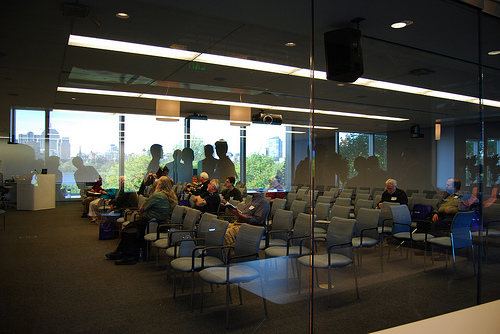
Meeting space at the NERD
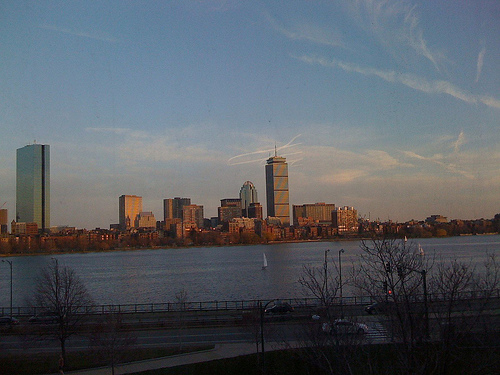
Boston view from the NERD
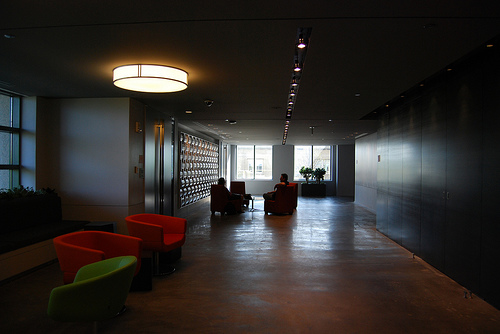
More hacking and chilling for the Hackday
Hey Lily – It’s not alright
Lily Allen has a new blog – “It’s not alright” where she writes about the evils of pirating music, but apparently she didn’t get the memo about the evils of plagiarizing other peoples writing. Her post about 50 cent is taken word for word from a techdirt article. Irony overflow. (via reddit + Torrent Freak)

