Archive for category fun
The Echo Nest remix 1.0 is released!
Posted by Paul in code, fun, Music, remix, The Echo Nest, web services on May 12, 2009
Version 1.0 of the Echo Nest remix has been released. Echo Nest Remix is an open source SDK for Python that lets you write programs that manipulate music. For example, here’s a python function that will take all the beats of a song, and reverse their order:
def reverse(inputFilename, outputFilename):
    audioFile = audio.LocalAudioFile(inputFilename)
    chunks = audioFile.analysis.beats
    chunks.reverse()
    reversedAudio = audio.getpieces(audioFile, chunks)
    reversedAudio.encode(outputFilename)
When you apply this to a song by The Beatles you get something that sounds like this:
which is surprisingly recognizable, musical – and yet different from the original.
Quite a few web apps have been written that use remix. One of my favorites is DonkDJ, which will ‘put a donk‘ on any song. Here’s an example: Hung Up by Madonna (with a Donk on it):
This is my jam lets you create mini-mixes to share with people.
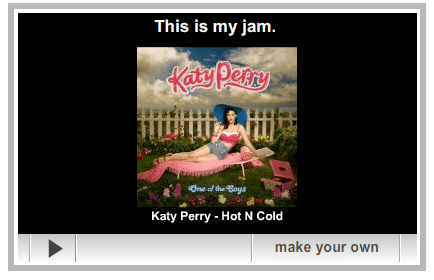
And where would the web be without the ability to add more cowbell to any song.
There’s lots of good documentation already for remix. Adam Lindsay has created a most excellent overview and tutorial for remix. There’s API documentation and there’s documentation for the underlying Echo Nest web services that perform the audio analysis. And of course, the source is available too.
So, if you are looking for that fun summer coding project, or if you need an excuse to learn Python, or perhaps you are a budding computational remixologist download remix, grab an API key from the Echo Nest and start writing some remix code.
Here’s one more example of the fun stuff you can do with remix. Guess the song, and guess the manipulation:
Echo Nest hero
When I’m not blogging about hacking online polls – I spend my time at The Echo Nest where I get to do some really cool things with music. Over the weekend, I wrote a program that uses the Echo Nest API to extract musical features to build the core of a guitar-hero like game. Even though this is a quick and dirty program, it performs quite well. Here ‘s a video of it in action.
Hopefully I’ll get a few programming cycles over the next couple of weeks to turn this into a real game where you can play Echo Nest hero with your own tracks on your computer. Of course, I’ll post all the code too so you can follow along and build your own computer game synchronized to music.
moot wins, Time Inc. loses
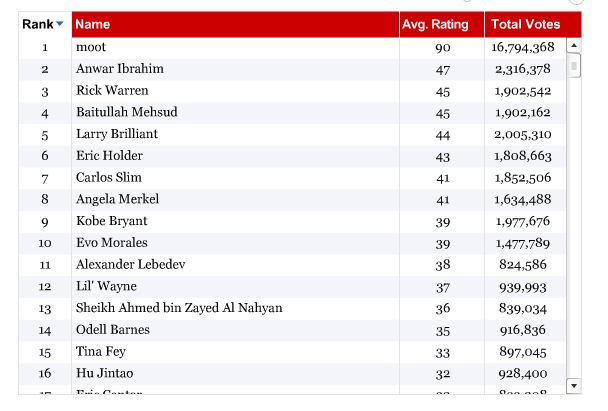
 This morning Time.com published the final result for their annual TIME 100 Poll. Time reports that the new owner of the title ‘Worlds’s most influential person, is moot’. What TIME doesn’t say is that their poll was so totally manipulated that the results of the poll are not an indication of who is the most influential, but instead they stand as a monument to Time’s incompetence.

Looking at the poll results we see clear evidence of the hack. The first letters of the top 21 finalists in the poll spell out ‘Marblecake, also the game’. Evidence of precision hackery for anyone to see. And yet, Time says they rebuffed all attempts to hack the poll. Quoting from the time article: “TIME.com’s technical team did detect and extinguish several attempts to hack the vote”. Which leads me to wonder whether Time.com is being dishonest or is just plain incompetent. Considering Hanlon’s razor , I have to go with incompetence. (And if you have any doubt about Time’s incompetence, take a close look at the Poll. Notice that Oprah Winfrey and Ratan Tata have the exact same number of votes. That’s because they both shared the same ID in the poll. A vote for either one was a vote for the other. Same goes for Michael Bloomberg and Gustavo Dudamel. If you vote for one, you vote for the other.)
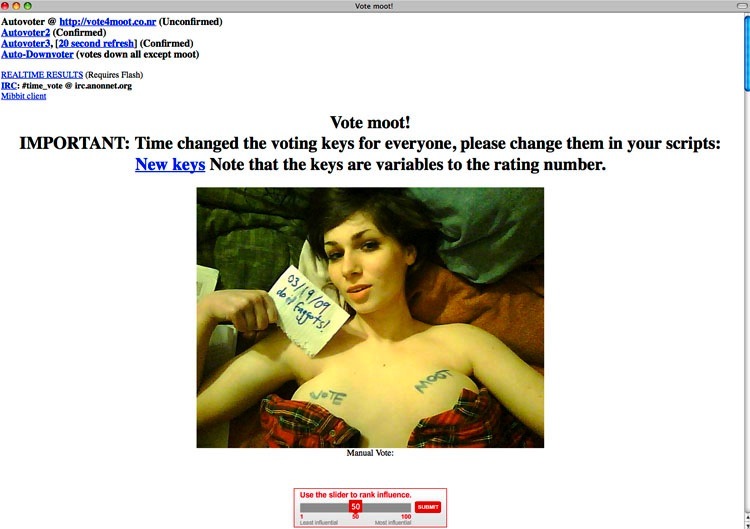
How did the hack happen? I’ve already described in great detail the steps that the loose collective known as ‘Anonymous’ took to hack the poll. This group (that gathered on an IRC channel at anonnet.org) probed for weaknesses in the poll protocols and wrote autovoters to stuff the ballot box with votes that would put the candidates in the proper order to spell out the Message, adapting as necessary whenever Time adjusted its protocol in a meager attempt to keep the hackers out. But two weeks ago, Time got serious about poll security. They modified the poll so that you needed to prove that you were human (via a captcha) in order to vote.

This instantly shut down all of the autovoters. Anonymous was offline – no longer able to submit thousands of votes per minute. And what’s worse, when the autovoters were shutdown, the Message ‘Marblecake, also the game’ soon decayed into a meaningless “mablre caelakosteghamm”. It seemed that Time.com had won – the Message would not survive the next two weeks of voting. But Anonymous didn’t give up, they considered it a challenge to restore the Message. Here’s how they did it.
Update -4/29 Professor Luis von Ahn, the project lead for reCAPTCHA, sent me a very polite email suggesting that I change a few words here to make it clear to a casual reader that reCAPTCHA was not hacked. I agree that the original post could be easily misinterpreted by a casual reader, so I’ve changed a couple of words here and there to make it absolutely clear that reCAPTCHA was not compromised for the Time Poll.
First attempt – trying (and failing) to crack reCAPTCHA
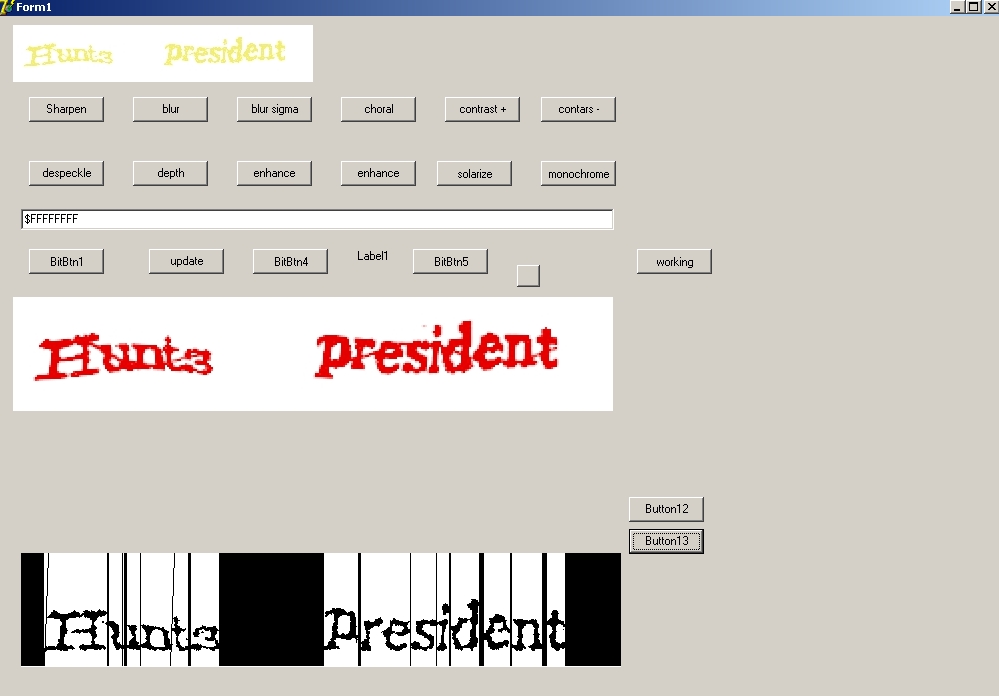
The first thing Anonymous tried to do was tried to break reCAPTCHA, the captcha technology used by Time.com. They built a program that would analyze the images, break the words into characters and apply OCR to the images in an attempt to automate the captcha process. However, unsurprisingly, it proved to be too difficult of a task – certainly that was a nut that would take more than a week to crack. So after a few days, they abandoned this approach.
Second Attempt: trying (and failing) to hack reCAPTCHA – ‘The Penis Flood’
The next tactic used was to see if they could find a flaw in the reCAPTCHA implementation. One thing they discovered about reCAPTCHA was that it always presents two words to a user for decoding – one word is a control word known by the reCAPTCHA system, while the other is an unknown word (reCAPTCHA uses the humans to help correct OCR errors). Wikipedia describes the process: “Scanned text is subjected to analysis by two different optical character recognition programs; in cases where the programs disagree, the questionable word is converted into a CAPTCHA. The word is displayed along with a control word already known and is labeled by the human. Those words that are consistently given a single label by human judges are recycled as control words”.  What Anonymous realized was that if they always labeled the unknown scanned text with the same word – and if they did this thousands and thousands of times eventually a large percentage of the unknown words would be mislabeled with their word. All they had to do was look at the two words in the captcha, enter the proper label for the ‘easy’ one (presumably that would be the one that the two optical scanners would agree upon) and enter the word “penis” for the hard one. If they did this often enough, then soon a significant percentage of the images would be labeled as ‘penis’ and the ability to autovote would be restored (one side effect, that was not lost on Anonymous, was the notion that for years to come there would be a number of digital books with the word ‘penis’ randomly inserted throughout the text. Update: I asked Ben Maurer, chief engineer of reCAPTCHA about this ‘penis flood‘ attack, Ben says that they’ve anticipated this type of attack and they have numerous protections that will keep the penises from penetrating the reCAPTCHA barrier. Update – 4/29 – Luis von Ahn, the project lead of reCAPTCHA goes on to say ” about the “penis attack”. We serve over 400 million CAPTCHAs per week, so submitting 200k CAPTCHAS with the word penis doesn’t even come close to poisoning our database — we serve each word to multiple random users, and we require them to be correct on the other word, so to get any traction with this attack, they would have had to submit at least 100 times more CAPTCHAs. And even if they did this, we have many other measures against it. That attack simply doesn’t work.”
Third Attempt: Optimizing reCAPTCHA entry
As appealing as the notion of sprinkling the word ‘penis’ into texts, the Anonymous team knew that the clock was ticking, and if they were going to restore the Message they didn’t have time to wait for the autovoters to come back online – they were going to have to vote manually, many, many times. And so they needed to be able to enter captcha’s as fast as they could. They developed a set of guidelines that allowed them to quickly decide which reCAPTCHA words they could skip. For example:
You will be given 2 words: 1 real, 1 fake.
For [REAL FAKE] or [FAKE REAL], you can just type in REAL and it should be accepted.
If it’s [LOOKSREAL LOOKSREAL] or [LOOKSFAKE LOOKSFAKE], it’s usually just quicker to just type in both words. Don’t waste precious time deciding which one of them is real.
Use both the appearance and the type of word to identify a fake
word. Don’t rely on just one of them.
The whole ruleset is here: fake captcha
By understanding how reCAPTCHA worked – the team was able to double their productivity (since they usually only had to enter one word instead of two). To further optimize their voting they created a poll front-end that allowed you to enter votes quickly while giving you an update of the poll status (and since it is a 4chan kind of crowd, they also provided the option to stream some porn just to keep you company while you are subverting one of the largest media companies in the world.

They found that with this version of the manual loader, the thing that was taking the most time was loading the captcha images, so they made a bare bones version that loaded 3 captchas at a time, in the background eliminating this bottleneck, and doubling their manual voting speed once more (and showing them vote per minute stats).

Update – Just to be perfectly clear, anon didn’t hack reCAPTCHA. It did exactly what it was supposed to do. It shut down the auto voters instantly and effectively. The only option left after Time added reCAPTCHA to the poll was a brute force attack. Ben Maurer, (chief engineer on reCAPTCHA) comments on the hack: “reCAPTCHA put up a hard to break barrier that forced the attackers to spend hundreds of hours to obtain a relatively small number of votes. reCAPTCHA prevented numerous would-be attackers from engaging in an attack. In any high-profile system, it’s important to implement reCAPTCHA as part of a larger defense-in-depth strategy”. As Dr. von Ahn points out “had Time used reCAPTCHA from the beginning, this would have never happened — anon submitted *tens of millions* of votes before Time added reCAPTCHA, but they were only able to submit ~200k afterwards. And to do this, they had to resort to typing the CAPTCHAs by hand!” One thing that Time inc. did that made it much easier for the anonymous hack was to allow leave the door open for cross-site request forgeries which allowed anon to create a streamlined poll that never had to fetch data from Time.com.
Brute Force
With the streamlined manual voting process, a single, motivated voter could cast 30 votes per minute (perhaps only 20 VPM if they were watching porn). But some calculations showed that they needed about 200K votes to cast to get everyone in their proper position. If they were going to succeed they really had to organize their votes. They churned the numbers and came up with this plan:
TOTAL VOTES NEEDED 191,209
Alexander Levedev (up to 37.5) 6,541 votes
Rick Warren (more than 1,902,130) 7,255 votes
Kobe Bryant (up to 39.50) 109,174 votes
Sheikh Ahmed bin Zayed Al Nahyan (up to 35.50) 5,000 votes
Hu Jintao (up to 31.50) 19,836 votes
Elizabeth Warren (up to 27.50) 43,403 votes
With a sprinkling of help from folks on /b/, the core team of about a dozen got down to manual voting. (To get help from /b/ they put together info on how to streamline the captcha process, how to configure the browser to mask referrals, deal with proxies and provided some other (perhaps not-safe-for work incentives). Some of the most hardcore voters (I call them ‘devoters’) spent 40+ hours voting. At their peak, they were casting about 200 votes per minute (compared to the many, many thousands per minute that they could cast via autovoter before Time added the captcha).
With 200k votes to cast, they knew it would be close, and they didn’t know exactly when the polls were closing. In the final days the crew was getting demotivated. But one boost to their productivity and morale occurred when they sussed out how Time actually did the final ordering (they round the average rating to the nearest rating, and then use the total number of votes to break a tie). With this little nugget of information, they were able to redistribute how they voted, eliminating the need for about 30K of the 200K votes. They discovered a few more quirks in how Time.com ranked the candidates which allowed them to shave even more votes off the required total for a total savings of 46k votes. With these vote savings, the goal was close at hand, with their boosted morale they were able to push across the finish line.
The End Game
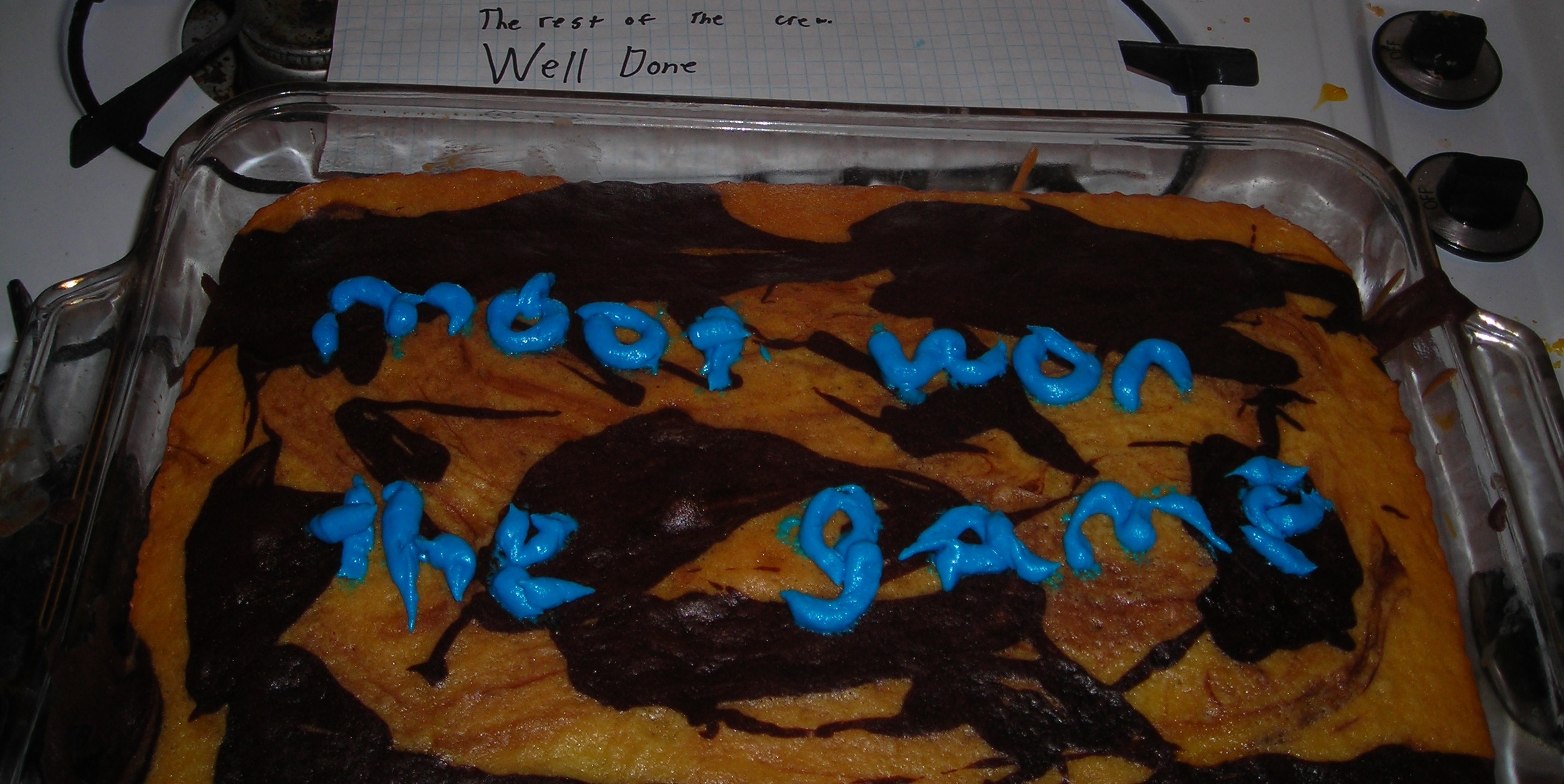
Finally, on Friday, Time closed the poll, but funny thing was they didn’t turn off the polling URLs, so even though you couldn’t vote through the official Time.com website, it was still possible to vote via the streamlined manual voter – and so the ballot stuffing continued. On Saturday afternoon, the message was restored, but the voting continued – as the team tried to gain a cushion of safety, should voters for other candidates mess things up at the last minute. Early morning on April 27th Time.com published the results. And there, for the whole world to see was the message, completely intact,”mARBLECAKE ALSO THE GAME”.
Celebrations were in order – there was cake
and happy faces

and a general sigh of relief from the group.
It is 12 hours after Time.com poll has been closed. The mood among Anonymous is high – the hack was completed, it is there for the world to see. Time.com behaved as expected – they refused to acknowledge the hack and the Message – but the word is out there. People are reading about the hack on 4chan, Reddit and Digg – people know that the poll was hacked and they know that Anonymous is responsible. They started with a goal and despite some rather severe setbacks were able to meet that goal
From where I sit, I really have to wonder about Time.com. They spent their time promoting and running this poll that they know (or should know) is a total farce. They give a wink and nudge to the questionable results by saying “This is an Internet poll. Doubting the results is kind of the point.” Which is just stupid. Perhaps the point should be “if you want to maintain any kind of journalistic integrity, don’t conduct online polls”.
So what’s next for Anonymous? One hacker (knowing the stereotype people have for an Anonymous hacker) says “we’re going to resume masturbating and being the total failures that we are “. When I asked Zombocom, the mastermind of the Message , if he had any message for moot – the man that they put on top of the world – Zombocom replied: ‘ “The Game” – but still, enjoy it.’
Update: A mini-interview with moot:
A friend put me in touch with moot so I could ask him about the hack. Since he’s so influential I kept my questions short and to the point. Here’s the mini-interview:
Time makes a joke a your expense (“To put the magnitude of the upset in perspective, it’s worth noting that everyone Moot beat out actually has a job. “). Any response to Time magazine about this:
I wasn’t offended by the blurb on TIME.com. To clarify, I never claimed to be unaware of the “concerted plan to influence the poll,” just that I hadn’t instructed anybody to vote for me. They did it all on their own (as you already know).
Time also indicates that they rebuffed the attempts to hack the poll. (“TIME.com’s technical team did detect and extinguish several attempts to hack the vote. “). This seems to me to be a lie. Likewise, they ignore the ‘marblecake, also the game’ message completely. Anything to say about this?
Honestly, I think Time had as much fun with the poll as we all did. It drove a lot of traffic to their site, and after the final results were released, generated a lot of buzz about the upcoming issue.
There’s a group of a dozen or so guys who’ve devoted a couple of months to this. Anything to say to them?
As for a response to the players: “Thanks.”
Update 10/24/2012:
Ukraine translation by Gmail Archive – http://www.stoodio.org/moot-wins-time-inc-loses.
The BPM Explorer
Posted by Paul in code, fun, java, processing, startup, tags, The Echo Nest, Uncategorized, visualization, web services on April 9, 2009
Last month I wrote about using the Echo Nest API to analyze tracks to generate plots that you can use to determine whether or not a machine is responsible for setting the beat of a song. I received many requests to analyze tracks by particular artists, far too many for me to do without giving up my day job. To satisfy this pent up demand for click track analysis I’ve written an application called the BPM Explorer that you let you create your own click plots. With this application you can analyze any song in your collection, view its click plot and listen to your music, synchronized with the plot. Here’s what the app looks like:

Check out the application here: The Echo Nest BPM Explorer. It’s written in Processing and deployed with Java Webstart, so it (should) just work.
My primary motiviation for writing this application was to check out the new Echo Nest Java Client to make sure that it was easy to use from Processing. One of my secret plans is to get people in the Processing community interested in using the Echo Nest API. The Processing community is filled with some ultra-creative folks that have have strong artistic, programming and data visualization skills. I’d love to see more song visualizations like this and this that are built using the Echo Nest APIs. Processing is really cool – I was able to write the BPM explorer in just a few hours (it took me longer to remember how to sign jar files for webstart than it did to write the core plotter). Processing strips away all of the boring parts of writing graphic programming (create a frame, lay it out with a gridbag, make it visible, validate, invalidate, repaint, paint arghh!). For processing, you just write a method ‘draw()’ that will be called 30 times a second. I hope I get the chance to write more Processing programs.
Update: I’ve released the BPM Explorer code as open source – as part of the echo-nest-demos project hosted at google-code. You can also browse the read for the BPM Explorer.
Killer music technology
Posted by Paul in fun, Music, recommendation, The Echo Nest, web services on April 1, 2009
We’ve been head down here at the Echo Nest putting the finishing touches on what I think is a game changer for music discovery. For years, music recommendation companies have been trying to get collaborative filtering technologies to work. These CF systems work pretty well, but sooner or later, you’ll get a bad recommendation. There are just too many ways for a CF recommender to fail. Here at the ‘nest we’ve decided to take a completely different approach. Instead of recommending music based on the wisdom of the crowds or based upon what your friends are listening to, we are going to recommend music just based on whether or not the music is good. This is such an obvious idea – recommend music that is good, and don’t recommend music that is bad – that it is a puzzle as to why this approach hasn’t been taken before. Of course deciding which music is good and which music is bad can be problematic. But the scientists here at The Echo Nest have spent years building machine learning technologies so that we can essentially reproduce the thought process of a Pitchfork music critic. Think of this technology as Pitchfork-in-a-box.
Our implementation is quite simple. We’ve added a single API method ‘get_goodness’ to our set of developer offerings. You give this method an Echo Nest artist ID (that you can obtain via an artist search call) and get_goodness returns a number between zero and one that indicates how good or bad the artist is. Here’s an example call for radiohead:
http://developer.echonest.com/api/get_goodness?api_key=EHY4JJEGIOFA1RCJP&id=music://id.echonest.com/~/AR/ARH6W4X1187B99274F&version=3

The results are:

<response version="3">
   <status>
     <code>0</code>
      <message>Success</message>
   </status>
   <query>
    <parameter name="api_key">EHY4JJEGIOFA1RCJP</parameter>
    <parameter name="id">music://id.echonest.com/~/AR/ARH6W4X1187B99274F</parameter>
  </query>
  <artist>
    <name>Radiohead</name>
    <id>music://id.echonest.com/~/AR/ARH6W4X1187B99274F</id>
    <goodness>0.47</goodness>
    <instant_critic>More enjoyable than Kanye bitching.</instant_critic>
  </artist>
</response>
We also include in the response, a text string that indicates how you should feel about this artist. This is just the tip of the iceberg for our forthcoming automatic music review technology that will generate blog entries, amazon reviews, wikipedia descriptions and press releases automatically, just based upon the audio.
We’ve made a web demo of this technology that will allow you try out the goodness API. Check it out at: demo.echonest.com.
We’ve had lots of late nights in the last few weeks, but now that this baby is launched, time to celebrate (briefly) and then on to the next killer music tech!
boston area music tech meetup
Monday, March 30th I’ll be heading down to the Miracle of Science (a watering hole near MIT) to attend the first official zed equals zee Happy Hour. If you are interested in joining a mix of music techies, music bloggers and music makers for a few hours, to talk about music and technology feel free to join us. RSVP here at zed equals zee.
Put a DONK on it
Posted by Paul in code, fun, Music, The Echo Nest on March 25, 2009
rfwatson has just released a site called donkdj that will ‘remix your favourite song into a bangin’ hard dance anthem‘. You upload a track and donkdj turns it into a dance remix. The results are just brilliant. Here are a few examples:
The site uses The Echo Nest Remix API to do all of the heavy lifting – adding a kick, snap, claps and the infamous donk (I had to look it up … a donk is a a pipe/plank-sound, that is used in Bouncy/scouse house/NRG music). What is doubly cool is rfwatson has open sourced his remix code so you can look under the hood and see how it works and adapt it for your own use. The core of this remix is done in just 200 lines of python code.
donkdj is really cool – the results sound fantastic and the open sourcing of the code makes it easy for anyone else to make their own remixer. I can’t wait to see it when someone makes an automatic Stephen Colbert remixer.
Update: Ben showed me this post that points to this video about Donk:
The full series is available here.
The Loudness War Analyzed
Posted by Paul in code, data, fun, Music, research, The Echo Nest, visualization on March 23, 2009
Recorded music doesn’t sound as good as it used to. Recordings sound muddy, clipped and lack punch. This is due to the ‘loudness war’ that has been taking place in recording studios. To make a track stand out from the rest of the pack, recording engineers have been turning up the volume on recorded music. Louder tracks grab the listener’s attention, and in this crowded music market, attention is important. And thus the loudness war – engineers must turn up the volume on their tracks lest the track sound wimpy when compared to all of the other loud tracks. However, there’s a downside to all this volume. Our music is compressed. The louds are louds and the softs are loud, with little difference. The result is that our music seems strained, there is little emotional range, and listening to loud all the time becomes tedious and tiring.
I’m interested in looking at the loudness for the recordings of a number of artists to see how wide-spread this loudness war really is. To do this I used the Echo Nest remix API and a bit of Python to collect and plot loudness for a set of recordings. I did two experiments. First I looked at the loudness for music by some of my favorite or well known artists. Then I looked at loudness over a large collection of music.
First, lets start with a loudness plot of Dave Brubeck’s Take Five. There’s a loudness range of -33 to about -15 dBs – a range of about 18 dBs.
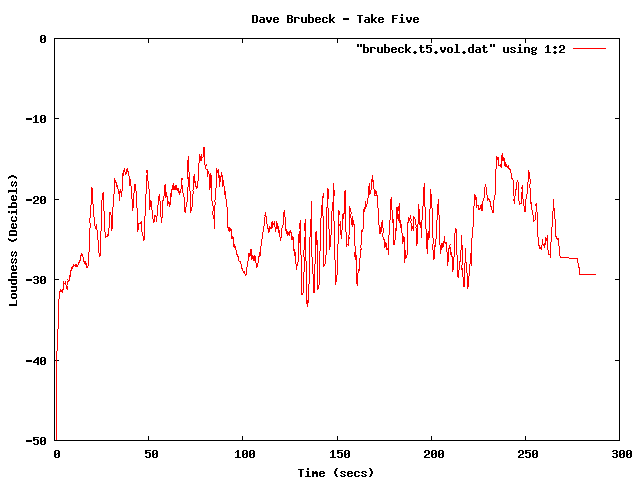
Dave Brubeck - Take Five
Now take a look at a track from the new Metallica album. Here we see a dB range of from about -3 dB to about -6 dB – for a range of about 3 dB. The difference is rather striking. You can see the lack of dynamic range in the plot quite easily.
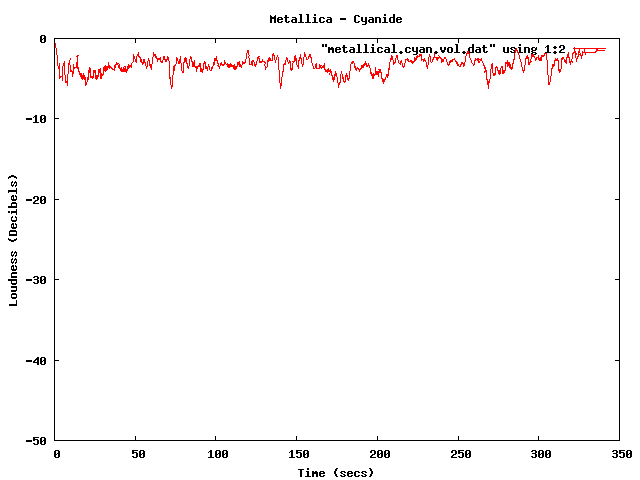
Metallica - Cyanide
Now you can’t really compare Dave Brubeck’s cool jazz with Metallica’s heavy metal – they are two very different kinds of music – so lets look at some others. (One caveat for all of these experiments – I don’t always know the provenance of all of my mp3s – some may be from remasters where the audio engineers may have adjusted the loudness, while some may be the original mix).
Here’s the venerable Stairway to Heaven – with a dB range of -40 dB to about -5dB for a range of 35 dB. That’s a whole lot of range.
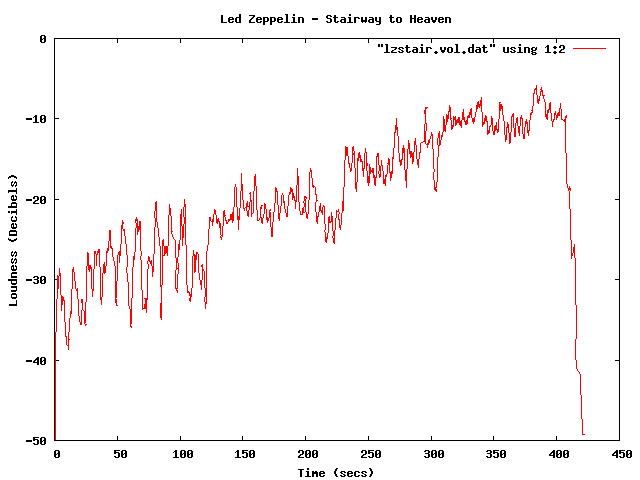
Led Zeppelin - Stairway to Heaven
Compare that to the track ‘supermassive black hole’ – by Muse – with a range of just 4dB. I like Muse, but I find their tracks to get boring quickly – perhaps this is because of the lack of dynamic range robs some of the emotional impact. There’s no emotional arc like you can see in a song like Stairway to Heaven.

Muse - Supermassive Black Hole
Some more examples – The Clash – London Calling. Not a wide dynamic range – but still not at ear splitting volumes.
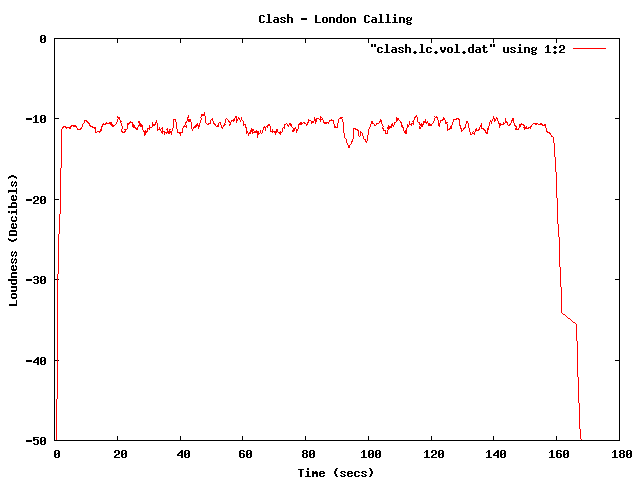
Clash - London Calling
This track by Nickleback is pushing the loudness envelope, but does have a bit of dynamic range.
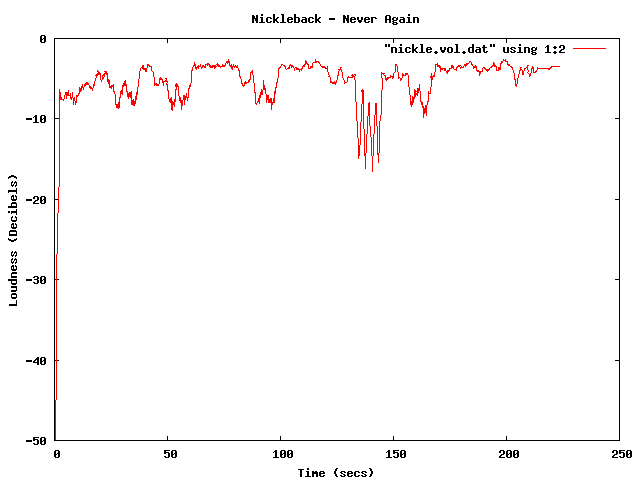
Nickleback - Never Again
Compare the loudness level to the Sex Pistols. Less volume, and less dynamic range – but that’s how punk is – all one volume.
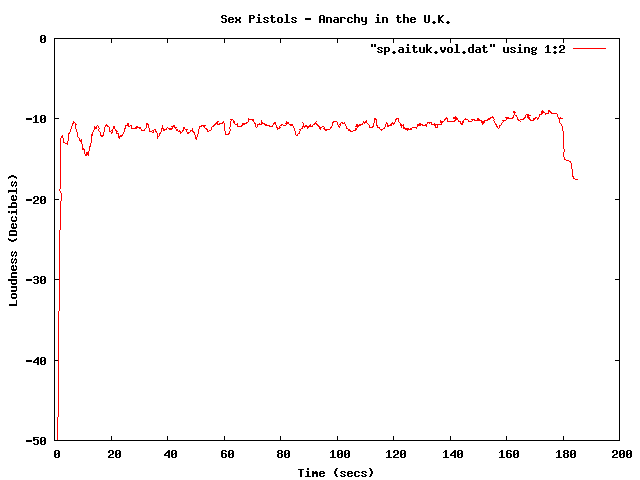
Sex Pistols - Anarchy in the U.K.
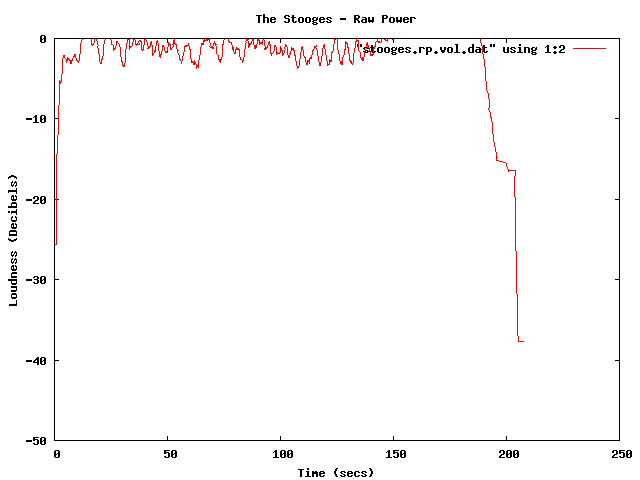
The Stooges – Raw Power is considered to be one of the loudest albums of all time. Indeed, the loudness curve is bursting through the margins of the plot.
The Stooges - Raw Power
Here in one plot are 4 tracks overlayed – Red is Dave Brubeck, Blue is the Sex Pistols, Green is Nickleback and purple is the Stooges.

Combined plot
There been quite a bit of writing about the loudness war. The wikipedia entry is quite comprehensive, with some excellent plots showing how some recordings have had a loudness makeover when remastered. The Rolling Stone’s article: The Death of High Fidelity gives reactions of musicians and record producers to the loudness war. Producer Butch Vig says “Compression is a necessary evil. The artists I know want to sound competitive. You don’t want your track to sound quieter or wimpier by comparison. We’ve raised the bar and you can’t really step back.”
The loudest artists
I have analyzed the loudness of about 15K tracks from the top 1,000 or so most popular artists. The average loudness across all 15K tracks is about -9.5 dB. The very loudest artists from this set – those with a loudness of -5 dB or greater are:
| Artist | dB |
|---|---|
| Venetian Snares | -1.25 |
| Soulja Boy | -2.38 |
| Slipknot | -2.65 |
| Dimmu Borgir | -2.73 |
| Andrew W.K. | -3.15 |
| Queens of the Stone Age | -3.23 |
| Black Kids | -3.45 |
| Dropkick Murphys | -3.50 |
| All That Remains | -3.56 |
| Disturbed | -3.64 |
| Rise Against | -3.73 |
| Kid Rock | -3.86 |
| Amon Amarth | -3.88 |
| The Offspring | -3.89 |
| Avril Lavigne | -3.93 |
| MGMT | -3.94 |
| Fall Out Boy | -3.97 |
| Dragonforce | -4.02 |
| 30 Seconds To Mars | -4.08 |
| Billy Talent | -4.13 |
| Bad Religion | -4.13 |
| Metallica | -4.14 |
| Avenged Sevenfold | -4.23 |
| The Killers | -4.27 |
| Nightwish | -4.37 |
| Arctic Monkeys | -4.40 |
| Chromeo | -4.42 |
| Green Day | -4.43 |
| Oasis | -4.45 |
| The Strokes | -4.49 |
| System of a Down | -4.51 |
| Blink 182 | -4.52 |
| Bloc Party | -4.53 |
| Katy Perry | -4.76 |
| Barenaked Ladies | -4.76 |
| Breaking Benjamin | -4.80 |
| My Chemical Romance | -4.81 |
| 2Pac | -4.94 |
| Megadeth | -4.97 |
It is interesting to see that Avril Lavigne is louder than Metallica and Katy Perry is louder than Megadeth.
The Quietest Artists
Here are the quietest artists:
| Artist | dB |
|---|---|
| Brian Eno | -17.52 |
| Leonard Cohen | -16.24 |
| Norah Jones | -15.75 |
| Tori Amos | -15.23 |
| Jeff Buckley | -15.21 |
| Neil Young | -14.51 |
| Damien Rice | -14.33 |
| Lou Reed | -14.33 |
| Cat Stevens | -14.22 |
| Bon Iver | -14.14 |
| Enya | -14.13 |
| The Velvet Underground | -14.05 |
| Simon & Garfunkel | -14.03 |
| Pink Floyd | -13.96 |
| Ben Harper | -13.94 |
| Aphex Twin | -13.93 |
| Grateful Dead | -13.85 |
| James Taylor | -13.81 |
| The Very Hush Hush | -13.73 |
| Phish | -13.71 |
| The National | -13.57 |
| Paul Simon | -13.53 |
| Sufjan Stevens | -13.41 |
| Tom Waits | -13.33 |
| Elvis Presley | -13.21 |
| Elliott Smith | -13.06 |
| Celine Dion | -12.97 |
| John Lennon | -12.92 |
| Bright Eyes | -12.92 |
| The Smashing Pumpkins | -12.83 |
| Fleetwood Mac | -12.82 |
| Tool | -12.62 |
| Frank Sinatra | -12.59 |
| A Tribe Called Quest | -12.52 |
| Phil Collins | -12.27 |
| 10,000 Maniacs | -12.04 |
| The Police | -12.02 |
| Bob Dylan | -12.00 |
(note that I’m not including classical artists that tend to dominate the quiet side of the spectrum)
Again, there are caveats with this analysis. Many of the recordings analyzed may be remastered versions that have have had their loudness changed from the original. A proper analysis would be to repeat using recordings where the provenance is well known. There’s an excellent graphic in the wikipedia that shows the effect that remastering has had on 4 releases of a Beatles track.
Loudness as a function of Year
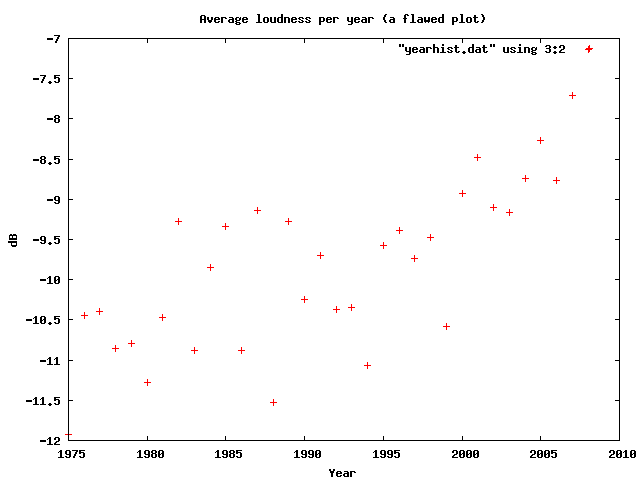
Here’s a plot of the loudness as a function of the year of release of a recording (the provenance caveat applies here too). This shows how loudness has increased over the last 40 years
Loudness as a function of year
I suspect that re-releases and re-masterings are affecting the Loudness averages for years before 1995. Another experiment is needed to sort that all out.
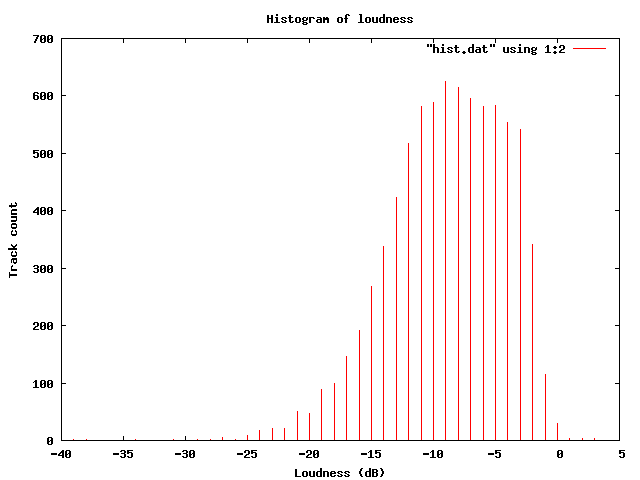
Loudness Histogram:
This table shows the histogram of Loudness:
Histogram of loudness
Average Loudness per genre
This table shows the average loudness as a function of genre. No surprise here, Hip Hop and Rock is loud, while Children’s and Classical is soft:
| Genre | dB |
|---|---|
| Hip Hop | -8.38 |
| Rock | -8.50 |
| Latin | -9.08 |
| Electronic | -9.33 |
| Pop | -9.60 |
| Reggae | -9.64 |
| Funk / Soul | -9.83 |
| Blues | -9.86 |
| Jazz | -11.20 |
| Folk, World, & Country | -11.32 |
| Stage & Screen | -14.29 |
| Classical | -16.63 |
| Children’s | -17.03 |
So, why do we care? Why shouldn’t our music be at maximum loudness? This Youtube video makes it clear:
 Luckily, there are enough people that care about this to affect some change. The organization Turn Me Up! is devoted to bringing dynamic range back to music. Turn Me Up! is a non-profit music industry organization working together with a group of highly respected artists and recording professionals to give artists back the choice to release more dynamic records.
If I had a choice between a loud album and a dynamic one, I’d certainly go for the dynamic one.
Update: Andy exhorts me to make code samples available – which, of course, is a no-brainer – so here ya go: volume.py
10 things I learned at SXSW
- I need to get a black tee-shirt

Black tees and Macs
- If I don’t have enough content to fill my timeslot, start showing pictures of puppies.

and puppies...
- If I start losing my hair, the best thing to do is to shave it all off and try to look like Clay Shirkey
- To be taken seriously, I must have the latest revision of Apple hardware

apple stack
- Nuclear tacos can burn me a second time, 4 hours later.

Nuclear Tacos
- Amongst my SXSW peers, my attention span is actually way above average

Time to check twitter
- When I have a choice between form and content, always chose form.

no phone number, but it looks good
- I need to turn off the key click on my iPhone lest I disturb my neighbors.

'click,' 'click' 'click'
- No matter what my second-grade teacher taught me, proper and polite behavior during a talk is to be chatting a way to all of my neighbors (via twitter).

twitterholic
- Don’t try my DVI to VGA adapter for the first time 5 minutes before my talk (f*ck you apple!)

adapter fail

Being Clay Shirky
More on click tracks …
Posted by Paul in fun, Music, The Echo Nest on March 9, 2009
I’ve just been astounded by the number of and quality of the comments that I’ve received on my recent ‘searching for click track’ posts. I’ve learned a lot about modern music production, drumming, the power of Waxy, Slashdot, Reddit, Stumbleupon, Metafilter and BoingBoing and a bit more about python. I was surprised and heartened by the fact that even those who thought I was wrong, or thought that my analysis was off beat (snicker), offered their criticism in a very civil fashion – is this really the Internet?
Many have suggested other drummers to analyze and I’ve taken a quick look at some but I haven’t had time to do anything (I’ve got this SXSW talk to prepare, plus my regular job to do as well, sigh). Luckily enough, some others have already started to do some analyses. I shall try to post the analysis that people add to the comments or send to me here, so we can build a nice directory of click plots for various drummers.
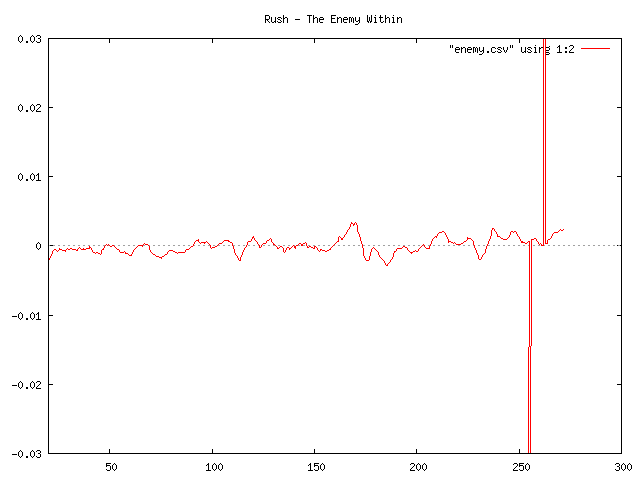
Rush – The Enemy Within
Plot by Arren Lex
It looks to me like Neil Pert is using a click track on this song.
Rush - The Enemy within
Elton John – A word in spanish
Plot by Arren Lex
Looks like a click track

Elton John - A Word In Spanish
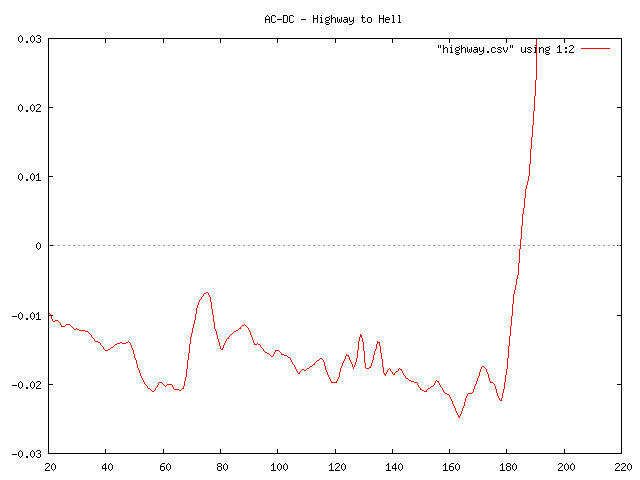
AC / DC – Highway to hell
Plot by Arren Lex
Looks like no click track for Phil Rudd.