Posts Tagged Music
Echo Nest Remix at the Boston Python Meetup Group
Posted by Paul in events, remix, The Echo Nest on July 15, 2010
Next week I’ll be giving a talk about remixing music with Echo Nest remix at the Boston Python Meetup Group. If you are in the Boston / Cambridge area next week, be sure to come on by and say ‘hi’. Info and RSVP for the talk are here: The Boston Python Meetup Group on Meetup.com
Here’s the abstract for the talk:
Paul Lamere will tell us about Echo Nest remix. Remix is an open source Python library for remixing music. With remix you can use Python to rearrange a track, combine it with others, beat/pitch shift it etc. – essentially it lets you treat a song like silly putty.
The Swinger is an interesting example of what it can do that made the rounds of the blogosphere: it morphs songs to give them a swing rhythm.
For more details about the type of music remixing you can do with remix, feel free to read: http://musicmachinery…
The Name Dropper
Posted by Paul in data, fun, Music, The Echo Nest, web services on July 10, 2010
[tweetmeme source= ‘plamere’ only_single=false]
TL;DR; I built a game called Name Dropper that tests your knowledge of music artists.
One bit of data that we provide via our web APIs is Artist Familiarity. This is a number between 0 and 1 that indicates how likely it is that someone has heard of that artists. There’s no absolute right answer of course – who can really tell if Lady Gaga is more well known than Barbara Streisand or whether Elvis is more well known than Madonna. But we can certainly say that The Beatles are more well known, in general, than Justin Bieber.
To make sure our familiarity scores are good, we have a Q/A process where a person knowledgeable in music ranks our familiarity score by scanning through a list of artists ordered in descending familiarity until they start finding artists that they don’t recognize. The further they get into the list, the better the list is. We can use this scoring technique to rank multiple different familiarity algorithms quickly and accurately.
One thing I noticed, is that not only could we tell how good our familiarity score was with this technique, this also gives a good indication of how well the tester knows music. The further a tester gets into a list before they can’t recognize artists, the more they tend to know about music. This insight led me to create a new game: The Name Dropper.
The Name Dropper is a simple game. You are presented with a list of dozen artist names. One name is a fake, the rest are real.
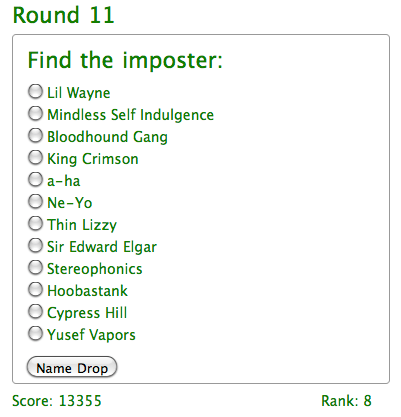
If you find the fake, you go onto the next round, but if you get fooled, the game is over. At first, it is pretty easy to spot the fakes, but each round gets a little harder, and sooner or later you’ll reach the point where you are not sure, and you’ll have to guess. I think a person’s score is fairly representative of how broad their knowledge of music artists are.
The biggest technical challenge in building the application was coming up with a credible fake artist name generator. I could have used Brian’s list of fake names – but it was more fun trying to build one myself. I think it works pretty well. I really can’t share how it works since that could give folks a hint as to what a fake name might look like and skew scores (I’m sure it helps boost my own scores by a few points). The really nifty thing about this game is it is a game-with-a-purpose. With this game I can collect all sorts of data about artist familiarity and use the data to help improve our algorithms.
So go ahead, give the Name Dropper a try and see if you can push me out of the top spot on the leaderboard:

Play the Name Dropper
The Echo Nest Song API
Posted by Paul in Music, The Echo Nest, web services on April 24, 2010
- Performance – api method calls run faster – on average API methods are running 3X faster than the older version.
- JSON Output – all of our methods now support JSON output in addition to XML. This greatly simplifies writing client libraries for the Echo Nest
- Nimble coding – with the new architecture it will be much easier for us to roll out new features – so expect to see new features added to the Echo Nest platform every month
- No cruft – we are revisiting our APIs to try to eliminate inconsistencies, redundancies and unnecessary features to make them as clean as we can.
The beta version of our next generation APIs are here: http://beta.developer.echonest.com/
The first significant new API we are adding is the Song API – this gives you all sorts of ways to search for and retrieve song level data. With the song API you can do the following:
- search for songs via artist name, song title, and description. You can affect the results with constraints and sorts:
- constrain the results by a number of factors including musical attributes like tempo, loudness, time signature and key, artist hotttnesss, location
- sort – the results by any of the attributes
- Find similar songs – find similar songs to a seed song
- Find profile – get all sorts of info about a song including audio, audio summary info, track data for different catalogs, song hottttnesss, artist_hotttnesss, artist_location, and detailed track analysis
- Identify songs – works in conjunction with the ENMFP
There are lots of things you can do with this API. Here’s just a quick sample of the types of queries you can make:
Find the loudest thrash songs
song/search?sort=loudness-desc&description=thrash
Find indie songs for jogging
song/search?min_tempo=120&description=indie&max_tempo=125
Fetch the tempo of Hey Jude
search?title=hey+jude&bucket=audio_summary&artist=the+beatles
Fetch the track audio and analysis of Bad Romance
search?title=bad+romance&bucket=tracks&bucket=id:paulify&artist=lady+gaga
Find songs similar to Bad Romance
song/similar?id=SOAOBBG127D9789749
- jen-api – a java client
- beta_pyechonest – a new branch of the venerable pyechonest library. Grab it from SVN with
svn checkout http://pyechonest.googlecode.com/svn/branches/ beta-pyechonest-read-only
I’ll be writing more about all of the new APIs real soon. Access the beta Echo Nest APIs here:
Unofficial Artist Guide to SXSW
Posted by Paul in events, Music, recommendation, The Echo Nest on March 4, 2010
I’m excited! Next week I travel to Austin for a week long computer+music geek-fest at SXSW. A big part of SXSW is the music – there are nearly 2,000 different artists playing at SXSW this year. But that presents a problem – there are so many bands going to SXSW (many I’ve never heard of) that I find it very hard to figure out which bands I should go and see. I need a tool to help me find sift through all of the artists – a tool that will help me decide which artists I should add to my schedule and which ones I should skip. I’m not the only one who was daunted by the large artist list. Taylor McKnight, founder of SCHED*, was thinking the same thing. He wanted to give his users a better way to plan their time at SXSW. And so over a couple of weekends Taylor built (with a little backend support from us) The Unofficial Artist Discovery Guide to SXSW.
The Unofficial Artist Discovery Guide to SXSW is a tool that allows you to explore the many artists attending this year’s SXSW. It lets you search for artists, browse popularity, music style, ‘buzzworthiness’, or similarity to your favorite artists – and it will make recommendations for you based on your music taste (using your Last.fm, Sched* or Hype Machine accounts) . The Artist Guide supplies enough context (bios, images, music, tag clouds, links) to help you decide if you might like an artist.
Here’s the guide:
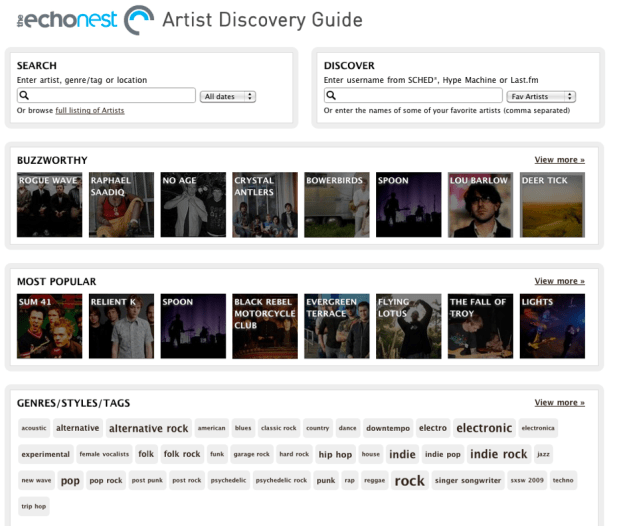
Here’s a quick tour of some of the things you can do with the guide. First off, you can Search for artists by name, genre/tag or location. This helps you find music when you know what you are looking for.
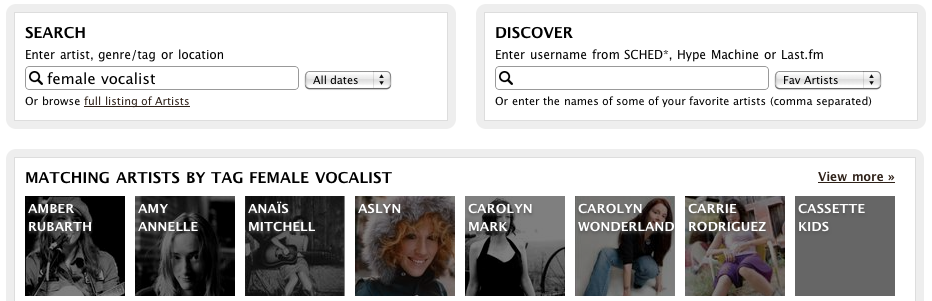
However, you may not always be sure what you are looking for – that’s where you use Discover. This gives you recommendations based on the music you already like. Type in the name of a few artists (even artists that are not playing at SXSW) or your SCHED*, Hype Machine or Last.fm user name, and ‘Discover’ will give you a set of recommendations for SXSW artists based on your music taste. For example, I’ve been listening to Charlotte Gainsbourg lately so I can use the artist guide to help me find SXSW artists that I might like:
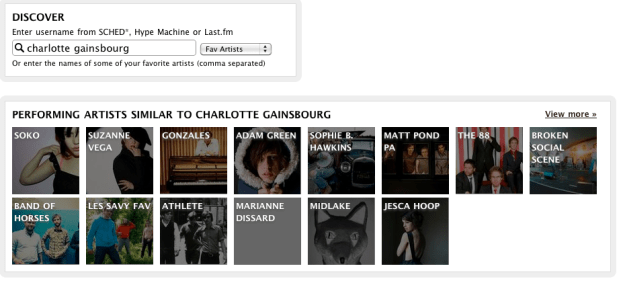
If I see an artist that looks interesting I can drill down and get more info about the artist:
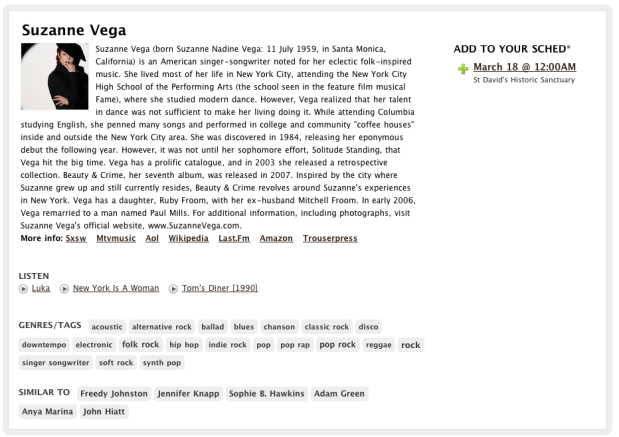 From here I can read the artist bio, listen to some audio, explore other similar SXSW artists or add the event to my SCHED* schedule.
I use Last.fm quite a bit, so I can enter my Last.fm name and get SXSW recommendations based upon my Last.fm top artists. The artist guide tries to mix things up a little bit so if I don’t like the recommendations I see, I can just ask again and I can get a different set. Here are some recommendations based on my recent listening at Last.fm:
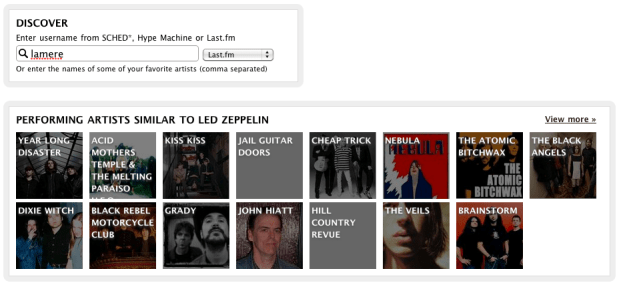
If you’ve been using the wonderful SCHED* to keep track of your SXSW calendar you can use the guide to get recommendations based on artists that you’ve already added to your SXSW calendar.
In addition to search and discovery, the guide gives you a number of different ways to browse the SXSW Artist space. You can browse by ‘buzzworthy’ artists – these are artists that are getting the most buzz on the web:

Or the most well-known artists:

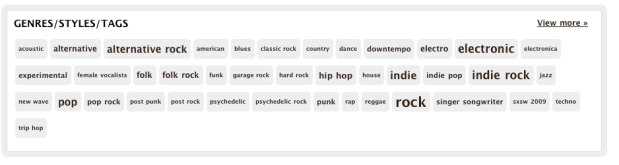
You can browse by the style of music via a tag cloud:
And by venue:

Building the guide was pretty straightforward. Taylor used the Echo Nest APIs to get the detailed artist data such as familiarity, popularity, artist bios, links, images, tags and audio. The only data that was not available at the Echo Nest was the venue and schedule info which was provided by Arkadiy (one of Taylor’s colleagues). Even though SXSW artists can be extremely long tail (some don’t even have Myspace pages), the Echo Nest was able to provide really good coverage for these sets (There was coverage for over 95% of the artists). Still there are a few gaps and I suspect there may be a few errors in the data (my favorite wrong image is for the band Abe Vigoda). If you are in a band that is going to SXSW and you see that we have some of your info wrong, send me an email (paul@echonest.com) and I’ll make it right.
We are excited to see the this Artist Discovery guide built on top of the Echo Nest. It’s a great showcase for the Echo Nest developer platform and working with Taylor was great. He’s one of these hyper-creative, energetic types – smart, gets things done and full of new ideas. Taylor may be adding a few more features to the guide before SXSW, so stay tuned and we’ll keep you posted on new developments.
Organize your online music with ExtensionFM
On Friday I installed ExtensionFM– a chrome extension that helps you manage your online music listening. Dan Kantor, the creator, has a little video that shows you how it works:
The idea behind ExtensionFM is very simple. When I visit a site that has music ExtensionFM notices and squirrels away all of the links to the music into an iTunes like player:
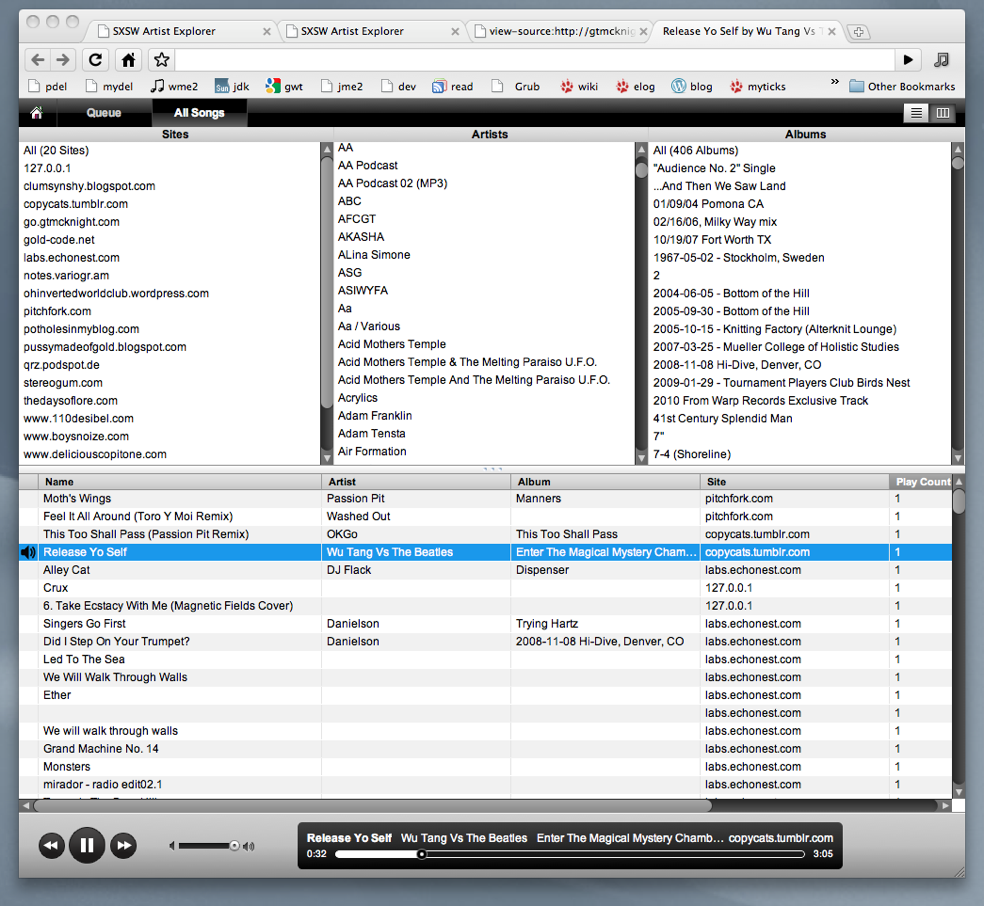
It does all of this work in the background without me having to do anything. After a weekend of browsing, ExtensionFM found music on 20 sites from over 300 artists, over 400 albums – for a total of over 1,000 tracks. ExtensionFM remembers the sites where the music was from and keeps track of when the links die. Note that it doesn’t actually copy music onto your computer, ExtensionFM just makes it easier to play music that is already out there.
There are many nice touches in ExtensioFM. It keeps a play queue, and when you visit a music site you can easily add music to the queue.
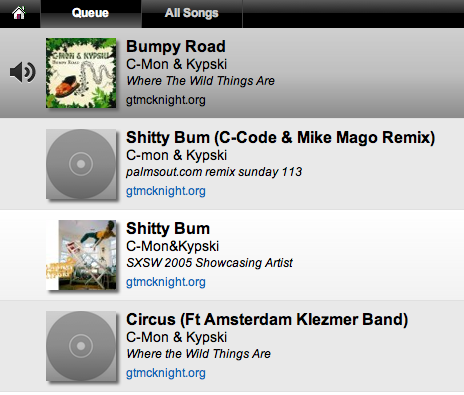
You can edit the play queue easily adding and removing tracks from it.
ExtensionFM also augments a music laden site with music player buttons. So a site that looks like this:
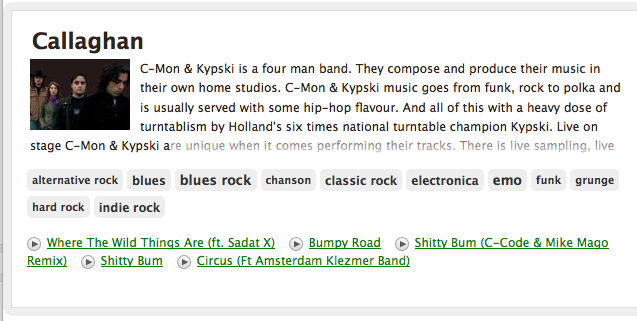
is transformed into something like this:
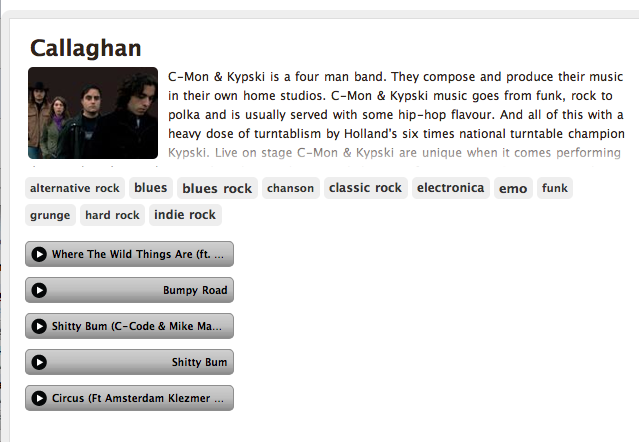
Dan Kantor says he’ll be adding an option soon that will allow the disabling of this re-formatting for those who don’t like their web pages tampered with.
Unfortunately, ExtensionFM doesn’t always find music on a web page. Certain sites (Hype Machine for example) doesn’t expose Mp3 links so ExtensionFM can’t find the music. Dan says that right now ExtensionFM only grabs links that end in .mp3 or .ogg. It also works on Tumblr since they offer a very easy API to get a user’s audio posts. It is going to support Soundcloud embeds soon as well since they also offer an easy API. So the best way for developers to make sure their songs work with ExtensionFM is to make sure that the audio links are exposed in the html or to use Tumblr, or Soundcloud.
ExtensionFM is still in pre-release mode, but if you are lucky enough to get a release code, get the app, install it (it’s very easy to install), and start organizing your online music listening.
Python and Music at PyCon 2010
Posted by Paul in code, Music, The Echo Nest on February 15, 2010
 If you are lucky enough to be heading to PyCon this week and are interested in hacking on music, there are two talks that you should check out:
DJing in Python: Audio processing fundamentals – In this talk Ed Abrams talks about how his experiences in building a real-time audio mixing application in Python. I caught a dry-run of this talk at the local Python SIG – lots of info packed into this 30 minute talk. One of the big takeaways from this talk is the results of Ed’s evaluation of a number of Pythonic audio processing libraries. Sunday 01:15pm, Centennial I
Remixing Music Pythonically – This is a talk by Echo Nest friend and über-developer Adam Lindsay. In this talk Adam talks about the Echo Nest remix library. Adam, a frequent contributor to remix, will offer details on the concise expressiveness offered when editing multimedia driven by content-based features, and some insights on what Pythonic magic did and didn’t work in the development of the modules. Audio and video examples of the fun-yet-odd outputs that are possible will be shown. Sunday 01:55pm, Centennial I
The schedulers at PyCon have done a really cool thing and have put the talks back to back in the same room. Also, keep your eye out for the Hacking on Music OpenSpace
Searching for beauty and surprise in popular music
Posted by Paul in events, Music, The Echo Nest on November 23, 2009
During the Boston Music Hack Day, 30 or 40 music hacks were produced. One phenomenal hack was Rob Ochshorn’s Outlier FM. Rob’s goal for the weekend was to utilize technology to search for beauty and surprise in even the most overproduced popular music. He approached this problem by searching musical content for the audio that “exists outside of a song’s constructed and statistical conventions”.
With Outlier FM rob can deconstruct a song into musical atoms, filter away the most common elements, leaving behind the non-conformist bits of music. This yields strange, unpredictable minimal techno-sounding music.
So how does it work? Well, first Outlier FM uses the Echo Nest analyzer to break a song down into the smallest segments. You can then visualize these segments using numerous filters and layout schemes to give you an idea of what the unusual audio segments are:

Next, you can filter out clusters of self-similar segments, leaving just the outliers:

Finally you can order, visualize and render that segments to yield interesting music:
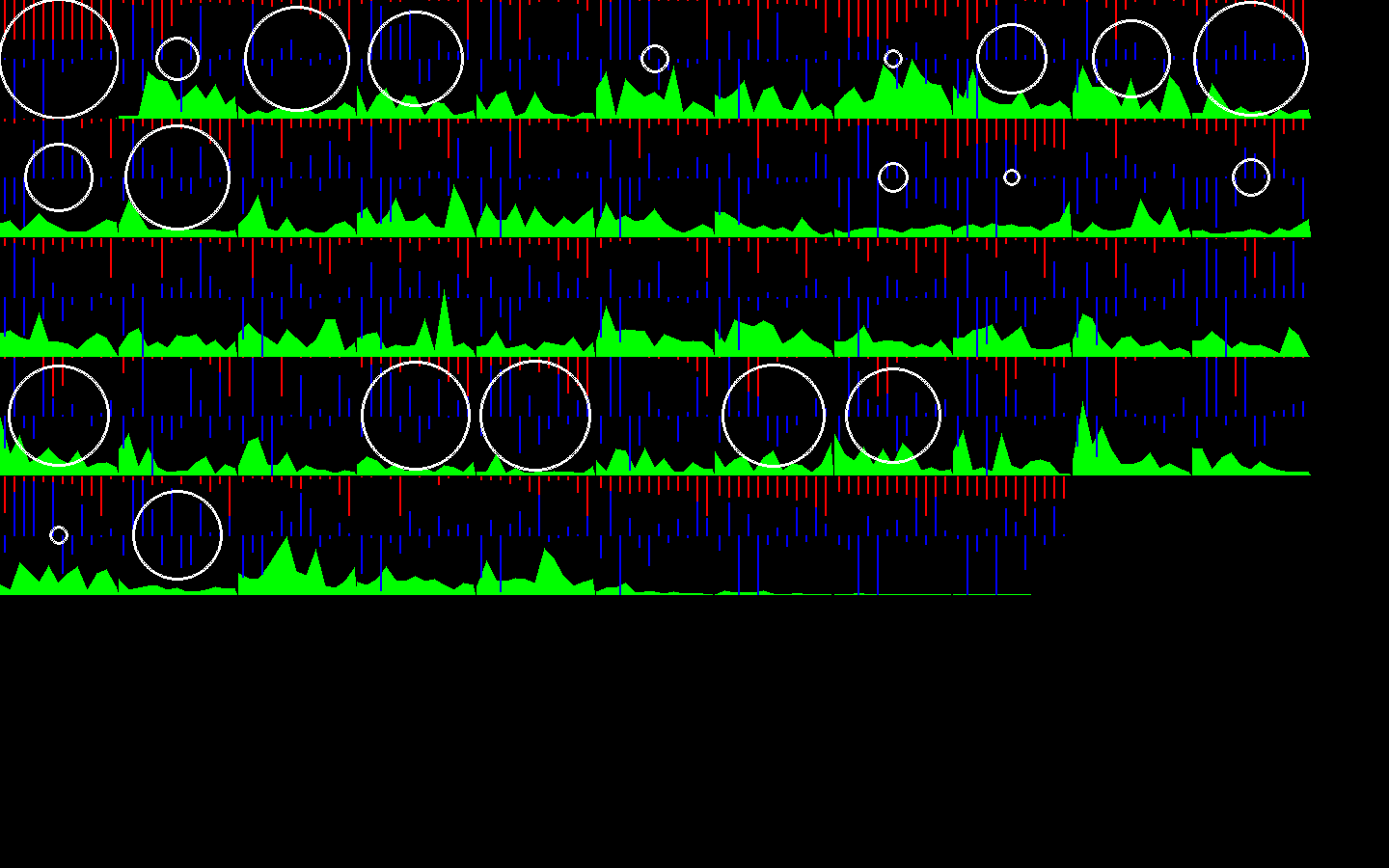
Here’s an example of Outlier FM applied to Here’ Comes the Sun:
Rob’s hack was an amazing weekend effort, he combined music analysis and visualization into a tool that can be used to make interesting sounds. Outlier.fm was voted the best hack for the music hack day weekend. Rob chose as his prize the Sun Ultra 24 workstation with flat panel display donated by Sun Microsystems Startup Essentials. Here’s Rob receiving his prize from Sun.

Congrats to Rob for a well done hack!
Paul’s Music Wreckommender
Posted by Paul in events, Music, playlist, The Echo Nest on November 22, 2009
I just posted my music hack day hack. It is called Paul’s Music Wreckommender. Use this Wreckommender to find anti-recommendations. Give the wreckommender an artist that you like and it will give you a playlist of tracks from artists that are very different from the seed artist. Some obvious use cases:
- Your 14 year old daughter’s slumber party is getting too loud. Send the girls home by putting on the Hannah Montana Wreckommender – which yields a playlist with tracks by Glenn Gould, Dream Theater and Al Hirt.
- It’s time to break up with your girl friend. Give her the ‘You are the wind beneath my wings‘ wrecklist and your intentions will be clear.
- If you like ‘everything but country’ then Garth Williams will guide the way: Garth Williams Wreckommendations
You can try it out at Wreckommender.com.

How it works:
This was a pretty easy hack. I already had a playlister engine with some neat properties. It maintains a complete artist graph using Echo Nest artist similarities, so I can make make routes through the artist space for making smooth artist/song transitions. Adapting this playlister engine to create wreckommendations was really easy. To create the recommendations, I find the seed node in the graph and then from this node I find the set of artists that have the longest ‘shortest path’ to the seed artist. These are the artists that are furthest away from the seed artists. I then select songs from this set to make my ‘wrecklist’. However, this list isn’t the best list. There are a small set of artists that are far away from everything. These artists become frequent wrecommendations for many many artists, which is bad. To avoid this problem I adapted the algorithm to find far away artist clusters and then draw artists from that cluster. This gives yields a playlist with much more variety.
This hack is primarily for fun, but I think there’s something in the wreckommendations that is worth persuing. When asked to describe their taste in music, many people will use a negative – such as “Anything but country and rap”. If this is really the case, then using the wreckommender to literally find ‘anything but country and rap’ – whether it is J-Pop or crabcore might actually be useful.
Inspiration
A couple of sources of inspiration for this hack. First, the name. A word like ‘wreckommendation’ clearly deserves an application. Second, a coffee pot conversation with Reid, and finally, the LibraryThing Unsuggester, which does a similar thing for books (but in a very different way).
I hope you like the wreckommender, let me know if you find any interesting wreckommendations.
A little help from my mutant muppet friends
Build one of these at Boston Music Hack Day
Noah Vawter will be holding a workshop during the Boston Music Hack Day where you can learn how to build a working prototype Exertion Instrument. It is unclear at this time if a leekspin lesson his included. Details on the Exertion Instrument site.
 Music Machinery