Archive for category The Echo Nest
Finding a path through the Jukebox: The Playlist Tutorial
Posted by Paul in events, music information retrieval, playlist, research, The Echo Nest on August 6, 2010
Ben Fields and I have just put the finishing touches on our playlisting tutorial for ISMIR. Everything you could want to know about playlists. As one of the founders of a well known music intelligence company once said: Take the fun out of music and read Paul’s slides …
Visual Music
Posted by Paul in code, data, events, fun, Music, The Echo Nest, visualization on July 28, 2010
The week long Visual Music Collaborative Workshop held at the Eyebeam just finished up. This was an invite-only event where participants did a deep dive into sound analysis techniques, openGL programming, and interfacing with mobile control devices.
Here’s one project built during the week that uses The Echo Nest analysis output:
(Via Aaron Meyers)
Novelty playlist ordering
[tweetmeme source= ‘plamere’ only_single=false] We’ve been building a new playlisting engine here at the Echo Nest. The engine is really neat – it lets you apply a whole range of very flexible constraints and orderings to make all sorts of playlists that would be a challenge for even the most savvy DJ. Playlists like 15 songs with a tempo between 120 and 130 BPM ordered by how danceable they are by very popular female artists that sound similar to Lady Gaga, that live near London, but never ever include tracks by The Spice Girls.
I was playing with the engine this weekend, writing some rules to make novelty playlists to test the limits of the engine. I started with rules typical for a similar-artist playlist: 15 songs long, filled with songs by artists similar to a seed artist (in this case Weezer), the first and last song must be by the seed artist, and no two consecutive songs can be by the same artist. Simple enough, but then I added two more rules to turn this into a novelty playlist that would be very hard for a human to make. See if you can guess what the two rules are. I think one of the rules is pretty obvious, but the second is a bit more subtle. Post your guesses in the comments.
 0    Tripping Down the Freeway - Weezer
 1    Yer All I've Got Ttonight - The Smashing Pumpkins
 2    The Most Beautiful Things - Jimmy Eat World
 3    Someday You Will Be Loved - Death Cab For Cutie
 4    Don't Make Me Prove It - Veruca Salt
 5    The Sacred And Profane - Smashing Pumpkins, The
 6    Everything Is Alright - Motion City Soundtrack
 7    The Ego's Last Stand - The Flaming Lips
 8    Don't Believe A Word - Third Eye Blind
 9    Don's Gone Columbia - Teenage Fanclub
10    Alone + Easy Target - Foo Fighters
11    The Houses Of Roofs - Biffy Clyro
12    Santa Has a Mullet - Nerf Herder
13    Turtleneck Coverup - Ozma
14    Perfect Situation - Weezer
Here’s another playlist – with a different set of two novelty rules, with a seed artist of Led Zeppelin. Again, if you can guess the rules, post a comment.
0 El Niño - Jethro Tull
1 Cheater - Uriah Heep
2 Hot Dog - Led Zeppelin
3 One Thing - Lynyrd Skynyrd
4 Nightmare - Black Sabbath
5 Ezy Ryder - The Jimi Hendrix Experience
6 Soulshine - Govt Mule
7 The Gypsy - Deep Purple
8 I'll Wait - Van Halen
9 Slow Down - Ozzy Osbourne
10 Civil War - Guns N' Roses
11 One Rainy Wish - Jimi Hendrix
12 Overture (Live) - Grand Funk Railroad
13 Larger Than Life - Gov'T Mule
The Music App Summit
Posted by Paul in events, Music, startup, The Echo Nest on July 23, 2010
Billboard has long been known for tracking the hottest artists, albums and songs. Now they are moving into new territory – Music Apps. In October Billboard is hosting a Music App Summit – a day focused on the world of mobile music apps. The summit will focus on new companies and technologies that are now building the next generation of music applications for mobile devices. The summit has some awesome speakers and panelist lined up from a cross section of domains (technology, business and music) like Ge Wang, Ted Cohen, Dave Kusek, Brian Zisk and The Echo Nest’s CEO Jim Lucchese.
At the core of the summit are Billboard’s first ever Music App Awards. Billboard is giving awards to the best apps in a number of categories:

- Best Artist-based App: Apps created specifically for an individual artist
- Best Music Streaming App: Apps that allow users to stream, download or otherwise enjoy music, such as Internet radio or on-demand.
- Best Music Engagement App: Apps that lets users engage in music in various ways, such as music games, music ID services, etc.
- Best Music Creation App: App that lets users make their own music.
- Best Branded App: App that best incorporates a sponsor with music capabilities to promote both the sponsor’s message and highlight the music
- Best Touring App: App created in conjunction with a specific tour or festival
Judges for the apps include Eliot Van Buskirk of Wired, Ian Rogers of Top Spin and Grammy Award winner MC Hammer.
Winning developers receive some modest prizes – but the real award is getting to demo your app to the attendees of the summit – the movers and shakers of the music industry will be there looking for that killer music app – the winner in each of the app categories will get to show their stuff. If you have a mobile music app consider submitting it to the Music App Awards. The submission deadline is July 30.
Keith Moon meets Animal
Another vafromb.py masterpiece from joshmillard.
Echo Nest Remix at the Boston Python Meetup Group
Posted by Paul in events, remix, The Echo Nest on July 15, 2010
Next week I’ll be giving a talk about remixing music with Echo Nest remix at the Boston Python Meetup Group. If you are in the Boston / Cambridge area next week, be sure to come on by and say ‘hi’. Info and RSVP for the talk are here: The Boston Python Meetup Group on Meetup.com
Here’s the abstract for the talk:
Paul Lamere will tell us about Echo Nest remix. Remix is an open source Python library for remixing music. With remix you can use Python to rearrange a track, combine it with others, beat/pitch shift it etc. – essentially it lets you treat a song like silly putty.
The Swinger is an interesting example of what it can do that made the rounds of the blogosphere: it morphs songs to give them a swing rhythm.
For more details about the type of music remixing you can do with remix, feel free to read: http://musicmachinery…
Some NameDropper stats
Posted by Paul in code, fun, Music, The Echo Nest on July 11, 2010
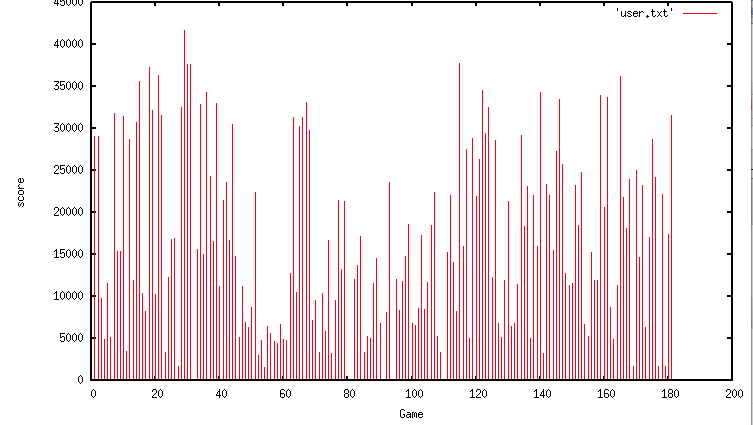
The NameDropper has been live for less than a day and already I ‘ve collected some good data from the game play. Here are some stats:
Total games played: 1841
Total unique players: 462
Total play time: 30hrs, 20mins, 36 seconds
The artists that were most frequently confused with fake artists were:
The Name Dropper
Posted by Paul in data, fun, Music, The Echo Nest, web services on July 10, 2010
[tweetmeme source= ‘plamere’ only_single=false]
TL;DR; I built a game called Name Dropper that tests your knowledge of music artists.
One bit of data that we provide via our web APIs is Artist Familiarity. This is a number between 0 and 1 that indicates how likely it is that someone has heard of that artists. There’s no absolute right answer of course – who can really tell if Lady Gaga is more well known than Barbara Streisand or whether Elvis is more well known than Madonna. But we can certainly say that The Beatles are more well known, in general, than Justin Bieber.
To make sure our familiarity scores are good, we have a Q/A process where a person knowledgeable in music ranks our familiarity score by scanning through a list of artists ordered in descending familiarity until they start finding artists that they don’t recognize. The further they get into the list, the better the list is. We can use this scoring technique to rank multiple different familiarity algorithms quickly and accurately.
One thing I noticed, is that not only could we tell how good our familiarity score was with this technique, this also gives a good indication of how well the tester knows music. The further a tester gets into a list before they can’t recognize artists, the more they tend to know about music. This insight led me to create a new game: The Name Dropper.
The Name Dropper is a simple game. You are presented with a list of dozen artist names. One name is a fake, the rest are real.
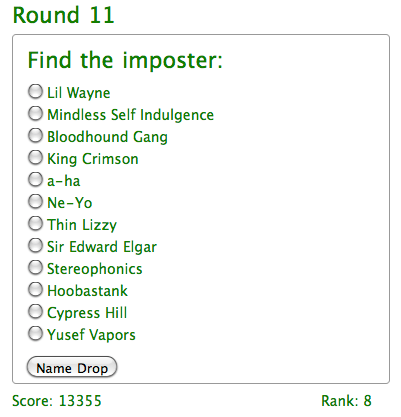
If you find the fake, you go onto the next round, but if you get fooled, the game is over. At first, it is pretty easy to spot the fakes, but each round gets a little harder, and sooner or later you’ll reach the point where you are not sure, and you’ll have to guess. I think a person’s score is fairly representative of how broad their knowledge of music artists are.
The biggest technical challenge in building the application was coming up with a credible fake artist name generator. I could have used Brian’s list of fake names – but it was more fun trying to build one myself. I think it works pretty well. I really can’t share how it works since that could give folks a hint as to what a fake name might look like and skew scores (I’m sure it helps boost my own scores by a few points). The really nifty thing about this game is it is a game-with-a-purpose. With this game I can collect all sorts of data about artist familiarity and use the data to help improve our algorithms.
So go ahead, give the Name Dropper a try and see if you can push me out of the top spot on the leaderboard:

Play the Name Dropper
MeToo – a scrobbler for the room
Posted by Paul in code, fun, Music, The Echo Nest, web services on June 11, 2010
 [tweetmeme source= ‘plamere’ only_single=false] One of the many cool things about working at the Echo Nest is that we have an Sonos audio system with single group playlist for the office. Anyone from the CEO to the greenest intern can add music to the listening queue for everyone to listen to. The office, as a whole has a rather diverse taste in music and as a result I’ve been exposed to lots of interesting music. However, the downside of this is that since I’m not listening to music being played on my personal computer, every day I have 10 hours of music listening that is never scrobbled, and as they say, if it doesn’t scrobble, it doesn’t count. Sure the Sonos system scrobbles all of the plays to the Echo Nest account on Last.fm but I’d also like it to scrobble it to my account so I can use nifty apps like Lee Byron’s Last.fm Listening History or Matt Ogle’s Bragging Rights on my own scrobbles.
This morning while listening to that nifty Emeralds album, I decided that I’d deal with those scrobble gaps once and for all. So I wrote a little python script called MeToo that keeps my scrobbles up to date. It’s really quite simple. Whenever I’m in the office, I fire up MeToo. MeToo watches the most recent tracks played on The Echo Nest account and whenever a new track is played, it scrobbles it to my personal account. In effect, my scrobbles will track the office scrobbles. When I’m not listening I just close my laptop and the scrobbling stops.
The script itself is pretty simple – I used pylast to do interfacing to Last.fm – the bulk of the logic is less than 20 lines of code. I start the script like so:
% python metoo.py TheEchoNest lamere
when I do that, MeToo will continuously monitor most recently played tracks on TheEchoNest and scrobble the plays on my account. When I close my laptop, the script is naturally suspended – so even though music may continue to play in the office, my laptop won’t scrobble it.
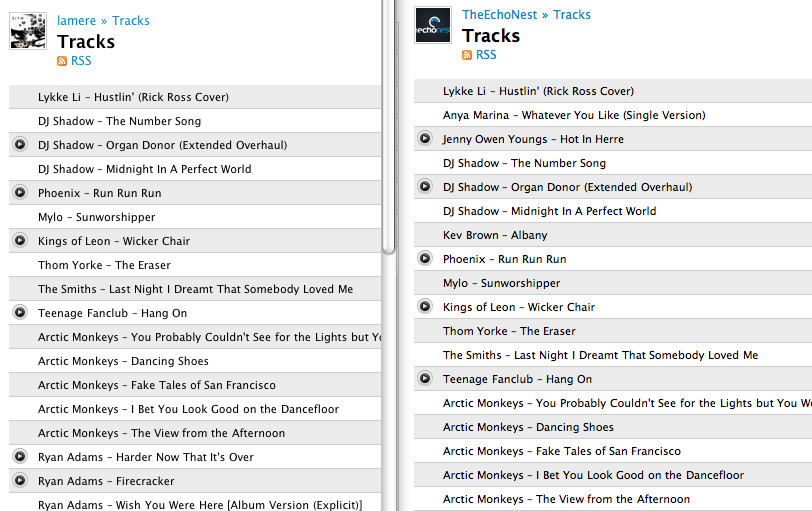
My scrobbles and Echo Nest scrobbles
I suspect that this use case is relatively rare, and so there’s probably not a big demand for something like MeToo, but if you are interested in it, leave a comment. If I see some interest, I’ll toss it up on google code so anyone can use it.
It feels great to be scrobbling again!
We swing both ways
 Perhaps one of the most frequently asked questions about Tristan’s Swinger is whether it can be used to ‘Un-swing’ a song. Can you take a song that already swings and straighten it out? Indeed, the answer is yes – we can swing both ways – but it is harder to unswing than it is to swing. Ammon on Happy Blog, the Happy Blog has given de-swinging a go with some success with his de-swinging of Revolution #1. Read his post and have a listen at Taking the swing out of songs. I can’t wait for the day when we can turn on the TV to watch and listen to MTV-Unswung.

