Archive for category events
The most music tech ever squeezed into 1 weekend
Posted by Paul in events, Music, The Echo Nest on November 18, 2009

Workshops! The core activity for the music hack day weekend is hacking. But before we dive into the hard core hacking the weekend starts with a set of music tech workshops where hackers can learn about the latest in music technologies – it’s a way for the hacker to add more tools to their toolbox. On Saturday morning we will be conducting around 25 workshops running in 5 sessions of 5 parallel tracks. Anyone interested in the music+technology space will likely find something interesting – music recommendation, concert/event data, music meta-data, iPhone programming, electronic instrument construction, Playdar, NPR – everything from how to author a song for the Rock Band Network to the Yahoo! query language. If you are going to the Hack Day, you may want to do a little bit of planning to help you decide which of the workshops you’ll want to attend, so check out the workshop schedule.
Music Hack Day T-shirt
Posted by Paul in events, fun, The Echo Nest on November 17, 2009
Ben Lacker shows off the Boston Music Hack day tee-shirt – hot off the loom.

Who isn’t coming to Boston Music Hackday?
Look at all the companies and organizations coming to Boston Music Hack Day. Time is running out, only a few slots are left, so if you want to go, sign up soon.
 The Echo Nest
 SoundCloud
 Indaba Music
Build one of these at Boston Music Hack Day
Noah Vawter will be holding a workshop during the Boston Music Hack Day where you can learn how to build a working prototype Exertion Instrument. It is unclear at this time if a leekspin lesson his included. Details on the Exertion Instrument site.
10 Awesome things about ISMIR 2009
ISMIR 2009 is over – but it will not be soon forgotten. It was a wonderful event, with seemingly flawless execution. Some of my favorite things about the conference this year:
- The proceedings – distributed on a USB stick hidden in a pen that has a laser! And the battery for the laser recharges when you plug the USB stick into your computer. How awesome is that!? (The printed version is very nice too, but it doesn’t have a laser).
- The hotel – very luxurious while at the same time, very affordable. I had a wonderful view of Kobe, two very comfortable beds and a toilet with more controls than the dashboard on my first car.
- The presentation room – very comfortable with tables for those sitting towards the front, great audio and video and plenty of power and wireless for all.
- The banquet – held in the most beautiful room in the world with very exciting Taiko drumming as entertainment.
- The details – it seems like the organizing team paid attention to every little detail and request – they had taped numbers on the floor so that the 30 folks giving their 30 second pitches during poster madness would know just where to stand, to the signs on the coffeepots telling you that the coffee was being made, to the signs on the train to the conference center welcoming us to ISMIR 2009. It seems like no detail was left to chance.
- The food – our stomachs were kept quite happy – with sweet breads and pastries every morning, bento boxes for lunch, and coffee, juices, waters, and the mysterious beverage ‘black’ that I didn’t dare to try. My absolute favorite meal was the box lunch during the tutorial day – it was a box with a string – when you are ready to eat you give the string a sharp tug – wait a few minutes for the magic to do its job and then you open the box and eat a piping hot bowl of noodles and vegetables. Almost as cool as the laser-augmented proceedings.
- The city – Kobe is a really interesting city – I spent a few days walking around and was fascinated by it all. I really felt like I was walking around in the future. It was extremely clean, the people will very polite, friendly and always willing to help. Going into some parts of town was sensory overload, the colors, sounds, smells, the sights were overwhelming – it was really fun.
- the Keynote – music making robots – what more is there to say.
- The Program – the quality of papers was very high – there was some outstanding posters and oral presentations. Much thanks to George and Keiji for organizing the reviews to create a great program. (More on my favorite posters and papers in an upcoming post)
- f(mir) – The student-organized workshop looked at what MIR research would look like in 10, 20 or even 50 years (basically after I’m dead and gone). The presentations in this workshop were quite provactive – well done students!
I write this post as I sit in the airport in Osaka waiting for my flight home. I’m tired, but very energized to explore the many new ideas that I encountered at the conference. It was a great week. I want to extend my personal thanks to Professor Fujinaga and Professor Goto and the rest of the conference committee for putting together a wonderful week.

Masataka and Ichiro at the conference table
ISMIR Oral Session – Sociology and Ethnomusicology
Session Title: Sociology & Ethnomusicology
Session Chair: Frans Wiering (Universiteit Utrecht, Netherland)
Exploring Social Music Behavior: An Investigation of Music Selection at Parties
Sally Jo Cunningham and David M. Nichols
Abstract: This paper builds an understanding how music is currently listened to by small (fewer than 10 individuals) to medium-sized (10 to 40 individuals) gatherings of people—how songs are chosen for playing, how the music fits in with other activities of group members, who supplies the music, the hardware/software that supports song selection and presentation. This fine-grained context emerges from a qualitative analysis of a rich set of participant observations and interviews focusing on the selection of songs to play at social gatherings. We suggest features for software to support music playing at parties.
Notes:
- What happens at parties, especially informal small and medium sized parties
- Observations and interviews – 43 party observations
- Analyzing the data: key events that drive the activity, patterns of behavior, social roles
- Observations
- music selection cannot require fine motor movements (because of drinking and holding their drings) (Drinking dislexia)
- Need for large displays
- Party collection from different donors, sources, media
- Pre-party: host collection
- As party progresses: additional contributions (ipods, thumbdrives, etc)
- Challenge: bring together into a single browseable searchable collection
- Roles: Host, guest, guest of honor. Host provides initial collection, party playlist. High stress ‘guilty pleasures’
- Guests: may contribute, could insult the host, may modify party playlist if receive the invitation from the host. Voting jukeboxes may help
- Guest of Honor had ultimate control
- insertion into playlist, looking for specific song, type of song.
- Delete songs from playlist without disrupting the party
- Setting and maintaining atmosphere
- softer for starts, move to faster louder, ending with chilling out
- What next:other situations, long car ride
- Questions: Spotify turned into the best party
Great study, great presentation.
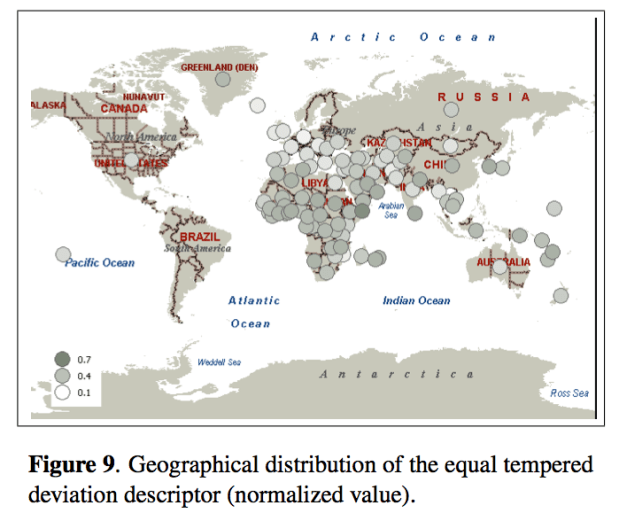
Music and Geography: Content Description of Musical Audio from Different Parts of the World
Emilia Gómez, Martín Haro and Perfecto Herrera
Abstract: This paper analyses how audio features related to different musical facets can be useful for the comparative analysis and classification of music from diverse parts of the world. The music collection under study gathers around 6,000 pieces, including traditional music from different geographical zones and countries, as well as a varied set of Western musical styles. We achieve promising results when trying to automatically distinguish music from Western and non-Western traditions. A 86.68% of accuracy is obtained using only 23 audio features, which are representative of distinct musical facets (timbre, tonality, rhythm), indicating their complementarity for music description. We also analyze the relative performance of the different facets and the capability of various descriptors to identify certain types of music. We finally present some results on the relationship between geographical location and musical features in terms of extracted descriptors. All the reported outcomes demonstrate that automatic description of audio signals together with data mining techniques provide means to characterize huge music collections from different traditions, complementing ethnomusicological manual analysis and providing a link between music and geography.
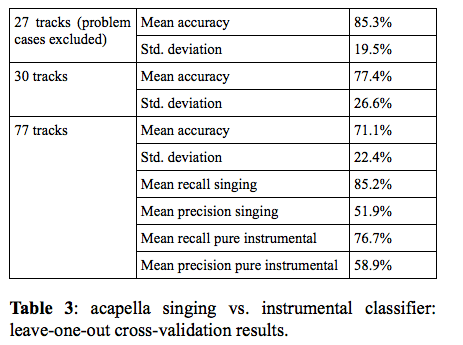
You Call That Singing? Ensemble Classification for Multi-Cultural Collections of Music Recordings
Polina Proutskova and Michael Casey
Abstract: The wide range of vocal styles, musical textures and re- cording techniques found in ethnomusicological field recordings leads us to consider the problem of automatic- ally labeling the content to know whether a recording is a song or instrumental work. Furthermore, if it is a song, we are interested in labeling aspects of the vocal texture: e.g. solo, choral, acapella or singing with instruments. We present evidence to suggest that automatic annotation is feasible for recorded collections exhibiting a wide range of recording techniques and representing musical cultures from around the world. Our experiments used the Alan Lomax Cantometrics training tapes data set, to encourage future comparative evaluations. Experiments were con- ducted with a labeled subset consisting of several hun- dred tracks, annotated at the track and frame levels, as acapella singing, singing plus instruments or instruments only. We trained frame-by-frame SVM classifiers using MFCC features on positive and negative exemplars for two tasks: per-frame labeling of singing and acapella singing. In a further experiment, the frame-by-frame classifier outputs were integrated to estimate the predominant content of whole tracks. Our results show that frame-by- frame classifiers achieved 71% frame accuracy and whole track classifier integration achieved 88% accuracy. We conclude with an analysis of classifier errors suggesting avenues for developing more robust features and classifier strategies for large ethnographically diverse collections.
ISMIR Oral Session – Folk Songs
Session Title: Folk songs
Session Chair: Remco C. Veltkamp (Universiteit Utrecht, Netherland)
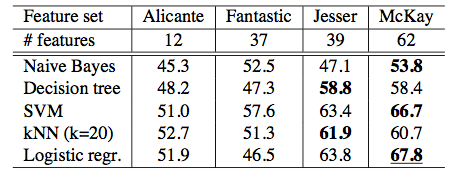
Global Feature Versus Event Models for Folk Song Classification
Ruben Hillewaere, Bernard Manderick and Darrell Conklin
Abstract: Music classification has been widely investigated in the past few years using a variety of machine learning approaches. In this study, a corpus of 3367 folk songs, divided into six geographic regions, has been created and is used to evaluate two popular yet contrasting methods for symbolic melody classification. For the task of folk song classification, a global feature approach, which summarizes a melody as a feature vector, is outperformed by an event model of abstract event features. The best accuracy obtained on the folk song corpus was achieved with an ensemble of event models. These results indicate that the event model should be the default model of choice for folk song classification.
Robust Segmentation and Annotation of Folk Song Recordings
Meinard Mueller, Peter Grosche and Frans Wiering
Abstract: Even though folk songs have been passed down mainly by oral tradition, most musicologists study the relation between folk songs on the basis of score-based transcriptions. Due to the complexity of audio recordings, once having the transcriptions, the original recorded tunes are often no longer studied in the actual folk song research though they still may contain valuable information. In this paper, we introduce an automated approach for segment- ing folk song recordings into its constituent stanzas, which can then be made accessible to folk song researchers by means of suitable visualization, searching, and navigation interfaces. Performed by elderly non-professional singers, the main challenge with the recordings is that most singers have serious problems with the intonation, fluctuating with their voices even over several semitones throughout a song. Using a combination of robust audio features along with various cleaning and audio matching strategies, our approach yields accurate segmentations even in the presence of strong deviations.
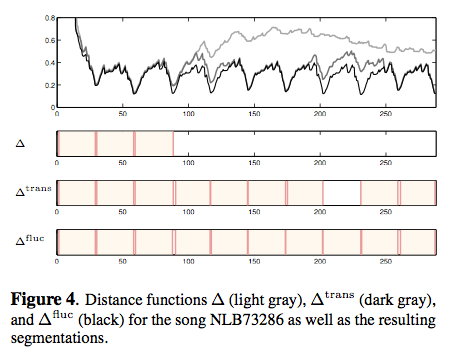
Notes: Interesting talk (as always) by Meinard about dealing with real world problems when dealing with folk song audio recordings.
Supporting Folk-Song Research by Automatic Metric Learning and Ranking
Korinna Bade, Andreas Nurnberger, Sebastian Stober, Jörg Garbers and Frans Wiering
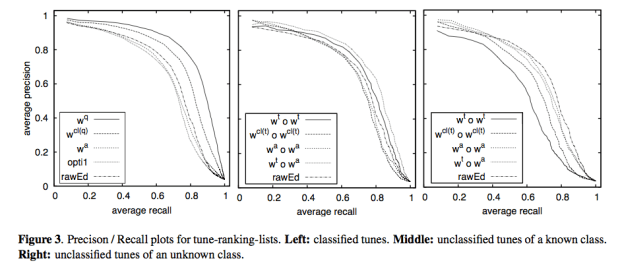
Abstract: In folk song research, appropriate similarity measures can be of great help, e.g. for classification of new tunes. Several measures have been developed so far. However, a particular musicological way of classifying songs is usually not directly reflected by just a single one of these measures. We show how a weighted linear combination of different basic similarity measures can be automatically adapted to a specific retrieval task by learning this metric based on a special type of constraints. Further, we describe how these constraints are derived from information provided by experts. In experiments on a folk song database, we show that the proposed approach outperforms the underlying basic similarity measures and study the effect of different levels of adaptation on the performance of the retrieval system.
ISMIR 2009 – The Industry Panel

On Thursday I participated in the ISMIR industrial panel. 8 members of industry talked about the issues and challenges that they face in industry. I had a good time on the panel, the panelists were all on target and very thoughtful, and there were great questions from the audience. I’m happy too that the IRC channel offered a place for those to vent without the session turning into SXSW-style riot.
Justin Donaldson kept good notes on the panel and has posted them on his blog: ISMIR 2009 Industry Panel
Taiko at the ISMIR 2009 Banquet
During the ISMIR Banquet (held in the most beautiful place in the world, the Kobe Kachoen) we were entertained by the Maturishu a Taiko performance group. They were just fantastic:
 Music Machinery