Paul

I'm the Director of Developer Community at The Echo Nest, a research-focused music intelligence startup that provides music information services to developers and partners through a data mining and machine listening platform. I am especially interested in hybrid music recommenders and using visualizations to aid music discovery.
Amsterdam Music Hack Day
Posted in Music, The Echo Nest on April 24, 2010
The Amsterdam Music Hack Day is underway. The Echo Nest is participating but due to some problems with actually getting there, we are participating virtually. We needed someone to physically give our API presentation – Matt Ogle of Last.fm graciously offered to give it – so around 5AM this morning I had the surreal experience of watching via a streaming webcam, employee #1 of Last.fm don an Echo Nest tee-shirt and talk about the Echo Nest APIs. Surreal especially since many of our APIs overlap with Last.fm’s wonderful APIs – its kind of like seeing a Mercedes car salesman helping BMW meet their sales quota. So many thanks to Matt – he’s a totally classy guy. He did such a great job that people tweeted that they thought the Echo Nest API presentation was one of their favorites of the music hack day.
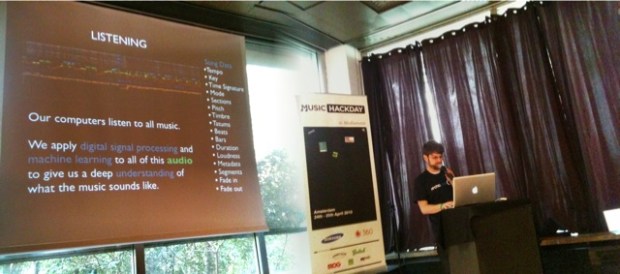
Matt Ogle wearing an Echo Nest shirt presenting the Echo Nest API (photo by frenkie)
We are releasing a bunch of new stuff this weekend. So much stuff, in fact that it is hard to write about it all in one post, so I shall be posting in small doses. Here’s what’s new from the Echo Nest:
- New, awesome music fingerprinter: ENMFP
- New API architecture: harder, faster, better, stronger
- New Song API – get detailed info on just about any song in the world
- New remix technology – create infinite versions of your favorite songs (more on this soon)
- New Java and Python clients that let you access all of our features (such as Rosetta Stone)
So what is a Music Hack Day all about? It’s the hacking! This video gives you a taste:
The Echo Nest Song API
Posted in Music, The Echo Nest, web services on April 24, 2010
- Performance – api method calls run faster – on average API methods are running 3X faster than the older version.
- JSON Output – all of our methods now support JSON output in addition to XML. This greatly simplifies writing client libraries for the Echo Nest
- Nimble coding – with the new architecture it will be much easier for us to roll out new features – so expect to see new features added to the Echo Nest platform every month
- No cruft – we are revisiting our APIs to try to eliminate inconsistencies, redundancies and unnecessary features to make them as clean as we can.
The beta version of our next generation APIs are here: http://beta.developer.echonest.com/
The first significant new API we are adding is the Song API – this gives you all sorts of ways to search for and retrieve song level data. With the song API you can do the following:
- search for songs via artist name, song title, and description. You can affect the results with constraints and sorts:
- constrain the results by a number of factors including musical attributes like tempo, loudness, time signature and key, artist hotttnesss, location
- sort – the results by any of the attributes
- Find similar songs – find similar songs to a seed song
- Find profile – get all sorts of info about a song including audio, audio summary info, track data for different catalogs, song hottttnesss, artist_hotttnesss, artist_location, and detailed track analysis
- Identify songs – works in conjunction with the ENMFP
There are lots of things you can do with this API. Here’s just a quick sample of the types of queries you can make:
Find the loudest thrash songs
song/search?sort=loudness-desc&description=thrash
Find indie songs for jogging
song/search?min_tempo=120&description=indie&max_tempo=125
Fetch the tempo of Hey Jude
search?title=hey+jude&bucket=audio_summary&artist=the+beatles
Fetch the track audio and analysis of Bad Romance
search?title=bad+romance&bucket=tracks&bucket=id:paulify&artist=lady+gaga
Find songs similar to Bad Romance
song/similar?id=SOAOBBG127D9789749
- jen-api – a java client
- beta_pyechonest – a new branch of the venerable pyechonest library. Grab it from SVN with
svn checkout http://pyechonest.googlecode.com/svn/branches/ beta-pyechonest-read-only
I’ll be writing more about all of the new APIs real soon. Access the beta Echo Nest APIs here:
What is that song?
Posted in Music, The Echo Nest on April 24, 2010
One of the biggest problems faced by music application developers is song identification – that is – given an mp3 file, how can you accurately find the name of the song, album and artist? There are some hints in the mp3 file – the file name and the ID3 tags contain metadata about the track – but anyone who has worked with this metadata knows that this data is notoriously hard to deal with. The metadata is often missing, inconsistently formatted or just plain wrong. The result of this difficulty is that music application developers spend an inordinate amount of time just dealing with song identification.
Here at the Echo Nest we want to make it easy for developers to create music applications so we really want to solve the music metadata problem once and for all. That’s why we’ve created music fingerprinting technology. Today, we are starting to release it to the world.
The Echo Nest music fingerprinter takes a bit of music such as an MP3 and identifies the song based solely on the musical attributes of the song. No matter how messy the metadata is, the fingerprinter can identify the song since it relies on the music to do the identification. On his blog, Echo Nest co-founder Brian Whitman dives into the technical details of the Echo Nest Musical Fingerprinter.
 This is not the first audio fingerprinter in the world, but we think our fingerprinter is distinctive in several important ways:
- Very fast – under a second to ID a track
- Very accurate – uses Echo Nest music analysis technology at the core. (we hope to publish some data on ENMFP accuracy real soon)
- Open Data – all of the mapping of fingerprints to songs is open data. Anyone can get the data
- Open server – all of the server code is open – you can host your own FP server if you wish
We want to make sure that anyone who takes advantage of the EN Fingerprinter participates fully in the ENMFP ecosystem – and so it is licensed so that anyone who uses the fingerprinter technology will share their FP/song mapping data with everyone. No walled gardens – if you benefit from the ENMFP you are also helping others that are using the ENMFP.
It is still early days with the fingerprinter – we are doing a soft release. If you want to experiment with the ENMFP and you are at the Amsterdam music hackday this weekend send an email to enmfp@echonest.com with your intended use case. We will get back to you ASAP with a link to libraries for Mac, Windows and Linux.
When 4Chan Gamed the Time 100
Posted in Music on April 22, 2010
Last week I did a skype interview with a reporter from Time who was interested in the backstory on how the 2009 Time 100 Poll was hacked. They’ve put it all together into a nifty video segment: When 4Chan gamed the TIME 100

Music Hack Days are awesome
Posted in events, Music, The Echo Nest on April 10, 2010

Flickr photo by paulamarttila
There are now two Music Hack Days on the calendar for the next month: Amsterdam on April 24th, 25th and San Francisco on May 15th, 16th.
The Echo Nest will be participating in both. We just love music hack days – the amount of creativity that gets packed into one room during a hack day is just amazing. Plus it is a great way to meet developers face-to-face to see how they use are stuff. Brian will be representing at the Amsterdam event (I think Brian really likes Amsterdam). He’ll be showing off some new APIs that we are all really excited about – plus we’ll be giving our new API infrastructure a workout – everything will (hopefully) be faster, more reliable, better documented.
Right on the heals of the Amsterdam event is the San Francisco Hack Day. It is being hosted at the Automattic Lounge on Pier 38 right in the city. The event is filling up really fast – there’s lots of pent up demand for a hack day in SF – and the mention in Techcrunch didn’t hurt. At the SF hack day if the stars align we’ll be releasing another new API feature – one that is perhaps the most requested feature of our APIs. Can’t wait. Oh and the SF Music Hack Day is right between two other cool music events: The Bay Area Computer Music Technology Group (BArCMuT) meetup on Thursday May 13, and the SF Music Tech Summit on Monday May 17th.
Wondering what a music hack day is like? Check out these photos: Flickr Slide show of Music Hack days past
Which band has the hotttnesss?
Posted in Music, The Echo Nest on April 9, 2010
Developer/musician Paul Barrett (aka echodeck) has created pop.ularity a nifty web-based music quiz based on last.fm and the Echo Nest APIs. In the quiz you try to guess which band is hotter on the web. The quiz uses Last.fm plays, Last.fm listeners, Echo Nest Hottttnesss and Echo Nest familiarity to measure popularity for each band.
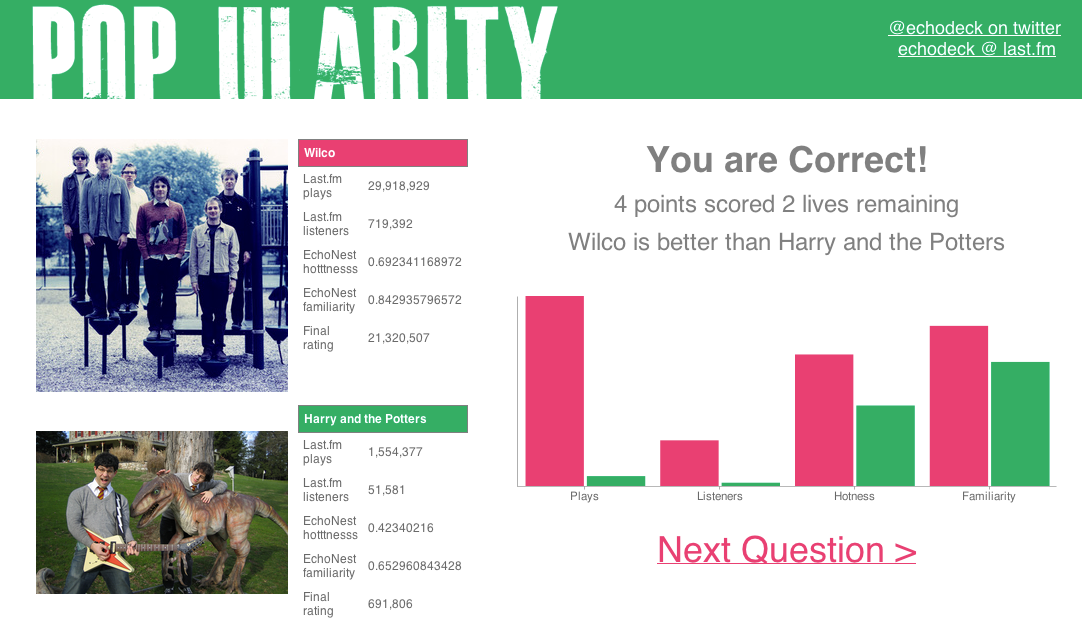 It’s a fun game – give it a whirl! http://pop.ularity.co.uk/
Can you judge an album by its cover?
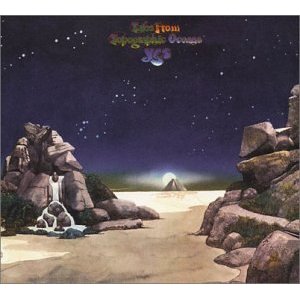 Album art has always been a big part of music. It is designed to catch your eye in a record store, and also perhaps to give you a hint as to what kind of music is inside. Music Information Retrieval scientists Jānis Lībeks and Douglas Turnbull from Swathmore are interested in learning more about how much information an album cover can give you about the music. They are conducting a simple study – they present the participants with a set of album art and the participants try to guess the genre of the artist based only upon what they see. It’s the genre identification task that uses album art as the feature set.
Anyone can participate in the study, it takes about 5 to 10 minutes – and its fun to look at an album cover and try to guess what’s inside. I’m looking forward to seeing the results of the study when they publish.

Spying on how we read
Posted in data, Music, recommendation on March 26, 2010
 [tweetmeme source=”plamere” only_single=false] I’ve been reading all my books lately using Kindle for iPhone. It is a great way to read – and having a library of books in my pocket at all times means I’m never without a book. One feature of the Kindle software is called Whispersync. It keeps track of where you are in a book so that if you switch devices (from an iPhone to a Kindle or an iPad or desktop), you can pick up exactly where you left off. Kindle also stores any bookmarks, notes, highlights, or similar markings you make in the cloud so they can be shared across devices. Whispersync is a useful feature for readers, but it is also a goldmine of data for Amazon. With Whispersync data from millions of Kindle readers Amazon can learn not just what we are reading but how we are reading. In brick-and-mortar bookstore days, the only thing a bookseller, author or publisher could really know about a book was how many copies it sold. But now with the Whispersync Amazon can get learn all sorts of things about how we are reading. With the insights that they gain from this data, they will, no doubt, find better ways to help people find the books they like to read.
I hope Amazon aggregates their Whispersync data and give us some Last.fm-style charts about how people are reading. Some charts I’d like to see:
- Most Abandoned – the books and/or authors that are most frequently left unfinished. What book is the most abandoned book of all time? (My money is on ‘A Brief History of Time’) A related metric – for any particular book where is it most frequently abandoned? (I’ve heard of dozens of people who never got past ‘The Council of Elrond’ chapter in LOTR).
- Pageturner – the top books ordered by average number of words read per reading session. Does the average Harry Potter fan read more of the book in one sitting than the average Twilight fan?
- Burning the midnight oil – books that keep people up late at night.
- Read Speed – which books/authors/genres have the lowest word-per-minute average reading rate? Do readers of Glenn Beck read faster or slower than readers of Jon Stewart?
- Most Re-read – which books are read over and over again? A related metric – which are the most re-read passages? Is it when Frodo claims the ring, or when Bella almost gets hit by a car?
- Mystery cheats – which books have their last chapter read before other chapters.
- Valuable reference – which books are not read in order, but are visited very frequently? (I’ve not read my Python in a nutshell book from cover to cover, but I visit it almost every day).
- Biggest Slogs – the books that take the longest to read.
- Back to the start – Books that are most frequently re-read immediately after they are finished.
- Page shufflers – books that most often send their readers to the glossary, dictionary, map or the elaborate family tree. (xkcd offers some insights)
- Trophy Books – books that are most frequently purchased, but never actually read.
- Dishonest rater – books that most frequently rated highly by readers who never actually finished reading the book
- Most efficient language – the average time to read books by language. Do native Italians read ‘Il nome della rosa‘ faster than native English speakers can read ‘The name of the rose‘?
- Most attempts – which books are restarted most frequently? (It took me 4 attempts to get through Cryptonomicon, but when I did I really enjoyed it).
- A turn for the worse – which books are most frequently abandoned in the last third of the book? These are the books that go bad.
- Never at night – books that are read less in the dark than others.
- Entertainment value – the books with the lowest overall cost per hour of reading (including all re-reads)
Whispersync is to books as the audioscrobbler is to music. It is an implicit way to track what you are really paying attention to. The data from Whispersync will give us new insights into how people really read books. A chart that shows that the most abandoned author is James Patterson may steer readers away from Patterson and toward books by better authors. I’d rather not turn to the New York Times Best Seller list to decide what to read. I want to see the Amazon Most Frequently Finished book list instead.
SoundBite for Songbird
Posted in Music, music information retrieval, research, visualization on March 23, 2010
Steve Lloyd of Queen Mary University has released SongBite for Songbird. (Update – if the link is offline, and you are interested in trying SoundBite just email soundbite@repeatingbeats.com ). SongBite is a visual music explorer that uses music similarity to enable network-based music navigation and to create automatic “sounds like” playlists.
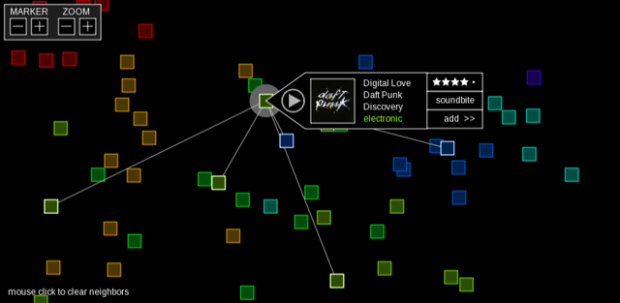
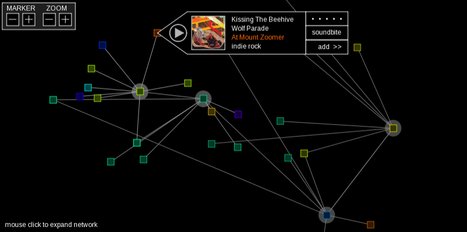
Here’s a video that shows SoundBite in action:
It’s a pretty neat plugin for Songbird. It’s great to see yet another project from the Music Information Retrieval community go mainstream.
Lady Gaga meets Edward Tufte
Posted in Music, The Echo Nest, visualization, web services on March 22, 2010
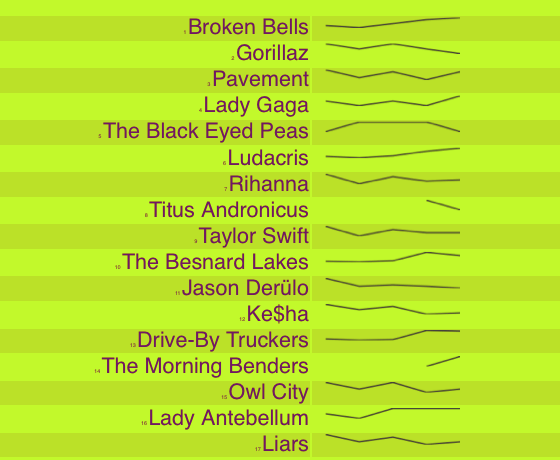
In his spare time, Echo Nest developer Reid Draper built hotttnesss.com – a neat web app that shows the top 50 hotttest artists (according to the Echo Nest get_top_hottt_artists) along with sparklines showing the historical hotttnesss for the last week. Reid used the nifty jquery sparklines plugin to make it happen. Mouse over an artist name to get links to the Last.fm and Spotify pages for the artist so you can find out what the big deal is about Broken Bells or lyaz.

