Posts Tagged Music
Auto-tune for the iPhone
According to Rebecca, it is already the in the top 5 iPhone paid apps, (and it was only released yesterday). Congrats to Rebecca and the rest of the Smule team for creating yet another really cool iPhone music app.
What’s your favorite visualization for music discovery?
Posted by Paul in Music, research, visualization on September 4, 2009
 Justin and I have been working on our tutorial on using visualizations for music discovery to be presented ISMIR 2009. One part of this tutorial will be a survey of current commercial and research-oriented systems that use visualization to help people explore for and discover new music. Ultimately we hope to build a comprehensive web directory of these visualization as part of the supplementary material for the tutorial. We could use your help building this directory. If you know of an interesting visualization that is used for music discovery (or even a technique that you think *could* be used for music discovery), add a link/description in the comments on this post or send me an email at paul.lamere@gmail.com. Thanks much!
Music Hack Day Berlin
Posted by Paul in code, data, Music, The Echo Nest on September 1, 2009
On the heals of the very successful London Music Hackday, comes the Berlin Music Hackday which will be held on September 18/19/20 at the very cool Radialsystem V in Berlin Germany.

Site of the Berlin Music Hacday
The hackday is totally free for participants but is limited to 150 participants. (and if this is organized like the London hackday, if you want to attend, be prepared to describe how you hack hardware, software or music – not just anyone can fill one of the 150 slots).
The London hackday was such a great event, I’m glad to see that it is being repeated in different parts of the world. Look for more Music Hackdays coming to a city near you.

Hacking music at the London Music Hackday
Cool music 2.0 panels at SXSW
I took a tour through the many music 2.0 related panels for SXSW 2010. Here’s my short list of favorites.
- Music Discovery Redux – Controlled Chaos – Continuing the fun debate from SXSW 2009 about music discovery – humans vs. machines, metrics
- Screw Music and Mobiles, I have my iPod! – Petar Djekic from Mufin looks at the mobile music business
- Practical Uses for Music Industry Technical Standards – Discussion of how OEM’s, music services, social networks, retailers are working together to create monetizable music services in the cloud
- Visual Music and Realtime Interactive Performance – This panel explores how to engage audiences, foster collaboration, remix, mashup, create opportunities for dynamic improvisation, and prepare for tomorrow’s advances in live performance
- Online Tastemakers: Death or Rebirth of Music Curation – . A new breed of tastemakers are cropping up with innovative twists. Are they helping or hurting? Is online music curation dying or evolving?
- Set Your Data Free – a panel on copyrights and licenses
- Realtime Social Discovery – Using people to Find Content – Instead of using tags, genres or other slices, instead allow users to interact with your content, let users form relationships (the social graph) and then see their friend’s interactions with your site.
- The State of Music Blogs in 2010 – Just how important are music blogs to the industry today, is that prominence growing or fading, and how will new technologies and strategies impact the marketing mix in the coming year?
- Bands, Fans and Brands – Learning from past music industry hits and misses, this panel will evaluate the ways music and technology intersects, delighting fans while challenging labels.
- 10 Cool Audacity Tricks You (probably) Didn’t Know – the title says it all
- Remixing for the Masses – My totally self-serving recommendation. In this panel we show how automatic music analysis and remix technology is making it easier for anyone to create their own music remixes, from simple alterations like adding more cowbell to your favorite song to complex manipulations that would be worthy of the next ‘Grey Album’.
The best way to make sure that a cool panel will be held is to go and vote for it.
The Stairway Detector
Posted by Paul in data, fun, Music, playlist, The Echo Nest, web services on August 17, 2009
Last night I was watching the pilot for Glee (a snarky TV version of High school musical) with my 3 teenage daughters. I was surprised to hear the soundtrack filled with songs by the band Journey, songs that brought me back to my own high school years. The thing that I like the most about Journey is that many of their songs have this slow and gradual build up over the course of the whole song as in this song Lovin Touchin Squeezin:
A number of my favorite songs have this slow build up. The canonical example is Zep’s ‘Stairway to Heaven’ – it starts with a slow acoustic guitar and over the course of 8 minutes builds to metal frenzy. I thought it would be fun to see if I could write a bit of software that could find the songs that have the same arc as ‘Stairway to Heaven’ or ‘Lovin, Touchin Squeezin’ – songs that have this slow build. With this ‘stairway detector’ I could build playlists filled with the songs that fire me up.
The obvious place to start with is to look how the loudness of a song changes overtime. To do this I used the Echo Nest developer API to extract the loudness as a function of time for Journey’s Lovin, Touchin Squeezin:
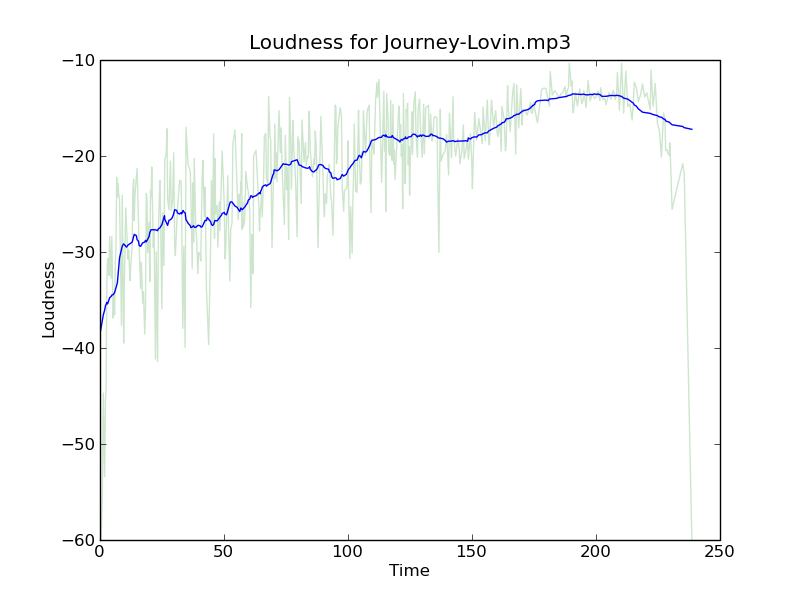 In this plot the light green curve is the loudness, while the blue line is a windowed average of the loudness. This plot shows a nice rise in the volume over the course of the song. Compared to a song like the Beatles ‘Ticket to Ride’ that doesn’t have this upward slope:
 From these two examples, it is pretty clear that we can build our stairway-detector just by looking at the average slope of the volume. The higher the slope, the bigger the build. Now, I suspect that there’s lots of ways to find the average slope of a bumpy line – but I like to always try the simplest thing that could possibly work first – and for me the simplest thing was to just divide the average loudness of the second half of the song by the average loudness of the first half of the song. So for example, with the Journey song the average loudness of the second half of the song is -15.86 db and the average of the first half of the song is -24.37 db. This gives us a ratio of 1.54, while ‘Ticket to ride’ gets a ratio of 1.06. Here’s the Journey song with averages shown:
 Here are a few more songs that fit the ‘slow build’ profile:
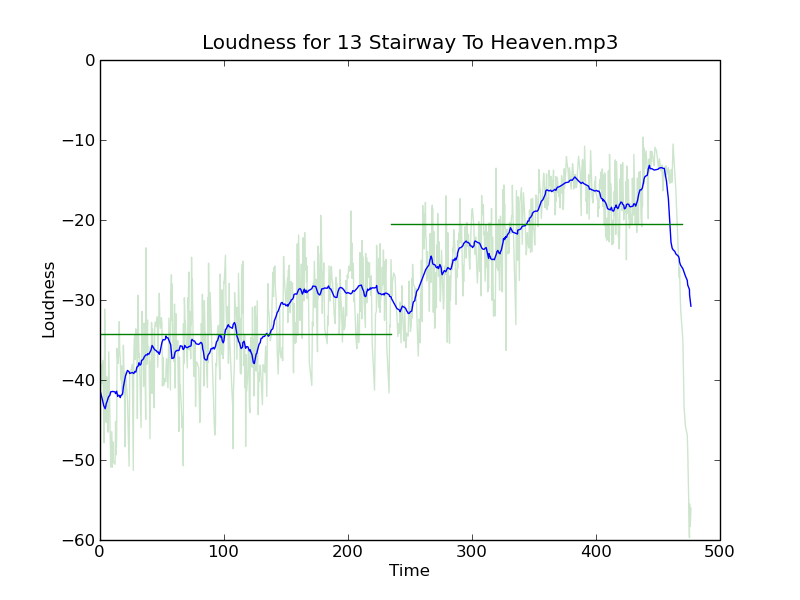 ‘Stairway to Heaven’ has a score of 1.6 so it has a bigger build than Journey’s Lovin’.
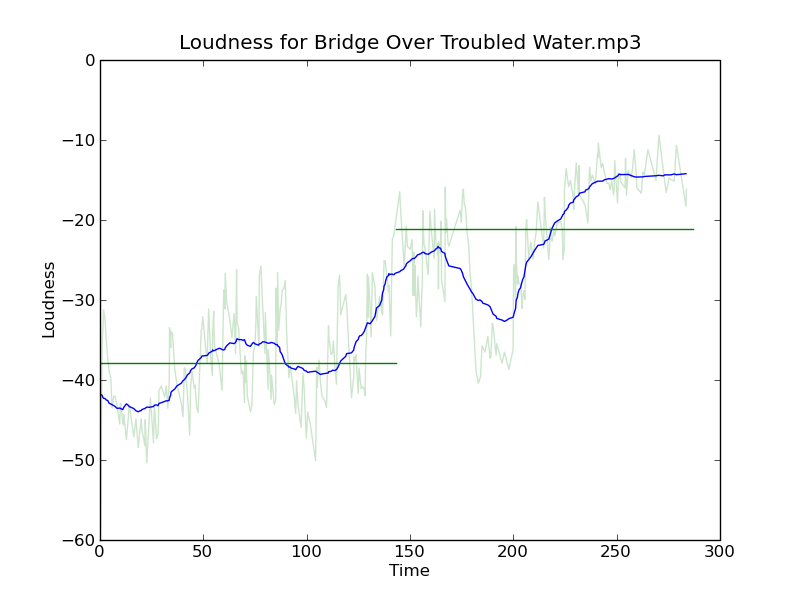 Simon and Garfunkle’s ‘Bridge over troubled water’ has an even bigger build with a score of 1.7.
 Also sprach Zarathustra has a more modest score of 1.56
With this new found metric I analyzed a few thousand of the tracks in my personal collection to find the songs with the biggest crescendos. The biggest of all was this song by Muse with a whopping score of 3.07:
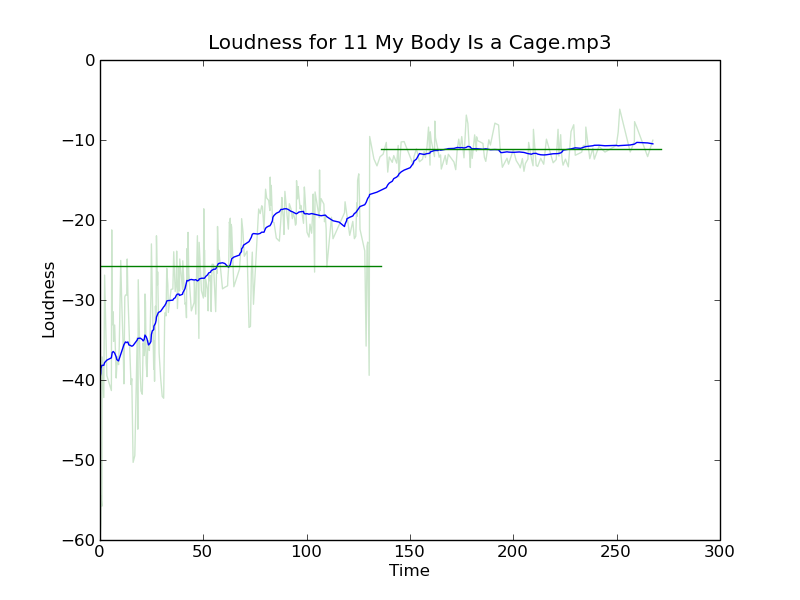
 Another find is Arcade Fire’s “My Body is a Cage” with a score of 2.32.
The metric isn’t perfect. For instance, I would have expected Postal Services ‘Natural Anthem’ to have a high score because it has such a great build up, but it only gets a score of 1.19. Looking at the plot we can see why:
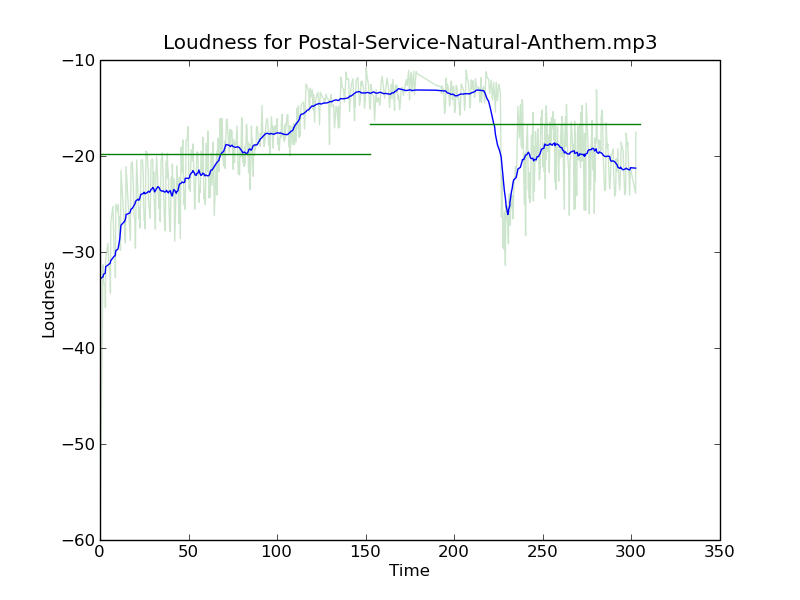 After the initial build up, there’s a drop an energy for that last quarter of the song, so even though the song has a sustained crescendo for 3 minutes it doesn’t get a high score due to this drop.
Of course, we can use this ratio to find tracks that go the other way, to find songs that gradually wind down. These seem to occur less frequently than the songs that build up. One example is Neutral Milk Hotel’s Two Headed Boy:

Despite the fact that I’m using a very naive metric to find the loudness slope, this stairway detector is pretty effective in finding songs that have that slow build. It’s another tool that I can use for helping to build interesting playlists. This is one of the really cool things about how the Echo Nest approaches music playlisting. By having an understanding of what the music actually sounds like, we can build much more interesting playlists than you get from genius-style playlists that only take into account artists co-occurrence.
Spotify for the iPhone
On the Spotify blog they have a video of the latest version of the Spotify iPhone app that has just been submitted to the iPhone app store for approval. Notice how on the video, the Spotify client is in the position on the home screen that the iPod app normally occupies. I wonder if Apple is going to like this.
Some of the interesting details emerging about the app are:
- Won’t be released in the US app store since Spotify is not available in the U.S (sniff)
- Free Download
- Only works for premium users
- Offline mode allows you to cache 3,333 tracks (!)
- Works on iPod touch
- Music stops when you switch away from the app
I’m really looking forward to being able to run this app. And rumor is that it won’t be long before people in the US get to play.
The Sinister Index
Posted by Paul in data, fun, Music, research, The Echo Nest, web services on July 8, 2009
 Like many, I like to eat Cheetos,
  when I’m relaxing and browsing the web, especially when I’m looking for new music. The problem is that Cheetos leaves this nasty residue on the fingers which gets transferred to the keyboard rather quickly. To avoid this problem I like to use my keyboard one handed (I know what you are thinking, but really, its the Cheetos). Which is why one of my favorite bands is Weezer. I can type ‘weezer’ with my left hand leaving my right hand free for Cheetos, and leaving my keyboard clean. Still, I was in the mood for music by some other bands so I thought it would be interesting to find all of the bands that can be typed using just my left hand. I wrote a Python script, ran it on a list of about 800 thousand artist names and came up with a rather large list of sinister band names. Here are the longest:
der weg des wassers
everette red bear
sweet ever after
state far better
cassettezzzzzzzz
barbara decesare
westgate street
streetbeat crew
street bastards
reve de cabaret
rebecca everett
cabezas de cera
barbara taggart
warsaw was raw
Restricting the search to just the more popular artists I find this list of popular sinister artists:
wet wet wet
savatage
bee gees
seabear
garbage
cascada
carcass
caesars
weezer
feeder
vader
texas
sweet
stars
seeed
eve 6
dredg
creed
vast
sade
free
bebe
abba
xtc
war
rza
eve
era
d12
atb
afx
abc
311
112
bt
To be evenhanded, I offer this list of dexterous artists:
phillip moll
phillip hill
yumiko ohno
yoon il-loh
uh uh loony
polmo polpo
pinko pinko
opi yum yum
oli oli oli
oh no oh my
nylon union
nylon pylon
monki monki
homo homini
yuko kouno
yuho yokoi
And a list of popular dexterous artists:
yoko ono
moloko
pulp
pink
mylo
mono
koop
mum
iio
him
l7
There seem to be many more sinister artists than dexterous artists. I suspect that this is because many artists now recognize the Cheetos issue and are selecting sinister names. Since identifying sinister artists is becoming such a big issue in music search, we will likely be offering a sinister index as part of The Echo Nest web services. The sinister index is a number between zero and one that indicates how easy it is to type the artist name with your left hand. Weezer has a sinister index of 1 while Yoko Ono has a sinister index of zero. Look for it soon.
The Coolness Index
Posted by Paul in data, fun, Music, The Echo Nest on July 1, 2009
Some artists just are not cool – your mom likes ABBA, so there’s no way you are going to listen to them, even if you think Mamma Mia is rather catchy. Likewise you may think High School Musical’s ‘Bop to the top’ is mucho gusto, but you don’t want anyone to know it. Coolness is hard to quantify, ephemeral and transient (and of course, very subjective); some artists like Miles Davis and the Velvet Underground will always be totally cool – while some fade in and out of coolness (Elvis, Stevie Wonder, Neil Diamond, Sting), and some artists – well, it is hard to tell if they were ever cool (Miley Cyrus, Creed, and Nickeback come to mind).
Imagine if there was an objective measure for coolness – a number that could be attached to each artist that indicated how ‘cool’ the artist was. We’d be able to do all sorts of interesting things with such a ‘coolness index’. We could make a ‘music makeover’ playlist that would take you from Miley to Miles in 12 songs (consider it a 12-step taste recovery program) or we could create a music rehab playlist that takes you from Amy Winehouse to Kate Nash. But of course, the concept of cool is too hard to nail down. Is Johnny Cash cool? Michael Jackson? Prince? Context, demographics, locale all play a role.
It may be too hard to tell whether an artist is cool, but we have all sorts of ways to tell that an artist is definitely not cool. For instance, if lots of listeners really don’t want people to know that they are listening to a particular artist, then that artist is probably not too cool. Luckily, there’s an interesting source for just this kind of data. Recently, the researchers at Last.fm published a list of the ‘most unwanted scrobbles‘. This is a list of tracks that were most frequently deleted by the Last.fm community from their scrobbles in the last month. These are the tracks that Last.fm listeners didn’t want people to know that the listened to. Here’s the first page of the most unwanted scrobbles:
 Kudos to Last.fm for publishing this data. It’s a great source for the uncool. Collecting all the artists from the pages we can build a list of artists that have frequently had their scrobbles deleted:
Lady GaGa
Britney Spears
Katy Perry
Rihanna
Paramore
Coldplay
Taylor Swift
Beyoncé
Avril Lavigne
Marc Seales, composer. New Stories. Ernie Watts, saxophone
Alexander Rybak
Black Eyed Peas
Kings of Leon
Muse
My Chemical Romance
Linkin Park
Korn
Miley Cyrus
Jason Mraz
Metro Station
Leona Lewis
Green Day
Evanescence
Amy Whinehouse
Oasis
Nelly Furtado
This list rings true as set of ‘uncool’ artists (with the exception Marc Seales, who happens to have a piece of music, called ‘Highway Blues’, that can be found in most ‘Sample Music’ folders on most Windows XP computers, and is likely frequently scrobbled because of this). Ideally this list should be normalized for popularity – naturally artists that have more listeners will be scrobbled more and consequently be deleted more too. but there’s not enough data in this list to normalize properly so we’ll make do with an unnormalize list. I find it interesting how many female acts are on the list. Is it not cool to listen to female artists?
Another approach to find the uncool is to look for artists that have been tagged as ‘guilty pleasure’ on sites like Last.fm. For these artists, by applying the ‘guilty pleasure’ tag people are identifying artists that they are embarrassed to be listening to. Here’s a list of the top 100 popular artists that have been frequently tagged with ‘guilty pleasure’ – for this list I’m normalizing the data so popularity doesn’t factor into the list order:
Katy Perry
Ashlee Simpson
Spice Girls
Lindsay Lohan
Mandy Moore
Jessica Simpson
Backstreet Boys
Hilary Duff
Metro Station
Britney Spears
Justin Timberlake
Taylor Swift
Rihanna
The Pussycat Dolls
Kelly Clarkson
Christina Aguilera
Fall Out Boy
Take That
Avril Lavigne
Ricky Martin
Girls Aloud
Fergie
Neil Diamond
McFly
Robyn
The Veronicas
Ace of Base
ABBA
Cline Dion
Chris Brown
All Time Low
Kanye West
Gwen Stefani
Good Charlotte
P!nk
Usher
blink-182
R. Kelly
Nelly Furtado
The Get Up Kids
Madonna
Timbaland
Beyonce
New Found Glory
Natasha Bedingfield
Akon
Jem
Ciara
Robbie Williams
Paramore
The Wallflowers
Michelle Branch
Taking Back Sunday
Creed
Savage Garden
The All-American Rejects
Simple Plan
Shania Twain
Sugababes
Tegan and Sara
Everclear
Sugarcult
The Starting Line
Brand New
Destiny’s Child
Cyndi Lauper
Mariah Carey
Westlife
Maroon 5
Melanie C
Jennifer Lopez
Michael Jackson
Kelis
Tears for Fears
Alkaline Trio
Dashboard Confessional
Vanessa Carlton
Lily Allen
Bowling for Soup
Jet
50 Cent
Trivium
Cher
Eve 6
Sean Paul
Kylie Minogue
Howie Day
Sophie Ellis-Bextor
My Chemical Romance
Third Eye Blind
Saves the Day
Bryan Adams
Blondie
Boston
John Mellencamp
Simply Red
Whitney Houston
The Corrs
The Calling
Motion City Soundtrack
There’s overlap between the two lists: Avril, Britney, Katy, Nelly, Taylor, Rihanna, along with the Disney crowd. Again, there seems to be an anti-female coolness bias on the list. It is hard to be cool and female.
The ‘most unwanted scrobbles’ and the ‘guilty+pleasure’ approach to the coolness index only get us so far. They can help us identify music that people are embarrassed to admit that they enjoy. But they only give us one end of the coolness spectrum. We can find what is not cool, but we can’t find out what is cool. We have in effect an ‘Uncoolness Index’. Still, knowing which artists are uncool can be helpful for all sorts of things. If we are building a playlist for that party, we can turn on the uncool filter to make sure that Ricky Martin or Robbie Williams won’t sneak into the mix. Likewise, if we are building a recommender, we can use the Uncoolness index to decide how cool the user is and recommend music that’s slightly less uncool than what they are used to listening to.
Next steps are to figure out how to learn not just what is uncool, but also what is cool, so we can build the true ‘coolness index’ and be able to tell how cool any artist is. I think that is going to be a harder problem, but I have some ideas …
The Echo Nest Cocoa Framework
Posted by Paul in code, Music, The Echo Nest, web services on July 1, 2009
Kamel Makhloufi (aka melka) has created a Cocoa Framework for the Echo Nest and has released it as open source. This framework makes it easy for Mac developers (and presumable iPhone and iTouch developers) to use the Echo Nest API services. Kamel’s goal is to build an application similar to Audiosurf (a music-adapting puzzle racer that uses your own music), but along the way Kamel realized his framework may be useful to others and so he has released it for all of us to use.
The Framework supports all of the Track/Analysis methods of the API including Track Upload, getting tempos, duration, bar, beat and tatum info as well as detailed segment information. On Melka’s TODO list is to add the Echo Nest artist methods.
Using the framework, Melka created a nifty track visualization tool that will render a colorful representation of the Echo Nest analysis for a track:
 Kamel implemented this in about 300 lines of Objective-C code.
The Echo Nest Cocoa Framework is released under a GPL V3 license and is hosted on google code at: http://code.google.com/p/echonestcocoaframework/.
The release is just in time for Music Hackday – I’m hoping we see an iPhone app or two emerge from this event that use the Echo Nest APIs! Kamel’s framework is just the thing to make it happen
The Dissociated Mixes
Posted by Paul in fun, Music, remix, The Echo Nest, web services on June 30, 2009
Check out Adam Lindsay’s latest post on Dissociated Mixes. He’s got a pretty good collection of automatically shuffled songs that sound interesting and eerily different from the original. One example is this remixed audio/video of Beck’s Record Club cover of “Waiting for my Man” by The Velvet Underground and Nico:
 Music Machinery