The Way Out West Hack Battle 2

The Way Out West Hack Battle 2, a 2 day music hackathon conducted in conjunction with the Way Out West music festival in Gothenburg Sweden shows that when in comes to music hacking, there’s no place like Sweden. In 24 hours of hacking the 125+ hackers put together a total of 32 hacks. These hacks were some of the most clever and innovative set of hacks put together at any hackathon.
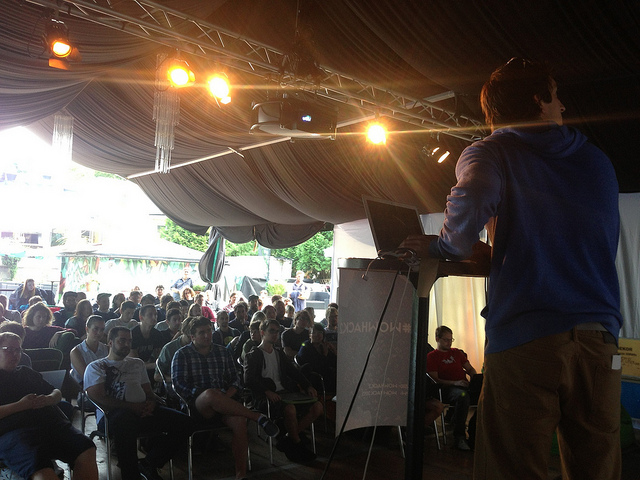
The SendGrid API workshop (Photo by Andrew Mager)
The hackathon began with short API presentations by companies such as Spotify, Facebook, Sendgrid and The Echo Nest. When I presented the Echo Nest API, I asked how many folks had heard of the Echo Nest. There were quite a few who didn’t know anything about the Echo Nest. But at the end of the hackathon I was quite pleased to see that half of the demos used the Echo Nest’s API. Some of my favorite Echo Nest hacks at the event were:


Music MAP – Music MAP is a Spotify app that lets you explore the world of music using a 3D globe. You can narrow your search down to country or region and filter the searches by genre and year. Looking for blues artists from the 1950s from Mississippi? The Music MAP can help you out. Music MAP was one of the winners of the Echo Nest Prize.
Lego Rock Raiders – This team built a Guitar Hero style game that you play by smashing on fruit (yes, real, juicy, sticky, messy fruit) that is connected to your computer (via makeymakey of course). This team used the Echo Nest API to find the notes and beats used to drive the game. Quite fun and creative. This hack also won an Echo Nest prize.
Other notable Echo Nest hacks were:
- intro ninja – similar artists and songs music guessing game – with a really good design
- beatiful – an infinite runner game for IOS – it uses Echo Nest analysis data of a song to generate the level.
- Time Traveling music machine – a music discovery tool that helps you find artist influences. You enter an artist and a year and go back in time to find that artist’s influences from that time.
- meshuggafy – a nifty web-based remixing tool
- SVT Playlist 2.0 – Uses the Echo Nest fingerprinter to identify music in TV shows shows. With this tool you can instantly find when your favorite music was played in your favorite TV show.
- My – Uses the Echo Nest data to help recommend music based upon your physical activity as determined by a fitbit.
- hackatune – A very nice looking and simple to use festival app that uses the Echo Nest to find the hotttest songs by festival artists.
- Autopilot – Get a customised festival schedule based on your social profile on Facebook, Spotify, Last-fm and Songkick. Then you can simply put on the AutoPilot and enjoy the ride!
- The Saddest Stylophonist – My hack – makes any song sadder and more pathetic by automatically adding a Stylophone accompaniment to the track.
- Spotify Screensaver 2 – Party Mode – a Chrome extension that adds a “Party Mode” that shows cover art, song name and Fan Art.
I had a great time at the event. I got to meet some really interesting folks. I sat next to Jens Nockert for much of the weekend. Jens is famous for writing audio decoders in Javascript. I hope he works for the Echo Nest some day. Jens was kind enough to let me tether through his iPhone so I could submit my hack when the local wifi connection to the Internet was getting overloaded.
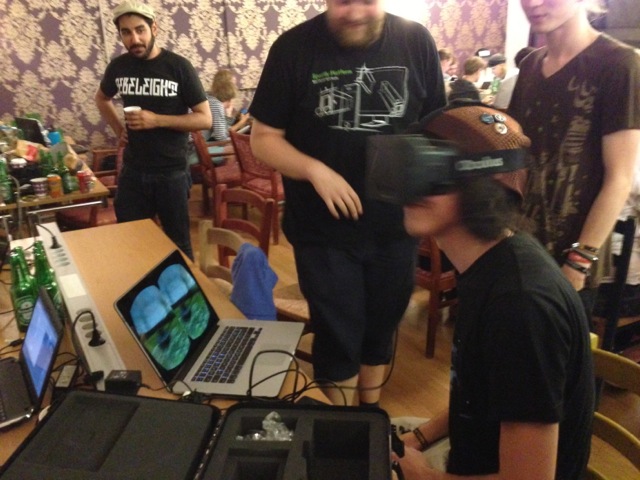
The Oculus Rift in action
I also got to chat with Per-Olov Jernberg. He brought an Oculus Rift to the hackathon and built a really nifty 3D music explorer with it. I got my first try with the 3D virtual reality goggles and I was really impressed with it. Quite immersive. Per-Olov is quite the hacker – he’s been adding Oculus Rift support to three.js. I was excited to hear that he’s joined the Spotify team and may be applying some of his considerable hacking skills to improving their API.
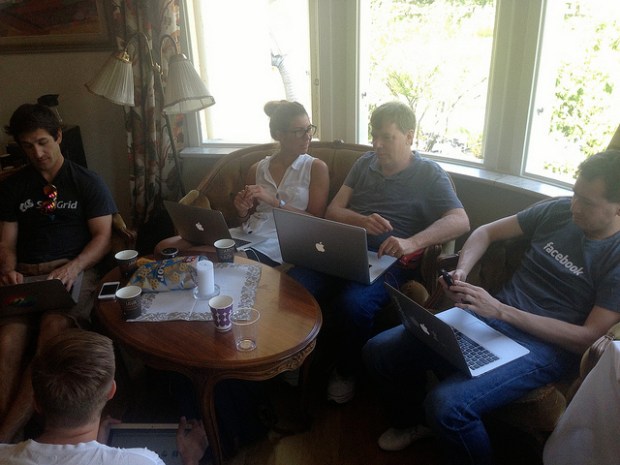
Hacking with SendGrid, Chalmers, and Facebook folk at #wowhack2 (Photo by Andrew Mager)
I also met a number of students from Chalmers University – they were a pretty innovative and tech savvy bunch of folks.
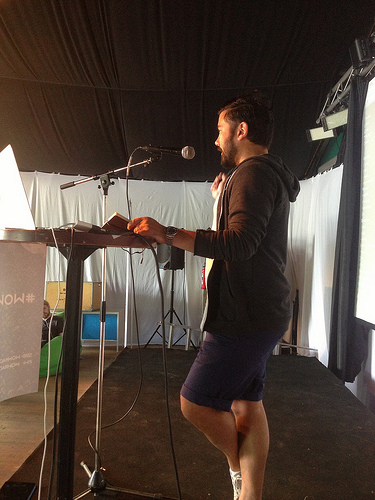
Paul Sonkamble giving some opening remarks (Photo by Andrew Mager)
#wowhack2 was a really great hackathon. Thanks to Paul Sonkamble and Andrew Mager for organizing such a cool event. Now for a day or two of exploring the Gothenburg city and countryside. It really is a beautiful part of the world.

A path in the woods on the island of STYRSÖ in the archipelago
HOW MACHINES CAN HELP US DISCOVER OVERLOOKED FILMS
Check out this post by my co-worker @ajaymkalia about how machines can help us discver overlooked films. I’m not sure if Ajay knows about the Shawshankr – http://shawshankr.com/

Feeling like I’d burned through my standard sources for movie recommendations, I recently decided to turn to box office failures. I was seeking out an automated way to explore the world of such movies and find “overlooked” films that are actually very good, but were ignored in theaters and dismissed by critics.
Using Nathan Rabin’s popular “My Year of Flops” series on The AV Club and follow-up book as a starting point, I designed an algorithm to predict whether a box office failure is actually a film worth seeing. The algorithm examines multiple aspects of a movie’s cultural response to make its prediction – such as applying sentiment analysis to capture the tone of reviews, and understanding whether critics and audiences responded differently to a movie. The output is a list of 100+ movies released over the past decade with high likelihood of being quality, “overlooked” films.
Here’s how it…
View original post 2,662 more words
The MobiusTube
I’m putting the finishing touches on my Music Hack Day Denver hack. My hack is called The MobiusTube. It’s the Infinite Jukebox for Youtube. With The MobiusTube you can watch a never-ending and ever-changing version of your favorite music video.
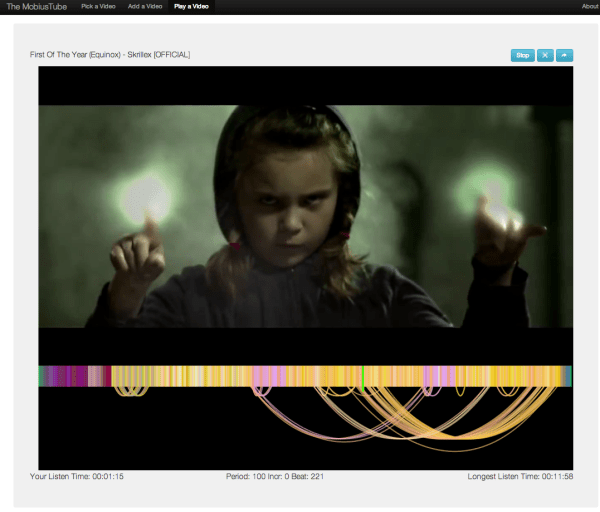
This is an incremental hack. Standing directly on the shoulders of the infrastructure that I built for the Infinite Jukebox, The Bonhamizer and Girl Talk in the Box.
The hack takes advantage of the new HTM5 Video capabilities – in particular, the ability to quickly segue to any position in a video (as long as that position is already in the play buffer). With that capability, it was pretty easy to repurpose the Infinite Jukebox to show synchronized video while playing an infinite song. I flattened the visualization used in the Infinite Jukebox into a strip of connected tiles that shows the relationships of all the beats.
There were a few interesting technical challenges involved in the hack. The first being how to extract audio from Youtube videos. Luckily there’s a very active open source python library called youtube-dl that provides a way to download most videos from youtube. The trusty swiss army knife of audio – ffmpeg – can then be used to extract the audio track so that it can be analyzed by The Echo Nest.
A significant challenge was the jitter in the HTML5 video slewing. Even under the best of circumstances, jumping to random points in a video would yield very unpleasant sounding audio artifacts. Skips and jitters made for a very unmusical experience. To deal with this, I decided to simply mute the video soundtrack and play the audio separately using the Web Audio API. The Web Audio API does a fine job of giving jitter and artifact free audio no matter how often and how far we jump in the audio track. Even if the video falls behind (which sometimes happens due to buffering), there’s a seamless audio experience.
I wanted to be able to keep track of how long any particular video was played, so I could keep a leader board of sorts. In previous hacks, I would have just kept this data in a flat file (PBLML format), but I decided to try to get into this decade – so I gave redis a try. I’m glad I did, it seems perfect for this kind of task.
I borrowed some of the interactive control logic from Girl Talk In a Box, so you can interact with The MobiusTube letting you dynamically rework a music video.
I still have a few things to clean up, but I hope some folks can give it a try and give me some feedback. It is online now. Check it out here: The MobiusTube
Rock Steady – My Music Ed Hack
This weekend I’m at The Music Education Hack in New York City where educators and technologists are working together to transform music education in New York City. My hack, Rock Steady, is a drummer training app for the iPhone. You use the app to measure how well you can keep a steady beat. Here’s how it works:

First you add songs from your iTunes collection. The app will then use The Echo Nest to analyze the song and map out all of the beats. Once the song is ready you enter Rock Steady training mode: The app will show you the current tempo of the song. Your goal then is to match the tempo by using your phone as a drumstick and tapping out the beat. You are scored based upon how well you match the tempo. There are three modes: matching mode – in this easy-peesy mode you listen to the song and match the tempo. A bit harder is silent mode – you listen to the song for a few seconds and then try to maintain the tempo on your own. Finally there’s bonzo mode – here the music is playing, but instead of you matching the music, the music matches you. If you speed up, the music speeds up, if you slow down, the music slows down. This is the trickiest mode – you have to keep a steady beat and not be fooled by the band that is following you.
This is my first iOS hack. I got to use lots of new stuff, such as Core Motion to detect the beats. I stole lots of code from the iOS version of the Infinite Jukebox (all the track upload and analysis stuff). It was a fun hack to build. If anyone thinks it is interesting I may try to finish it and put it in the app store.
Here’s a video:
[youtube http://www.youtube.com/watch?v=UsJ7RBkRAag]
Two music hackathons in NYC next weekend ….
Next weekend, (starting friday, June 28th) there are two music-related hackathons in NYC. First up, there’s The Hamr
Hacking Audio and Music Research (HAMR)
Organized by Colin Raffel is HAMR: Hacking Music and Audio Research. This hackathon is focused on music research with a goal of testing out new ideas rather than making a finished product. The focus of HAMR is on the development of new techniques for analyzing, processing, and synthesizing audio and music signals. HAMR will be modeled after a traditional hack day in that it will involve a weekend of fast-paced work with an emphasis on trying something new rather than finishing something polished. However, this event will deviate from the typical hack day in its focus on research (rather than commercial) applications. In addition to HAMRing out work, the event will include presentations, discussions, and informal workshops. Registration is free and researchers from any stage in their career are encouraged to participate. Read more about Hamr
The other hacking event is Music Education Hack
Music Education Hack
 The goal of the Music Education Hack is to explore how technology and help transform music education in NYC schools. Hackers will have 24 hours to ideate, collaborate and innovate, before presenting their work to a panel of esteemed judges for a grand prize of $5,000. The Hacker teams will have access to New York City teachers as part of the creation process as they focus on building products that incorporate music and technology into the education space. For more info visit the Music Education Hack registration page.
Infinite Jukebox on iOS
What’s nearly as anticipated as the re-release of Arrested Development? Why its the release of Infinite Jukebox for iPhone. I’ve finally started coding it and have something to show. Here it is running in the simulator:
[youtube http://www.youtube.com/watch?v=C11r-qYWM2E]And on my device:
[youtube http://www.youtube.com/watch?v=nW8FGR_ClpE&feature=youtube_gdata_player]There still a long way to go, but progress is being made. No tricks here, Michael. Illusions.
Update: Here’s Monday’s coding update .. now with fancy animations (as suggested by Ajay)
[youtube http://youtu.be/oztFUho0Gu0]
And the O Awards Nominees for Best Music Hack are …
I was pretty excited to learn that two of my recent music hacks have been nominated in the Best Music Hack category of the MTV O Music Awards:

 Other nominees include The Leap Orchestra, Ian Rogers’s Maebe and Tweet Concrete. If you are so inclined you can head on over to the O Awards site and vote your favorite music hack.
Jennie takes over the Internet
My daughter Jennie made a hack last week at Hill Holliday‘s TVnext Hack. She won her category, and ultimately went on to win the grand prize. She got lots of prizes including multiple iPads, Rokus boxes, Apple TVs, lots of money and even Viggle Points. Eliot wrote a really nice article about how Jennie found herself at the hackathon and how she managed to win it. Since then it has been a rather crazy week for Jennie. She’s received multiple internship offers, a number of interview requests and an offer to help market her hack. Today, her story got picked up by Mother Jones which has opened the mainstream media floodgates. In the last 24 hours there have been stories in: US News and World Report, The Los Angeles Times, Huffpo, CNET, Hollywood.com, Dailydot, The AV Club, IMDB, Turnstyle, The Mary Sue (The Geek Guide to Girl Culture) and Wil Wheaton! More to come tomorrow. Yes, it is a big day for Jennie – she had her last AP Exam of high school (Calculus), she got her birthday present (an iPhone), and she was interviewed for NPR Morning Edition (expect to hear her tomorrow morning Update – it is here). Her next life goal is to get more twitter followers than her friend Andrew (@ambushsabre). It’s a lot for someone just two days shy of her 18th birthday.
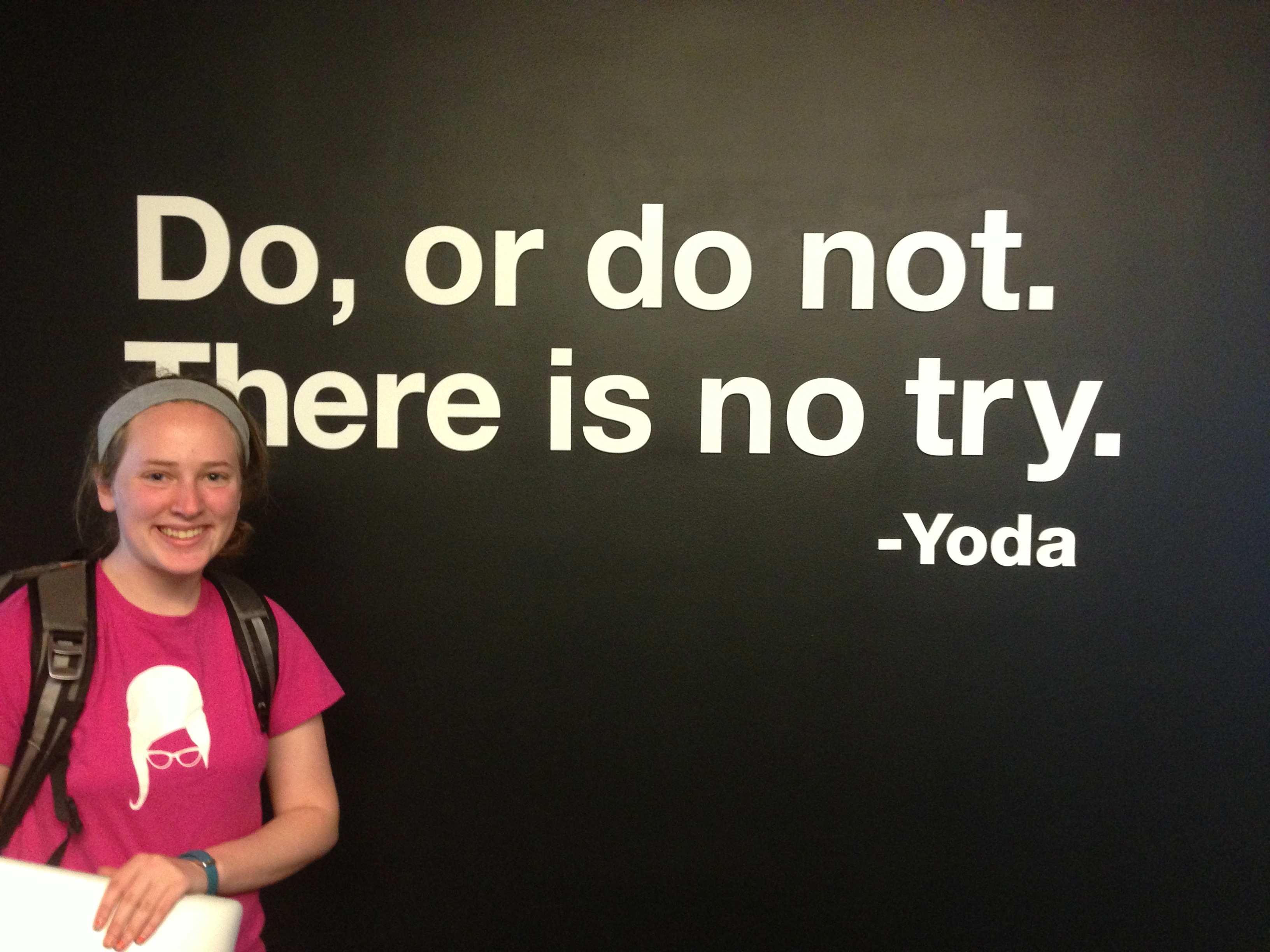
(Note, Jennie has never ever seen The Empire Strikes Back).
Update: A few more stories: Today, The BBC, NBC News, The Hollywood Gossip, Buzz 60, FastCompany, Let’s get Digital
Update (May 11) – as I write this, a Good Morning America camera is filming Jennie typing on her computer. She has had recent appearances in: slashdot, Marketplace, Aljazeera, AP (Wire service), lots of foreign news sites from Romania, Sweden and France. Here’s a photo of the Good Morning America shoot:

Update: 5/12/2013 – Here’s a screengrab of the Good Morning America piece.
[youtube http://www.youtube.com/watch?v=IuTVbx_WcF4]
The Curation Station
 I’ve spent the weekend on the 35th floor of a very fancy office building in the heart of Boston hacking on the TV at Hill Holliday‘s TVnext Hack. My hack is called ‘The Curation Station’. It is a tool for helping music curators pick new music for TV shows. Here’s how it works:
The curator enters the name of the the TV show – the app then uses either the Rdio or the Watchwith API to find music that has played on those shows. The curator is then brought to the curation screen where the song collection can be visualized and previewed along any of 16 Echo Nest parameters such as energy, loudness, danceability, artist hotttnesss and so on.
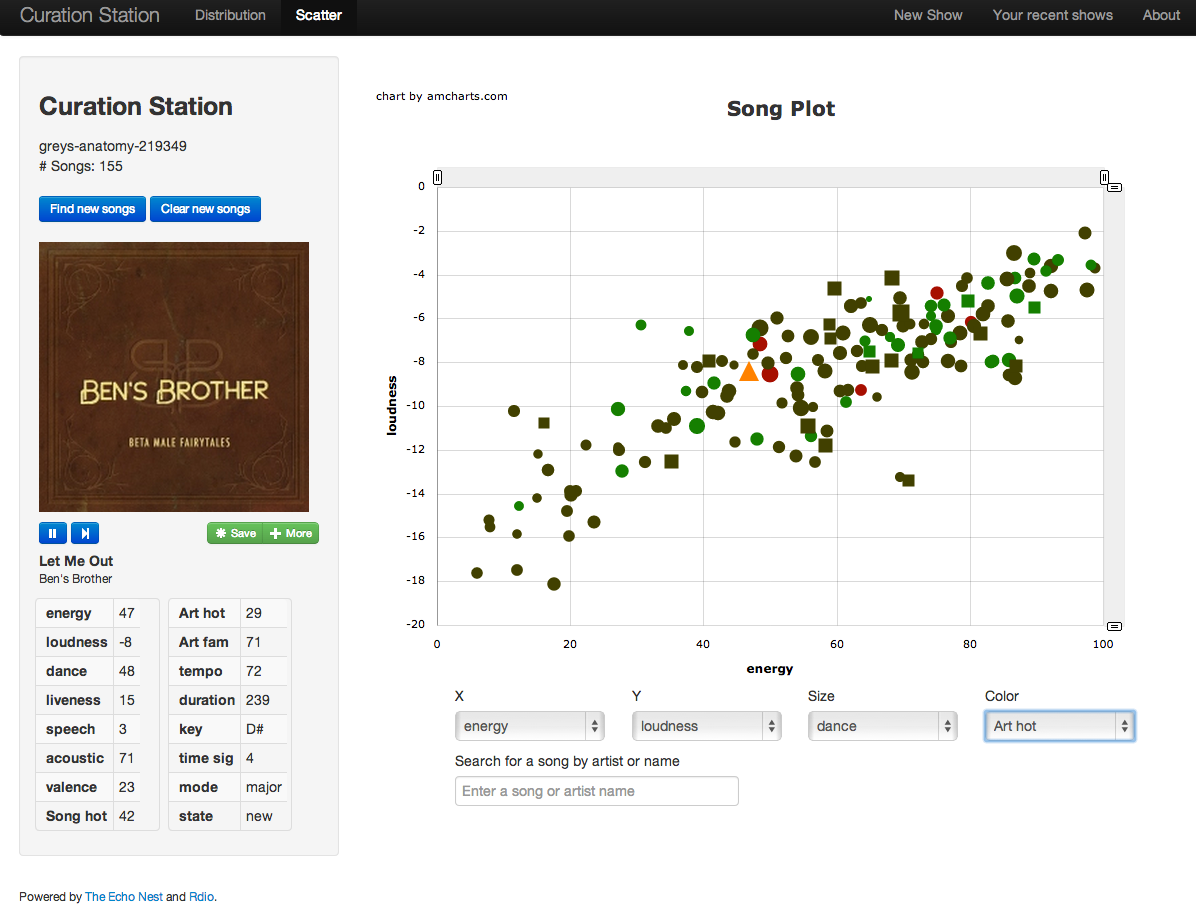
You can click on any particular song, inspect all of its attributes You can use this to explore the collection and to find new music that matches the mood or style of show. If you like a particular song, you can ask to see and hear more new music like that song. If you like one of the recommended songs you can save it for future use. You can try the app out here: The Curation Station
I’ve enjoyed the weekend at TVNext hack. It was a really nice event – with all the best amenities for hacking. Well done all!
A quick hack to explore gender and music
Given that it is a holiday today, I only had a short amount of coding time this morning. Still, I built something that is pretty fun to play with. It is a little tool that lets you explore gender and music. With the tool, you can search for Rdio playlists via keywords and the app will give you the gender breakdown of the matching playlist creators. For example, if you type in ‘exercise’ the tool finds the top 200 playlists with exercise in the title and gives you the gender breakdown like so:
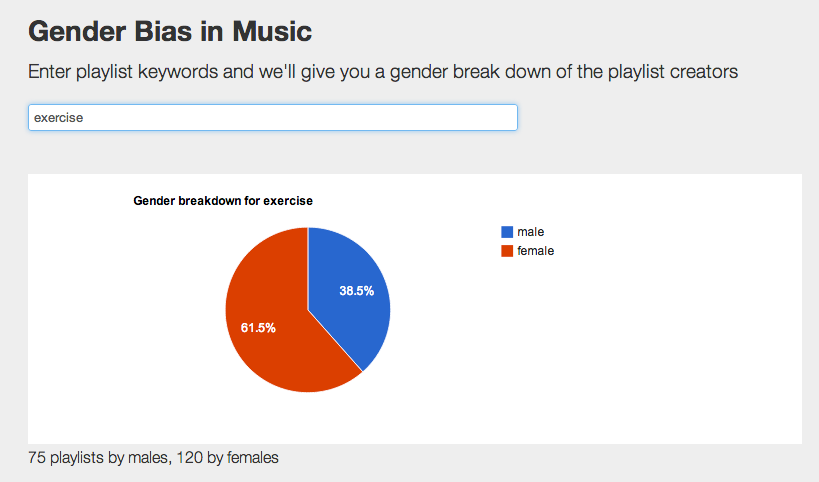
You can use the tool to explore gender biases in music. Some examples:
- 90% of Bieber playlists are by female listeners
- 81% of heavy metal playlists are by male listeners
- 61% of love playlists are by female listeners
- 70% of driving playlists are by male listeners
- 70% of cleaning playlists are by female listeners
- 95% of coding playlists are by male (!) listeners
- 100% of Mamma Mia playlists are by female listeners
- 88% of frat playlists are by male listeners
The tool was built using the superduper Rdio API. Try the tool out here: Gender Bias in Music
 Music Machinery