Archive for category Music
Music Hack Day Chicago
The first ever Music Hack Day Chicago was held this past weekend. It was hosted in the best hacking space ever: Blue 1647 – there was plenty of bandwidth, power, food, hacking fuel and unending music to keep us hacking all weekend. I was quite impressed with the technical chops and the creativity of those in attendance. There was an unusually high ratio of novel hacks at this event – and many had a very high degree of technical difficultly – so Well Done Chicago! Here are some of my favorite hacks:

modeshifter – by Hannah Roberston – Hannah’s goal is to build an automatic mode shifter that will take a song and generate a new version of it in a major (or minor) key. Here’s an example of the goal:
Hannah’s added an extra degree of difficulty by doing this all in Javascript, in the browser. It’s quite an ambitious undertaking. She completed the first part of her hack – extracting the fundamental frequencies via a comb filter. Next step (in a future hack day) is to shift the frequencies and add them back in. I’m looking forward to hearing the results.
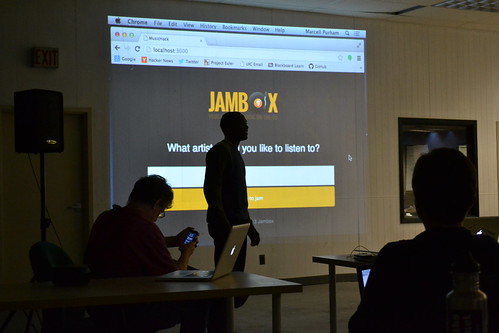
jambox – by Marcell Purham – This is my favorite kind of hack. Marcell is a student at nearby University of Illinois. Marcell had never used a music API before, but in the 24 hour hackathon, was able to use The Echo Nest and the Rdio APIs to build a nifty music discovery app that runs on web (including the Mobile Web). Marcell won the Rdio prize for his efforts.
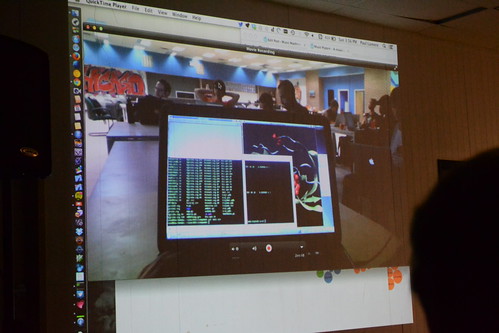
Sectionizer – by Nathan Leiby – Winner of The Echo Nest prize – For this hack Nathan took a close look at how a song can be automatically broken up into labelled sections such as intro, verse, pre-chorus, chorus and outro.

Using visualizations and heuristics, Nathan was able to identify section boundaries accurately across a wide range of songs.
GearSpotting – by the Reverb Hacking team – This hack lets you tag your favorite videos with the gear the artists are using, then find out what it’s worth in the Reverb PriceGuide, or buy similar items on Reverb.
Molecular Dynamics Sonification – by Josiah Zayner – Molecular Dynamics is the process of creating a 3D simulation of physical processes on the nanoscale. Scientists use this to predict how proteins, DNA and other macromolecules function. The data generated by these simulations is massive, highly multi-dimensional and very difficult to comprehend. By analyzing simulations and sonifying the different types of data (changes is secondary structure, radius of gyration and root mean square deviation) this hack creates a way to both auditorilly and visually experience the data to provide a much higher level of comprehension.
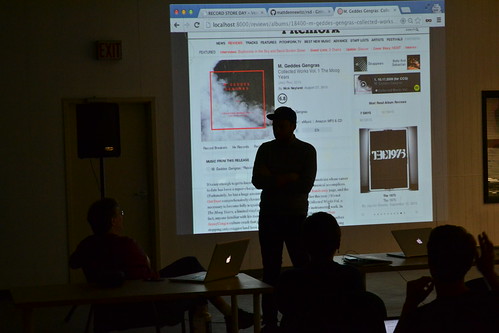
Record Store Day – by @mattdennewitz. – creates a database of record stores from the Record Store Day website. Its a nifty bit of open source code, – the ultimate goal is to make it easy to embed record store information directly into Pitchfork reviews:
Music Popcorn – this is my hack – Music Popcorn is a music exploration tool that allows you to explore the world of music via the many hundreds of music genres. Genres are grouped into higher level families and are sized based upon their overall popularity.

Grooveshark Mobile player is horribly insecure
It is incredibly easy to rip streams onto mp3 files with the new htm5.grooveshark.com player. Start playing a song, then open your browser developer console, hit the network tab, right click on the stream.php, copy as curl, paste into a terminal window and you’ve got yourself a 64bit mono mp3 of the song.

If you try these shenanigans with Rdio, you get a 403 Forbidden error. The Grooveshark is wide open. It’s a music free for all. How can Grooveshark still get away with this stuff?
Music Popcorn – A visualization of the music genre space
My Music Hack Day Chicago music hack is Music Popcorn. It is a visualization of the music space that lets you explore and learn about the many different music genres.

Yes, this is well trod territory. Glenn’s Every Noise at Once is the destination app for this sort of thing, and I’ve had a number of quasi-successful attempts at this as well (the map of music styles, and the labyrinth of genre). Still, I think it is an interesting problem that has not been totally solved yet. This time I wanted to explore a few different aspects. In particular, I wanted to incorporate some notion of genre hierarchy. So unlike the aforementioned attempts, Music Popcorn places each genre into one of 15 or so high level genre families. This helps to bring an overall structure to the space. All the rock genres are close together, and all the metal genres are close together, and they are far away from the country genres.
I also wanted to incorporate a notion of popularity in the visualization. I didn’t want a fringe genre like djent or oi to have the same visual prominence as genre like rock or pop. So I’ve sized each genre in proportion to its overall popularity. Coupled with the clustering based on families it is easy to get a quick overview of how prominent a genre family like metal is when compared to another genre like pop or rock.
The music genre space is quite complex. Genres don’t have hard and fast borders. In order to show the fuzziness of the borders, when you click on any particular genre I show all the related genres and rearrange the map so that the related genres are closer to the selected genre. And of course you need to be able to listen to a genre, which you can do by clicking on it. Music is streamed via Rdio.
To build this app, I used The Echo Nest API to supply the genres (nearly 800 of them) and the genre-radio playlisting with Rdio. The visualization is driven by the amazing d3.
It’s been fun building this hack in Chicago. Give it a try and let me know what you think: Music Popcorn
The worst kind of tweet to read after giving a talk …
I was giving a talk last week at the Boston Music Tech Meetup about hacking on music. I was showing some of my recent music hacks, one of which is the Saddest Stylophone – a web app that generates a Stylophone auto accompaniment to any song.

In my build-up for the demo I think I described the stylophone as “the worst sounding musical instrument in the world”. The demo went well, and the audience had a few good laughs at the stylophone’s expense. All good, until after my talk when I saw this tweet appear on my feed:

Wah?
I never would have imagined that there was such as thing as stylophone devotees, nor that I would one day offend the premier drone ambient stylophone composer. But, then again, I was in Cambridge MA, where no niche is too fringe. I was worried that I had gravely offended someone. I was steeling myself for an awkward conversation, but it turns out I had nothing to fear. The premier drone ambient stylophone composer was Rev. Johnny Healy (i.e. the tweeter), and he was not offended but was just giving me a good natured ribbing. He really is, however, the premier drone ambient stylophone composer. And he can make that “worst sounding instrument in the world” sound really interesting. Here is some of his work:
The Fighting Fifth – The Fifth Harmony fan army
Posted by Paul in data, Music, recommendation on September 13, 2013
In yesterday’s post about the Hot Songs of Summer 2013, I noted that some songs were attracting a very passionate fan base. In particular, the song Miss Movin’ On by Fifth Harmony was an extreme outlier, attracting more than twice the number of plays per listener than any other song.
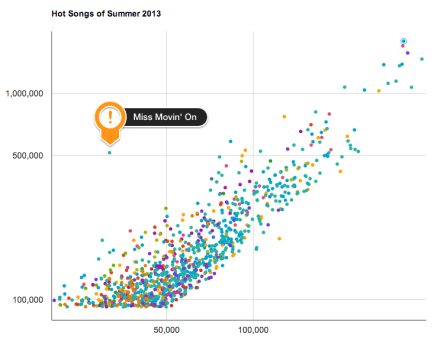
Based on this data I suggested that the Fifth Harmony was going places – such high passion among their listeners was surely indicative of future success. But now I am not so sure. Shortly after I made that post I learned that our crack data team here at The Echo Nest were already on to some Fifth Harmony shenanigans. Yes, Fifth Harmony is getting lots of plays, but many of these plays are due to an orchestrated campaign. Fifth Harmony fans are encouraged to go to music streaming sites such as Spotify and Rdio and stream Miss Movin’ On (aka MMO) 24/7. Here are some examples:
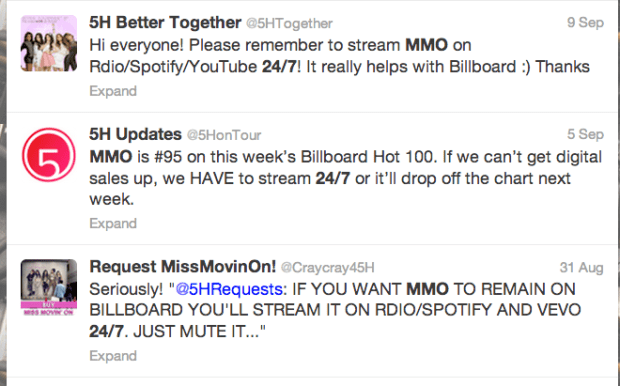
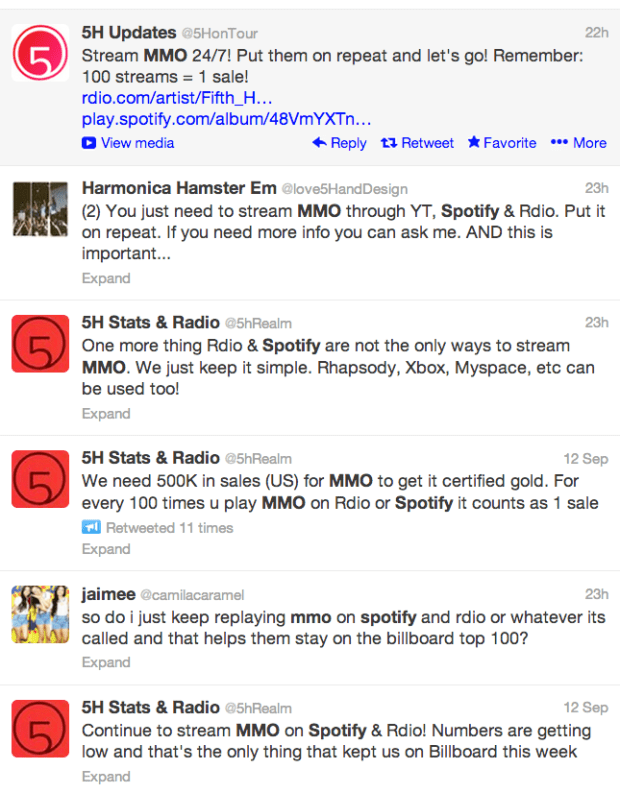
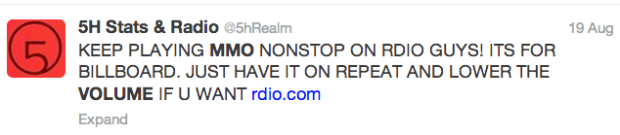
There are a number of twitter accounts that are prompting such MMO plays. The campaign seems to be working. 5H is moving up in the charts. Just take a look at the top songs on Rdio this week, Miss Movin’ On is number two on the list:
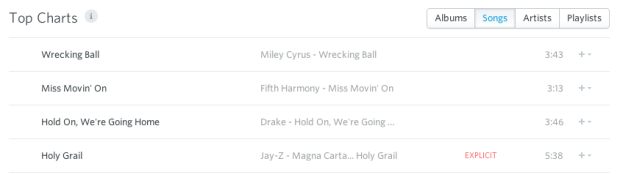
But what effect is this campaign really having on Fifth Harmony? Perhaps Fifth Harmony’s position on the charts is a natural outcome of their appeal, and is not a result of a small number of fans that stream MMO 24/7 with their computers and iPhones on mute. Can we see the effect that The Harmonizers are having? And if so, how substantial is this effect? The answer lies in the data, so that’s where we will go.
Can we see the effect of the Harmonizers?
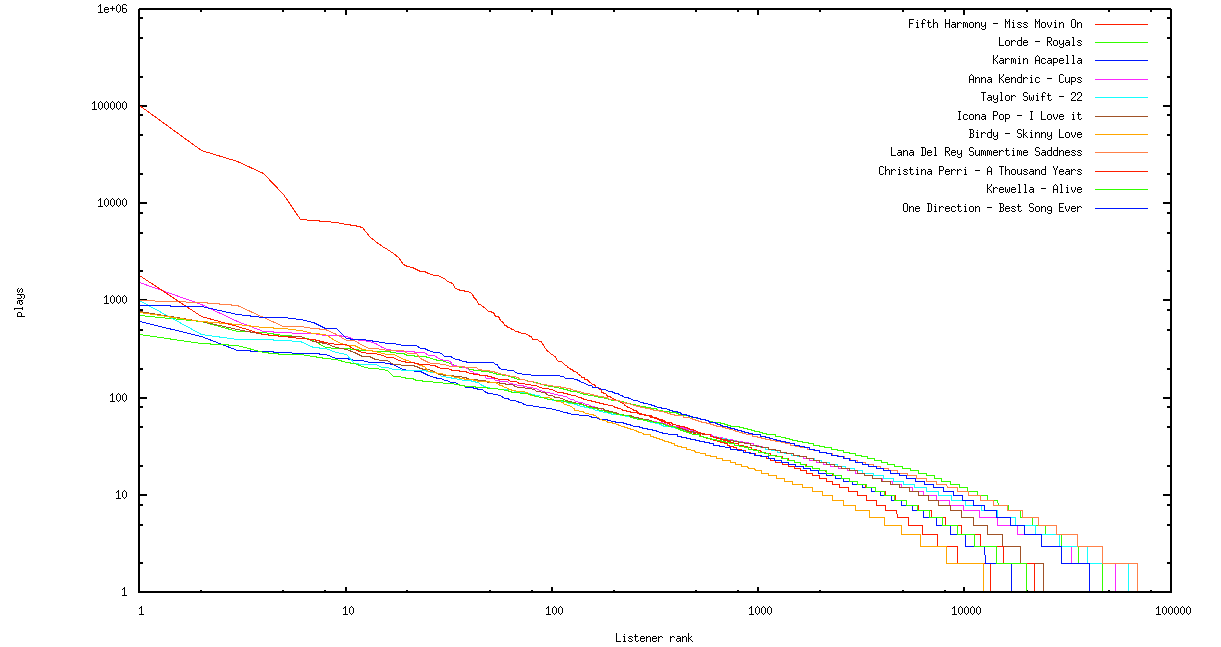
The first thing to do is to take a look at the listener play data for MMO and compare it to other songs to see if there are any tell-tale signs of a shilling campaign. To do this, I selected 9 other songs with similar number of fans that appeal to a similar demographic as MMO. For each of these songs I ordered the listeners in descending play order (i.e. the first listener is the listener that has played the song the most) and plotted the number of plays per listener for the 10 songs.
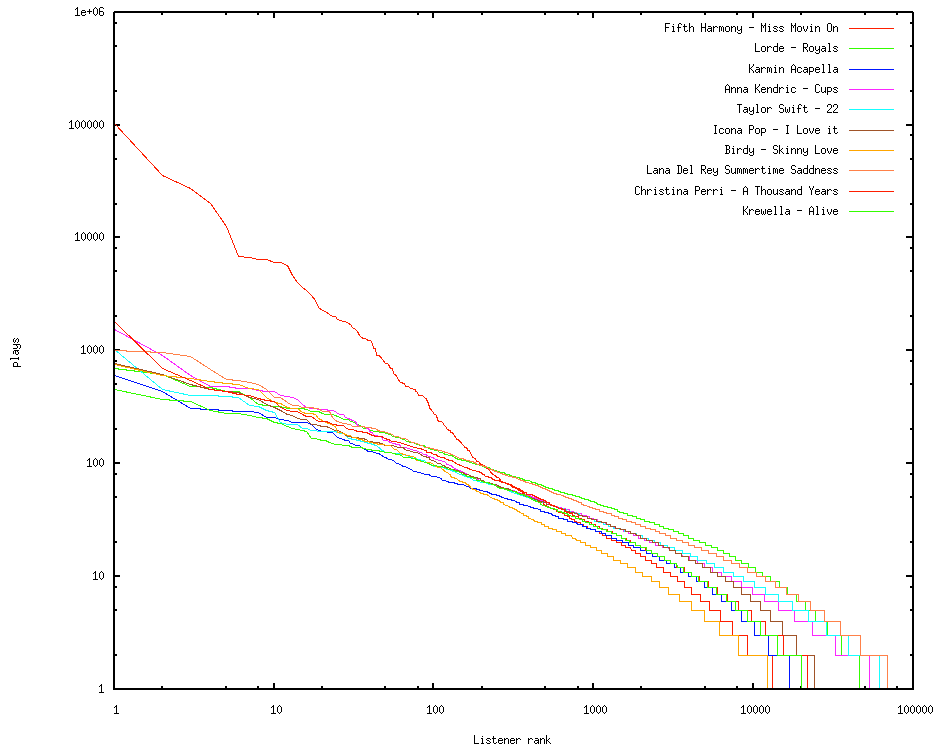
As you can see, 9 out of 10 songs follow a similar pattern. The top listeners of a song have around a thousand plays. As we get deeper into the listener ranks, the number of plays per listener drops off at a very predictable rate. The one exception is Fifth Harmony’s Miss Movin’ On. The effect of the Harmonizers is clearly seen. The top plays are skewed to greatly inflate the total number of plays by two full orders of magnitude. We can also see that the number of listeners that are significantly skewing the data is relatively small. Beyond the top 200 most active listeners (less than 0.5 % of the Fifth Harmony listeners in the sample), the listening pattern for MMO falls in line with the rest of the songs. It is pretty clear that the Harmonizers are really having an effect on the number of plays. It is also clear that we can automate the detection of such shilling by looking for such non-standard listening patterns.
Update – a reader has asked that I include One Direction’s Best Song Ever on the plot. You can find it here.
How big of an impact do the Harmonizers have on the overall play count?
The Harmonizers are having a huge impact. 80% of all track plays of Miss Movin’ On are concentrated into just the top 1% of listeners. Compare that to the other 9 tracks in our sample:
Percentage of listeners that account for 80% of all plays
| Fifth Harmony – Miss Movin’ On | 1.0 |
|---|---|
| Lorde – Royals | 14.0 |
| Karmin – Acapella | 16.0 |
| Anna Kendrick – Cups | 17.0 |
| Taylor Swift – 22 | 14.0 |
| Icona Pop – I love it | 15.0 |
| Birdy – Skinny Love | 25.0 |
| Lana Del Rey – Summertime Sadness | 15.0 |
| Christina Perri – A Thousand Years | 21.0 |
| Krewella – Alive | 17.0 |
A plot of this data makes the difference quite clear:
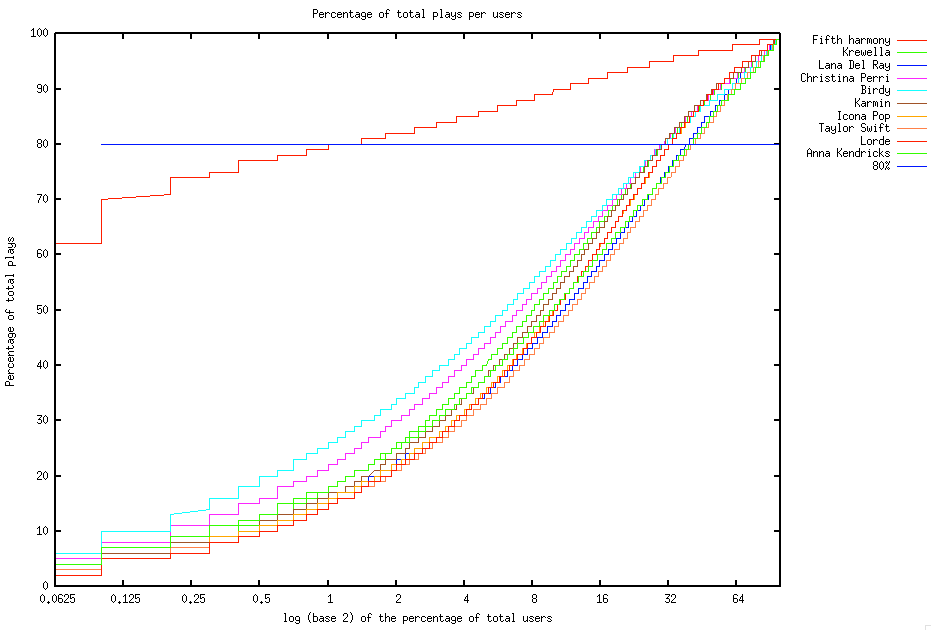
I estimate that at least 75% of all plays of Miss Movin’ On are overplays that are a direct result of the Harmonizer campaign.
What effect does the Fifth Harmony campaign have on chart position?
It is pretty easy to back out the overplays by finding another song that has a similarly-shaped plays vs listener rank curve once we get beyond past the first 1% of listeners (the ones that are overplaying the track). For instance, Karmin’s Acapella has a similar mid-tail and long-tail listener curve and has a similar audience size making it a good proxy. It’s Summer Time rank was 378. Based on this proxy, MMO’s real rank should be dropped from 45 to around 375. This means that a few hundred committed fans were able to move a song up more than 300 positions on the chart.
The bottom line here is that an organized campaign for very little cost has harnessed the most passionate fans to substantially bolster the apparent popularity of an artist, making the artist appear to be about 4 times more popular than it really is.
What does this all mean for music services?
Whenever there’s a high-stakes metric like chart position some people will try to find a way to game the system to get their stuff to the top of the chart. Twenty years ago, the only way to game the charts was either by spending lots of money buying copies of your record to boost the sales figures, or bribe radio DJs to play your songs to boost radio airplay. With today’s music subscription services, there’s a much easier way to game the system. Fans and shills need to simple play a song on autorepeat across a a few hundred accounts to boost the chart position of a song. Fifth Harmony proves that if you have a small, but committed fan base, you can radically boost your chart position for very little cost.
Obviously, a music service doesn’t like this. First, the music service has to pay for all those streams, even if no one is actually listening to them. Second, when a song gets to the top of a chart through shilling and promotion campaigns, it reduces the listening enjoyment for those who use the charts to find music. Instead of finding a new song that got to the top of the chart based solely (or at least mostly) on merit, they are listening to a song that is a product of a promotion machine. Finally, music services that rely on user play data to generate music recommendations via collaborative filtering have a significant problem trying to make sure that fake plays don’t improperly influence their recommendations.
So what can be done to limit the damage to music services? As we’ve seen, it is pretty easy to detect when a song is being overplayed via a campaign and these overplays can be removed. Perhaps even simpler though is to rely on metrics that are less easily gamed – such as the number of fans a song has instead of the total number of plays. For a music subscription service that has a credit card number associated with each user account, the number of fans a song has is a much harder metric to hack.
What does this say about Fifth Harmony fans ?
I am always happy when I see people getting excited about music. The Fifth Harmony fans are really excited about Miss Movin’ On, the tour and the upcoming album. Its great that the fans are so invested in the music that they want to help the band be successful. That’s what being a fan is all about. But I hope they’ll avoid trying to take their band to the top by a shortcut. As they say, it’s a long way to the top if you want to rock n’ roll. Let Fifth Harmony earn their position at the top of charts, don’t give them a free ride.
And finally, a special message to music labels or promoters: If you are trying to game the music charts by enlisting hundreds of pre-teens and teens to continuously stream your one song: screw you.
Update – I’ve received **lots** of feedback from Harmonizers – thanks. A common theme among this feedback is that the fan activities and organization really are a grassroots movement, and there really is no input from the labels. Many took umbrage with my suspicions that the label was pulling the strings. I remain suspicious, but less so than before. My parting ‘screw you’ comment was in no way directed at the 5H fans, it was reserved for the mythical music label marketeer who I imagined was pulling the strings. I’m hoping to dig in a bit deeper to understand the machinery behind the 5H fan movement. Expect a follow up article soon.

What really was the Song of the Summer?
It’s the time of the year when everyone is crowning the Song the Summer. Billboard has picked Robin Thicke’s Blurred Lines as their choice based upon radio airplay, audience impressions, sales data and streaming activity, but that’s not the final word. Other’s have chimed in with their own picks. MTV Video Music Awards Best Song of the Summer, based on online voting went to One Direction’s Best Song Ever, while Paste Magazine’s editors picked Daft Punk’s Get Lucky.
But do any of these songs really deserve the Song of the Summer crown? I really don’t like a metric like Billboard’s that uses radio airplay or sales data – that’s really a measure of how well a label’s marketing department is performing, not a measure of how well the song is liked. Online voting, such as is used to select the MTV Video Music Award winner, is easily hacked, manipulated and subject to the Tyranny of the Bored, while an editorial pick is just the opinion of a couple of writers on a deadline.
I think the best way to pick the Song of the Summer is see which song is actually played more by music listeners. Forget the song that is getting the most buzz, the Song of the Summer is the song that is getting the most plays. So, let’s look at song plays and pick our own Song of the Summer.
The following chart shows a plot of the top 750 songs played over the summer. The plot represents the song plays vs the song fans. Songs on the upper right are the songs that have the most fans and are getting the most plays
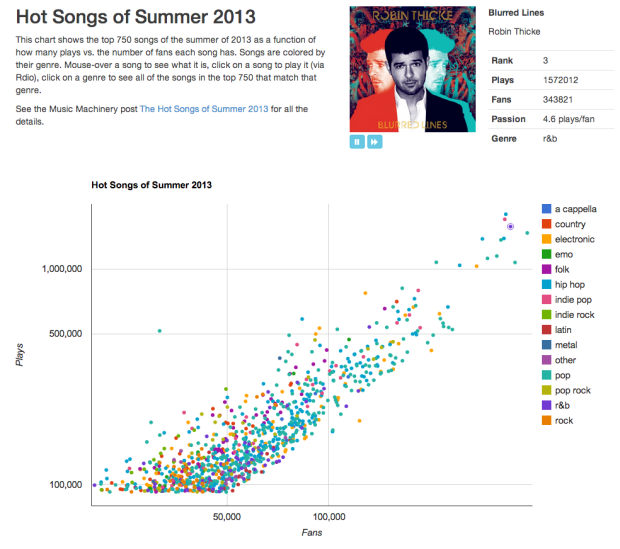
click to view an interactive version of the chart
You can click on the above image to open an interactive version of the chart. You can mouse over the songs to see what they are, you can click on a song to hear it, and you can click on a genre in the legend to highlight songs within a particular genre.
Using this chart we can see that the top songs of the summer based on play data are:
- Can’t Hold Us – Macklemore & Ryan Lewis
- Radioactive – Imagine Dragons
- Blurred Lines – Robin Thicke
- When I Was Your Man – Bruno Mars
- Thrift Shop – Mackmore & Ryan Lewis
- Holy Grail – Jay Z
- Just Give Me A Reason – P!nk
- Treasure – Bruno Mars
- Mirrors – Justin Timberlake
- We Can’t Stop – Miley Cyrus
Daft Punk’s Get Lucky is at #13, and One Direction’s rank is way down at #74.
Blurred Lines is close at number three, but the clear winner of the Song of the Summer crown, based on play data is Macklemore’s Can’t Hold Us.
http://www.rdio.com/artist/Macklemore__Ryan_Lewis/album/The_Heist_1/track/Can%27t_Hold_Us_(feat._Ray_Dalton)/The songs with the most passionate fans
I like plotting songs on a plays vs fans plot. It not only shows what songs are most popular in terms of plays and fans, but it also helps us find songs that are attracting the most passionate fans. For example, in the plot below, I’ve highlighted certain songs that are getting more than their fair share of songs plays:
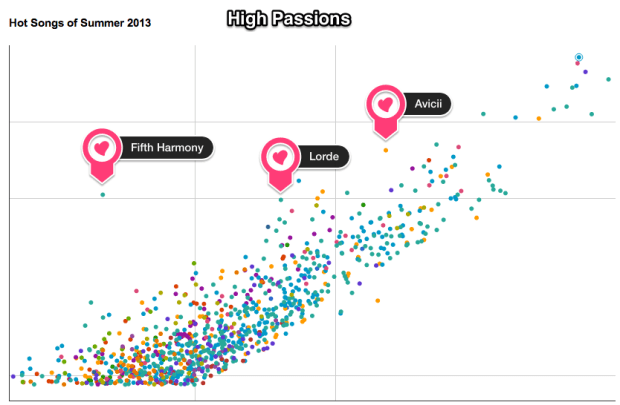
These are songs that fans are listening to over and over – a good indicator that the song is destined for greatness. Avicii and Lorde are already on the Billboard top 10. The Fifth Harmony Song Miss Movin’ On has an extremely high passion score. I expect we’ll be hearing a lot about Fifth Harmony over the next year.
Update – it turns out that the Fifth Harmony high passion score is not an honest score. The fans of Fifth Harmony (aka Harmonizers) have been organizing a continuous streaming of Fifth Harmony’s Miss Movin’ On to push it up the charts. Here’s a peek into the twitter campaign:
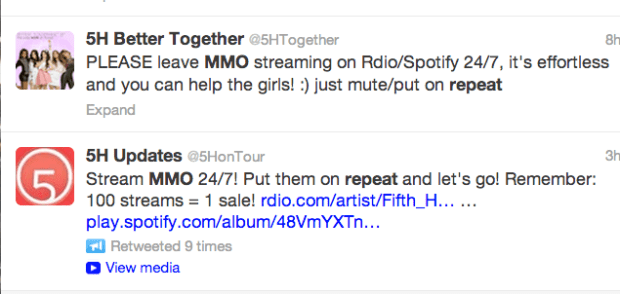
This campaign explains why the Fifth Harmony track is such an outlier, and is a reminder that any single metric used to pick winners can and will be manipulated. sigh.
Perhaps Blurred Lines is the Song of the Summer in that it best captured the vibe of 2013, but my vote, and the data say that the real song of the summer was Macklemore’s Can’t hold us. Now, since it is after labor day, we can put this topic to rest, and start thinking about how we feel about the Song of the Summer 2014 being by Fifth Harmony.
Boston Music Technology Group Meetup
Did you know that there is a Boston-based Meetup group for music-tech entrepreneurs, hackers, founders, developers, designers, programmers, musicians, idea-ists, scientists, and data experts? It’s the Boston Music-Technology Group organized by David Blutenthal. Join if you are interested in bumping elbows with others with a similar passion for music and technology.

The next meetup is tomorrow, (Wednesday 9/11). I’ll be giving a short talk on creating dynamic music apps in the browser. Looks like the event is going to fill up, so grab a spot while you can.
Upcoming Music Hack Days – Chicago, Bologna and NYC
Posted by Paul in events, hacking, Music, The Echo Nest on September 3, 2013


Photo by Thomas Bonte
Fall is traditional Music Hack Day season, and 2013 is shaping up to be the strongest yet. Three Music Hack Days have just been announced:
- Chicago – September 21st and 22nd – this will be the first ever Music Hack Day in Chicago.
- Bologna – October 5th and 6th – in collaboration with roBOt Festival 2013. The first Music Hack Day in Italy.
- New York – October 18th and 19th – being held in Spotify’s nifty new offices.
There will no doubt be more hack days before the end of the year including the traditional Boston and London events. You can check out the full schedule and sign up to be notified whenever at a new Music Hack Day is announced at MusicHackDay.org.
Music Hack Day is an international 24-hour event where programmers, designers and artists come together to conceptualize, build and demo the future of music. Software, hardware, mobile, web, instruments, art – anything goes as long as it’s music related.
Github repositories of music tech
There are a lot of music tech companies working to create new ways for people to engage with music. Lots of these companies are also giving back to the world by making their source code available. Here are the top music tech companies who have made significant open source contributions (in alphabetical order). Criteria to be on this list: The organization must be primarily a music company (sorry, google and twitter) that has participated in a Music Hack Day and must have at least three 10-star or more github projects. If I’ve missed anyone, please let me know.
Last.fm – 23 public repos. Top Projects:
- lastfm-deskiop – 166 stars – The official Last.fm desktop application suite
- Fingerprinter – 160 stars – the official repository for the last.fm fingerprint library.
- libmoost – 122 stars – Last.fm’s collection of C++ utility libraries
Rdio – 31 public repos. Top projects:
- Vernacular – 95 stars – a localization tool for developers. It currently is focused on providing a unified localization system for MonoTouch, Mono for Android, and Windows Phone.
- Bujagali – 90 stars – Bujagali is a flexible template system that is a thin layer on top of JavaScript which makes it easier to write HTML (or any templated text) using JavaScript
- rdio-simple – 83 stars – a set of simple clients libraries for Rdio’s web API.
SongKick – 52 public repos – Top Projects
- oauth2-provider – 334 stars – Simple OAuth 2.0 provider toolkit
- transport – 40 stars – A transport layer abstraction for talking to service APIs
- aspec – 10 stars – a testing language for API external surfaces.
SoundCloud – 123 public repos – Top projects:
- lhm – 438 stars – Online MySQL schema migrations
- soundcloud-custom-player – 395 stars – SoundCloud Custom Player as a jQuery plugin
- areweplayingyet – 134 stars – html5 audio benchmarks
Spotify – 28 public repos – Top projects:
- luigi – 682 stars – Luigi is a Python module that helps you build complex pipelines of batch jobs. It handles dependency resolution, workflow management, visualization etc. It also comes with Hadoop support built in.
- cocoalibspotify – 425 stars – A Cocoa wrapper for libpotify
- sparkey – 161 stars – Sparkey is a simple constant key/value storage library.
The Echo Nest – 42 public repos. Top Projects:
- Echoprint-codegen – 323 stars – Echoprint is an open source music fingerprint and resolving framework powered by the The Echo Nest.
- pyechonest – 258 stars – Pyechonest is an open source Python library for the Echo Nest API. With Pyechonest you have Python access to the entire set of API methods.
- Echoprint-server – 212 stars – the server component for Echoprint – an open source music fingerprint and resolving framework powered by the The Echo Nest.
Misc:
A few companies / organizations have only one frequently starred repos, but since it is their entire source code, it seems worth mentioning.
- MuseScore – 135 stars – MuseScore is a open source and free music notation software
- Tomahawk-player – 445 stars – Tomahawk, the social music player app
Criteria to be on this list: The organization must be primarily a music company (sorry, google and twitter) that has participated in a Music Hack Day and must have at least three 10-star or more github projects. If I’ve missed anyone, please let me know.
Are these the angriest tracks on the web?
I built a playlist of songs that most frequently appear in playlists with the words angry or mad with the Smart Playlist Builder. These are arguably some of the angriest tracks on the web.
http://www.rdio.com/people/plamere/playlists/5779446/Top_angry_songs_created_with_SPB/
It is interesting to compare these angry tracks to the top tracks tagged with angry at Last.fm.
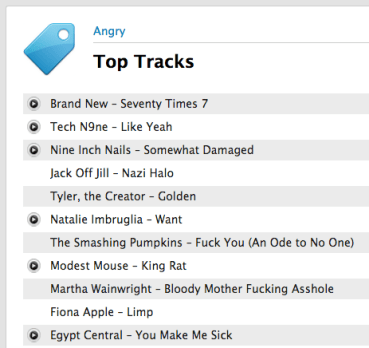
I can’t decide whether the list derived from angry playlists is better or worse than the list driven by social tags. I’d love to hear your opinion. Take a look at these two lists and tell me which list is a better list of angry tracks and why.
yep, this is totally unscientific poll, but I’m still interested in what you think.
 Music Machinery