Archive for category fun
Searching for chilled metal
It seems like every heavy metal band has at least one chill-out song – from Metallica’s Nothing Else Matters to Led Zeppelin’s That’s the Way. These tracks give some relief from the otherwise relentless pounding of the hammer of the gods. It’d be nice to be able to collect up a bunch of these chilled-metal songs into a playlist – perfect for when your mom’s visiting (she tells me that she doesn’t like pounding metal).

ChilLed Zeppelin - Some rights (by-nc-sa) reserved by Heinrich Klaffs
To find chilled metal, we can use The Echo Nest API. The Echo Nest has calculated a wide range of acoustic and musical attributes for millions of songs. One such attribute is energy . We can make a simple song/search query for heavy metal songs that have low energy. These will be our chilled-metal songs that your mom enjoys so much. Here’s the API query:
http://developer.echonest.com/api/v4/song/search?&style=heavy+metal&sort=energy-asc
This query searches for songs by heavy metal artists, and sorts the results in order of ascending energy (so the lowest energy tracks will be returned first). The query does a really good job of finding chilled metal. Here’s a sampling of the results:

Sphinx (The Guardian) by Black Sabbath
[audio http://previews.7digital.com/clips/34/645345.clip.mp3]
Sphinx (The Guardian) by Black Sabbath – energy: 0.0003

Demon Driver reprise by Gillan
[audio http://previews.7digital.com/clips/34/4179195.clip.mp3]
Demon Drive by Gillan – energy: 0.010

The Return by Saxon
[audio http://previews.7digital.com/clips/34/5318312.clip.mp3]
The Return by Saxon – energy: 0.013

Solitude by Judas Priest
[audio http://previews.7digital.com/clips/34/3544312.clip.mp3]
Solitude by Judas Priest – energy: 0.049

Joan of Arc by UFO
[audio http://previews.7digital.com/clips/34/7952114.clip.mp3]
Joan of Arc by UFO – Energy: 0.05

Fear by Black Label Society
[audio http://previews.7digital.com/clips/34/5768332.clip.mp3]
Fear by Black Label Society – Energy – 0.119
You can also use the Echo Nest Playlist API to generate a chilled metal playlist. Here’s a call to create a playlist of chilled metal in XSPF format.
You can toss this playlist into a player like VLC or Songbird that supports XSPF and start listening to chilled metal right away (30 second samples only) like this:
% curl 'http://developer.echonest.com/api/v4/playlist/static?api_key=N6E4NIOVYMTHNDM8J\
   &style=heavy+metal&max_energy=.1\
   &type=artist-description&bucket=id:7digital&bucket=tracks&limit=true\
   &format=xspf' > chilled-metal.xspf
% open chilled-metal.xspf
There you go, you now have all the tools you need to keep your chilled metal queue filled and fresh, almost everything you need to keep your mom happy.
Thanks much to 7Digital for providing audio clips and album art.
Loudest songs in the world
Posted by Paul in fun, Music, The Echo Nest on August 17, 2011
Lots of ink has been spilled about the Loudness war and how modern recordings keep getting louder as a cheap method of grabbing a listener’s attention. We know that, in general, music is getting louder. But what are the loudest songs? We can use The Echo Nest API to answer this question. Since the Echo Nest has analyzed millions and millions of songs, we can make a simple API query that will return the set of loudest songs known to man. (For the hardcore geeks, here’s the API query that I used). Note that I’ve restricted the results to those in the 7Digital-US catalog in order to guarantee that I’ll have a 30 second preview for each song.
So without further adieu, here are the loudest songs

Topping and Core by Grimalkin555
The song Topping and Core by Grmalking555 has a whopping loudness of 4.428 dB.

Modifications by Micron
The song Modifications by Micron has a loudness of 4.318 dB.

Hey You Fuxxx! by Kylie Minoise
The song Hey You Fuxxx! by Kylie Minoise with a loudness of 4.231 dB
Here’s a little taste of Kylie Minoise live (you may want to turn down your volume)

War Memorial Exit by Noma
The song War Memorial Exit by Noma with a loudness of 4.166 dB

Hello Dirty 10 by Massimo
The song Hello Dirty 10 by Massimo with a loudness of 4.121 dB.
These songs are pretty niche. So I thought it might be interesting to look the loudest songs culled from the most popular songs. Here’s the query to do that. The loudest popular song is:

Welcome to the Jungle by Guns 'N Roses
The loudest popular song is Welcome to the Jungle by Guns ‘N Roses with a loudness of -1.931 dB.
You may be wondering how a loudness value can be greater than 0dB. Loudness is a complex measurement that is both a function of time and frequency. Unlike traditional loudness measures, The Echo Nest analysis models loudness via a human model of listening, instead of directly mapping loudness from the recorded signal. For instance, with a traditional dB model a simple sinusoidal function would be measured as having the same exact “amplitude” (in dB) whether at 3KHz or 12KHz. But with The Echo Nest model, the loudness is lower at 12KHz than it is at 3KHz because you actually perceive those signals differently.
Thanks to the always awesome 7Digital for providing album art and 30 second previews in this post.
Bipolar Radio
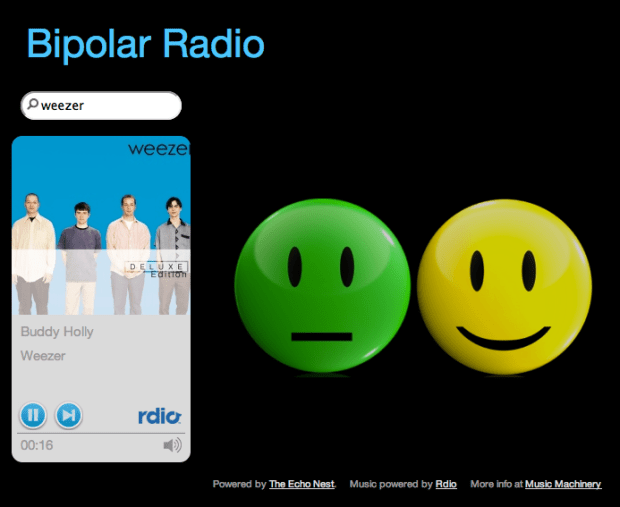
I just finished my hack for Music Hack Day SF. It is called Bipolar Radio. It is your standard Pandora-style artist radio but with a twist. Type in an artist, and you’ll get an endless stream of music by similar artists. When you need to hear a high energy song, just click on the yellow happy face and you’ll instantly hear a high energy song by the currently playing artist. Similarly, if you’d like to chill out, just click on the green face and you’ll instantly hear a low energy song that should help you relax a bit.
The hack uses the Echo Nest song data to help find the high and low energy songs. I use a combination of loudness, energy, danceability, and tempo to sort and filter the songs by an artist into the high and low energy buckets. I’m taking advantage of the new Rdio / Echo Nest integration to get Rdio IDs so I can play them in Rdio’s nifty player.
Give it a whirl and let me know what you think: Bipolar Radio
Memento Friday
It had to be done. Created with Echo Nest Remix.
The SXSW Music Maze
Posted by Paul in code, fun, visualization on March 10, 2011
There are thousands of artists playing at SXSW this year. To help sort it all out, I thought I’d adapt my Music Maze to work within the world of SXSW 2011 artists. It is a good way to figure out which bands you’d like to see.

This visualization fits in with the SXSW talk I’m giving in a few days: Finding Music With Pictures
Is that a hipster in your pocket, or are you just glad to see me?
Yes, this app will mock your music taste and then will tell you what you really should be listening to. It’s Pocket Hipster.
Finding the most dramatic bits in music
Posted by Paul in code, fun, Music, The Echo Nest on February 20, 2011
Evanescence is one of my guilty listening pleasures. I enjoy how Amy Lee’s voice is juxtaposed against the wall of sound produced by the rest of the band. For instance, in the song Imaginary, there’s a 30 seconds of sweet voice + violins before you get slammed by the hammer of the gods:
This extreme change in energy makes for a very dramatic moment in the music. It is one of the reasons that I listen to progressive rock and nu-metal (despite the mockery of my co-workers). However, finding these dramatic gems in the music is hard – there’s a lot of goth- and nu-metal to filter through, and much of it is really bad. After even just a few minutes of listening I feel like I’m lost at a Twicon. What I need is a tool to help me find these dramatic moments, to filter through the thousands of songs to find the ones that have those special moments when the beauty comes eye to eye with the beast.
My intuition tells me that a good place to start is to look at the loudness profile for songs with these dramatic moments. I should expect to see a sustained period of relatively soft music followed by sharp transition to a sustained period of loud music. This is indeed what we see:
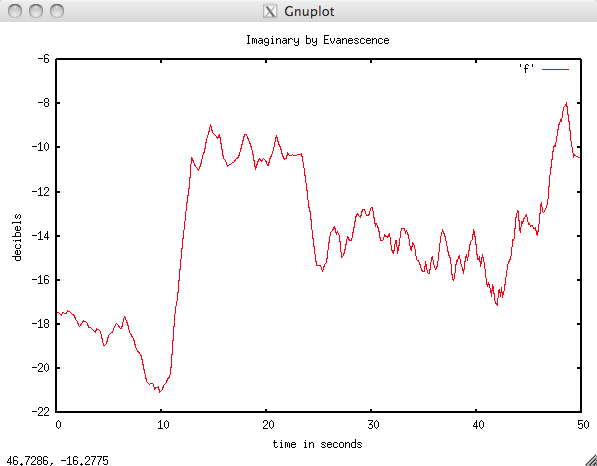
Loudness plot for 'Imaginary'
This plot shows a windowed average of the Echo Nest loudness for the first 50 seconds of the song. In this plot we see a relatively quiet first 10 seconds (hovering between -21 and -18 db), followed by an extremely loud section of around -10db). (Note that this version of the song has a shorter intro than the version in the Youtube video). If we can write some code to detect these transitions, then we will have a drama detector.
The Drama Detector: Finding a rising edge in a loudness profile is pretty easy, but we want to go beyond that and make sure we have a way to rank then so that we can find the most dramatic changes. There are two metrics that we can use to rank the amount of drama: (1) The average change in loudness at the transition and (2) the length of the quiet period leading up to the transition. The bigger the change in volume and the the longer it has been quiet means more drama. Let’s look at another dramatic moment as an example:
The opening 30 seconds of Blackest Eyes by Porcupine Tree fit the dramatic mold. Here’s an annotated loudness plot for the opening:
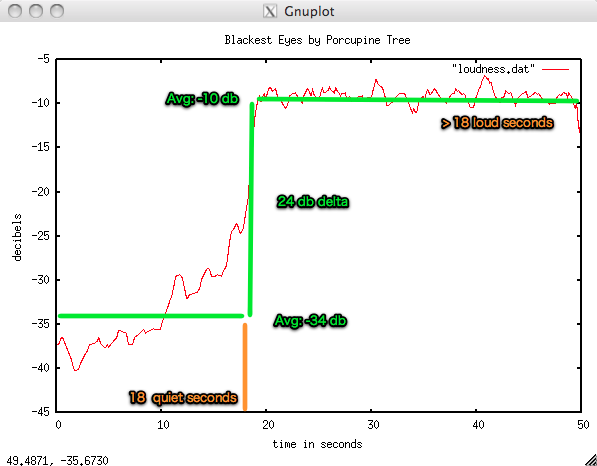
The drama-finding algorithm simply looks for loudness edges above a certain dB threshold and then works backward to find the beginning of the ‘quiet period’. To make a ranking score that combines both the decibel change and the quiet period, I tried the simplest thing that could possible work which is to just multiply the change in decibels by the quiet period (in seconds). Let’s try this metric out on a few songs to see how it works:
- Porcupine Tree – Blackest Eyes – score: 18 x 24 = 432
- Evanescence – Imaginary (w/ 30 second intro) – score: 299
- Lady Gaga – Poker Face- score: 82 – not very dramatic
- Katy Perry – I kissed a girl – score: 33 – extremely undramatic
This seems to pass the sanity test, dramatic songs score high, non-dramatic songs score low (using my very narrow definition of dramatic). With this algorithm in mind, I then went hunting for some drama. To do this, I found the 50 artists most similar to Evanescence, and for each of these artists I found the 20 most hotttest songs. I then examined each of these 1,000 songs and ranked them in dramatic order. So, put on your pancake and eye shadow, dim the lights, light the candelabra and enjoy some dramatic moments
First up is the wonderfully upbeat I want to Die by Mortal Love. This 10 minute long song has a whopping drama score of 2014. There a full two minutes of quiet starting at 5 minutes into the song before the dramatic moment (with 16 dB of dramatic power!) occurs:
The dramatic moment occurs at 7:12 seconds into the song – but I’m not sure if it is worth the wait. Not for me, but probably something they could play at the Forks Washington High School prom though.
The song Jillian by Within Temptation gets a score of 861 for this dramatic opening:
Now that’s drama! Take a look at the plot:
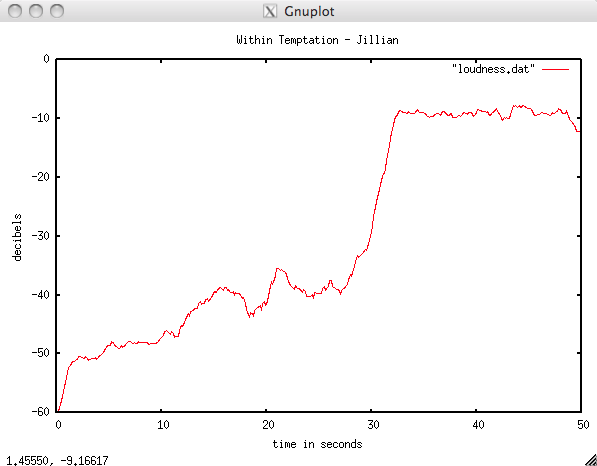
The slow build – and then the hammer hits. You can almost see the vampires and the werewolves colliding in a frenzy.
During this little project I learned that most of the original band members of Evanescence left and formed another band called We are the Fallen – with a very similar sound (leading me to suspect that there was a whole lot of a very different kind of drama in Evanescence). Here’s their dramatic Tear The World Down (scores a 468):
Finally we have this track Maria Guano Apes – perhaps my favorite of the bunch:
Update: @han wondered how well the dramatic detector faired on Romantic-era music. Here’s a plot for Berlioz’s Symphony Fantastique: March to the Scaffold:
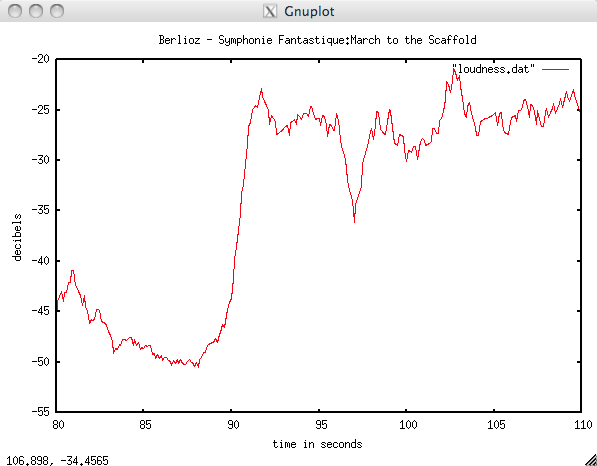
This gets a very dramatic score 361. Note that in the following rendition the dramatic bit that aligns with the previous plot occurs at 1:44:
Well – there you have it , a little bit of code to detect dramatic moments in music. It can’t, of course, tell you whether or not the music is good, but it can help you filter music down to a small set where you can easily preview it all. To build the drama detector, I used a few of The Echo Nest APIs including:
- song/search – to search for songs by name and to get the analysis data (where all the detailed loudness info lives)
- artist/similar – to find all the similar artists to a seed (in this case Evanescence)
The code is written in Python using pyechonest, and the plots were made using gnuplot. If you are interested in finding your own dramatic bits let me know and I’ll post the code somewhere.
Spot the sweatsedo!
Posted by Paul in fun, The Echo Nest, video on February 16, 2011
While all of the hackers were making music hacks at last weekend’s Music Hack Day, the non-technical staff from The Echo Nest were working on their own hack – a video of the event. They’ve posted it on Youtube. It is pretty neat – with a cool remix soundtrack by Ben Lacker.
But wait … they also tweeted this contest:
 To win the contest, you had to count the number of Echo Nest tee-shirts and Sweatsedos appear in the video and tweet the results. It turns out it was a really hard contest. My first try I counted 12, but there were many more, some were very very subtle. But we do have a winner! Here’s the answer key:
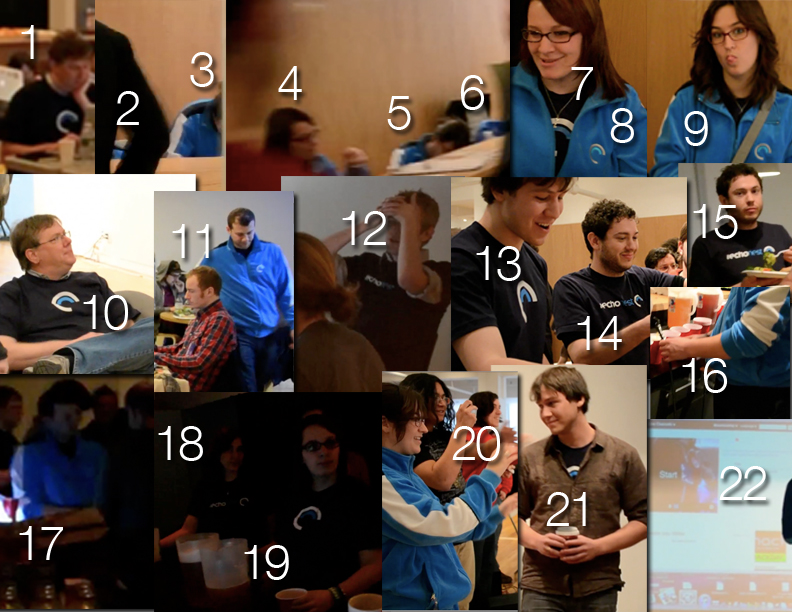
Last night at 7:30 PM EST one Kevin Dela Rosa posted this tweet:

Congrats to Kevin for his excellent counting ability! Kevin please email your size and shipping info to Paul@echonest.com and we’ll get you into the smooth and velvety blue!
Fans Forever and Ever
One of my very very favorite hacks from this weekend’s Music Hack Day is Greg Sabo’s Fans Forever And Ever. “Fans Forever and Ever” automatically generates a (sometimes rather creepy) fan page for an artist. It works by taking an artist’s cultural data from The Echo Nest API as well as song lyrics from musiXmatch. The fictional fan that creates the page has a randomly created set of personality traits drawn from a pool of crazy. I especially like the Geocities look and the borderline-psychotic poetry:
Give me country music!
Here’s a poem I wrote:
I fill myself with the pop sound
The concert changed my life
I hope I do a good job
die, die
…because death is the only solution
I put it on my iPod
I’ll just put on some female
such music
HEAVEN is the only place for Taylor Swift
My friends don’t understand female artist
There is only one life that I want to take
I live for the music.
what should I wear as I commit murder
“Forever & Always” gets me every time
it’s a shame to make it go quick
I don’t care what they say
I have a collection of saws
Never ever say I’m not a true Taylor Swift fan
‘Fans Forever and Ever’ makes sure you remember to keep the ‘fan’ in ‘fanatic’.
MIDEM Hack Day
I’m just back from a whirlwind trip to Cannes where I took part in the first ever MIDEM Hack Day where 20 hotshot music hackers gathered to build the future of music. The hackers were from music tech companies like Last.fm, SoundCloud, Songkick, The Echo Nest, BMAT, MusixMatch, from universities like Queen Mary and Goldsmiths, one of the four major Labels, and a number of independent developers. We all arrived to the exotic French Riviera, with its casinos, yachts and palm trees. But instead of spending our time laying on the beach we all willingly spent our time in this wonderful room called Auditorium J:

First thing was we did was rearrange the furniture so we could all see each other making interactions easier. It wasn’t long before we had audio hooked up – with hackers taking turns at being the DJ for the room.

Dave and I took a break from the hacking to give a talk on the ‘New Developer Ecosystem’. We talked about how developers were becoming the new gatekeepers in the world of music. The talk was well attended with lots of good questions from the audience. (Yes, I was a bit surprised. I was half expecting that MIDEM would be filled with the old guard – reps from the traditional music industry that would be hostile toward self-proclaimed new gatekeepers. There were indeed folks from the labels there and asking questions, but they seemed very eager to engage with us).

While Dave and I were talking, the rest of the gang had self-organized, giving project pitches, forming teams, making coding assignments and perhaps most importantly figuring out how to make the espresso machine work.

Here are some of the project pitches:
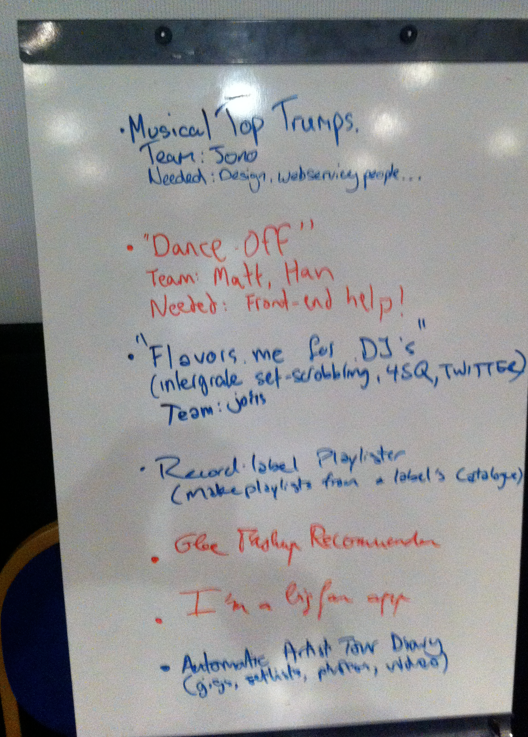
Some teams started with designs with dataflow diagrams, while others dived straight into coding (one team instead, starting composing the music for their app)

Dataflow diagrams, system architecture, and UI minispecs became the artwork for the hacking space.

After the lightening design rounds, people settled into their hacking spots to start hacking:

By mid-afternoon on the first day of hacking, the teams were focused on building their hacks.

There were some interesting contrasts during the day. While we were hacking away in Auditorium J, right next door was a seminar on HADOPI. (the proposed French law where those accused of copyright violations could be banned from the Internet forever).

As we got further in to our hacks, we gave demos for each other

Over the course of the weekend, we had a few ‘walk-ins’ who were interested in understanding what was going on. We did feel a little bit like zoo animals as we coded with an audience.

Taylor Hanson dropped by to see what was going on. He was really interested in the idea of connecting artists with hackers/technologists. After the visit we were MMMboppping the rest of the day.

Towards the end of the first day, the Palais cleared out, so we had the whole conference center to ourselves. We made the beer run, had a couple and then went right back to hacking.

Finally, the demo time had arrived. After more than 24 hours of hacking we were ready (or nearly ready). Demos were created, rehearsed and recorded.

We presented our demos to an enthusiastic audience. We laughed, we cried …

There were some really creative hacks demoed – Evolver.fm has chronicled them all: MIDEM Hack Day Hacks Part 1 and MIDEM Hack Day Hacks Part 2. At the end of the hack day, we were all very tired, but also very excited about what we had accomplished in one weekend.

Thanks much to the MIDEMNet organizers who took care of all of the details for the event – sandwiches, soda, coffee, flawless Internet. They provided everything we needed to make this event possible. Special thanks to Thomas Bonte (unofficial Music Hack Day photographer) for taking so many awesome photos.

