Archive for category events
The Hack Day Manifesto
What do you need to do to put on a good hack event like a Music Hack Day? Read The Hack Day Manifesto for insights on what it takes to make sure you don’t have hack event fail. Here’s some choice bits:
Your 4MB DSL isn’t enough
Hack days have special requirements: don’t just trust anyone who tells you that “it’ll be fine”. Think about the networking issues, and verify that they work for the kind of capacity you are going to have. People from the venue or their commercial partner will tell you all sorts of things you want to hear but keep in the back of your mind that they may not have any clue what they are talking about. Given the importance of network access, if you are operating a commercial event consider requiring network performance as part of your contract with venues and suppliers.
Rock solid WiFi
Many commercial WiFi providers plan for much lower use than actually occurs at hack days. The network should be capable of handling at least 4 devices per attendee.
Don’t make people feel unwelcome
Avoid sexism and other discriminatory language or attitudes. Don’t make any assumptions about your attendees. Get someone who is demographically very different from you to check your marketing material through to see if it makes sense and isn’t offensive to someone who doesn’t share your background.
Read The Hack Day Manifesto. If you agree with the sentiment, and you have enough hacker juice to fork the manifesto, edit it and send a pull request, you are invited to add yourself to the list of supporters.
Slides for my Data Mining Music talk
Posted by Paul in events, The Echo Nest on March 15, 2012
I recently gave a talk on Data Mining Music at SXSW. It was a standing room only session, with an enthusiastic audience that asked great questions. It was a really fun time for me. I’ve posted the slides to Slideshare, but be warned that there are no speaker notes so it may not always be clear what any particular slide is about. There was lots of music in the talk, but unfortunately, it is not in the Slideshare PDF. The links below should flesh out most of the details and have some audio examples.
Related Links:
- Have artist names been getting longer?
- The Passion Index – Find the bands that have the most passionate fans
- Six Degrees of Black Sabbath – Using artist relationship data to build a Six Degrees of Kevin Bacon for Music
- Frog-based playlisting – Building advanced playlists by finding paths through the artist space
- The Click Track Detector – Finding drummers that use a click track
- Looking for the Slow Build – Finding songs that have a gradual build
- Bohemian Rhapsichord – Turning a popular song into a musical instrument, with data.
- Midem Music Machine – Making a beautiful visualization of music
- The Swinger – Making any song swing
Thanks to everyone who attended.
Data Mining Music at SXSW
If you happen to be in Austin this week for SXSW consider attending my talk called Data Mining Music. It is all about the fun things you can discover about music when you have data about millions of songs and artists.
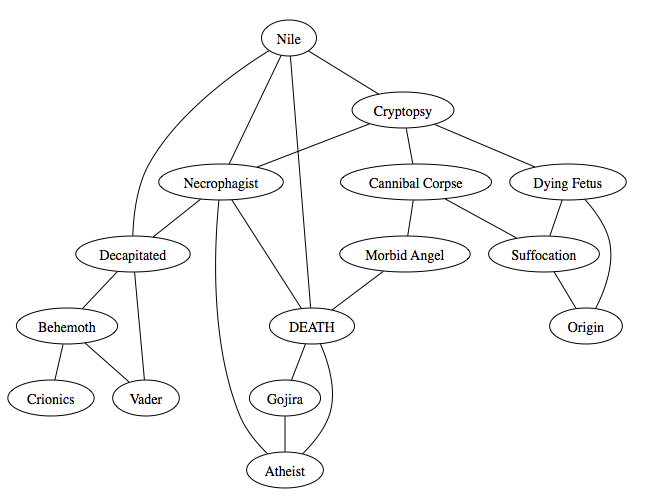
The talk is on Sunday, Marcy 11 at 5:00PM in the Rio Grande room of the Hilton Garden Inn. All the details are here: Data Mining Music
Boil the Frog – the unreleased Spotify Version
Update – You are probably looking for this web-based version of Boil The Frog and the blog post about it.
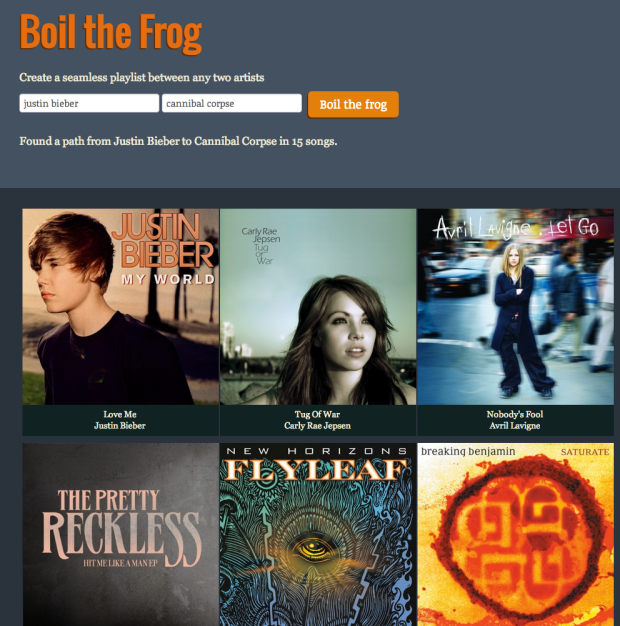
The rest of this article is about the unreleased Spotify Version of Boil the Frog.

I’m at Music Apps Hack Weekend doing my favorite thing: hacking on music. I’ve just finished my hack called Boil the Frog. Boil the Frog is a Spotify App that will create playlists that gradually take you from one music style to another. It is like the proverbial story of the frog in the pot of water. If you heat the water gradually, the frog won’t notice and will happily sit in the pot until it becomes frog stew. With Boil the Frog you can do the same thing musically. Create a playlist that gradually takes your pre-teen from Miley Cyrus to Miles Davis, or perhaps more perversely the Kenny G fan to Cannibal Corpse.
To build the app I built an artist similarity graph of 100,000 of the most popular artists. I use The Echo Nest artist similarity to connect each artist to its four nearest neighbors. To find the path between any two artists I use a bidirectional Dijkstra shortest path algorithm. Most paths can be computed in less than 100ms.
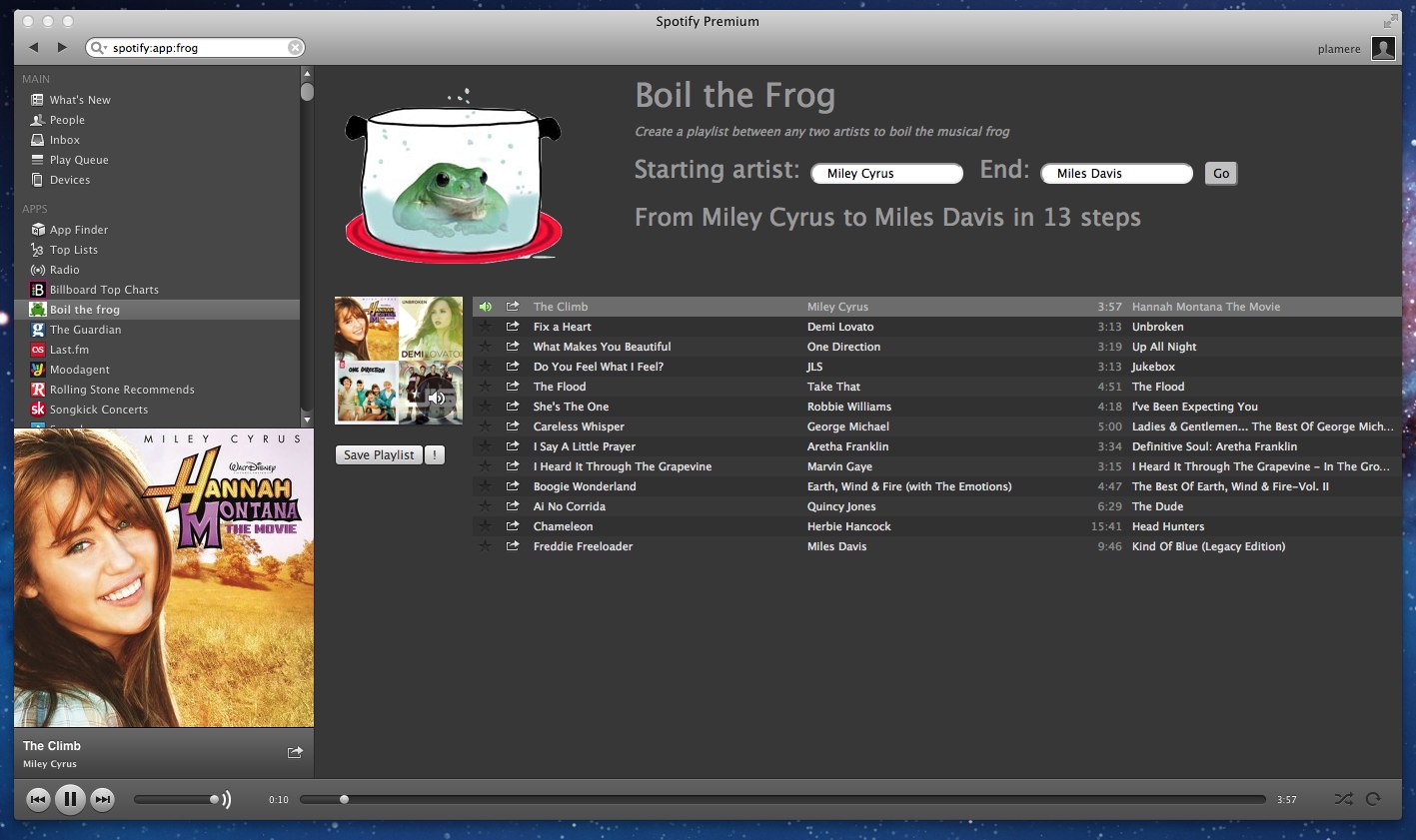
The Spotify Apps API is the perfect hacking platform. You can build a Spotify app that has full access to the vast Spotify music catalog and artwork, along with access to the listener’s catalog. Since the Spotify Apps run in an embedded browser all of your web app programming skills apply. You can use jQuery, make calls to JSON APIs, use HTML 5 canvas. It is all there. Spotify has done a really good job putting together this platform. The only downside is that, unlike the web, it is hard to actually release Spotify apps, but the Spotify team is working to make this easier. I’d love to release Boil the Frog because it is really fun to make playlists that bring you from one music style to another. It is interesting to see what musical neighborhoods you wander through on your way. For instance, I made a Kenny G to Cannibal Corpse playlist. To get there, the playlist brought me from easy listening, to movie soundtracks and then through video game soundtracks to get to the heavy metal world. Cool stuff. If you want to see a playlist between two artists let me know in the comments and I’ll create and share the playlist with you.
I made a video of Boil the Frog in action. Check it out:
[youtube http://youtu.be/Nj6JAxm9aPE]
Update: I’ve just pushed the client code out to github: https://github.com/plamere/boilthefrog
Hackathons are not nonsense
Dave Winer says that Hackathons are nonsense. Specifically he says:
Hackathons are how marketing guys wish software were made.
However, to make good software, requires lots of thought, trial and error, evaluation, iteration, trying the ideas out on other users, learning, thinking, more trial and error, and on and on. At some point you say it ain’t perfect, but it’s useful, so let’s ship. That process, if the software is to be any good, doesn’t happen in 24 hours. Sometimes it takes years, if the idea is new enough.
Dave says that software is hard and you can’t you can’t expect to build shippable software in a day. That’s certainly true, and if the goal of a hackathon was to get a bunch of developers together to build and ship commercial software in a day, I’d agree with him. But that’s not the goal of any of the hackathons I’ve attended.
I’ve participated in and/or helped organize perhaps a dozen Music Hack Days. At a Music Hack Day, people who are interested in music and technology get together for a weekend to learn about music tech and to build something with it. The goal isn’t to ship a software product, it is to scratch that personal itch to do something cool with music. The people who come to a Music Hack Day are often not in the music tech space, but are interested in learning about all the music APIs and tech available. They come to learn and then use what they’ve learned to build something. At the most recent Music Hack Day in San Francisco, 200 hackers built 60 hacks including new musical instruments, new music discovery tools, social music apps and music games.
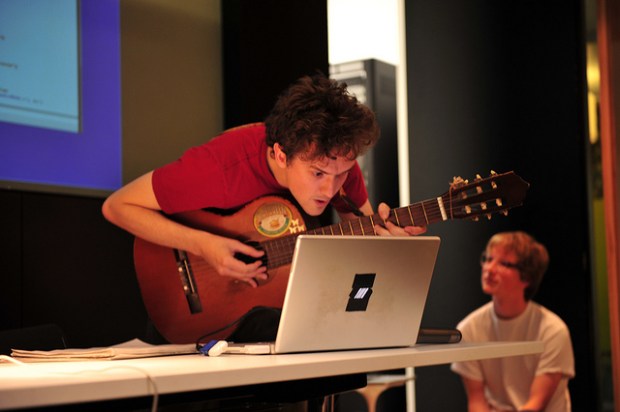
Photo by Thomas Bonte
Music Hack Days are not nonsense. They are incredibly creative weekends that have resulted in a 1,000 or more really awesome music hacks. Consider the hackathon to be the Haiku of programming. Instead of 17 syllables in 3 lines, a hacker has 24 hours. (Maybe we should call them Haikuthons;) I think the 24 hour constraint contributes to the creativity of the event.
Here are some of my favorite hacks built at recent Music Hack Days. Plenty of whimsy but no nonsense here:
- Drinkify – Answers the question “I’m listening to X, what should I drink?
- Invisible Instruments – Just what it says, musical instruments that you can’t see
- Bohemian Rhapsichord – Turns Queen’s Opus into a musical instrument
- Musaic – Discover music through photomoasics
- MIDEM Music Machine – a beautiful visualization of a song
- Tourrent Plans – Plan your tour based on where all the torrent downloaders are
- Stringer – a virtual string instrument
- The Swinger – Makes any song swing
The Midem Music Machine
Just a quick post before it is demo time. This weekend at MIDEM Hack Day, I teamed up this weekend with the famous Mr. Doob to build a music hack. We created the Midem Music Machine. It creates a beautiful visualization of music using The Echo Nest analyzer and Three.js. Here’s a pic:

As you can see, our hack was inspired by the Animusic folks. Working with Mr. Doob was awesome. He did just amazing stuff.
You can see the Midem Music Machine online here: Midem Music Machine. You’ll need a browser that supports WebGL like Chrome.
Music Hack Day London Photos
Thomas Bonte, master photographer has posted his photos for Music Hack Day London. Thomas really captures what it is like to be there in person. Thanks Thomas!
My Music Hack Day London hack
Posted by Paul in code, data, events, The Echo Nest on December 4, 2011
It is Music Hack Day London this weekend. However, I am in New England, not Olde England, so I wasn’t able to enjoy in all the pizza, beer and interesting smells that come with a 24 hour long hackathon. But that didn’t keep me from writing code. Since Spotify Apps are the cool new music hacking hotttnesss, I thought I’d create a Spotify related hack called the Artist Picture Show. It is a simple hack – it shows a slide show of artist images while you listen to them. It gets the images from The Echo Nest artist images API and from Flickr. It is a simple app, but I find the experience of being able to see the artist I’m listening too to be quite compelling.
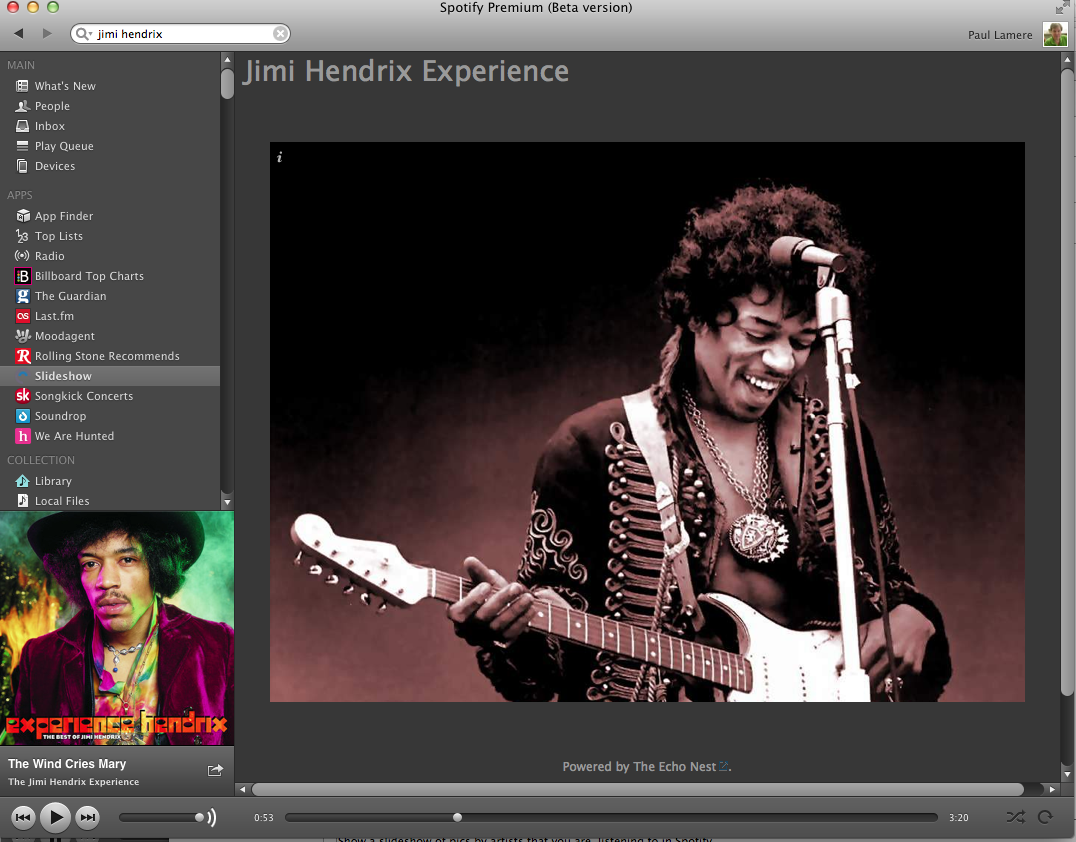
Slightly more info on the hack here.
How to avoid demo fail
So you’ve spent all weekend working on an awesome hack. It is demo time. You have exactly 2 mins to show it off to your hacking peers. You are at the podium, you look out at the faces in the crowd that are anticipating your demo. And nothing works. The 2 minutes stretch to two hours as you wait for that web page with your hack to load. You stammer a “what you would see if this was working” explanation and you leave the stage to a smattering of applause a much more humble person.

As one of the organizers for the Music Hack Day hackathon, I’ve sat through about 500 music hack demos in the last few years and I’ve probably seen at least 50 demo failures. Most of them could have been avoided with just a little bit of preparation. So here’s a list of the most common ways for demos to fail and how you can avoid them.
Hardware Failures
Hooking your computer up to a projector and audio projector should be easy, but sometimes it can be the most vexing of all. If you have the opportunity, do an A/V check before the demo session so you will have all the kinks worked out. Here are the most common failures:
- Missing Adapter – Don’t be surprised if you get to the podium to give your demo and the only thing there is a VGA connector. It never hurts to have an adapter that works with your computer/device in your pocket just in case. (but if you leave your adapter at the podium, you will never see it again).

- Projector won’t sync – it is the worst feeling in the world to connect your laptop to a projector and have it not see the projector. You should know how to force your computer to detect displays.
- No Internet – you are sitting in the audience hitting refresh on your demo web page ever 3 seconds. All is well. It is your turn to give your demo, you close your laptop, walk up to the podium, open it up, plug it in and find that your web page is no longer loading. I’ve see this happen dozens of times. It is easy to forget that when you close your laptop you may lose your network connection and may have to re-login to the local Internet provider before you get access. If you are running a non-web based demo that needs the Internet, this may be hard to notice. What’s worse, when there’s a big demo audience, with lots of laptops, iPads and iPhones, you may no longer even be able to reconnect to the local network. All the local IPs may be used up.

- Non-mirrored display – Lots of hackers have dual display setups. This can work against you when it is time to give a demo. What you see on your laptop in front of you is not what your audience can see. Moreover, the display topology probably won’t match the demo room layout so you may find you can’t even find a way to get your mouse onto the proper screen. Before you give a demo, make sure display mirroring is on. Pro-tip – on a Mac hit CMD-F1 to toggle mirror mode.
- Unexpected display resolution – Projectors usually have a much lower resolution than your desktop. If you are running your demo in a browser, usually you can adjust to a lower resolution, but if your app is written to expect a fixed display size (such as common with a 3D library, or Processing), your app may just not work. Be especially careful if your app needs to switch into fullscreen mode.
- Colors don’t show properly – I’ve seen demos with beautiful visualizations fail because projectors couldn’t show the colors well. If you are relying on colors and textures in your app an A/V check is mandatory.

- No audio jack – At a Music Hack Day you can expect that there will be an audio jack that pipes your laptop audio to the P/A system, but this is not always the case for other hacking events. If you are at a non-music hacking event, double check to make sure that there is an adequate audio hookup. There’s nothing that sounds worse than a demo where you have to hold a microphone up to your laptop speakers so the audience can hear your music.
- Audio Problems – (Added on 12/6/11) (This tip from Yuli Levtov). For those doing hacks based on certain audio-based programming languages e.g. Pure Data, SuperCollider, MaxMSP etc., plugging and un-plugging the mini-jack in a laptop can make these applications behave strangely, as some OSs think the soundcard is being swapped.The solution to this is either a) use a USB soundcard and plug into the headphone jack output at the podium, or b) leave a headphone splitter (small, inexpensive piece of kit) plugged into the headphone output of your laptop at all times, and simply plug the podium minijack into the headphone splitter when you come to give your demo. This will prevent your OS thinking the soundcard has changed, and avoid any nasty needs to re-boot your whole music masterpiece.
- Too many things to hook up – No, you probably don’t need your power supply for a 2 minute demo. Probably don’t need your mouse either. Think twice about that turntable, those lasers, the full rack of keyboards and midi sequencers. Every extra item you bring to the podium doubles the chances of demo fail. Some of the best hacks ever were essentially slide show presentations

Podium Failures
Even if you have successfully hooked up your gear to the projector and audio you are not out of the woods yet. Giving a demo at a podium can be tricky
- Can’t type and hold a microphone at the same time – it is hard enough to type in front of a room full of people. The adrenalin is flowing and your hands are shaking. It is ten times worse if you are also trying to hold a microphone while typing. If there’s a podium or clip on microphone use it. Don’t try to type with a handheld microphone.

- That’s no podium, that’s a table – sometimes there’s no podium, your laptop will be on a desk. You can chose to give your demo standing up and do crouch typing, or sit at the desk where no one will be able to see you. Be ready for unusual setups.

- Notificatus Interruptus – Don’t forget to turn off growl, email and twitter clients that like to put up friendly messages in the middle of your demo.

- No place to put my mouse – If you really need to use a mouse, be ready to find that there’s no room at the podium for a mouse and a laptop.

- It’s chaos up there! – When timing is tight, you’ll find that you are trying to setup your demo while the previous demo is tearing down and while the MC is at the same time trying to get the on deck demo ready. Too many people, too many things to setup, too little time make for a very stressful couple of minutes. Don’t get flustered.

Presentation Failures
Once you have everything setup and connected properly it is time to give actually give your demo. There are still ways to snatch success from the jaws of failure:
- Practice – Giving a demo can be challenging. You are standing at a podium in front of a couple hundred people. Your showing off something that you’ve only just finished building. There may be bugs that you need to work around, the screen may be at the wrong resolution, your hands may be shaking. You may get flustered because the audio volume was too low. With all of this stuff going on, you will forget to demo that cool feature, or you will run out of time before you get to the showstopper. The key to a great demo is Practice Practice Practice. Know what you are going to demo, know what the results will be. Know what you are going to say. Time it, give yourself a few extra seconds of time. Run through it all 10 times.

- Tell us what your demo does – You’ve been living your demo all weekend, you know what it does, but the 200 people in the audience don’t. Tell us what it does. Tell us in a couple of different ways. Make it clear why it is new, cool and worth paying attention to.

- Budget the time properly – You have 2 minutes. We don’t need to know about the github issue you had. We don’t need to know about the difficulties you had installing numpy and scipy. Get to the meat of the demo.
- Don’t waste time telling us about what you failed to do – I’ve heard lots of demos where I was told about this nifty feature that they couldn’t get to work. Don’t demo your failures, demo you successes.
- Make your demo do one thing – Two minutes is not a long time. Especially when you are showing something complex. You may have 5 nifty features in your demo, but you will never be able to demo them all. Pick the coolest feature in your demo and plan to show it a couple of times in a couple of different ways.

- Demo it! – Don’t tell us what your demo is going to do. Show it to us.

- Be enthusiastic – Excitement is contagious. If you are excited about what you are showing, we will get excited too. If you are bored, we will be checking our twitter feed.

Music Hack Day Boston 2011
Music Hack Day Boston 2011 is in the can. But what a weekend it was. 250 hackers from all over New England and the world gathered at the Microsoft NERD in Cambridge MA for a weekend of hacking on music. Over the course of the weekend, fueled by coffee, red bull, pizza and beer, we created 56 extremely creative music hacks that we demoed in a 3 hour music demo extravaganza at the end of the day on Sunday.

Music Hack Day Boston is held at the Microsoft NERD in Cambridge MA. This is a perfect hacking space – with a large presentation room for talks and demos, along with lots of smaller rooms and nooks and crannies for hackers to camp out .

Hackers started showing up at 9AM on Saturday morning and by 10AM hundreds of hackers were gathered and ready to get started.

After some intelligent and insightful opening remarks by the MC, about 20 companies and organizations gave 5 minute lightening workshops about their technology.
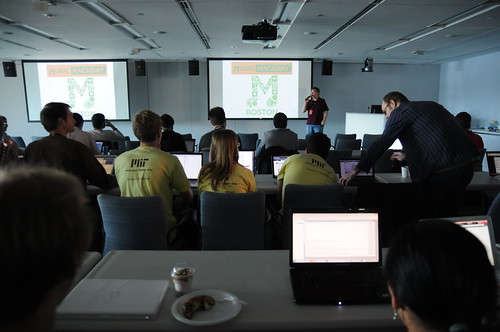
There were a few new (to Music Hack Day) companies giving workshops: Discogs announced Version 2 of their API at the Music Hack Day; Shoudio – the location based audio platform. Peachnote – and API for accessing symbolic music ngram data; EMI who were making a large set of music and data available for hackers as part of their OpenEMI initiative; the Free Music Archive showed their API to give access to 40,000 creative commons licensed songs and WinAmp – showed their developer APIs and network.

After lunch, hacking began in earnest. Some organizations held in-depth workshops giving a deeper dive in to their technologies. Hacking continued in to the evening after shifting to the over night hacking space at The Echo Nest.

Hackers were ensconced in their nests while one floor below there was a rager DJ’d by Ali Shaheed Muhammad (one third of A Tribe called Quest).

Thanks to the gods of time, we were granted one extra hour over night to use to hack or to sleep. Nevertheless, there were many bleary eyes on Sunday morning as hackers arrived back at the NERD to finish their hacks.

Finally at 2:30 PM at 25+ hours of hacking, we were ready to show our hacks.There was an incredibly diverse set of hacks including new musical instruments, new social web sites, new ways to explore for music. The hacks spanned from the serious to the whimsical. Here are some of my favorites.

Free Music Archive Radio – this hack uses the Echo Nest and the Creative Commons licensed music of the Free Music Archive to create interesting playlists for use anywhere.
Mustachiness – Can you turn music into a mustache? The answer is yes. This hack uses sophisticated moustache caching technology to create the largest catalog of musical mustaches in history.

Bohemian Rhapsichord – Turning a popular song into a musical instrument. This is my hack. It lets you play Bohemian Rhapsody like you’ve never played it before.
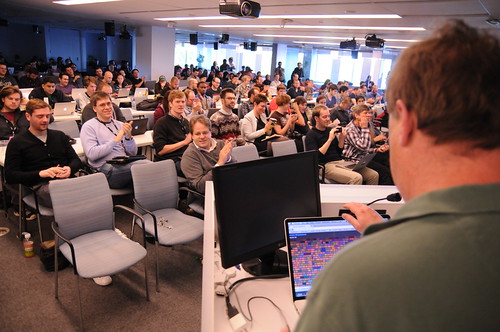
Spartify – Host a Party and let people choose what songs to play on Spotify. No more huddling in front of one computer or messing up the queue!

Snuggle – I want you to snuggle this. Synchronize animated GIFs to jams of the future. These guys get the prize for most entertaining patter during their demo.

Drinkify – Never listen to music alone again – This app has gone viral. Han, Lindsay and Matt built an app to scratch their own itch. Drinkify automatically generates the perfect cocktail recipe to accompany any music.

Peachnote Musescore and Noteflight search – searching by melody in the two social music score communities.
bitbin – Create and share short 8-bit tunes
The Videolizer – music visualizer that syncs dancing videos to any song. Tristan’s awesome hack – he built a video time stretcher allowing you to synchronize any video that has a soundtrack to a song. The demos are fantastic.
The Echo Nest Prize Winners
Two hacks received the Echo Nest prizes:
unity-echonest – An echonest + freemusicarchive dynamic soundtrack plugin for Unity3D projects. This was a magical demo. David Nunez created a Unity3D plugin that dynamically generates in game soundtracks using the Echo Nest playlist API and music from the Free Music Archive. Wow!

MidiSyncer – sync midi to echo nest songs. Art Kerns built An iPhone app that lets you choose a song from your iTunes library, retrieves detailed beat analysis information from Echo Nest for the song, and then translates that beat info to MIDI clock as the song plays. This lets you sync up an electronic music instrument such as a drum machine or groovebox to a song that’s playing on your iPhone. So wow! Play a song on your iPod and have a drum machine play in sync with it. Fantastic!

Hardware Hacks
Some really awesome hardware hacks.
Neurofeedback – Electroencephalogram + strobe goggles + Twilio Chat Bot + Max/MSP patches which control Shephard-risset rhythms and binaural beats
Sonic Ninja – Zebra Tube Awesomeness – John Shirley develops PVC helmholtz resonator while hacking a WiiMote and bluetooth audio transmission.

SpeckleSounds – Super-sensitive 3D Sound Control w/ Lasers! Yes, with lasers.
Kinect BeatWheel – Control a quantized looping sample with your arm

Demo Fail
There were a few awesome hacks that were cursed by the demo demi gods. Great ideas, great hacks, frustrating (for the hacker) demos. Here are some of the best demo fail hacks .
Kinetic – Kinetic Typography driven by user selected music and text. This was a really cool hack that was plagued by a podium display issue leading to a demi-demo-fail. But the Olin team regrouped and posted a video of the app.
BetterTaste – improve your Spotify image – this was an awesome idea – use a man-in-the-middle proxy to intercept those embarassing scrobbles. Unfortunately Arkadiy had a network disconnect that lead to a demo fail.
Tracker – Connect your turntable to the digital world. Automatically identifies tracks, saves mp3s, and scrobbles plays, while displaying a beautiful UI that’s visible from across the room, or across the web. Perhaps the most elaborate of the demos – with a real Hi Fi setup including a turntable. But something wasn’t clicking, so Abe had to tell us about it instead of showing it.

Carousel – tell the story behind your pictures – it was a display fail – but luckily Johannes had a colleague who had his back and re-gave the demo. That’s what hacker friends are for.

This was a fantastic weekend. Thanks to Thomas Bonte of MuseScore for taking these super images. Special thanks to the awesome Echo Nest crew lead by Elissa for putting together this event, staffing it and making it run like clockwork. It couldn’t have happened without her. I was particularly proud of The Echo Nest this week. We created some awesome hacks, threw a killer party, and showed how to build the future of music while having a great time. What a place to work!
 Music Machinery
