Posts Tagged spotify
Where is my JSpot?
Posted by Paul in code, fun, Music, web services on November 3, 2009
I like Spotify. I like Java. So I combined them. Here’s a Java client for the new Spotify metadata API: JSpot
This client lets you do things like search for a track by name and get the Spotify ID for the track so you can play the track in Spotify. This is useful for all sorts of things like building web apps that use Spotify to play music, or perhaps to build a Playdar resolver so you can use Spotify and Playdar together.
Here’s some sample code that prints out the popularity and spotify ID for all versions of Weezer’s ‘My Name Is Jonas’.
    Spotify spotify = new Spotify();
    Results<Track> results = spotify.searchTrack("Weezer",  "My name is Jonas");
    for (Track track : results.getItems()) {
       System.out.printf("%.2f %s \n", track.getPopularity(), track.getId());
    }
This prints out:
If you have Spotify and you click on those links, and those tracks are available in your locale you should hear Weezer’s nerd anthem.
You can search for artists, albums and tracks and you can get all sorts of information back such as release dates for albums, countries where the music can be played, track length, popularity for artists, tracks and albums. It is very much a 0.1 release. The search functionality is complete so its quite useful, but I haven’t implemented the ‘lookup’ methods yet. There some javadocs. There’s a jar file: jspot.jar. And it is all open source: jspot at google code.
Spotify for the iPhone
On the Spotify blog they have a video of the latest version of the Spotify iPhone app that has just been submitted to the iPhone app store for approval. Notice how on the video, the Spotify client is in the position on the home screen that the iPod app normally occupies. I wonder if Apple is going to like this.
Some of the interesting details emerging about the app are:
- Won’t be released in the US app store since Spotify is not available in the U.S (sniff)
- Free Download
- Only works for premium users
- Offline mode allows you to cache 3,333 tracks (!)
- Works on iPod touch
- Music stops when you switch away from the app
I’m really looking forward to being able to run this app. And rumor is that it won’t be long before people in the US get to play.
I may never use iTunes again
 On the Spotify blog there’s a video demo of Spotify running on Android (the Google mobile OS). This is a demo of work-in-progress, but already it shows that just as Spotify is pushing the bounds on the desktop, they are going to push the bounds on mobile devices. The demo shows that you get the full Spotify experience on your device. You can listen to just about any song by any artist. No waiting for music to load, it just starts playing right away. All your Spotify playlists are available on your device. You don’t have to do that music shuffle game that you play with the iPod – where you have to decide on Sunday what songs you will want to listen to on Tuesday.
I think the killer feature in the demo is offline syncing. You can make any playlist available for listening even when you are offline. When you mark a playlist for offline sync, the tracks in the playlist are downloaded to your device allowing you to listen to them in those places that have no Internet connection (such as a plane, the subway or Vermont). The demo also shows how Spotify keeps all your playlists magically in sync. Add a song to one of your Spotify playlists while sitting at your computer and the corresponding playlist on your device is instantly updated. Totally cool. I do worry that the record labels may balk at the offline sync feature. Spotify may be pushing the bounds further than the labels want to go, by letting us listen to any music at any time, whether at home, in the office or mobile.
Much of my daily music listening is now through the Spotify desktop client. The folks at Spotify continue to add music at a phenomenal rate (100K new tracks in the last week). The only reason I ever fire up iTunes now is to synchronize music to my iPhone. It is no secret that Spotify is also working on an iPhone version of their mobile app. I can’t wait to get a hold of it. When that happens, I may never use iTunes again.
Check out the demo:
Spotify + Echo Nest == w00t!
Posted by Paul in Music, The Echo Nest, web services on May 19, 2009
 Yesterday, at the SanFran MusicTech Summit, I gave a sneak preview that showed how Spotify is tapping into the Echo Nest platform to help their listeners explore for and discover new music. I must say that I am pretty excited about this. Anyone who has read this blog and its previous incarnation as ‘Duke Listens!’ knows that I am a long time enthusiast of Spotify (both the application and the team). I first blogged about Spotify way back in January of 2007 while they were still in stealth mode. I blogged about the Spotify haircuts, and their serious demeanor:

Those crazy Spotify guys
I blogged about the Spotify application when it was released to private beta: Woah – Spotify is pretty cool, and continued to blog about them every time they added another cool feature.
I’ve been a daily user of Spotify for 18 months now. It is one of my favorite ways to listen to music on my computer. It gives me access to just about any song that I’d like to hear (with a few notable exceptions – still no Beatles for instance).
It is clear to anyone who uses Spotify for a few hours that having access to millions and millions of songs can be a bit daunting. With so many artists and songs to chose from, it can be hard to decide what to listen to – Barry Schwartz calls this the Paradox of Choice – he says too many options can be confusing and can create anxiety in a consumer. The folks at Spotify understand this. From the start they’ve been building tools to help make it easier for listeners to find music. For instance, they allow you to easily share playlists with your friends. I can create a music inbox playlist that any Spotify user can add music to. If I give the URL to my friends (or to my blog readers) they can add music that they think I should listen to.
Now with the Spotify / Echo Nest connection, Spotify is going one step further in helping their listeners deal with the paradox of choice. They are providing tools to make it easier for people to explore for and discover new music. The first way that Spotify is tapping in to the Echo Nest platform is very simple, and intuitive. Right click on a playlist, and select ‘Extend Playlist’. When you do that, the playlist will automatically be extended with songs that fit in well with songs that are already in the playlist. Here’s an example:
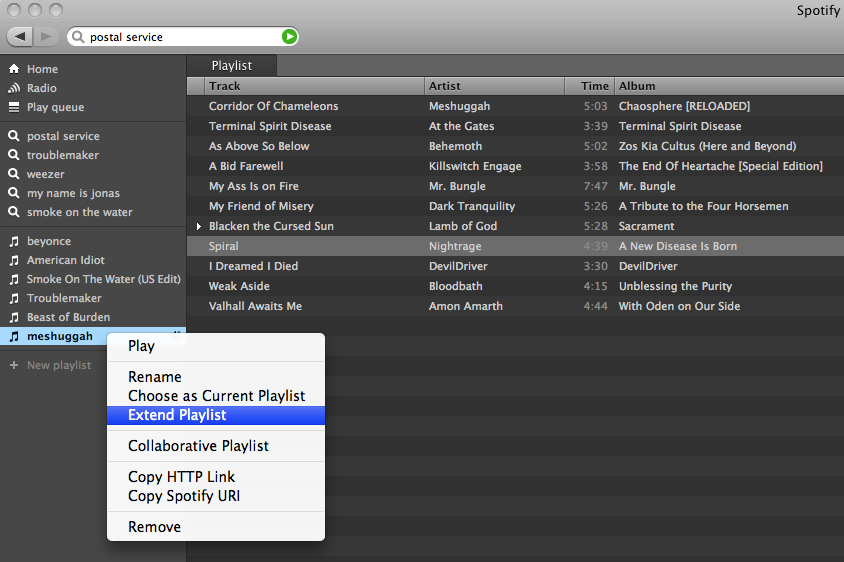
So how is this different from any other music recommender? Well, there are a number of things going on here. First of all, most music recommenders rely on collaborative filtering (a.k.a. the wisdom of the crowds), to recommend music. This type of music recommendation works great for popular and familiar artists recommendations … if you like the Beatles, you may indeed like the Rolling Stones. But Collaborative Filtering (CF) based recommendations don’t work well when trying to recommend music at the track level. The data is often just to sparse to make recommendations. The wisdom of the crowds model fails when there is no crowd. When one is dealing with a Spotify-sized music collection of many millions of songs, there just isn’t enough user data to give effective recommendations for all of the tracks. The result is that popular tracks get recommended quite often, while less well known music is ignored. To deal with this problem many CF-based recommenders will rely on artist similarity and then select tracks at random from the set of similar artists. This approach doesn’t always work so well, especially if you are trying to make playlists with the recommender. For example, you may want a playlist of acoustic power ballads by hair metal bands of the 80s. You could seed the playlist with a song like Mötley Crüe’s Home Sweet Home, and expect to get similar power ballads, but instead you’d find your playlist populated with standard glam metal fair, with only a random chance that you’d have other acoustic power ballads. There are a boatload of other issues with wisdom of the crowds recommendations – I’ve written about them previously, suffice it to say that it is a challenge to get a CF-based recommender to give you good track-level recommendations.
The Echo Nest platform takes a different approach to track-level recommendation. Here’s what we do:
- Read and understand what people are saying about music – we crawl every corner of the web and read every news article, blog post, music review and web page for every artist, album and track. We apply statistical and natural language processing to extract meaning from all of these words. This gives us a broad and deep understanding of the global online conversation about music
- Listen to all music – we apply signal processing and machine learning algorithms to audio to extract a number perceptual features about music. For every song, we learn a wide variety of attributes about the song including the timbre, song structure, tempo, time signature, key, loudness and so on. We know, for instance, where every drum beat falls in Kashmir, and where the guitar solo starts in Starship Trooper.
- We combine this understanding of what people are saying about music and our understanding of what the music sounds like to build a model that can relate the two – to give us a better way of modeling a listeners reaction to music. There’s some pretty hardcore science and math here. If you are interested in the gory details, I suggest that you read Brian’s Thesis: Learning the meaning of music.
What this all means is that with the Echo Nest platform, if you want to make a playlist of acoustic hair metal power ballads, we’ll be able to do that – we know who the hair metal bands are, and we know what a power ballad sounds like. And since we don’t rely on the wisdom of the crowds for recommendation we can avoid some of the nasty problems that collaborative filtering can lead to. I think that when people get a chance to play with the ‘Extend Playlist’ feature they’ll be happy with the listening experience.
It was great fun giving the Spotify demo at the SanFran MusicTech Summit. Even though Spotify is not available here in the U.S., the buzz that is occuring in Europe around Spotify is leaking across the ocean. When I announced that Spotify would be using the Echo Nest, there’s was an audible gasp from the audience. Some people were seeing Spotify for the first time, but everyone knew about it. It was great to be able to show Spotify using the Echo Nest. This demo was just a sneak preview. I expect there will be lots more interestings to come. Stay tuned.
The ultimate Spotify blog
 If you use Spotify, you should check out The Pansentient League, where blogger Jer White blogs about all things spotify. For instance, Jer recently compared 10 different Spotify playlist sites listing their pluses and minuses. He’s also maintaing a complete list of Spotify Resources. Pansentient is a pretty handy site.
the sound of a million passwords changing
A bad day for my friends at Spotify. First the news of a security breach that compromised the personal information of their one million users – followed by the outage of the Spotify.com website as a million people all tried to change their passwords at once. But despite all of this trouble, the Spotify player kept playing music.
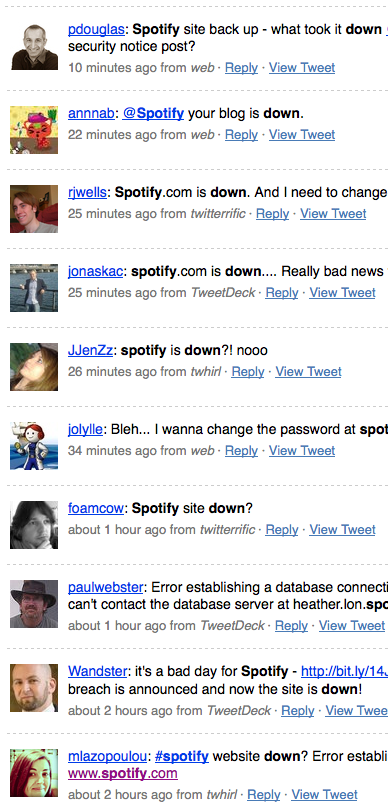
It is interesting to see how Spotify is handling their first big crises. So far, they seem to be doing most things right – they are being open about what the problem was and they have already fixed the problem that has caused the breach. Looks like they may need to be a bigger web server though.
Hacking spotify
Spotify is the new “old napster” – everyone who uses it seems to love it. As this Google trends plot shows it is starting to become very popular.
But there is a downside to becoming popular – when you are popular you start to become a target of hackers. This is happening to Spotify now – Spotify is another platform waiting to be explored and exploited. Some notable hacks:
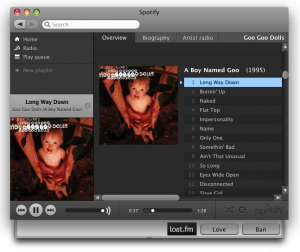
- Lastify – this is a rather benign hack – it adds a couple of buttons to the bottom of your spotify client that let you apply Last.fm ‘love’ and ‘ban’ to the currently playing track.
- Despotify – the open source Spotify client – this is a rather extensive hack. #hack.se has reverse engineeered the Spotify protocols and have built an open source Spotify client (with curses text-mode goodness). The client includes code that decrypts the encrypted music served by Spotify, potentially allowing anyone to not just listen to music, but to download and save it as well. Here’s a video of Despotify in action:
Already, Spotify seems to have responded to this hack, according to the Despotify page: “Despotify has been blocked for users using ‘free’ or ‘daypass’ accounts. You can still use despotify using ‘Premium’ accounts.”. That seems fair – if you pay for Spotify, you can use whatever client you want.
- Geographic hacks – Spotify is only released in certain countries. If you don’t live in the UK, Spain, France, Sweden, Norway or Finland you are out of luck – but not really. According to this article in Wired, some users are using a UK-based proxy to allow access to Spotify from places like the USA.
As Spotify gains in popularity, the Spotify engineers are going to be playing a bit of wack-a-mole to keep the hackers at bay in order to keep the Spotify platform stable and performant. So far, they seem to be doing a very good job.
 Music Machinery