New Genre APIs
Posted by Paul in code, Music, The Echo Nest, web services on January 16, 2014
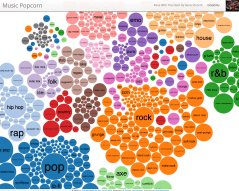 Today at the Echo Nest we are pushing out an update to our Genre APIs. The new APIs lets you get all sorts of information about any of over 800 genres including a description of the genre, representative artists in the genre, similar genres, and links to web resources for the genre (such as a wikipedia page, if one exists for a genre). You can also use the genres to create various types of playlists. With these APIs you build all sorts of music exploration apps like Every Noise At Once, Music Popcorn and Genre-A-Day.
The new APIs are quite simple to use. Here are a few python examples created using pyen.
List all of the available genres with a description
This file contains hidden or bidirectional Unicode text that may be interpreted or compiled differently than what appears below. To review, open the file in an editor that reveals hidden Unicode characters.
Learn more about bidirectional Unicode characters
| import pyen | |
| en = pyen.Pyen() | |
| response = en.get('genre/list', bucket=['description']) | |
| for g in response['genres']: | |
| print g['name'], '-', g['description'] |
This outputs text like so:
This file contains hidden or bidirectional Unicode text that may be interpreted or compiled differently than what appears below. To review, open the file in an editor that reveals hidden Unicode characters.
Learn more about bidirectional Unicode characters
| a cappella – A cappella is singing without instrumental accompaniment. From the Italian for "in the manner of the chapel," a cappella may be performed solo or by a group. | |
| abstract hip hop – | |
| acid house – From house music came acid house, developed in the mid-'80s by Chicago DJs experimenting with the Roland TB-303 synthesizer. That instrument produced the subgenre's signature squelching bass, used to create a hypnotic sound. | |
| acid jazz – Acid jazz, also called club jazz, is a style of jazz that takes cues from a number of genres, including funk, hip-hop, house, and soul. | |
| … |
We can get the top artists for any genre like so:
This file contains hidden or bidirectional Unicode text that may be interpreted or compiled differently than what appears below. To review, open the file in an editor that reveals hidden Unicode characters.
Learn more about bidirectional Unicode characters
| import pyen | |
| import sys | |
| en = pyen.Pyen() | |
| if len(sys.argv) > 1: | |
| genre = ' '.join(sys.argv[1:]) | |
| response = en.get('genre/artists', name=genre) | |
| for artist in response['artists']: | |
| print artist['name'] | |
| else: | |
| print "usage: python top_artists_for_genre.py genre name" |
Here are the top artists for ‘cool jazz’
This file contains hidden or bidirectional Unicode text that may be interpreted or compiled differently than what appears below. To review, open the file in an editor that reveals hidden Unicode characters.
Learn more about bidirectional Unicode characters
| % python top_artists_for_genre.py cool jazz | |
| Thelonious Monk | |
| Stan Getz | |
| Lee Konitz | |
| The Dave Brubeck Quartet | |
| Bill Evans | |
| Cannonball Adderley | |
| Art Pepper | |
| Charlie Parker | |
| John Coltrane | |
| Gil Evans | |
| Ahmad Jamal | |
| Miles Davis | |
| Horace Silver | |
| Dave Brubeck | |
| Oliver Nelson |
We can find similar genres to any genre with this bit of code:
This file contains hidden or bidirectional Unicode text that may be interpreted or compiled differently than what appears below. To review, open the file in an editor that reveals hidden Unicode characters.
Learn more about bidirectional Unicode characters
| import pyen | |
| import sys | |
| en = pyen.Pyen() | |
| if len(sys.argv) > 1: | |
| genre = ' '.join(sys.argv[1:]) | |
| response = en.get('genre/similar', name=genre) | |
| for genre in response['genres']: | |
| print genre['name'] | |
| else: | |
| print "usage: python sim_genres.py genre name" |
Sample output:
% python sim_genres.py cool jazz
bebop
jazz
hard bop
contemporary post-bop
soul jazz
big band
jazz christmas
stride
jazz funk
jazz fusion
avant-garde jazz
free jazz
We can use the genres to create excellent genre playlists. To do so, create a playlist of type ‘genre-radio’ and give the genre name as a seed. We’ve also added a new parameter called ‘genre_preset’ that, if specified will control the type of songs that will be added to the playlist. You can chose from core, in_rotation, and emerging. Core genre playlists are great for introducing a new listener to the genre. Here’s a bit of code that generates a core playlist for any genre:
This file contains hidden or bidirectional Unicode text that may be interpreted or compiled differently than what appears below. To review, open the file in an editor that reveals hidden Unicode characters.
Learn more about bidirectional Unicode characters
| import pyen | |
| import sys | |
| en = pyen.Pyen() | |
| if len(sys.argv) < 2: | |
| print 'Usage: python genre_playlist.py seed genre name' | |
| else: | |
| genre = ' '.join(sys.argv[1:]) | |
| response = en.get('playlist/static', type='genre-radio', genre_preset='core-best', genre=genre) | |
| for i, song in enumerate(response['songs']): | |
| print "%d %s by %s" % ((i +1), song['title'], song['artist_name']) |
The core classic rock playlist looks like this:
- Simple Man by Lynyrd Skynyrd
- Born To Be Wild by Steppenwolf
- All Along The Watchtower by Jimi Hendrix
- Kashmir by Led Zeppelin
- Sunshine Of Your Love by Cream
- Let’s Work Together by Canned Heat
- Gimme Shelter by The Rolling Stones
- It’s My Life by The Animals
- 30 Days In The Hole by Humble Pie
- Midnight Rider by The Allman Brothers Band
- The Joker by Steve Miller Band
- Fortunate Son by Creedence Clearwater Revival
- Black Betty by Ram Jam
- Heart Full Of Soul by The Yardbirds
- Light My Fire by The Doors
The ‘in rotation’ classic rock playlist looks like this:
- Heaven on Earth by Boston
- Doom And Gloom by The Rolling Stones
- Little Black Submarines by The Black Keys
- I Gotsta Get Paid by ZZ Top
- Fly Like An Eagle by Steve Miller Band
- Blue On Black by Kenny Wayne Shepherd
- Driving Towards The Daylight by Joe Bonamassa
- When A Blind Man Cries by Deep Purple
- Over and Over (Live) by Joe Walsh
- The Best Is Yet To Come by Scorpions
- World Boss by Gov’t Mule
- One Way Out by The Allman Brothers Band
- Corned Beef City by Mark Knopfler
- Bleeding Heart by Jimi Hendrix
- My Sharona by The Knack
While the emerging ‘classic rock’ playlist looks like this:
- If You Were in Love by Boston
- Beggin’ by Shocking Blue
- Speak Now by The Answer
- Mystic Highway by John Fogerty
- Hell Of A Season by The Black Keys
- No Reward by Gov’t Mule
- Pretty Wasted by Tito & Tarantula
- The Battle Of Evermore by Page & Plant
- I Got All You Need by Joe Bonamassa
- What You Gonna Do About Me by Buddy Guy
- I Used To Could by Mark Knopfler
- Wrecking Ball by Joe Walsh
- The Circle by Black Country Communion
- You Could Have Been a Lady by April Wine
- 15 Lonely by Walter Trout
The new Genre APIs are really quite fun to use. I’m looking forward to seeing a whole new world of music exploration and discovery apps built around these APIs.
Learn about a new genre every day
Posted by Paul in code, genre, playlist, The Echo Nest on January 16, 2014
The Echo Nest knows about 800 genres of music (and that number is growing all the time). Among those 800 genres are ones that you already know about, like ‘jazz’,’rock’ and ‘classical’. But there are also hundreds of genres that you’ve probably never heard of. Genres like Filthstep, Dangdut or Skweee. Perhaps the best way to explore the genre space is via Every Noise at Once (built by Echo Nest genre-master Glenn McDonald). Every Noise At Once shows you the whole genre space, allowing you to explore the rich and varied universe of music. However, Every Noise at Once can be like drinking Champagne from a firehose – there’s just too much to take in all at once (it is, after all, every noise – at once). If you’d like to take a slower and more measured approach to learning about new music genres, you may be interested in Genre-A-Day.
Genre-A-Day is a web app that presents a new genre every day. Genre-A-Day tells you about the genre, shows you some representative artists for the genre, lets you explore similar genres, and lets you listen to music in the genre.
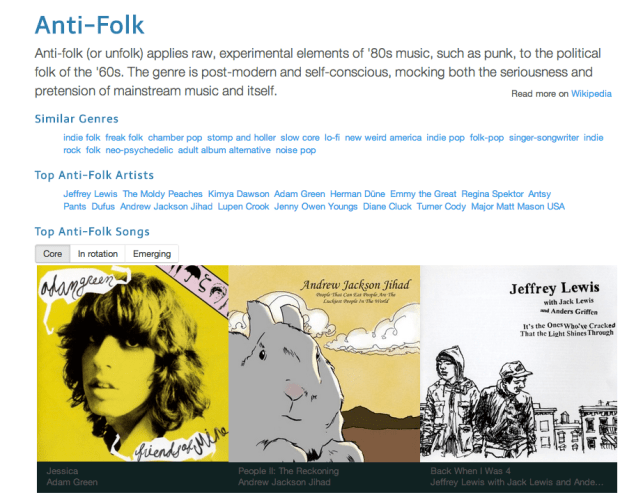
If you spend a few minutes every day reading about and listening to a new genre, after a few months you’ll be a much more well-rounded music listener, and after a few years your knowledge of genres will rival most musicologists’.
An easy way to make Genre-A-Day part of your daily routine is to follow @GenreADay on twitter. GenreADay will post a single tweet, once a day like so:
Under the hood – Genre-A-Day was built using the just released genre methods of The Echo Nest API. These methods allow you to get detailed info on the set of genres, the top artists for the genres, similar genres and so on. It also uses the super nifty genre presets in the playlist API that allow you to craft the genre-radio listener for someone who is new to the genre (core), for someone who is a long time listener of the genre (in rotation), or for someone looking for the newest music in that genre (emerging). The source code for Genre-A-Day is on github.
The Zero Button Music Player
Posted by Paul in music information retrieval, playlist, recommendation, research, The Echo Nest, zero ui on January 14, 2014
Ever since the release of the Sony Walkman 35 years ago, the play button has been the primary way we interact with music. Now the play button stands as the last barrier between a listener and their music. Read on to find out how we got here and where we are going next.
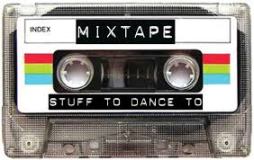 In the last 100 years, technology has played a major role in how we listen to and experience music. For instance, when I was coming of age musically, the new music technology was the Sony Walkman. With the Walkman, you could take your music with you anywhere. You were no longer tied to your living room record player to listen to your music. You no longer had to wait and hope that the DJ would play your favorite song when you were on the road. You could put your favorite songs on a tape and bring them with you and listen to them whenever you wanted to no matter where your were. The Sony Walkman really changed how we listened to music. It popularized the cassette format, which opened the door to casual music sharing by music fans. Music fans began creating mix tapes and sharing music with their friends. The playlist was reborn, music listening changed. All because of that one device.
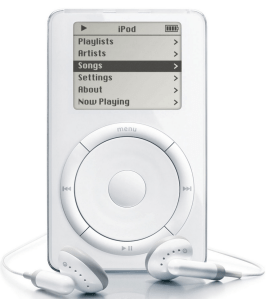 We are once again in the middle of music+technology revolution. It started a dozen years ago with the first iPod and it continues now with devices like the iPhone combined with a music subscription service like Spotify, Rdio, Rhapsody or Deezer. Today, a music listener armed with an iPhone and a ten dollar-a-month music subscription is a couple of taps away from being able to listen to almost any song that has ever been recorded. All of this music choice is great for the music listener, but of course it brings its own problems. When I was listening to music on my Sony Walkman, I had 20 songs to choose from, but now I have millions of songs to choose from. What should I listen to next? The choices are overwhelming. The folks that run music subscription services realize that all of this choice for their listeners can be problematic. That’s why they are all working hard to add radio features like Rdio’s You.FM Personalized Radio. Personalized Radio simplifies the listening experience – instead of having to pick every song to play, the listener only needs to select one or two songs or artists and they will be presented with an endless mix of music that fits well with initial seeds.
Helping listeners pick music is especially important when you consider that not all music listeners are alike, and that most listeners are, at best, only casual music fans. A study conducted in 2003 and again in 2006 by Emap (A UK-based Advertising agency), summarized here by David Jennings, identified four main types of music listeners. Jennings describes these four main listening types as:
-
Savants – for whom everything in life is tied up with music
-
Enthusiasts – Music is a key part of life but is balanced with other interests
-
Casuals – Music plays a welcoming role, but other things are far more important
-
Indifferents – Would not lose much sleep if music ceased to exist.
These four listener categories are an interesting way to organize music listeners, but of course, real life isn’t so cut and dried. Listener categories change as life circumstances change (have a baby and you’ll likely become a much more casual music listener) and can even change based on context (a casual listener preparing for a long road-trip may act like a savant for a few days while she builds her perfect road-trip playlist).
In 2006, the distribution of people across these 4 categories was as follows:
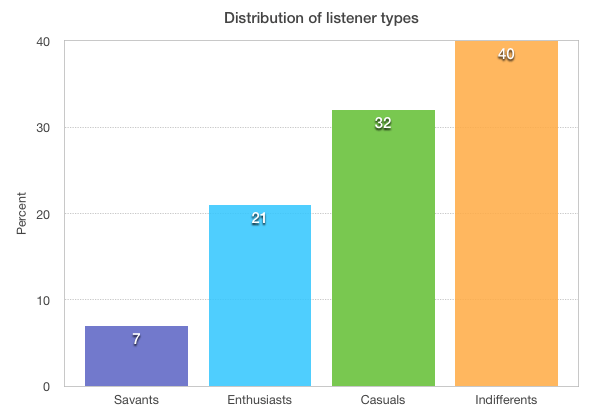
This chart says a lot about the music world and why it works the way it does. For instance, it gives us a guide as to how much different segments of the listening world are willing to pay for music in a year. On the chart below, I’ve added my estimate of the amount of money each listener type will spend on music in a year.

Savants will spend a thousand dollars or more on vinyl, concerts, and music subscriptions. Enthusiasts will spend $100 a year on a music subscription or, perhaps, purchase a couple of new tracks per week. Casuals will spend $10 a year (maybe splurge and buy that new Beyoncé album), while Indifferents will spend nothing on music. This is why music services like Spotify and Rdio have been exploring the Fremium model. If they want to enroll the 72% of people who are Casual or Indifferent music listeners, they need a product that costs much less than the $100 a year Enthusiasts are willing to pay.
However, price isn’t the only challenge music services face in attracting the Casuals and the Indifferents. Different types of listeners have a different tolerance around the amount of time and effort it takes to play music that they want to listen to.
A music Savant – someone who lives, eats and breathes music – is happy spending hours a day poring through music blogs, forums and review sites to find new music, while the Indifferent music listener may not even make the simplest of efforts like turning the radio on or switching to a new station if they don’t like the current song. A simple metric for the time and effort spent is Interactions Per Listening Session. In this chart, I’ve added my estimate of the number of interactions, on average, a listener of a given type will tolerate to create a listening session.
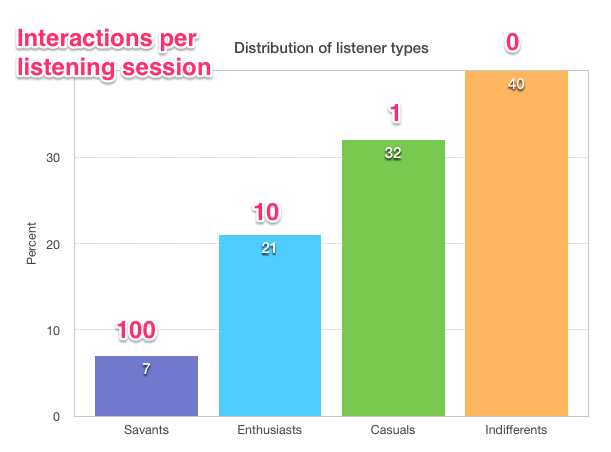
Interactions per Listening Session is an indication of how many times the listener controls their music player for a listening session. That music Savant may carefully handpick each song going into a playlist after reading a few music blogs and reviews about an artist on The Hype Machine, checking out the artist bio and previewing a few tracks. The music Enthusiast may grab a few top songs from a handful of their favorite artists to build a Spotify playlist. The casual listener may fire up Pandora, select an artist station and click play, while the Indifferent music listener may passively listen to the music that is playing on the radio or in the background at the local Starbucks.
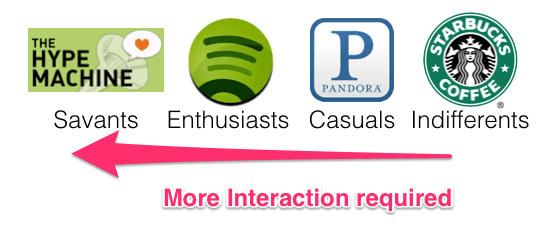
The above chart shows why a music service like Pandora has been so successful. With its simple interface, Pandora is able to better engage the Casual listeners who don’t want to spend time organizing their listening session. A Pandora listener need only pick a station, and Pandora does all the work from there. This is why music subscription services hoping to attract more users are working hard to add Pandora-like features. In order to make their service appeal to the Casuals, they need to make it incredibly easy to have a good listening experience.
But what about those Indifferents? If 40% of people are indifferent to music, is this a lost market for music services? Is it impossible to reach people who can’t even be bothered to queue up some music on Pandora? I don’t think so. Over the last 75 years, terrestrial radio has shown that even the most indifferent music fan can be coaxed into simple, “lean back” listening. Even with all of the media distractions in the world today, 92% of Americans age 12 or older listen to the radio at least weekly, much the same as it was back in 2003 (94%).
So what does it take to capture the ears of Indifferents? First, we have to drive the out-of-pocket costs to the listener to zero. This is already being done via the Freemium model – Ad supported Internet radio (non-on-demand) is becoming the standard entry point for music services. Next, and perhaps more difficult, we have to drive the number of interactions required to listen to music to zero.
Thus my current project – Zero UI – building a music player that minimizes the interactions necessary to get good music to play – a music player that can capture the attention of even the musically indifferent.
Implicit signals and context
Perhaps the biggest challenge in creating a Zero UI music player is how to get enough information about the listener to make good music choices. If a Casual or Indifferent listener can’t be bothered to explicitly tell us what kind of music they like, we have to try to figure it out based upon implicit signals. Luckily, a listener gives us all kinds of implicit signals that we can use to understand their music taste. Every time a listener adjusts the volume on the player, every time they skip a song, every time they search for an artist, or whenever they abandon a listening session, they are telling us a little bit about their music taste. In addition to the information we can glean from a listener’s implicit actions, there’s another source of data that we can use to help us understand a music listener. That’s the listener’s music listening device – i.e. their phone.

The mobile phone is now and will continue to be the primary way for people to interact with and experience music. My phone is connected to a music service with 25 million songs. It ‘knows’ in great detail what music I like and what I don’t like. It knows some basic info about me such as my age and sex. It knows where I am, and what I am doing – whether I’m working, driving, doing chores or just waking up. It knows my context – the time of day, the day of the week, today’s weather, and my schedule. It knows that I’m late for my upcoming lunch meeting and it even might even know the favorite music of the people I’m having lunch with.
Current music interfaces use very little of the extra context provided by the phone to aid in music exploration and discovery. In the Zero UI project, I’ll explore how all of this contextual information provided by the latest devices (and near future devices) can be incorporated into the music listening experience to help music listeners organize, explore, discover and manage their music listening. The goal is to create a music player that knows the best next song to play for you given your current context. No button pressing required.
There are lots of really interesting areas to explore:
-
Can we glean enough signal from the set of minimal listener inputs?
-
Which context types (user activity, location, time-of-day, etc.) are most important for scheduling music? Will we suffer from the curse of dimensionality with too many contexts?
-
What user demographic info is most useful for avoiding the cold start problem (age, sex, zip code)?
-
How can existing social data (Facebook likes, Twitter follows, social tags, existing playlists) be used to improve the listening experience?
-
How can we use information from new wearable devices such as the Jawbone’s Up, the Fitbit, and the Pebble Smart Watch to establish context?
-
How do we balance knowing enough about a listener to give them good music playlists and knowing so much about a listener that they are creeped out about their ‘stalker music player’?
Over the next few months I’ll be making regular posts about Zero-UI. I’ll share ideas, prototypes and maybe even some code. Feel free to follow along.
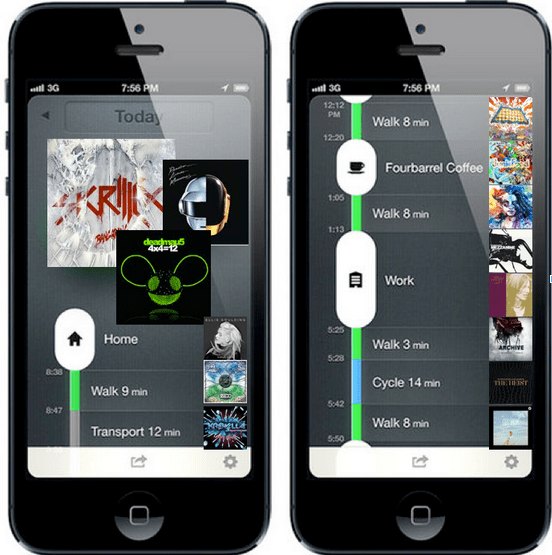
Conceptual zero-ui player that maps music listening onto user activity (as tracked by moves-app )
Must listen to podcast – Digital Music Trends
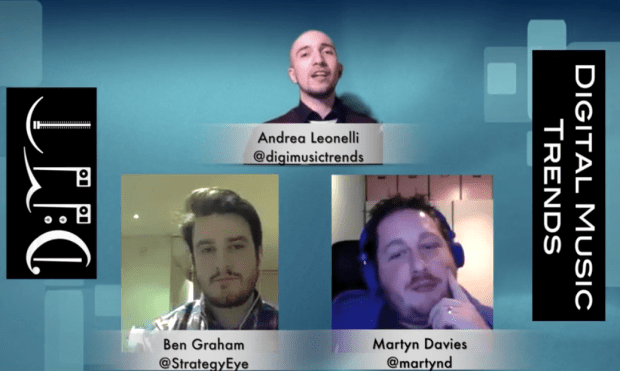
My top ‘must-listen’ podcast is now Andrea Leonelli’s Digital Music Trends. This weekly podcast is jam packed with analysis and info about what’s going on in the digital music space. The latest podcast includes Music Hack Day master Martyn Davies and Ben Graham from StrategyEye in a round table discussion on Gracenote’s recent sale, their Rhythm announcment, CES and more. Good stuff.
Six Degrees of Black Sabbath (v2)
Posted by Paul in code, fun, Music, The Echo Nest on January 6, 2014
For my Christmas vacation programming project this year, I revisited an old hack: Six Degrees of Black Sabbath. I wrote the original, way back in 2010 at the very first San Francisco Music Hack Day. That version is still up and running, and getting regular visits, but it is getting a bit long in the tooth and so I’ve given it a total rewrite from the ground up. The result is the new Six Degrees of Black Sabbath:
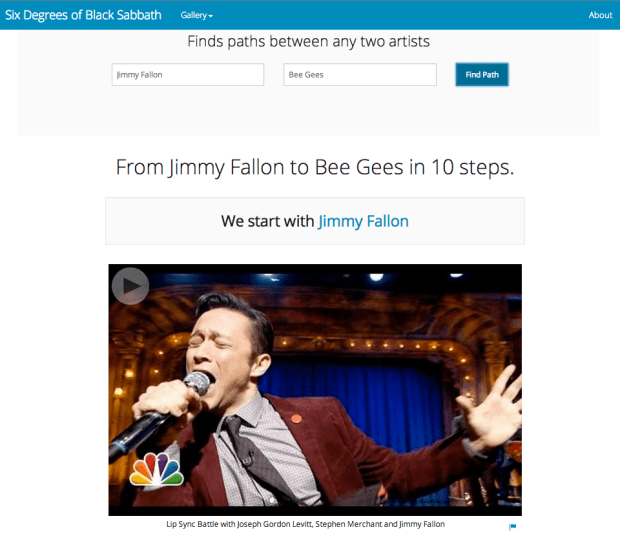
Six Degrees of Black Sabbath is like the Oracle of Bacon but for music. It lets you find connections to just about any two artists based upon their collaborations. Type in the name of two artists, and 6dobs will give you a pathway showing the connections that will get you from one artist to another. For instance, if you enter ‘The Beatles’ and ‘Norah Jones’ you’ll get a path like:
- We start with The Beatles
- The Beatles had member George Harrison
- George Harrison performed with Ravi Shankar on the song Bangla Dhun and 26 others.
- Ravi Shankar was parent of Norah Jones
If you don’t like a particular connection, you can bypass it generating a new path. For instance, if we bypass Ravi Shankar, it will take us eight steps to get to Norah Jones from the Beatles:
The Beatles -> Paul McCartney -> The Fireman -> Youth -> Pigface
-> Mike Dillon ->Garage A Trois -> Charlie Hunter -> Norah Jones
Not all connections are created equal. Mick Jagger and Keith Richards have been playing together for over 50 years in the Rolling Stones. That’s a much stronger connection than the one between Mick Jagger and Fergie for performing a single song together at the Rock and Roll Hall of Fame. We take these connection strengths into account when finding paths between artists. Preference is given to stronger connections, even if those stronger connections will yield a longer path.
The new version of Six Degrees of Black Sabbath has a number of new features:
Video – Each step in a path is represented by a Youtube video – often with a video by the two artists that represent that step. I’m quite pleased at how well the video works for establishing the connection between two artists. Youtube seems to have it all.

Live stats – The app tracks and reports all sorts of things such as the longest path discovered so far, the most frequently occurring artists on paths, the most connected artists, most searched for artists and so on.
Larger database of connections – the database has about a quarter million artists and 2.5 million artist-to-artist connections.
Autocomplete for artist names – no need to try to remember how to spell ‘Britney Spears‘ – just start typing the parts you know and it will sort it out.
Spiffier looking UI – It still looks like it was designed by an engineer, but at least it looks like it was designed in this decade by an engineer.
Path finding improvements – faster and better paths throughout.
Revisiting this app after 4 years was a lot of fun. I got to dive deep into a bunch of tech that was new to me including Redis, Bootstrap 3, and the YouTube video search API. I spent many hours untangling the various connections in the new Musicbrainz schema. I took a tour through a number of Pythonic network graph libraries (Networkx, igraph and graph-tool), I learned a lot about Python garbage collection when you have a 2.5gb heap.
Give the app a try and let me know what you think.
Million Song Shuffle
 Back in 2001 when the first iPod was released, Shuffle Play was all the rage. Your iPod had your 1,000 favorite songs on it, so picking songs at random to play created a pretty good music listening experience. Today, however, we don’t have 1,000 songs in our pocket. With music services like Rdio, Rhapsody or Spotify, we are walking around with millions of songs in our pocket. I’ve often wondered what it would be like to use Shuffle Play when you have millions of songs to shuffle through. Would it be a totally horrible listening experience listening to artists that are so far down the long tail that they don’t even know that they are part of a dog? Would you suffer from terminal iPod whiplash as you are jerked between Japanese teen pop and a John Philip Sousa march?
To answer these questions, I built an app called Million Song Shuffle. This app will create a playlist by randomly selecting songs from a pool of many millions of songs. It draws from the Rdio collection and if you are an Rdio user you can hear listen to the full tracks.
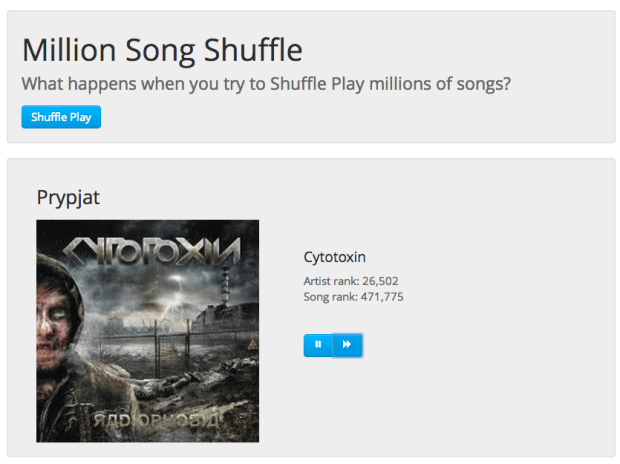
The app also takes advantage of a nifty new set of data returned by the Echo Nest API. It shows you the absolute hotttnesss rank for the song and the artist, so you will always know how deep you are into the long tail (answer: almost always, very deep).
So how is listening to millions of songs at random? Surprisingly, it’s not too bad. The playlist certainly gets a high score for eclecticism and surprise, and most of the time the music is quite listenable. But give it a try, and form your own opinion.
Its fun, too, to see how long you can listen to the Million Song Shuffle before you encounter a song or even an artist that you’ve heard of before. If the artist is not in the top 5K artists, it is likely you’ve never heard of them. After listening to Million Song Shuffle for a little while you start to get an idea of how much music there is out there. There’s a lot.
For the ultimate eclectic music listening experience, try the Million Song Shuffle.
Have a Very Nestive Christmas
Posted by Paul in code, Music, playlist, The Echo Nest on December 19, 2013
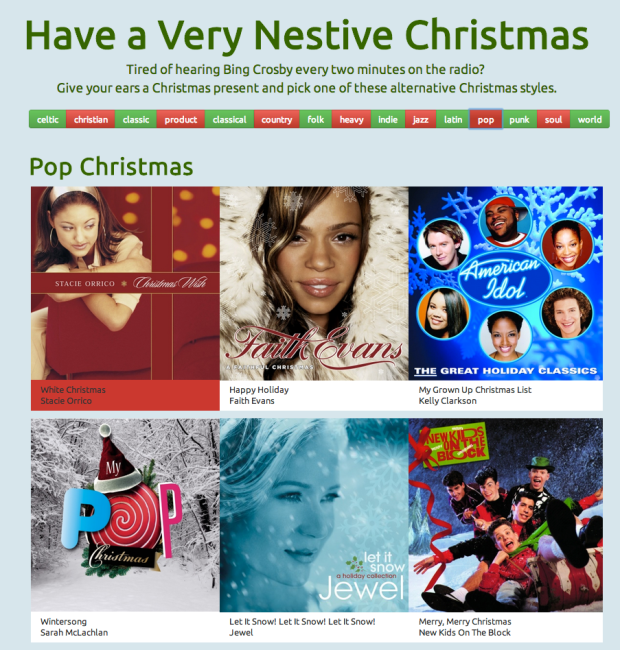
We are approaching peak Christmas music season. That means that many of us are getting really sick of hearing the same Christmas songs over and over. One can only hear Bing Crosby’s White Christmas so many times before measures must be taken. To remedy this situation, this morning I created a quick web app that let you chose from among a number of different Christmas genres (from classical to heavy metal) to let you add a little variety to your Christmas mix. If you are getting weary of the Christmas standards, but still want to listen to Christmas music, you may want to give it a try: The Christmas Playlister
The Perfect Music Hack Day – London 2013
Posted by Paul in events, music hack day on December 10, 2013
This weekend, Music Hack Day returned to the city where it all began. On Saturday morning, nearly 200 hackers arrived with the hottest hackathon tickets at the Shoreditch Works Village Hall, in Hoxton Square to spend the weekend exercising their passion for music and technology. After 24 hours of hacking, over 50 hacks were built – hacks that let you explore, discover, arrange, create and play with music.

Augdrum – Hacked drum for use in ‘expressive’ performance
I’ve been to many Music Hack Days, and I must say this was a special one. It had all the magical ingredients to make this the perfect event. First, the Shoreditch Works Village Hall was the ideal hacking venue.
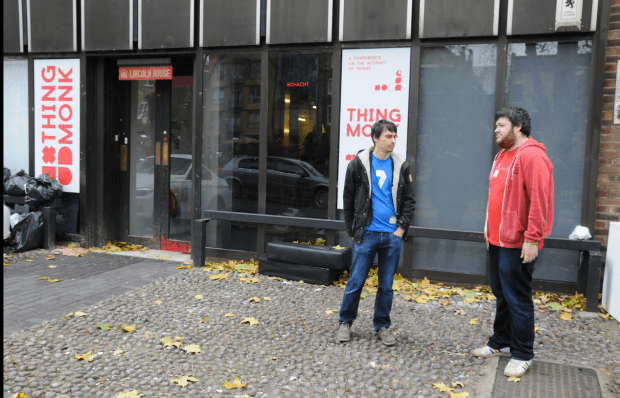
Getting ready to hack at the Shoreditch Works Village Hall
It is located in the heart of London’s exploding tech community, surrounded by pubs and restaurants (in my five minute walk from the hotel to the Village Hall, I walked past a dozen pubs). The Village Hall had perfect power and ample bandwidth for 200 data-starved hackers. The hackathon was sold out and everyone showed up, so we were all tightly packed into the hall – adding to the crazy energy. There’s a coffee shop connected to the hall where baristas were preparing coffee for the hackers long into the night.

Food was not your standard hacker pizza – it was “modern British slow cooking” provided by the Bow Street Kitchen. It really added to the London vibe.

Finally, Thomas Bonte of MuseScore was in attendance – Thomas is the official photographer of Music Hack Day. He’s been taking pictures of MHD since the very first one. He takes great pictures and makes them all available on Flickr via Creative Commons. Check out his full set of the event on Flickr. He took nearly all the photos in this blog post except for this one:

Thomas Bonte at work
Since the event was sure to sell out (everyone wants to go to a London Music Hack day), only the most motivated hackers were able to get tickets. Motivated hackers are the best kind of hackers.

Full house – hacker style
These are the folks that arrive early, stay late, work hard and finish their hacks on time – leading to a very high level of hacks being built.

Full house for hackers at Music Hack Day
The event kicked off with organizer Martyn Davies providing opening remarks, followed by API presentations by various companies. By 2PM hacking was in full swing.

Martyn Davies kicking things off
24 hours later, 51 hacks had been completed and submitted to hacker league. The epic demo session started at 3PM and by 6PM all the demos had been completed and prizes were awarded. Unlike other hack days, all the prizes were pooled and distributed to the top hacks (determined by popular vote).
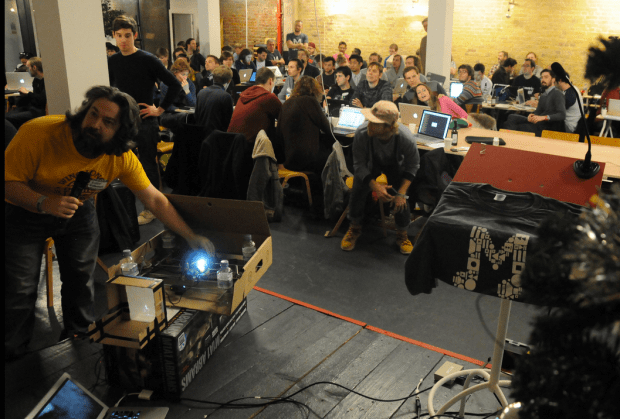
Andy Bennett’s rather complicated demo
A new and awesome twist to the demo session was provided by Becky Stewart’s hack. She created #mhdbingo – a set of custom bingo cards filled with common Music Hack Day tropes and memes. Each hacker received a unique bingo card to fill out during the demo session. Bingo wins were recorded by tweets with the #mhdbingo hashtag. Here’s a sample bingo card:
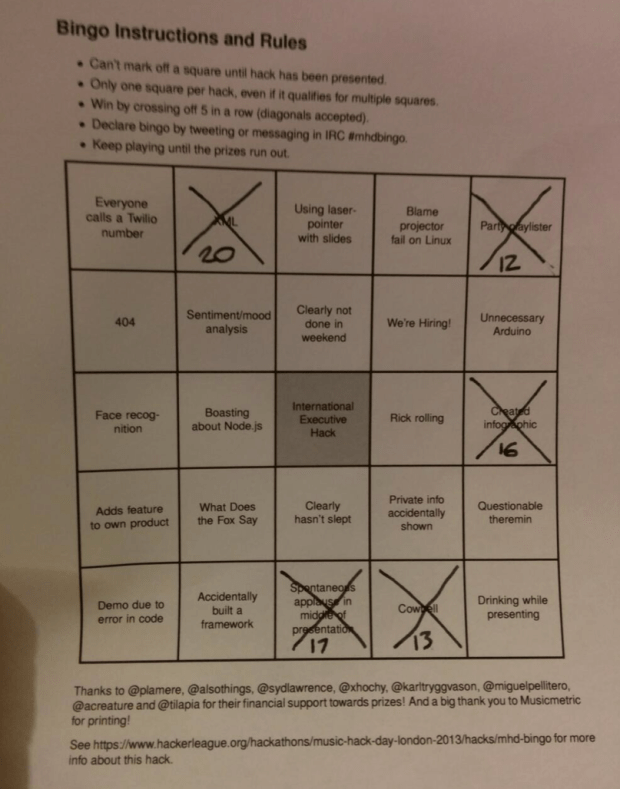
It’s the center square that’s the most interesting.
Becky’s hack not only provided a little humor for the demo session, but was a great tool to keep the attendees focused on the demo during the nearly 3 hour demo session. There was a point near the end of the demo session when seemingly dozens of folks were praying for a hack that showed ‘tracks on a map’ – and yes, their prayers were answered. Becky’s hack is on Github and she accepts pull requests so if you have suggestions for more MHD memes and tropes go ahead and add them and submit the pull requests. I’m sure #mhdbingo will become a fixture at future Music Hack days.

Watching the demos at Music Hack Day
Some of my favorite hacks of the weekend are:
Hipster Robot – A hipster robotic arm that stops you listening to any music it deems “too mainstream”
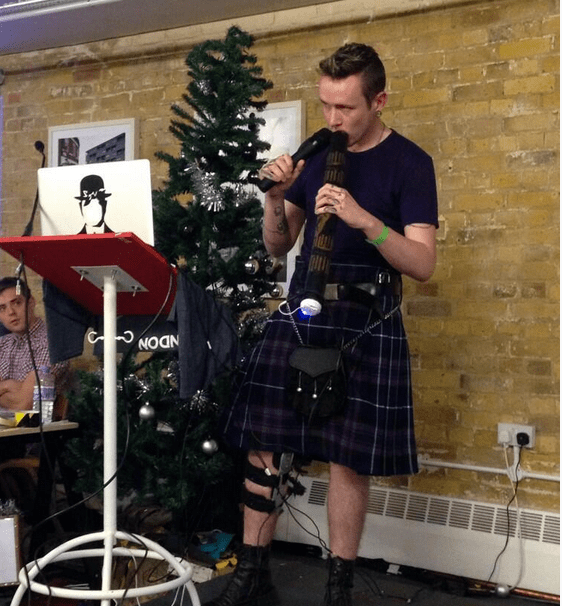
Didgidoo – An electronically augmented didgeridoo.
#mhdbingo – the aforementioned Bingo game celebrating all our favourite Music Hack Day tropes.

Becky combines Latex and Bingo to reshape Music Hack Day forever. Sitting behind her is someone else who, 10 years ago, reshaped music forever
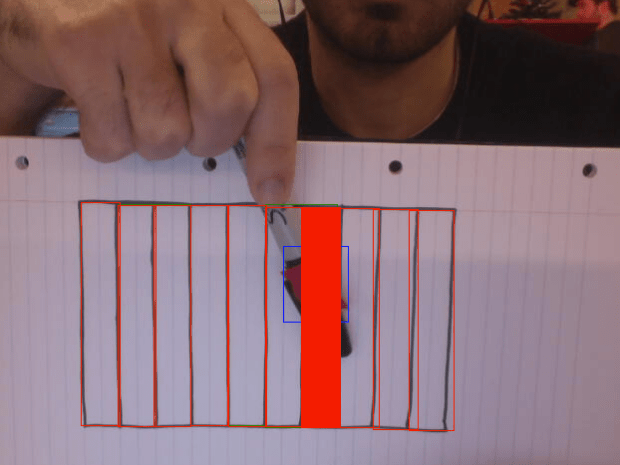
notepad – Draw a piano on a paper pad, and start playing it!
These are your Burns – takes your favourite bit of audio at the moment (Your ‘jam’ if you will) and creates a beautiful collage of memes, informed by the lyrics of the song, and presents them in a familiar documentary style.

MidiModulator – This Python script will take a song and modulate the pitch with the melody of a chosen score (basically, another song). Think of it as FM, except instead of a frequency we take an entire Christmas carol.

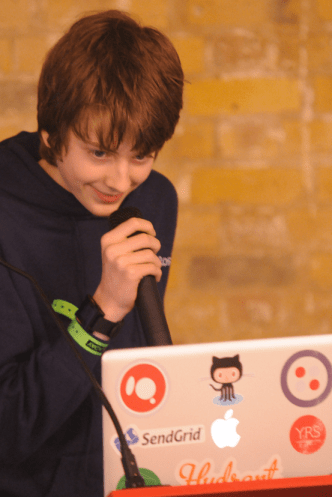
playsongsto.me – a collaborative playlist tool with a difference – you have to convince your friends to keep adding tracks faster than you can listen to them or face the consequences! This hack was created by Ross Penman – the youngest hacker to demo a project. I really liked his unique double twist on the party playlister.
album pairs – a nearly ready for the iOs App Store is the Album Pairs app by Iain Mullan – its an album cover matching game – when you make the match the corresponding song is added to the playlist.
Block Surfer – Rhythms created from waves using a bit of 2D physics.
Chiptar – hacked a guitar to control an 8-bit C64-inspired synth engine. Using an accelerometer it’s also possible to control arpeggiation.

best new sounds at the hack
Attention Deficit Radio – This is my hack – Attention Deficit Radio creates a Pandora-like radio experience for music listeners with short attention spans.

The top popular crowd favorite was Lifesong. This hack was written by Ben Nunney entirely on an Amstrad 1512 – a mid-80s PC with 512k RAM and a 4Mhz processor. It’s based in Pascal with a BASIC wrapper around it.
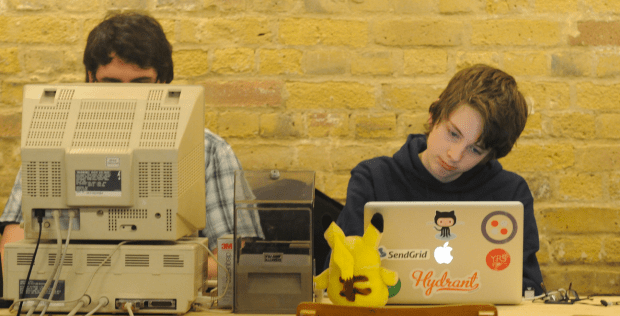
Since this computer has no network, audio out, or video out, Ben had to resort to some unusual methods to demo his hack.

It was a really fun demo session. There were lots of unique hacks. See the full list on hacker league. Many APIs were used including Spotify, Deezer, Songkick, Last.fm, Twilio, SoundCloud, Discogs, MuseScore, MusicMetric and more. I was especially pleased to see that several dozen hacks use our Echo Nest API to make cool hacks.
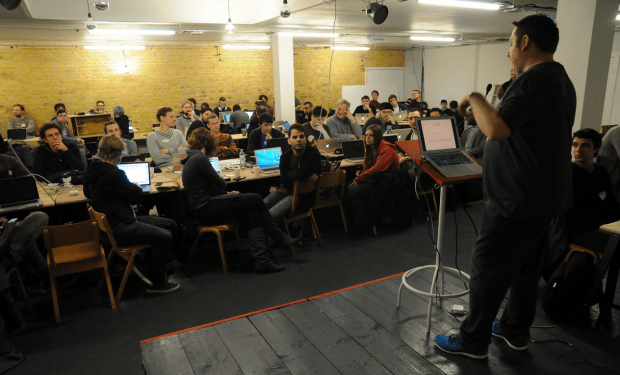
Martyn doing his thing at Music Hack Day
Thanks to @martynd and everyone involved in organizing the Music Hack Day London. It really was the perfect Music Hack Day.
Thanks to Thomas Bonte for all the photos used in this post. Be sure to see the full set.
Attention Deficit Radio
Posted by Paul in code, data, events, fun, hacking, music hack day, The Echo Nest on December 8, 2013
This weekend, I’ve been in London, attending the London Music Hack Day. For this weekend’s hack, I was inspired by daughter’s music listening behavior – when she listens to music, she is good for the first verse or two and the chorus, but after that, she’s on to the next song. She probably has never heard a bridge. So for my daughter, and folks like her with short attention spans, I’ve built Attention Deficit Radio. ADR creates a Pandora-like radio station based upon a seed artist, but doesn’t bother you by playing whole songs. Instead, after about 30 seconds or so, it is on to the next song. The nifty bit is that ADR will try to beat-match and crossfade between the songs giving you a (hopefully) seamless listening experience as you fly through the playlist. Of course those with short attention spans need something to look at while listening, so ADR has lots of gauges that show the radio status – it shows the current beat, the status of the cross-fade, tempo and song loading status.
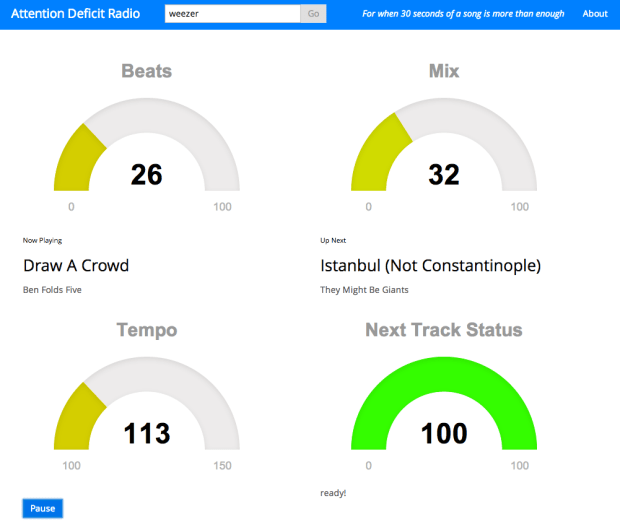
There may be a few rough edges, and the paint is not yet dry, but give Attention Deficit Radio a try if you have a short listening attention span.
Scary and Stretched
In the last few months I’ve found myself listening to Skrillex non-stop – usually because I’m working on some sort of Skrillexed-based hack. One thing about Skrillex – his music is quite layered, there’s lots of interesting sounds packed into every second of a song. I thought I’d explore this layering a little bit by applying Paul’s Stretch to Scary Monsters and Nice Sprites. The effect is quite pleasing.
 Music Machinery