Fans Forever and Ever
One of my very very favorite hacks from this weekend’s Music Hack Day is Greg Sabo’s Fans Forever And Ever. “Fans Forever and Ever” automatically generates a (sometimes rather creepy) fan page for an artist. It works by taking an artist’s cultural data from The Echo Nest API as well as song lyrics from musiXmatch. The fictional fan that creates the page has a randomly created set of personality traits drawn from a pool of crazy. I especially like the Geocities look and the borderline-psychotic poetry:
Give me country music!
Here’s a poem I wrote:
I fill myself with the pop sound
The concert changed my life
I hope I do a good job
die, die
…because death is the only solution
I put it on my iPod
I’ll just put on some female
such music
HEAVEN is the only place for Taylor Swift
My friends don’t understand female artist
There is only one life that I want to take
I live for the music.
what should I wear as I commit murder
“Forever & Always” gets me every time
it’s a shame to make it go quick
I don’t care what they say
I have a collection of saws
Never ever say I’m not a true Taylor Swift fan
‘Fans Forever and Ever’ makes sure you remember to keep the ‘fan’ in ‘fanatic’.
“We will hack!”
Music Hack Day NYC 2011 is done! What a weekend it was! 175 Hackers built 72 kick ass hacks in 24 hours. Much thanks to General Assembly for hosting the weekend in their wonderful ‘urban campus’. The facilities were top notch, wireless and network were flawless and the people from General Assembly were incredibly accommodating.

Music Hack Day presentations at General Assembly
John Britton from Twilio and NYHacker brought the whole event together lining up the venue, and great set of sponsors. (Oh, and Twilio is really cool – fantastic API for hacking on phones).

John Britton (channeling Roger Daltry) thanks the sponsors
The event would not have happened without Elissa and and sweatsedo army that did everything that needed to get done – from setting up 200 folding chairs, registering the hackers, serving beer, to taking out the trash. Thanks to Elissa, Matthew, Meghan, Janelle and DJ Sohn for working around the clock to make this all happen!

The sweatsedo army and their Commander
There are some great reporting on the Music Hack Day already appearing on line:
- At Evolver.FM Eliot Van Buskirk is writing a detailed blog post about each and every one of the 72 hacks. It should take him about 40 days and 40 nights to get it done.
- Peter Kirn at Create Digital Music has an excellent post focusing on the novel performance control hacks from the weekend: At Music Hack day, Amidst Listening Interfaces, Novel Performance Control a Winner
- Fuse.TV had a whole crew at the event, filming, interviewing and blogging the whole time.
- The New York Observer: 72 Apps are born at NYC Music Hack Day
Be sure to check out Thomas Bonte’s excellent Flickr photostream of the event.

Compulsory photo of official Music Hack Day model Matt Ogle with his fans
Final thanks to Dave Haynes for kicking off the Music Hack Day and diligently shepherding the movement over the last two years. Music Hack Day is now an unstoppable force!

Dave and Jason
Eric and the SoundCloud gang put together the Music Hack Day Rap – just listen to the energy in the crowd (and this is after sitting through nearly 3 hours and 72 demos):
I had a great time at the event – can’t wait to do it again next year!
The 3D Music Explorer
Posted by Paul in events, Music, visualization on January 27, 2011
Next month I’m giving a talk at SXSW Interactive on using visualizations for discovering music. In my talk I’ll be giving a number of demos of various types of visualizations used for music exploration and discovery. One of the demos is an interactive 3D visualizer that I built a few years back. The goal of this visualizer is to allow you to use 3D game mechanics to interact with your music collection. Here’s a video
Hope to see you at the talk.
MIDEM Hack Day
I’m just back from a whirlwind trip to Cannes where I took part in the first ever MIDEM Hack Day where 20 hotshot music hackers gathered to build the future of music. The hackers were from music tech companies like Last.fm, SoundCloud, Songkick, The Echo Nest, BMAT, MusixMatch, from universities like Queen Mary and Goldsmiths, one of the four major Labels, and a number of independent developers. We all arrived to the exotic French Riviera, with its casinos, yachts and palm trees. But instead of spending our time laying on the beach we all willingly spent our time in this wonderful room called Auditorium J:

First thing was we did was rearrange the furniture so we could all see each other making interactions easier. It wasn’t long before we had audio hooked up – with hackers taking turns at being the DJ for the room.

Dave and I took a break from the hacking to give a talk on the ‘New Developer Ecosystem’. We talked about how developers were becoming the new gatekeepers in the world of music. The talk was well attended with lots of good questions from the audience. (Yes, I was a bit surprised. I was half expecting that MIDEM would be filled with the old guard – reps from the traditional music industry that would be hostile toward self-proclaimed new gatekeepers. There were indeed folks from the labels there and asking questions, but they seemed very eager to engage with us).

While Dave and I were talking, the rest of the gang had self-organized, giving project pitches, forming teams, making coding assignments and perhaps most importantly figuring out how to make the espresso machine work.

Here are some of the project pitches:
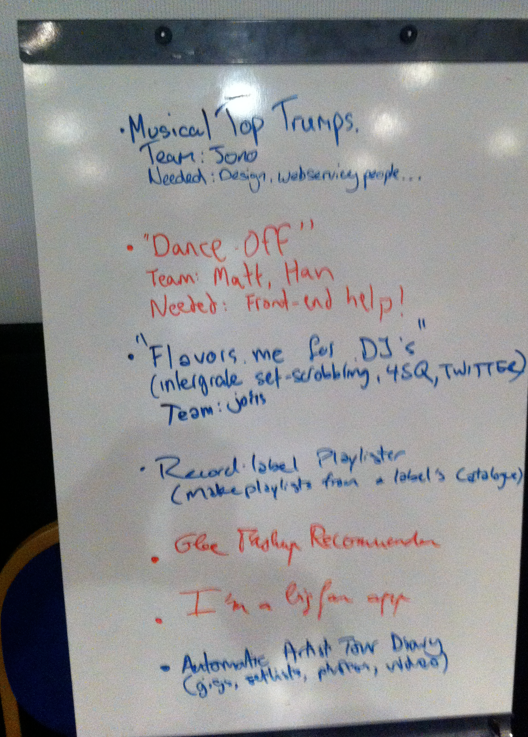
Some teams started with designs with dataflow diagrams, while others dived straight into coding (one team instead, starting composing the music for their app)

Dataflow diagrams, system architecture, and UI minispecs became the artwork for the hacking space.

After the lightening design rounds, people settled into their hacking spots to start hacking:

By mid-afternoon on the first day of hacking, the teams were focused on building their hacks.

There were some interesting contrasts during the day. While we were hacking away in Auditorium J, right next door was a seminar on HADOPI. (the proposed French law where those accused of copyright violations could be banned from the Internet forever).

As we got further in to our hacks, we gave demos for each other

Over the course of the weekend, we had a few ‘walk-ins’ who were interested in understanding what was going on. We did feel a little bit like zoo animals as we coded with an audience.

Taylor Hanson dropped by to see what was going on. He was really interested in the idea of connecting artists with hackers/technologists. After the visit we were MMMboppping the rest of the day.

Towards the end of the first day, the Palais cleared out, so we had the whole conference center to ourselves. We made the beer run, had a couple and then went right back to hacking.

Finally, the demo time had arrived. After more than 24 hours of hacking we were ready (or nearly ready). Demos were created, rehearsed and recorded.

We presented our demos to an enthusiastic audience. We laughed, we cried …

There were some really creative hacks demoed – Evolver.fm has chronicled them all: MIDEM Hack Day Hacks Part 1 and MIDEM Hack Day Hacks Part 2. At the end of the hack day, we were all very tired, but also very excited about what we had accomplished in one weekend.

Thanks much to the MIDEMNet organizers who took care of all of the details for the event – sandwiches, soda, coffee, flawless Internet. They provided everything we needed to make this event possible. Special thanks to Thomas Bonte (unofficial Music Hack Day photographer) for taking so many awesome photos.
Six Clicks to Imogen
Posted by Paul in events, fun, Music, visualization on January 25, 2011
For my weekend Music Hack Day hack I built in app called Six Clicks to Imogen. The hack is a game where the goal is to find the shortest path from a randomly selected artist to Imogen Heap.
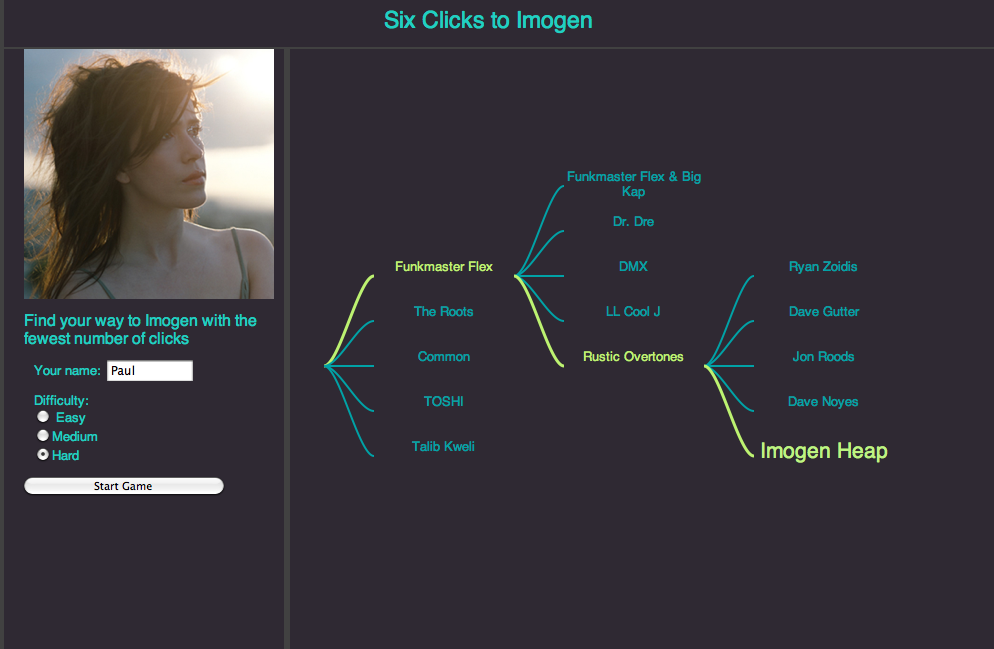
To build the hack I used the Musicbrainz artist relationship data to find all the artist connections, and plotted the graph with the JavaScript Infoviz toolkit . The game has about 55,000 artist nodes that are connected to Imogen by millions of artist relation ship edges. The hack is live, so go ahead a play the game:
Thanks much to Hannah for contributing excellent design suggestions for the app.
catfish smooth
Posted by Paul in data, Music, recommendation, research on January 20, 2011
Kurt Jacobson is a recent additions to the staff here at The Echo Nest. Kurt has built a music exploration site called catfish smooth that allows you to explore the connections between artists. Kurt describes it as: all about connections between music artists. In a sense, it is a music artist recommendation system but more. For each artist, you will see the type of “similar artist” recommendations to which you are accustomed – we use last.fm and The Echo Nest to get these. But you will also see some other inter-artist connections catfish has discovered from the web of linked data. These include things like “artists that are also English Male Singers” or “artists that are also Converts To Islam” or “artists that are also People From St.Louis, Missouri”. And, hopefully, you’ll get some media for each artist so you can have a listen.
It’s a really interesting way to explore the music space, allowing you to stumble upon new artists based on a wide range of parameters.
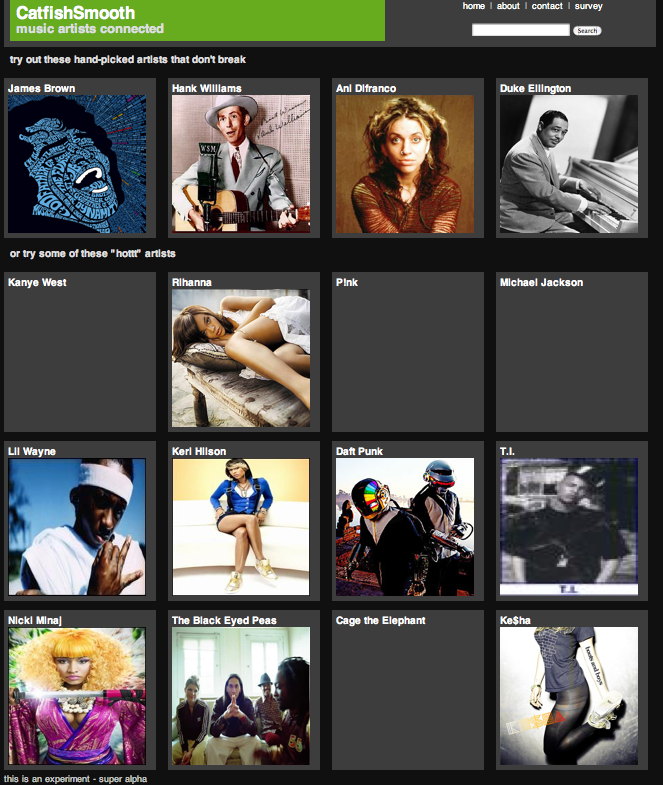
For example take a look at the many categories and connections catfish smooth exposes for James Brown.
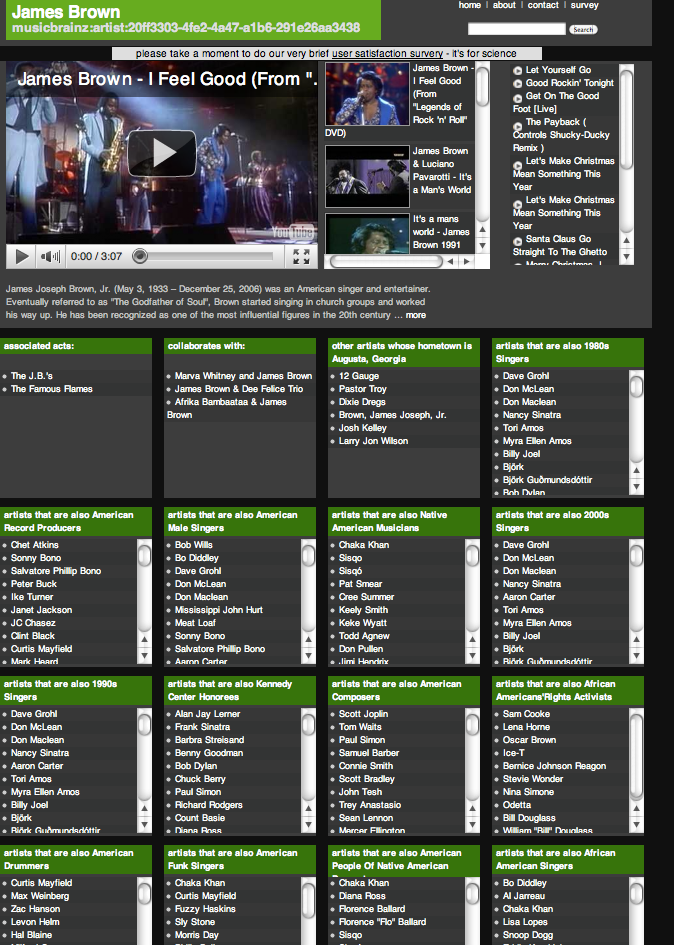
Kurt is currently conducting a usability survey for catfish smooth, so take a minute to kick the tires and then help Kurt finish his PhD and take the survey.
The Labyrinth of Genre
Posted by Paul in code, data, tags, The Echo Nest, visualization on January 16, 2011
I’m fascinated with how music genres relate to each other, especially how one can use different genres as stepping stones as a guide through the vast complexities of music. There are thousands of genres, some like rock or pop represent thousands of artists, while some like Celtic Metal or Humppa may represent only a handful of artists. Building a map by hand that represents the relationships of all of these genres is a challenge. Is Thrash Metal more closely related to Speed Metal or to Power Metal? To sort this all out I’ve built a Labyrinth of Genre that lets you explore the many genres. The Labyrinth lets you wander though about a 1000 genres, listening to samples from representative artists.

Click on a genre and the labyrinth will be expanded to show similar half a dozen similar genres and you’ll hear songs in the genre.
I built the labyrinth by analyzing a large collection of last.fm tags. I used the cosine distance of tf-idf weighted tagged artists as a distance metric for tags. When you click on a node, I attach the six closest tags that haven’t already been attached to the graph. I then use the Echo Nest APIs to get all the media.
Even though it’s a pretty simple algorithm, it is quite effective in grouping similar genre. If you are interested in wandering around a maze of music, give the Labyrinth of Genre a try.
A Genre Map
Inspired by an email exchange with Samuel Richardson, creator of ‘Know your genre‘ I created a genre map that might serve as a basis for a visual music explorer (perhaps something to build at one of the upcoming music hack days). The map is big and beautiful (in a geeky way). Here’s an excerpt, click on it to see the whole thing.

Update – I’ve made an interactive exploration tool that lets you wander through the genre graph. See the Labyrinth of Genre

Update 2 – Colin asked the question “What’s the longest path between two genres?” – If I build the graph by using the 12 nearest neighbors to each genre, find the minimum spanning tree for that graph and then find the longest path, I find this 31 step wonder:

Of course there are lots of ways to skin this cat – if I build the graph with just the nearest 6 neighbors, and don’t extract the minimum spanning tree, the longest path through the graph is 10 steps:

Music Hack Day comes to New York City

Mark your calendar! Music Hack Day is coming to New York City on February 12 and 13. Registrations are live, and going fast. This event is guaranteed to sell out. Register early if you want a seat: nyc.musichackday.org

Photo by Thomas Bonte
Know your genre
Not sure what the difference is between Black Metal or Death Metal? Looking for the quintessential nerdcore track? Confused about how 3rd wave ska relates to ska? Check out Know your Genre for all the answers.
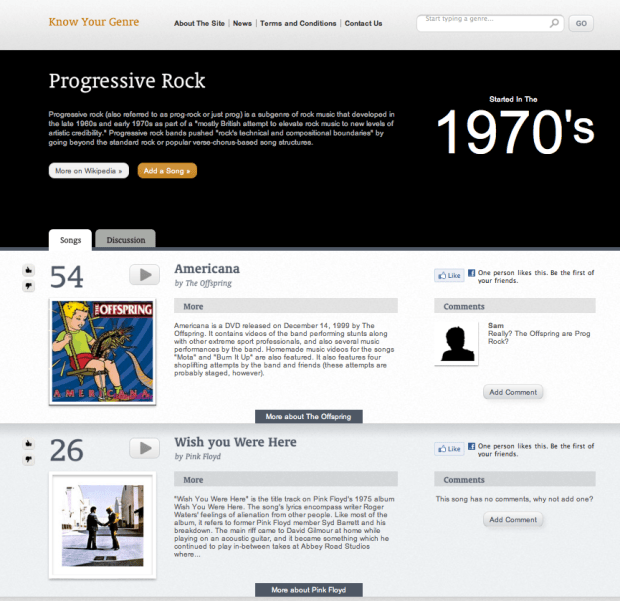
Know your Genre is a website built by Sam Richardson that helps you better understand the world of music genres. Type in the name of a genre, and Know Your Genre will bring you to a page devoted to the genre where you listen to the best examples, see the most representative bands and discuss the genre with other fans. There’s an interesting crowd sourcing component to Know Your Genre. You can submit your favorite example of a song for a particular genre. For example, I submitted Tales of Topographic Oceans by Yes to the Progressive Rock page. It is now sitting at the end of a long list of examples (with my single vote), but if people decide that ToTO really is the pinnacle of the progrock movement, it will be voted up, reddit style to the top of the prog rock page. (Clearly, this needs to happen, currently there’s a song by Offspring on the top of the progrock heap.)
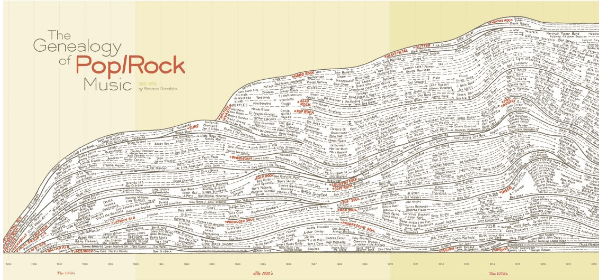
Know your genre is a well designed site, with lots of nice touches. Sam says he’s going to continue to build on the site, his ultimate plan being to build a timeline of music from pre history through to modern day music with examples of the evolution. Imagine a version of Ishkur’s guide but for all music, or an updated version of Reebee Garofalo’s Genealogy of Pop/Rock Music, that is hyperlinked to bios, audio and video. I’m looking forward to seeing what Sam does with Know Your Genre.
 Music Machinery