Archive for category Music
Must listen to podcast – Digital Music Trends
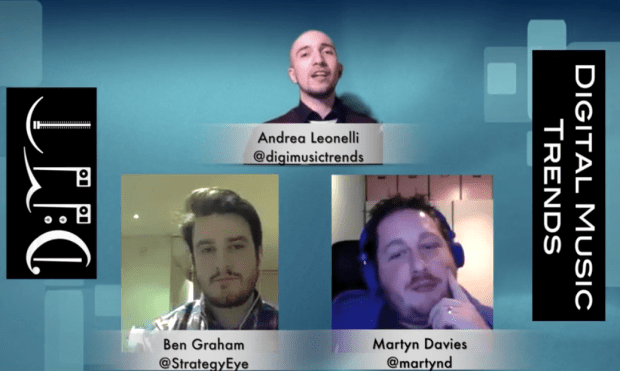
My top ‘must-listen’ podcast is now Andrea Leonelli’s Digital Music Trends. This weekly podcast is jam packed with analysis and info about what’s going on in the digital music space. The latest podcast includes Music Hack Day master Martyn Davies and Ben Graham from StrategyEye in a round table discussion on Gracenote’s recent sale, their Rhythm announcment, CES and more. Good stuff.
Six Degrees of Black Sabbath (v2)
Posted by Paul in code, fun, Music, The Echo Nest on January 6, 2014
For my Christmas vacation programming project this year, I revisited an old hack: Six Degrees of Black Sabbath. I wrote the original, way back in 2010 at the very first San Francisco Music Hack Day. That version is still up and running, and getting regular visits, but it is getting a bit long in the tooth and so I’ve given it a total rewrite from the ground up. The result is the new Six Degrees of Black Sabbath:
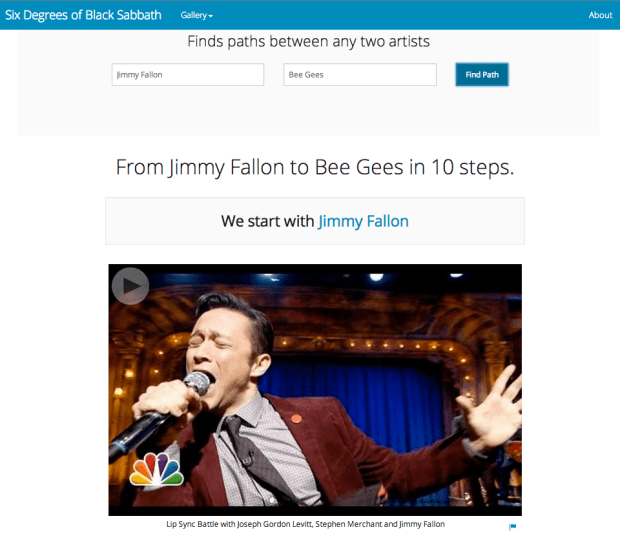
Six Degrees of Black Sabbath is like the Oracle of Bacon but for music. It lets you find connections to just about any two artists based upon their collaborations. Type in the name of two artists, and 6dobs will give you a pathway showing the connections that will get you from one artist to another. For instance, if you enter ‘The Beatles’ and ‘Norah Jones’ you’ll get a path like:
- We start with The Beatles
- The Beatles had member George Harrison
- George Harrison performed with Ravi Shankar on the song Bangla Dhun and 26 others.
- Ravi Shankar was parent of Norah Jones
If you don’t like a particular connection, you can bypass it generating a new path. For instance, if we bypass Ravi Shankar, it will take us eight steps to get to Norah Jones from the Beatles:
The Beatles -> Paul McCartney -> The Fireman -> Youth -> Pigface
-> Mike Dillon ->Garage A Trois -> Charlie Hunter -> Norah Jones
Not all connections are created equal. Mick Jagger and Keith Richards have been playing together for over 50 years in the Rolling Stones. That’s a much stronger connection than the one between Mick Jagger and Fergie for performing a single song together at the Rock and Roll Hall of Fame. We take these connection strengths into account when finding paths between artists. Preference is given to stronger connections, even if those stronger connections will yield a longer path.
The new version of Six Degrees of Black Sabbath has a number of new features:
Video – Each step in a path is represented by a Youtube video – often with a video by the two artists that represent that step. I’m quite pleased at how well the video works for establishing the connection between two artists. Youtube seems to have it all.

Live stats – The app tracks and reports all sorts of things such as the longest path discovered so far, the most frequently occurring artists on paths, the most connected artists, most searched for artists and so on.
Larger database of connections – the database has about a quarter million artists and 2.5 million artist-to-artist connections.
Autocomplete for artist names – no need to try to remember how to spell ‘Britney Spears‘ – just start typing the parts you know and it will sort it out.
Spiffier looking UI – It still looks like it was designed by an engineer, but at least it looks like it was designed in this decade by an engineer.
Path finding improvements – faster and better paths throughout.
Revisiting this app after 4 years was a lot of fun. I got to dive deep into a bunch of tech that was new to me including Redis, Bootstrap 3, and the YouTube video search API. I spent many hours untangling the various connections in the new Musicbrainz schema. I took a tour through a number of Pythonic network graph libraries (Networkx, igraph and graph-tool), I learned a lot about Python garbage collection when you have a 2.5gb heap.
Give the app a try and let me know what you think.
Million Song Shuffle
 Back in 2001 when the first iPod was released, Shuffle Play was all the rage. Your iPod had your 1,000 favorite songs on it, so picking songs at random to play created a pretty good music listening experience. Today, however, we don’t have 1,000 songs in our pocket. With music services like Rdio, Rhapsody or Spotify, we are walking around with millions of songs in our pocket. I’ve often wondered what it would be like to use Shuffle Play when you have millions of songs to shuffle through. Would it be a totally horrible listening experience listening to artists that are so far down the long tail that they don’t even know that they are part of a dog? Would you suffer from terminal iPod whiplash as you are jerked between Japanese teen pop and a John Philip Sousa march?
To answer these questions, I built an app called Million Song Shuffle. This app will create a playlist by randomly selecting songs from a pool of many millions of songs. It draws from the Rdio collection and if you are an Rdio user you can hear listen to the full tracks.
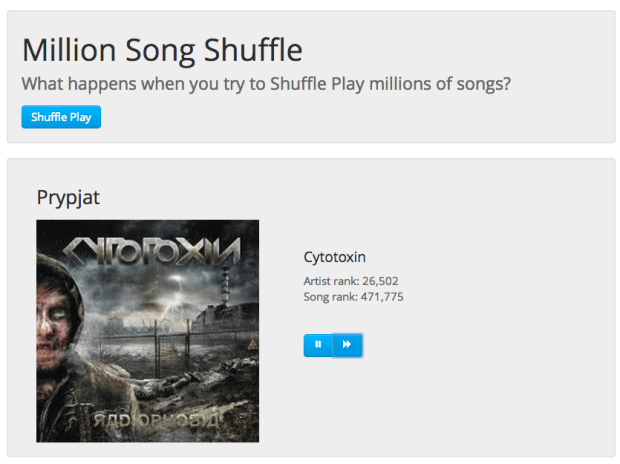
The app also takes advantage of a nifty new set of data returned by the Echo Nest API. It shows you the absolute hotttnesss rank for the song and the artist, so you will always know how deep you are into the long tail (answer: almost always, very deep).
So how is listening to millions of songs at random? Surprisingly, it’s not too bad. The playlist certainly gets a high score for eclecticism and surprise, and most of the time the music is quite listenable. But give it a try, and form your own opinion.
Its fun, too, to see how long you can listen to the Million Song Shuffle before you encounter a song or even an artist that you’ve heard of before. If the artist is not in the top 5K artists, it is likely you’ve never heard of them. After listening to Million Song Shuffle for a little while you start to get an idea of how much music there is out there. There’s a lot.
For the ultimate eclectic music listening experience, try the Million Song Shuffle.
Have a Very Nestive Christmas
Posted by Paul in code, Music, playlist, The Echo Nest on December 19, 2013
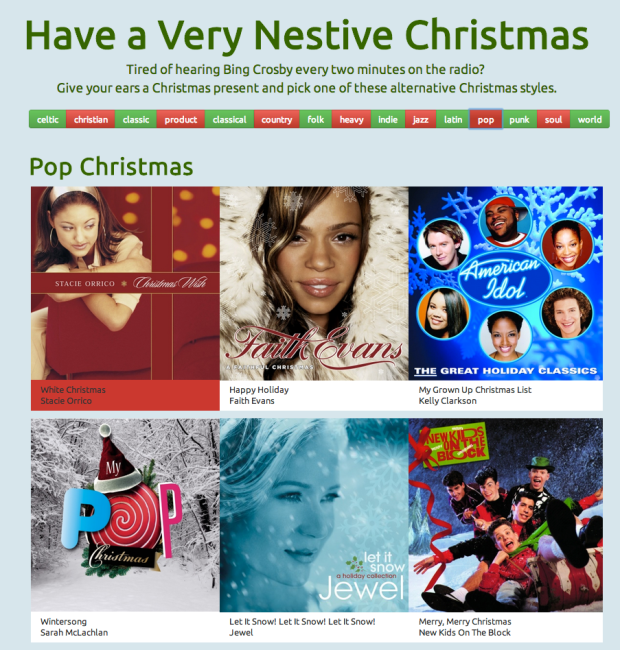
We are approaching peak Christmas music season. That means that many of us are getting really sick of hearing the same Christmas songs over and over. One can only hear Bing Crosby’s White Christmas so many times before measures must be taken. To remedy this situation, this morning I created a quick web app that let you chose from among a number of different Christmas genres (from classical to heavy metal) to let you add a little variety to your Christmas mix. If you are getting weary of the Christmas standards, but still want to listen to Christmas music, you may want to give it a try: The Christmas Playlister
Scary and Stretched
In the last few months I’ve found myself listening to Skrillex non-stop – usually because I’m working on some sort of Skrillexed-based hack. One thing about Skrillex – his music is quite layered, there’s lots of interesting sounds packed into every second of a song. I thought I’d explore this layering a little bit by applying Paul’s Stretch to Scary Monsters and Nice Sprites. The effect is quite pleasing.
Who are the shallowest artists?
Posted by Paul in data, Music, The Echo Nest on November 25, 2013
Yesterday, I wrote about who the Deepest Artists are. So naturally, today I’ll turn that on its head and take a look at who are the Shallowest Artists. I define a shallow artist as an artist that despite having a substantial number of released songs, has most listens concentrated in their top five tracks. These are the artists that are best known for just a small number of songs.
For each artist, I’ve calculated a Shallowness Score which is merely the percentage of an artist’s plays that occurs in an artist’s top 5 songs. A Shallowness Score of 71% means that 71% of all listens occur in the top 5 songs. Thus, 71% of all listens to Survivor (of Eye of the Tiger fame) are found in their top 5 songs.
Update: This post used to reference the Pitch Perfect Treblemakers, but Glenn points to an ambiguous artist issue with the Treblemakers where multiple artists were conflated. The Pitch Pefect Treblemakers only have 4 songs so they are no longer a candidate for this list.
Here are the top 15 Shallowest Artists. Click to see the full chart:

Click to see the full chart
As you’d expect, there are plenty of new artists on the list, artists like Icona Pop, Avicii and Zedd that have had a few charting songs. Being tagged as a shallow artist isn’t necessarily bad, it just means that your music is dominated by a handful of hits. That’s why we find Adele and Jeff Buckley on the same list as Paris Hilton and Smash Mouth.
Check out the full list of the Shallowest Artists as well as the full list of the Deepest Artists.
Who are the deepest artists?
Posted by Paul in data, fun, Music, The Echo Nest on November 24, 2013
Our playlists our filled with One Hit Wonders like My Sharona, Tainted Love and Final Countdown. One Hit wonders are the non-nutritious food of the music world – they are Twinkie’s, the Ho Hos and the Yodels of our musical diet. But what should we listen to when we want a full and nutritious musical meal? We should look for music by artists that have deeper catalogs – artists where the fans spend substantial time listening to the non-hits. These are the Deep Artists, the opposite of the One Hit Wonders – the artists that you can spend months or years listening to and exploring their collection.
Unfortunately, there’s no master list of Deep Artists – but I have lots of music listener data, so I figured I could build one. Here’s what I did. First I restricted my results to somewhat familiar artists with at least 100 songs in their catalog. I then scored each artist by the percentage of song plays that occur in the deep catalog versus the total plays for the artist – where deep catalog means a song that is not in the top ten for that artist. This gives each artist a Deepness Score that I could then use to sort artists to give us a list of the Deepest Artists. Here are the top ten:

Click for the full list
Not surprising to see Johann Sebastian Bach at number two. Bach has no real ‘hits’ – and indeed has an incredibly deep catalog. 90% of all Bach plays occur in Bach’s non-top 10. The number one deep artist is Vitamin String Quartet – they have 3500 covers of songs with no clear hits among them.
http://rd.io/x/QFqwK0FVUAYLooking at the full list we see jam bands like Phish and Grateful Dead, AOR staples like Pink Floyd and David Bowie.
I’ve built a list of a little over 500 of the Deepest Artists. These are artists that have a deepness score of 50% or greater – meaning that at least 50% of all listens for the artist is in the deeper cuts. This Thanksgiving if you are looking for some more nutritious music, stay away from Alice’s Restaurant and other One Hit Wonders and listen to music by artists on this Deep Artists list.
Update: Glenn looked at these results and felt that a nutritious music meal shouldn’t include Vitamin String Quartet (it’s the ‘artificially-fortified sugar-coated cereal of music’ according to Glenn), so Glenn took a different approach with different results. Glenn calls his results boring, but I think they are quite interesting. Read his post: Good Boring results
Children of the Hack (Angry Birds Edition)
Posted by Paul in data, events, hacking, Music, music hack day, The Echo Nest on November 18, 2013
I’m writing this post from Espoo Finland which is home to three disruptive brands: Nokia, who revolutionized the mobile phone market in the 1990s with its GSM technology; Rovio, who brought casual gaming to the world with Angry Birds; and Children of Bodom perhaps one of the most well known melodic death metal bands. So it is not surprising that Espoo is a place where you will find a mix of high tech, playfulness and hard core music – which is exactly what I found this past weekend at the Helsinki Music Hack Day hosted at the Startup Sauna in Espoo Finland.
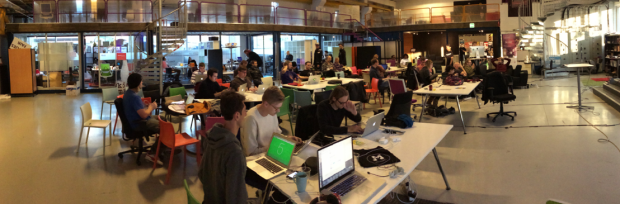
At the Helsinki Music Hack Day, dozens of developers gathered to combine their interest in tech and their passion for music in a 24 hour hacking session to build something that was music related. Representatives from tech companies such as SoundCloud, Spotify and The Echo Nest joined the hackers to provide information about their technologies and guidance in how to use their APIs.
After 24 hours, a dozen hacks were demoed in the hour-long demo session. There was a wide range of really interesting hacks. Some of my favorites are highlighted here:
Cacophony – A multi-user remote touch controlled beat data sequencer. This hack used the Echo Nest (via the nifty new SoundCloud/Echo Nest bridge that Erik and I built on the way to Espoo), to analyze music and then allow you to use the beats from the analyzed song to create a 16 step sequencer. The sequencer can be controlled remotely via a web interface that runs on an iPad. This was a really nice hack, the resulting sequences sounded great. The developer, Pekka Toiminen used music from his own band Different Toiminen which has just released their first album. You can see the band and Pekka in the video:
[youtube http://www.youtube.com/watch?v=nLwrTf5JQ5U]It was great getting to talk to Pekka, I hope he takes his hack further and makes an interactive album for his band.
Hackface & Hackscan – by hugovk – This is a pretty novel set of hacks. Hackface takes the the top 100 or 1000 artists from your listening history on Last.fm, finds photos of the artists (via the Echo Nest API), detects faces using a face detection algorithm, intelligently resizes them and composites them into a single image giving you an image of what your average music artist in your listening history looks like.

Hackscan – takes a video and summarizes it intelligently into a single image by extracting single columns of pixels from each frame. The result is a crazy looking image that captures the essence of the video.
Hugo was a neat guy with really creative ideas. I was happy to get to know him.
Stronger Harder Faster Jester – Tuomas Ahva and Valtteri Wikstrom built the first juggling music hack that I’ve seen in the many hundreds of hack demos I’ve witnessed over the years. Their hack used three bluetooth-enabled balls that when thrown triggered music samples.
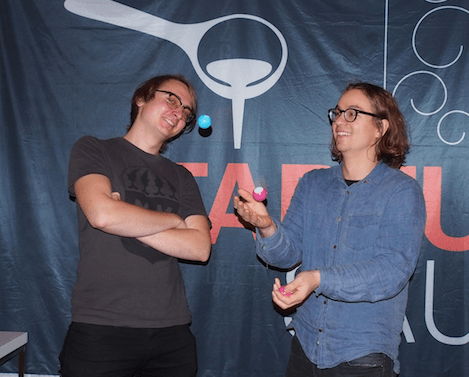
Photo via @tuomasahvra
The juggler juggles the balls in time with the music and the ball tossing triggers music samples that align with the music. The Echo Nest analysis is used to extract the salient pitch info for the aligment. It was a really original idea and great fun to watch and listen to. This hack won the Echo Nest prize.
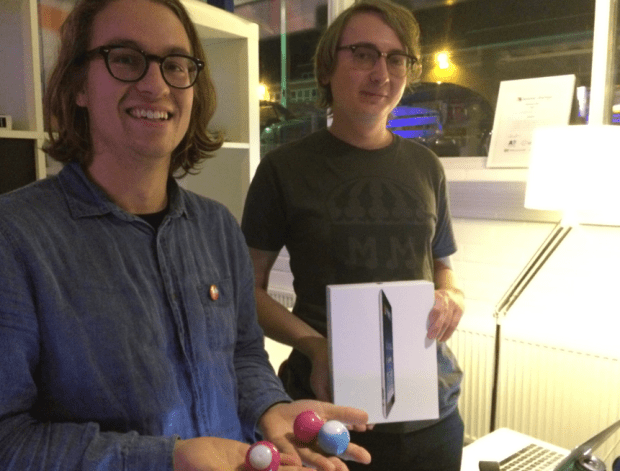
µstify – This is the classic boy meets girl story. Young man at his first hackathon meets a young woman during the opening hours of the hackathon.
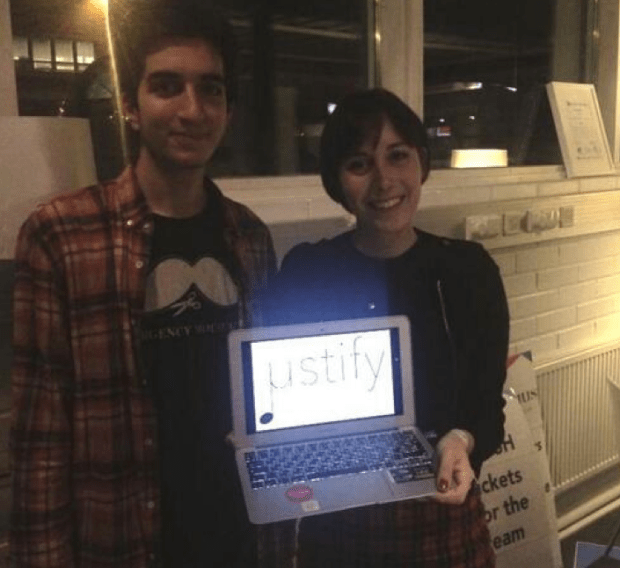
They decide to join forces and build a hack (It’s Instagram for Music!) and two days later they are winning the hackathon! Alexandra and Arian built a nifty hack that builds image filters (in the style of Instagram) based upon what the music sounds like. They use The Echo Nest to extract all sorts of music parameters and use these to select image filters. Check out their nifty presentation.
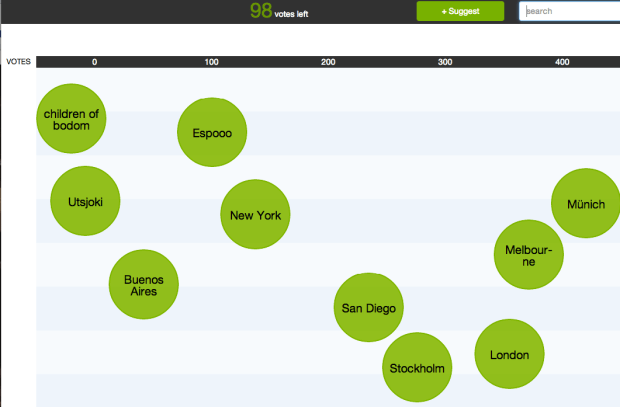
Gig Voter – this Spotify app provides a way for fans to get their favorite artists to come to their town. Fans from a town express an interest in an artist. Artists get a tool or helping them plan their tour based on information about where their most active fans actually are as well as helping them sell gigs to location owners by being able to prove that there is demand for them to perform at a certain location. Gig Voter uses Echo Nest data to help with the search and filtering.
Hit factory – Hit Factory is a generative music system that creates music based upon your SoundCloud tastes and adapts that music based upon your feedback . Unfortunately, no samples of the music are to be found online, but take my word, they were quite interesting – not your usual slightly structured noise.
Abelton Common Denominator – a minimal, mini-moog style interface to simplify the interaction with Abelton – by Spotify’s Rikard Jonsson.

Swap the Drop – this was my hack. You can read more about it here.
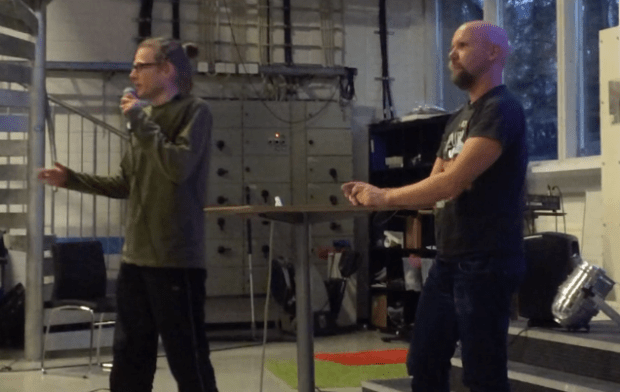
One unusual aspect of this Music Hack Day was that a couple of teams that encountered problems and were unable to finish their hacks still got up and talked about their failures. It was pretty neat to see hardcore developers get up in front of a room full of their peers and talk about why they couldn’t get Hadoop to work on their terrabyte dataset or get their party playlister based on Meteor to run inside Spotify.
I’ve enjoyed my time in Espoo and Helsinki. The Hack Day was really well run. It was held in a perfect hacking facility called the Startup Sauna.

There was plenty of comfortable hacking spots, great wifi, and a perfect A/V setup.

@sferik in a classic hacking position
The organizers kept us fed with great food (Salmon for lunch!), great music, including a live performance by Anni.
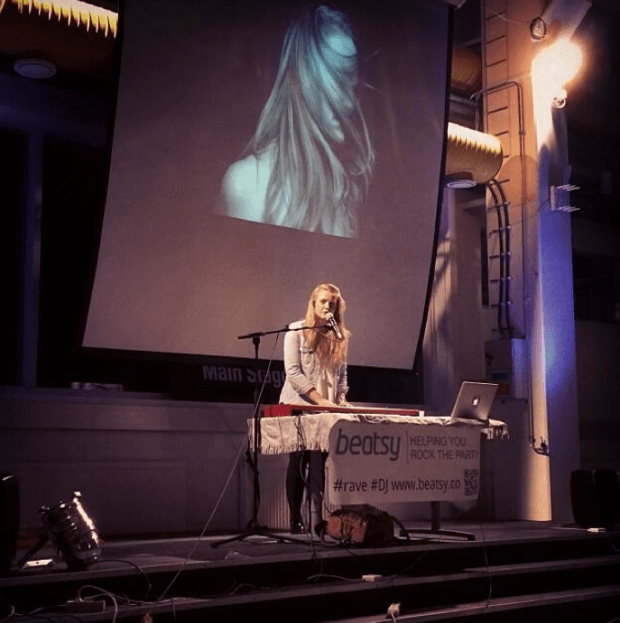
Anni performs. Photo by @sferik
There was plenty of Angry Birds Soda.
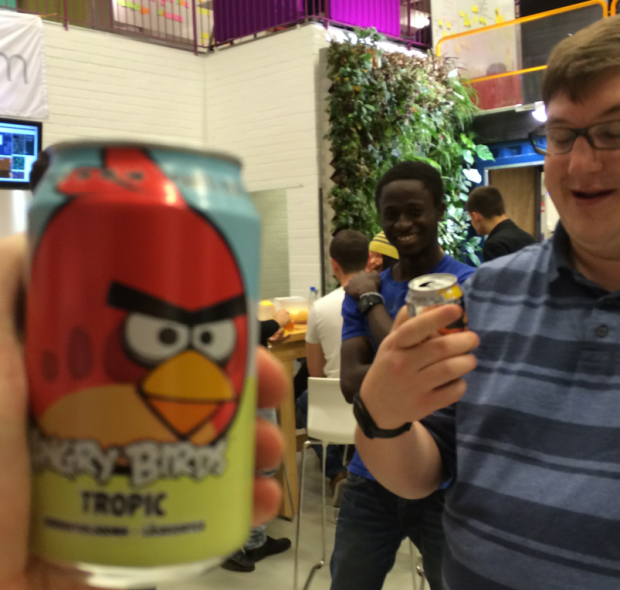
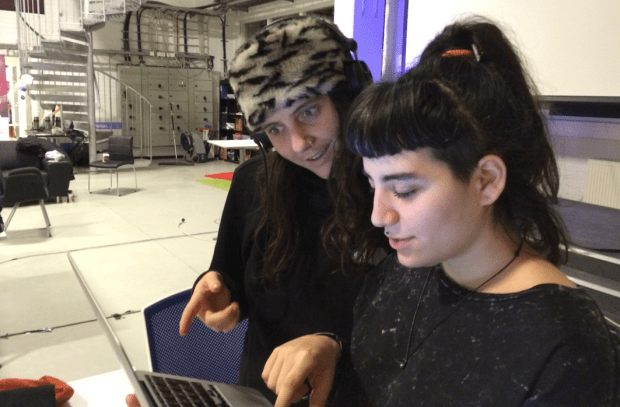
Many interesting folks to talk to …
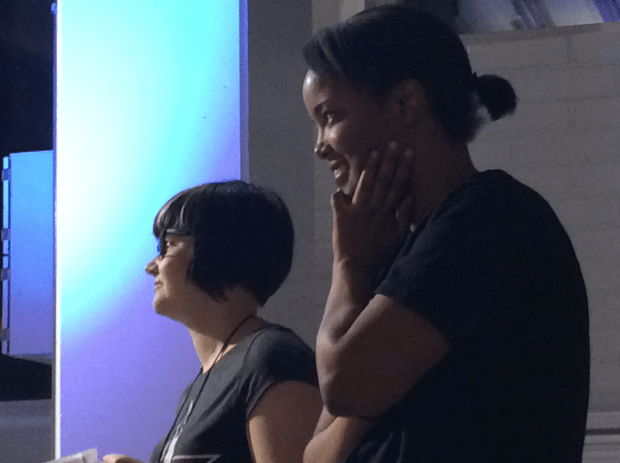
Thanks to Lulit and the rest of the Aaltoes team for putting together such a great event.
Swap the Drop
Posted by Paul in code, data, events, fun, hacking, Music, music hack day, The Echo Nest on November 17, 2013
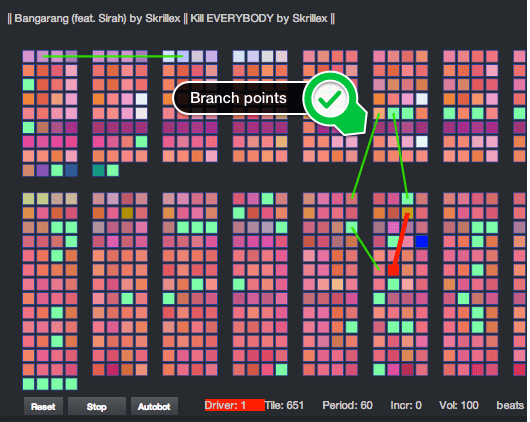
I’ve been in Helsinki this weekend (which is not in Sweden btw) for the Helsinki Music Hack Day. I wanted to try my hand at a DJ app that will allow you to dynamically and interactively mix two songs. I started with Girl Talk in a Box, ripped out the innards and made a whole bunch of neat changes:
- You can load more than one song at a time. Each song will appear as its own block of music tiles.
- You can seamlessly play tiles from either song.
- You can setup branch points to let you jump from an point in one song to any point in another (or the same) song.
- And the killer feature – you can have two active play heads allowing you to dynamically interact with two separate audio streams. The two play heads are always beat matched (the first play head is the master that sets the tempo for everyone else). You can cross-fade between the two audio streams – letting you move different parts of the song into the foreground and the background.
All the regular features of Girl Talk in a Box are retained – bookmarks, arrow key control, w/a/s/d navigation and so on. See the help for more details on the controls.
You can try the app here: Swap the Drop
SoundCloud => Echo Nest bridge service
On my way to Helsinki for the Music Hack Day I ran into Erik Michaels-Ober from SoundCloud. While sitting in the Frankfurt airport, we decided it would be pretty cool if it was super easy for developers to get the Echo Nest analysis for any SoundCloud track. So we put together a little prototype webservice that does just that. You give the web service a SoundCloud track ID, URN or URI and the service gives you back the corresponding Echo Nest Track ID that you can use to fetch the detailed Echo Nest analysis.
The service is deployed here: SCAnalyzer. There’s a quick, dirty and ugly demo of the service here: SCAnalyzer Demo. All the code is on github.

