Archive for category events
Locating Tune Changes and Providing a Semantic Labelling of Sets of Irish Traditional Tunes
Posted by Paul in events, ismir, music information retrieval on August 10, 2010
Locating Tune Changes and Providing a Semantic Labelling of Sets of Irish Traditional Tunes by Cillian Kelly (pdf)
Abstract – An approach is presented which provides the tune change loca- tions within a set of Irish Traditional tunes. Also provided are semantic labels for each part of each tune within the set. A set in Irish Traditional music is a number of individual tunes played segue. Each of the tunes in the set are made up of structural segments called parts. Musical variation is a prominent characteristic of this genre. However, a certain set of notes known as ‘set accented tones’ are considered impervious to musical variation. Chroma information is extracted at ‘set accented tone’ locations within the music. The resulting chroma vectors are grouped to represent the parts of the music. The parts are then compared with one another to form a part similarity matrix. Unit kernels which represent the possible structures of an Irish Traditional tune are matched with the part similarity matrix to determine the tune change locations and semantic part labels.
 This looks to be a very hard problem to solve.
Identifying Repeated Patterns in Music …
Posted by Paul in events, ismir, music information retrieval on August 10, 2010
I am at ISMIR this week, blogging sessions and papers that I find interesting.
Identifying Repeated Patterns in Music using Sparse Convolutive Non-Negative Matrix Factorization – Ron Weiss, Juan Bello (pdf)
Problem: Looking at repetition in music – verse, chorus, repeated motifs. Can one identify high level and short term structiure simulataneous from audio? Lots of math in this.
Ron describes an unsupervised, data-driven, method for automatically identifying repeated patterns in music by analyzing a feature matrix using a variant of sparse convolutive non-negative matrix factorization. They utilize sparsity constraints to automatically identify the number of patterns and their lengths, parameters that would normally need to be fixed in advance. The proposed analysis is applied to beat- synchronous chromagrams in order to concurrently extract repeated harmonic motifs and their locations within a song. They show how this analysis can be used for long- term structure segmentation, resulting in an algorithm that is competitive with other state-of-the-art segmentation algorithms based on hidden Markov models and self similarity matrices.
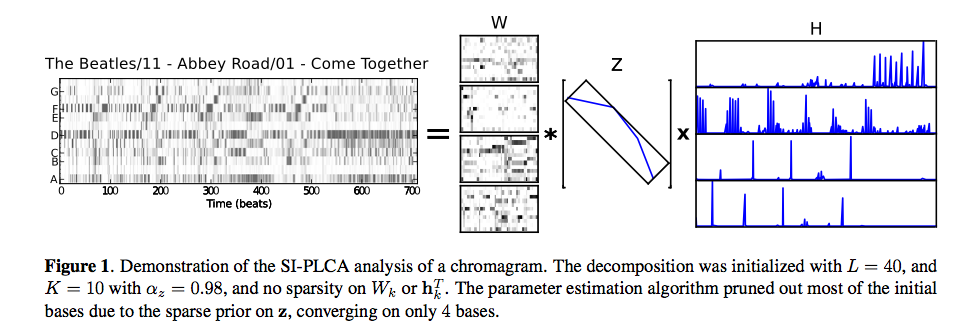
One particular application is riff identification for music thumbnailing. Another application is structure segmentation – verse chorus, bridge etc.)
The code is open-sourced here: http://ronw.github.com/siplca-segmentation/
This was a really interesting presentation, with great examples. Excellent work. This one should be a candidate for best paper IMHO.
What’s Hot? Estimating Country Specific Artist Popularity
I am at ISMIR this week, blogging sessions and papers that I find interesting.
What’s Hot? Estimating Countrhy Specific Artist Popularity
Markus Schedl, Tim Pohle, Noam Koenigstein, Peter Knees
Traditional charts are not perfect, not available in on countries, have biases (sales vs. plays), don’t incorporate non-sales channels like p2p. inhomogenity between countries .
Approach: Look at different channels: Google, Twitter, shared folders in Gnutella, Last.fm
- Google: “led zeppelin” + “france” but applied a popularity filter to reduce affect of overall popularity
- twiiter – geolocated major citiies of the world using freebase. Used twitter APIs with #nowplaying hashtag along with the geolocation api to search for plays in a particular country
- P2p shared folders – gnutella network – gathered a million gnutella IP addresses, gathered the metadata for the shared folders at each address, used IP2location to resolve to a geographic location
- Last.fm – retreive top 400 listeners in each country. For these top 400 listeners, retrieve the top-played artists.
Evaluation: Retrieve Last.fm most popular. Use top-n rank overlap for scoring. Compared the 4 different sources. Each approach was prone to certain distortions and bias. For future they hope to combine these sources to build a hybrid system that combines best attributes of all approaches.
ISMIR Day zero in Utrecht
Posted by Paul in events, music information retrieval on August 10, 2010
We’ve just finished Day 0 of ISMIR (the yearly conference of the International Society of Music Information Retrieval) being held in Utrecht. It is a lovely city, I’ve been enjoying walks along the many canals in the comfortably cool weather.

The zeroth day of ISMIR is the tutorial day. Ben Fields and I presented our playlisting tutorial. It was well attended, with lots of good questions at the end. The 3 hour long presentation seemed to fly by. Here’s Ben making last minute edits just before the presentation.

Finding a path through the Jukebox: The Playlist Tutorial
Posted by Paul in events, music information retrieval, playlist, research, The Echo Nest on August 6, 2010
Ben Fields and I have just put the finishing touches on our playlisting tutorial for ISMIR. Everything you could want to know about playlists. As one of the founders of a well known music intelligence company once said: Take the fun out of music and read Paul’s slides …
Visual Music
Posted by Paul in code, data, events, fun, Music, The Echo Nest, visualization on July 28, 2010
The week long Visual Music Collaborative Workshop held at the Eyebeam just finished up. This was an invite-only event where participants did a deep dive into sound analysis techniques, openGL programming, and interfacing with mobile control devices.
Here’s one project built during the week that uses The Echo Nest analysis output:
(Via Aaron Meyers)
The Music App Summit
Posted by Paul in events, Music, startup, The Echo Nest on July 23, 2010
Billboard has long been known for tracking the hottest artists, albums and songs. Now they are moving into new territory – Music Apps. In October Billboard is hosting a Music App Summit – a day focused on the world of mobile music apps. The summit will focus on new companies and technologies that are now building the next generation of music applications for mobile devices. The summit has some awesome speakers and panelist lined up from a cross section of domains (technology, business and music) like Ge Wang, Ted Cohen, Dave Kusek, Brian Zisk and The Echo Nest’s CEO Jim Lucchese.
At the core of the summit are Billboard’s first ever Music App Awards. Billboard is giving awards to the best apps in a number of categories:

- Best Artist-based App: Apps created specifically for an individual artist
- Best Music Streaming App: Apps that allow users to stream, download or otherwise enjoy music, such as Internet radio or on-demand.
- Best Music Engagement App: Apps that lets users engage in music in various ways, such as music games, music ID services, etc.
- Best Music Creation App: App that lets users make their own music.
- Best Branded App: App that best incorporates a sponsor with music capabilities to promote both the sponsor’s message and highlight the music
- Best Touring App: App created in conjunction with a specific tour or festival
Judges for the apps include Eliot Van Buskirk of Wired, Ian Rogers of Top Spin and Grammy Award winner MC Hammer.
Winning developers receive some modest prizes – but the real award is getting to demo your app to the attendees of the summit – the movers and shakers of the music industry will be there looking for that killer music app – the winner in each of the app categories will get to show their stuff. If you have a mobile music app consider submitting it to the Music App Awards. The submission deadline is July 30.
Echo Nest Remix at the Boston Python Meetup Group
Posted by Paul in events, remix, The Echo Nest on July 15, 2010
Next week I’ll be giving a talk about remixing music with Echo Nest remix at the Boston Python Meetup Group. If you are in the Boston / Cambridge area next week, be sure to come on by and say ‘hi’. Info and RSVP for the talk are here: The Boston Python Meetup Group on Meetup.com
Here’s the abstract for the talk:
Paul Lamere will tell us about Echo Nest remix. Remix is an open source Python library for remixing music. With remix you can use Python to rearrange a track, combine it with others, beat/pitch shift it etc. – essentially it lets you treat a song like silly putty.
The Swinger is an interesting example of what it can do that made the rounds of the blogosphere: it morphs songs to give them a swing rhythm.
For more details about the type of music remixing you can do with remix, feel free to read: http://musicmachinery…
The Playlist Survey
[tweetmeme source= ‘plamere’ only_single=false] Playlists have long been a big part of the music experience. But making a good playlist is not always easy. We can spend lots of time crafting the perfect mix, but more often than not, in this iPod age, we are likely to toss on a pre-made playlist (such as an album), have the computer generate a playlist (with something like iTunes Genius) or (more likely) we’ll just hit the shuffle button and listen to songs at random. I pine for the old days when Radio DJs would play well-crafted sets – mixes of old favorites and the newest, undiscovered tracks – connected in interesting ways. These professionally created playlists magnified the listening experience. The whole was indeed greater than the sum of its parts.

The tradition of the old-style Radio DJ continues on Internet Radio sites like Radio Paradise. RP founder/DJ Bill Goldsmith says of Radio Paradise: “Our specialty is taking a diverse assortment of songs and making them flow together in a way that makes sense harmonically, rhythmically, and lyrically — an art that, to us, is the very essence of radio.” Anyone who has listened to Radio Paradise will come to appreciate the immense value that a professionally curated playlist brings to the listening experience.
I wish I could put Bill Goldsmith in my iPod and have him craft personalized playlists for me – playlists that make sense harmonically, rhythmically and lyrically, and customized to my music taste, mood and context . That, of course, will never happen. Instead I’m going to rely on computer algorithms to generate my playlists. But how good are computer generated playlists? Can a computer really generate playlists as good as Bill Goldsmith, with his decades of knowledge about good music and his understanding of how to fit songs together?
To help answer this question, I’ve created a Playlist Survey – that will collect information about the quality of playlists generated by a human expert, a computer algorithm and a random number generator. The survey presents a set of playlists and the subject rates each playlist in terms of its quality and also tries to guess whether the playlist was created by a human expert, a computer algorithm or was generated at random.

Bill Goldsmith and Radio Paradise have graciously contributed 18 months of historical playlist data from Radio Paradise to serve as the expert playlist data. That’s nearly 50,000 playlists and a quarter million song plays spread over nearly 7,000 different tracks.
The Playlist Survey also servers as a Radio DJ Turing test. Can a computer algorithm (or a random number generator for that matter) create playlists that people will think are created by a living and breathing music expert? What will it mean, for instance, if we learn that people really can’t tell the difference between expert playlists and shuffle play?
Ben Fields and I will offer the results of this Playlist when we present Finding a path through the Jukebox – The Playlist Tutorial – at ISMIR 2010 in Utrecth in August. I’ll also follow up with detailed posts about the results here in this blog after the conference. I invite all of my readers to spend 10 to 15 minutes to take The Playlist Survey. Your efforts will help researchers better understand what makes a good playlist.
Take the Playlist Survey
Is Music Recommendation Broken? How can we fix it?
Posted by Paul in events, Music, recommendation, research on June 1, 2010

Save the date: 26th September 2010 for The Workshop on Music Recommendation and Discovery being held in conjunction with ACM RecSys in Barcelona, Spain. At this workshop, community members from the Recommender System, Music Information Retrieval, User Modeling, Music Cognition, and Music Psychology can meet, exchange ideas and collaborate.
Topics of interest
Topics of interest for Womrad 2010 include:
- Music recommendation algorithms
- Theoretical aspects of music recommender systems
- User modeling in music recommender systems
- Similarity Measures, and how to combine them
- Novel paradigms of music recommender systems
- Social tagging in music recommendation and discovery
- Social networks in music recommender systems
- Novelty, familiarity and serendipity in music recommendation and discovery
- Exploration and discovery in large music collections
- Evaluation of music recommender systems
- Evaluation of different sources of data/APIs for music recommendation and exploration
- Context-aware, mobile, and geolocation in music recommendation and discovery
- Case studies of music recommender system implementations
- User studies
- Innovative music recommendation applications
- Interfaces for music recommendation and discovery systems
- Scalability issues and solutions
- Semantic Web, Linking Open Data and Open Web Services for music recommendation and discovery
More info: Wormrad 2010 Call for papers
 Music Machinery