Posts Tagged sxsw
Unofficial Artist Guide to SXSW
Posted by Paul in events, Music, recommendation, The Echo Nest on March 4, 2010
I’m excited! Next week I travel to Austin for a week long computer+music geek-fest at SXSW. A big part of SXSW is the music – there are nearly 2,000 different artists playing at SXSW this year. But that presents a problem – there are so many bands going to SXSW (many I’ve never heard of) that I find it very hard to figure out which bands I should go and see. I need a tool to help me find sift through all of the artists – a tool that will help me decide which artists I should add to my schedule and which ones I should skip. I’m not the only one who was daunted by the large artist list. Taylor McKnight, founder of SCHED*, was thinking the same thing. He wanted to give his users a better way to plan their time at SXSW. And so over a couple of weekends Taylor built (with a little backend support from us) The Unofficial Artist Discovery Guide to SXSW.
The Unofficial Artist Discovery Guide to SXSW is a tool that allows you to explore the many artists attending this year’s SXSW. It lets you search for artists, browse popularity, music style, ‘buzzworthiness’, or similarity to your favorite artists – and it will make recommendations for you based on your music taste (using your Last.fm, Sched* or Hype Machine accounts) . The Artist Guide supplies enough context (bios, images, music, tag clouds, links) to help you decide if you might like an artist.
Here’s the guide:
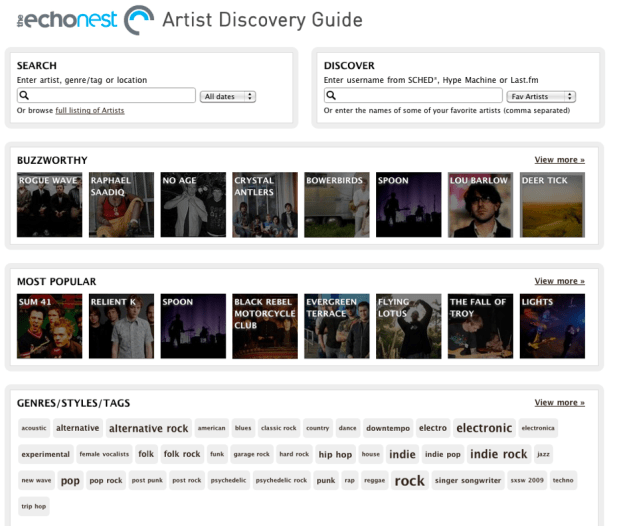
Here’s a quick tour of some of the things you can do with the guide. First off, you can Search for artists by name, genre/tag or location. This helps you find music when you know what you are looking for.
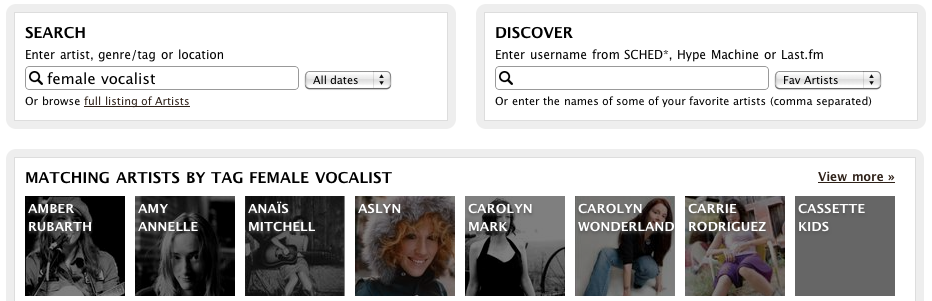
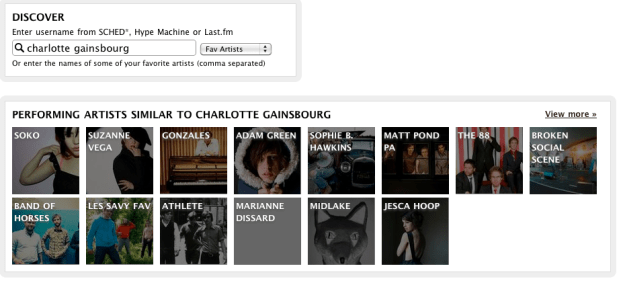
However, you may not always be sure what you are looking for – that’s where you use Discover. This gives you recommendations based on the music you already like. Type in the name of a few artists (even artists that are not playing at SXSW) or your SCHED*, Hype Machine or Last.fm user name, and ‘Discover’ will give you a set of recommendations for SXSW artists based on your music taste. For example, I’ve been listening to Charlotte Gainsbourg lately so I can use the artist guide to help me find SXSW artists that I might like:
If I see an artist that looks interesting I can drill down and get more info about the artist:
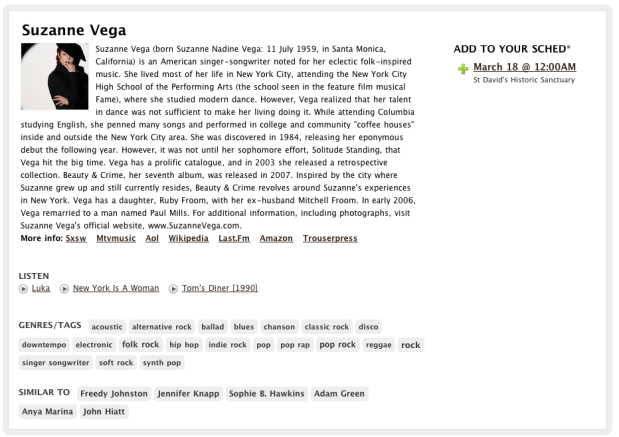 From here I can read the artist bio, listen to some audio, explore other similar SXSW artists or add the event to my SCHED* schedule.
I use Last.fm quite a bit, so I can enter my Last.fm name and get SXSW recommendations based upon my Last.fm top artists. The artist guide tries to mix things up a little bit so if I don’t like the recommendations I see, I can just ask again and I can get a different set. Here are some recommendations based on my recent listening at Last.fm:
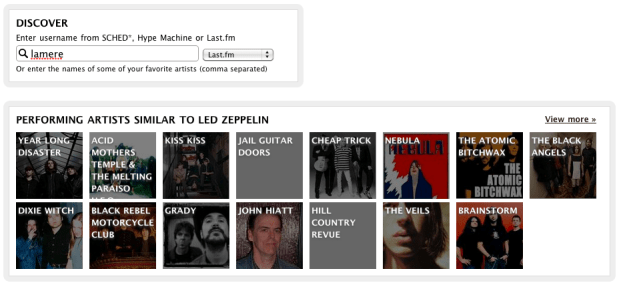
If you’ve been using the wonderful SCHED* to keep track of your SXSW calendar you can use the guide to get recommendations based on artists that you’ve already added to your SXSW calendar.
In addition to search and discovery, the guide gives you a number of different ways to browse the SXSW Artist space. You can browse by ‘buzzworthy’ artists – these are artists that are getting the most buzz on the web:

Or the most well-known artists:

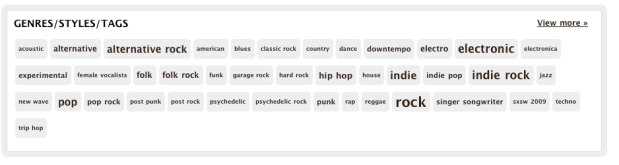
You can browse by the style of music via a tag cloud:
And by venue:

Building the guide was pretty straightforward. Taylor used the Echo Nest APIs to get the detailed artist data such as familiarity, popularity, artist bios, links, images, tags and audio. The only data that was not available at the Echo Nest was the venue and schedule info which was provided by Arkadiy (one of Taylor’s colleagues). Even though SXSW artists can be extremely long tail (some don’t even have Myspace pages), the Echo Nest was able to provide really good coverage for these sets (There was coverage for over 95% of the artists). Still there are a few gaps and I suspect there may be a few errors in the data (my favorite wrong image is for the band Abe Vigoda). If you are in a band that is going to SXSW and you see that we have some of your info wrong, send me an email (paul@echonest.com) and I’ll make it right.
We are excited to see the this Artist Discovery guide built on top of the Echo Nest. It’s a great showcase for the Echo Nest developer platform and working with Taylor was great. He’s one of these hyper-creative, energetic types – smart, gets things done and full of new ideas. Taylor may be adding a few more features to the guide before SXSW, so stay tuned and we’ll keep you posted on new developments.
Here comes the antiphon
Posted by Paul in Music, remix, The Echo Nest on February 25, 2010
I’m gearing up for the SXSW panel on remix I’m giving in a couple of weeks. I thought I should veer away from ‘science experiments’ and try to create some remixes that sound musical. Here’s one where I’ve used remix to apply a little bit of a pre-echo to ‘Here Comes the Sun’. It gives it a little bit of a call and answer feel:
The core (choir?) code is thus:
for bar in enumerate(self.bar):
 cur_data  = self.input[bar]
 if last:
     last_data = self.input[last]
     mixed_data = audio.mix(cur_data, last_data, mix=.3)
     out.append(mixed_data)
 else:
    out.append(cur_data)
 last = bar
Cool music 2.0 panels at SXSW
I took a tour through the many music 2.0 related panels for SXSW 2010. Here’s my short list of favorites.
- Music Discovery Redux – Controlled Chaos – Continuing the fun debate from SXSW 2009 about music discovery – humans vs. machines, metrics
- Screw Music and Mobiles, I have my iPod! – Petar Djekic from Mufin looks at the mobile music business
- Practical Uses for Music Industry Technical Standards – Discussion of how OEM’s, music services, social networks, retailers are working together to create monetizable music services in the cloud
- Visual Music and Realtime Interactive Performance – This panel explores how to engage audiences, foster collaboration, remix, mashup, create opportunities for dynamic improvisation, and prepare for tomorrow’s advances in live performance
- Online Tastemakers: Death or Rebirth of Music Curation – . A new breed of tastemakers are cropping up with innovative twists. Are they helping or hurting? Is online music curation dying or evolving?
- Set Your Data Free – a panel on copyrights and licenses
- Realtime Social Discovery – Using people to Find Content – Instead of using tags, genres or other slices, instead allow users to interact with your content, let users form relationships (the social graph) and then see their friend’s interactions with your site.
- The State of Music Blogs in 2010 – Just how important are music blogs to the industry today, is that prominence growing or fading, and how will new technologies and strategies impact the marketing mix in the coming year?
- Bands, Fans and Brands – Learning from past music industry hits and misses, this panel will evaluate the ways music and technology intersects, delighting fans while challenging labels.
- 10 Cool Audacity Tricks You (probably) Didn’t Know – the title says it all
- Remixing for the Masses – My totally self-serving recommendation. In this panel we show how automatic music analysis and remix technology is making it easier for anyone to create their own music remixes, from simple alterations like adding more cowbell to your favorite song to complex manipulations that would be worthy of the next ‘Grey Album’.
The best way to make sure that a cool panel will be held is to go and vote for it.
Remixing for the masses at SXSW 2010
Posted by Paul in code, The Echo Nest on August 25, 2009
 We are hoping to be able to present a panel on Echo Nest remix at next year’s SXSW interactive. We want to show lots of rather nifty ways that one can use Echo Nest remix to manipulate music – lots of code plus lots of music and video remix examples. What could be more fun? To actually get to present the panel we have to make it through the SXSW panel picking process. If you think this might be a good panel, head on over to our panel proposal page and vote for our panel called ‘remixing for the masses‘.
Help! My iPod thinks I’m emo – Part 1
Posted by Paul in Music, recommendation, research, The Echo Nest on March 26, 2009

At SXSW 2009, Anthony Volodkin and I presented a panel on music recommendation called “Help! My iPod thinks I’m emo”. Anthony and I share very different views on music recommendation. You can read Anthony’s notes for this session at his blog: Notes from the “Help! My iPod Thinks I’m Emo!” panel. This is Part 1 of my notes – and my viewpoints on music recommendation. (Note that even though I work for The Echo Nest, my views may not necessarily be the same as my employer).
The SXSW audience is a technical audience to be sure, but they are not as immersed in recommender technology as regular readers of MusicMachinery, so this talk does not dive down into hard core tech issues, instead it is a lofty overview of some of the problems and potential solutions for music recommendation. So lets get to it.
Music Recommendation is Broken.

Even though Anthony and I disagree about a number of things, one thing that we do agree on is that music recommendation is broken in some rather fundamental ways. For example, this slide shows a recommendation from iTunes (from a few years back). iTunes suggests that if I like Britney Spears’ “Hit Me Baby One more time” that I might also like the “Report on Pre-War Intelligence for the Iraq war”.
Clearly this is a broken recommendation – this is a recommendation no human would make. Now if you’ve spent anytime visiting music sites on the web you’ve likely seen recommendations just as bad as this. Sometimes music recommenders just get it wrong – and they get it wrong very badly. In this talk we are going to talk about how music recommenders work, why they make such dumb mistakes, and some of the ideas coming from researchers and innovators like Anthony to fix music discovery.
Why do we even care about music recommendation and discovery?
The world of music has changed dramatically. When I was growing up, a typical music store had on the order of 1,000 unique artists to chose from. Now, online music stores like iTunes have millions of unique songs to chose from. Myspace has millions of artists, and the P2P networks have billions of tracks available for download. We are drowning in a sea of music. And this is just the beginning. In a few years time the transformation to digital, online music will be complete. All recorded music will be online – every recording of every performance of every artist, whether they are a mainstream artist or a garage band or just a kid with a laptop will be uploaded to the web. There will be billions of tracks to chose from, with millions more arriving every week. With all this music to chose from, this should be a music nirvana – we should all be listening to new and interesting music.

With all this music, classic long tail economics apply. Without the constraints of physical space, music stores no longer need to focus on the most popular artists. There should be less of a focus on the hits and the megastars. With unlimited virtual space, we should see a flattening of the long tail – music consumption should shift to less popular artists. This is good for everyone. It is good for business – it is probably cheaper for a music store to sell a no-name artist than it is to sell the latest Miley Cyrus track. It is good for the artist – there are millions of unknown artists that deserve a bit of attention, and it is good for the listener. Listeners get to listen to a larger variety of music, that better fits their taste, as opposed to music designed and produced to appeal to the broadest demographics possible. So with the increase in available music we should see less emphasis on the hits. In the future, with all this music, our music listening should be less like Walmart and more like SXSW. But is this really happening? Lets take a look.

The state of music discovery
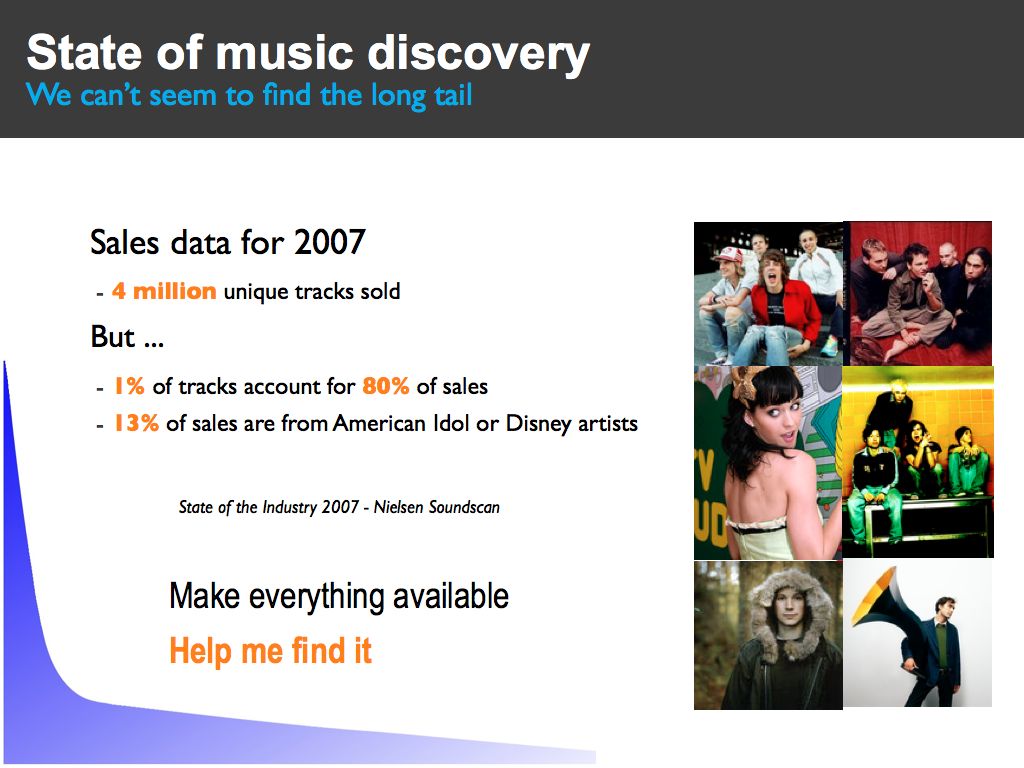
If we look at some of the data from Nielsen Soundscan 2007 we see that although there were more than 4 million tracks sold only 1% of those tracks accounted for 80% of sales. What’s worse, a whopping 13% of all sales are from American Idol or Disney Artists. Clearly we are still focusing on the hits. One must ask, what is going on here? Was Chris Anderson wrong? I really don’t think so. Anderson says that to make the long tail ‘work’ you have to do two things (1) Make everything available and (2) Help me find it. We are certainly on the road to making everything available – soon all music will be online. But I think we are doing a bad job on step (2) help me find it. Our music recommenders are *not* helping us find music, in fact current music recommenders do the exact opposite, they tend to push us toward popular artists and limit the diversity of recommendations. Music recommendation is fundamentally broken, instead of helping us find music in the long tail they are doing the exact opposite. They are pushing us to popular content. To highlight this take a look at the next slide.
Help! I’m stuck in the head
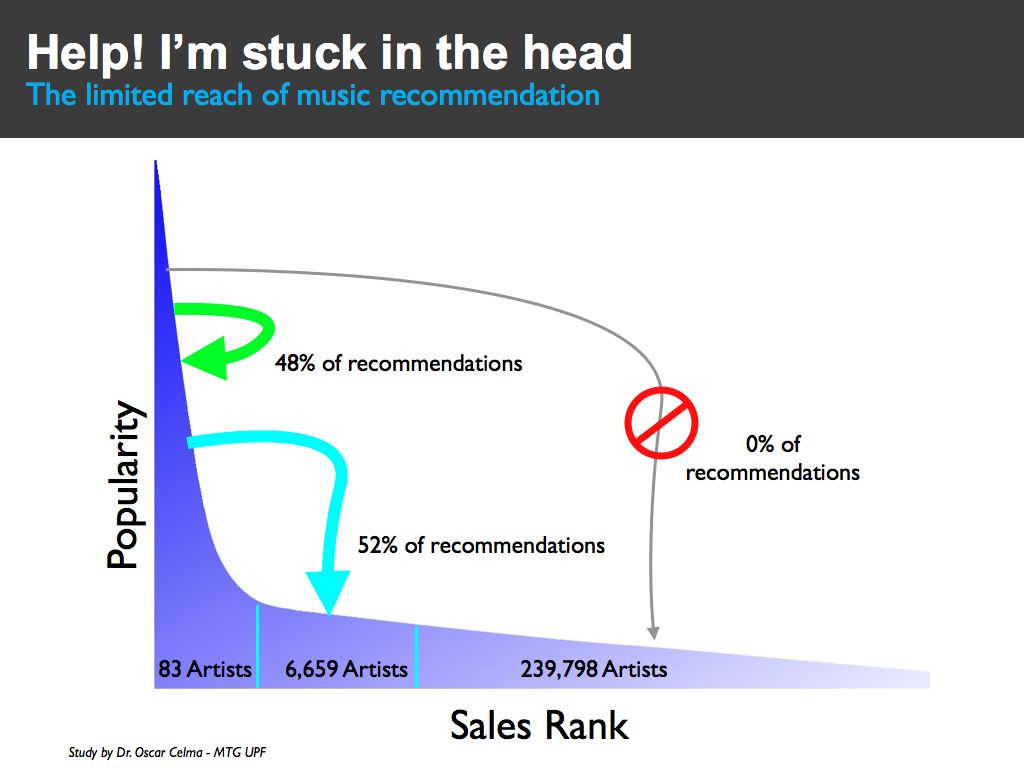
This is a study done by Dr. Oscar Celma of MTG UPF (and now at BMAT). Oscar was interested in how far into the long tail a recommender would get you. He divided the 245,000 most popular artists into 3 sections of equal sales – the short head, with 83 artists, the mid tail with 6,659 artists, and the long tail with 239,798 artists. He looked at recommendations (top 20 similar artists) that start in the short head and found that 48% of those recommendations bring you right back to the short head. So even though there are nearly a quarter million artists to chose from, 48% of all recommendations are drawn from a pool of the 83 most popular artists. The other 52% of recommendations are drawn from the mid-tail. No recommendations at all bring you to the long tail. The nearly 240,000 artists in the long tail are not reachable directly from the short head. This demonstrates the problem with commercial recommendation – it focuses people on the popular at the expense of the new and unpopular.
Let’s take a look at why recommendation is broken.
The Wisdom of Crowds
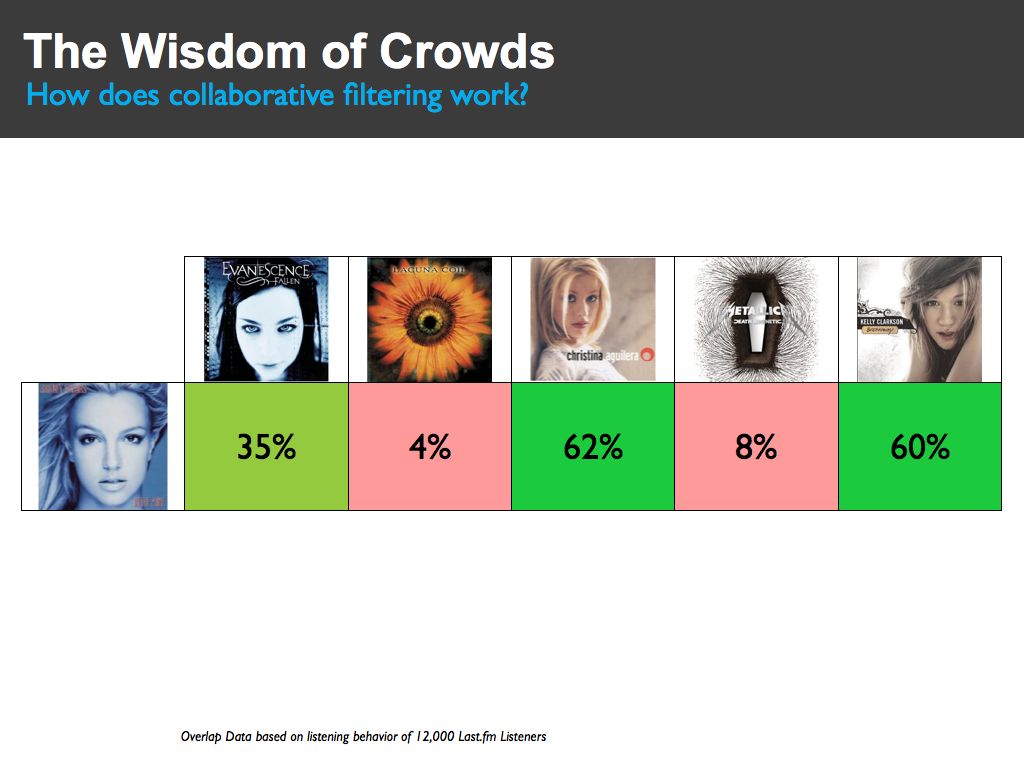
First lets take a look at how a typical music recommender works. Most music recommenders use a technique called Collaborative Filtering (CF). This is the type of recommendation you get at Amazon where they tell you that ‘people who bought X also bought Y’. The core of a CF recommender is actually quite simple. At the heart of the recommender is typically an item-to-item similarity matrix that is used to show how similar or dissimilar items are. Here we see a tiny excerpt of such a matrix. I constructed this by looking at the listening patterns of 12,000 last.fm listeners and looking at which artists have overlapping listeners. For instance, 35% of listeners that listen to Britney Spears also listen to Evancescence, while 62% also listen to Christina Aguilera. The core of a CF recommender is such a similarity matrix constructed by looking at this listener overlap. If you like Britney Spears, from this matrix we could recommend that you might like Christana and Kelly Clarkson, and we’d recommend that you probably wouldn’t like Metallica or Lacuna Coil.
CF recommenders have a number of advantages. First, they work really well for popular artists. When there are lots of people listening to a set of artists, the overlap is a good indicator of overall preference. Secondly, CF systems are fairly easy to implement. The math is pretty straight forward and conceptually they are very easy to understand. Of course, the devil is in the details. Scaling a CF system to work with millions of artists and billions of tracks for millions of users is an engineering challenge. Still, it is no surprise that CF systems are so widely used. They give good recommendations for popular items and they are easy to understand and implement. However, there are some flaws in CF systems that ultimately makes them not suitable for long-tail music recommendation. Let’s take a look at some of the issues.
The Stupidity of Solitude
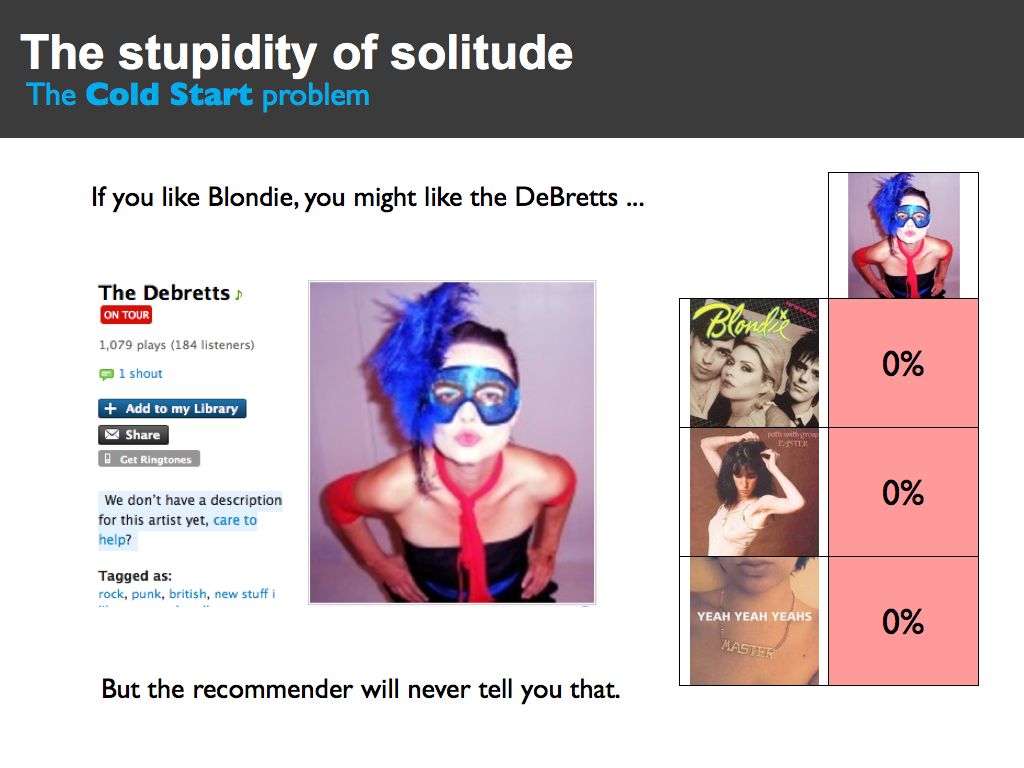
The DeBretts are a long tail artist. They are a punk band with a strong female vocalist that is reminiscent of Blondie or Patti Smith. (Be sure to listen to their song ‘The Rage’) .The DeBretts haven’t made it big yet. At last.fm they have about 200 listeners. They are a really good band and deserve to be heard. But if you went to an online music store like iTunes that uses a Collaborative Filterer to recommend music, you would *never* get a recommendation for the DeBretts. The reason is pretty obvious. The DeBretts may appeal to listeners that like Blondie, but even if all of the DeBretts listeners listen to Blondie the percentage of Blondie listeners that listen to the DeBretts is just too low. If Blondie has a million listeners then the maximum potential overlap(200/1,000,000) is way too small to drive any recommendations from Blondie to the DeBretts. The bottom line is that if you like Blondie, even though the DeBretts may be a perfect recommendation for you, you will never get this recommendation. CF systems rely on the wisdom of the crowds, but for the DeBretts, there is no crowd and without the crowd there is no wisdom. Among those that build recommender systems, this issue is called ‘the cold start’ problem. It is one of the biggest problems for CF recommenders. A CF-based recommender cannot make good recommendations for new and unpopular items.
Clearly we can see that this cold start problem is going to make it difficult for us to find new music in the long tail. The cold start problem is one of the main reasons why are recommenders are still’ stuck in the head’.
The Harry Potter Problem

This slide shows a recommendation “If you enjoy Java RMI” you many enjoy Harry Potter and the Sorcerers Stone”. Why is Harry Potter being recommended for a reader of a highly technical programming book?
Certain items, like the Harry Potter series of books, are very popular. This popularity can have an adverse affect on CF recommenders. Since popular items are purchased often they are frequently purchased with unrelated items. This can cause the recommender to associate the popular item with the unrelated item, as we see in this case. This effect is often called the Harry Potter effect. People who bought just about any book that you can think of, also bought a Harry Potter book.
Case in point is the “The Big Penis Book” – Amazon tells us that after viewing “The Big Penis Book” 8% of customers go on to by the Tales of Beedle the Bard from the Harry Potter series. It may be true that people who like big penises also like Harry Potter but it may not be the best recommendation.
(BTW, I often use examples from Amazon to highlight issues with recommendation. This doesn’t mean that Amazon has a bad recommender – in fact I think they have one of the best recommenders in the world. Whenever I go to Amazon to buy one book, I end up buying five because of their recommender. The issues that I show are not unique to the Amazon recommender. You’ll find the same issues with any other CF-based recommender.)
Popularity Bias

One effect of this Harry Potter problem is that a recommender will associate the popular item with many other items. The result is that the popular item tends to get recommended quite often and since it is recommended often, it is purchased often. This leads to a feedback loop where popular items get purchased often because they are recommended often and are recommended often because they are purchased often. This ‘rich-get-richer’ feedback loop leads to a system where popular items become extremely popular at the expense of the unpopular. The overall diversity of recommendations goes down. These feedback loops result in a recommender that pushes people toward more popular items and away from the long tail. This is exactly the opposite of what we are hoping that our recommenders will do. Instead of helping us find new and interesting music in the long tail, recommenders are pushing us back to the same set of very popular artists.
Note that you don’t need to have a fancy recommender system to be susceptible to these feedback loops. Even simple charts such as we see at music sites like the hype machine can lead to these feedback loops. People listen to tracks that are on the top of the charts, leading these songs to continue to be popular, and thus cementing their hold on the top spots in the charts.
The Novelty Problem
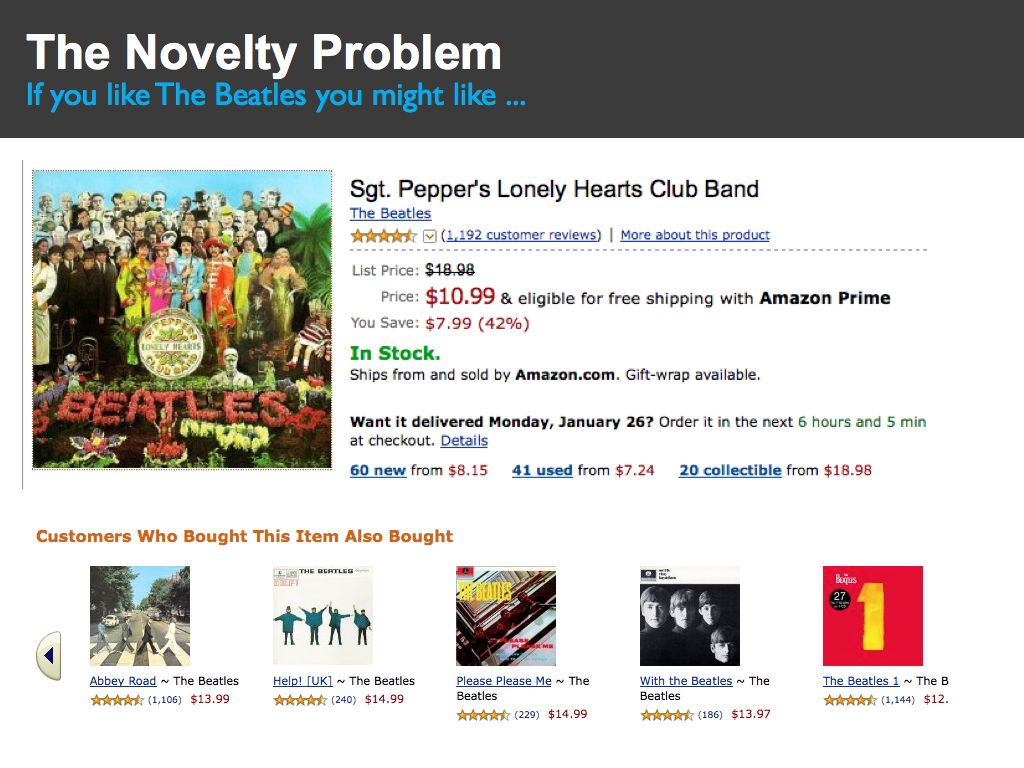
There is a difference between a recommender that is designed for music discovery and one that is designed for music shopping. Most recommenders are intended to help a store make more money by selling you more things. This tends to lead to recommendations such as this one from Amazon – that suggests that since I’m interested in Sgt. Pepper’s Lonely Hearts Club Band that I might like Abbey Road and Please Please Me and every other Beatles album. Of course everyone in the world already knows about these items so these recommendations are not going to help people find new music. But that’s not the point, Amazon wants to sell more albums and recommending Beatles albums is a great way to do that.
One factor that is contributing to the Novelty Problem is high stakes evaluations like the Netflix prize. The Netflix prize is a competition that offers a million dollars to anyone that can improve the Netflix movie recommender by 10%. The evaluation is based on how well a recommender can predict how a movie viewer will rate a movie on a 1-5 star scale. This type of evaluation focuses on relevance – a recommender that can correctly predict that I’ll rate the movie ‘Titanic’ 2.2 stars instead of 2.0 stars – may score well in this type of evaluation, but that probably hasn’t really improved the quality of the recommendation. I won’t watch a 2.0 or a 2.2 star movie, so what does it matter. The downside of the Netflix prize is that only one metric – relevance – is being used to drive the advancement of recommender state-of-the-art when there are other equally import metrics – novelty is one of them.
The Napoleon Dynamite Problem
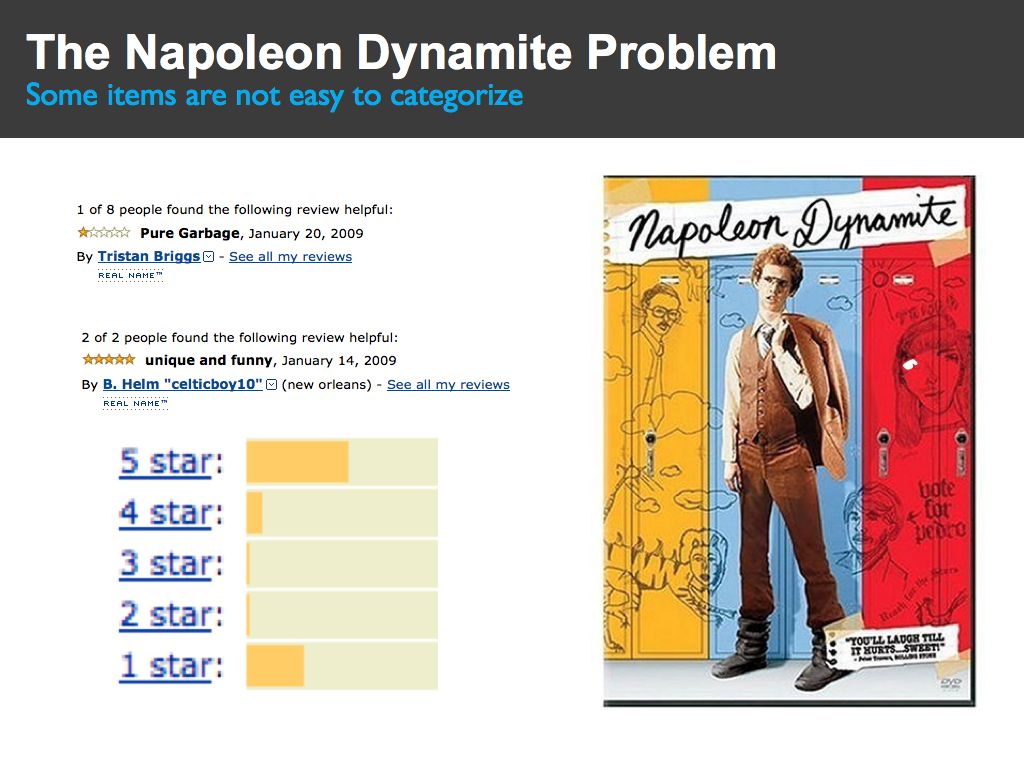
Some items are not always so easy to categorize. For instance, if you look at the ratings for the movie Napoleon Dynamite you see a bimodal distribution of 5 stars and 1 stars. People either like it or hate it, and it is hard to predict how an individual will react.
The Opacity Problem
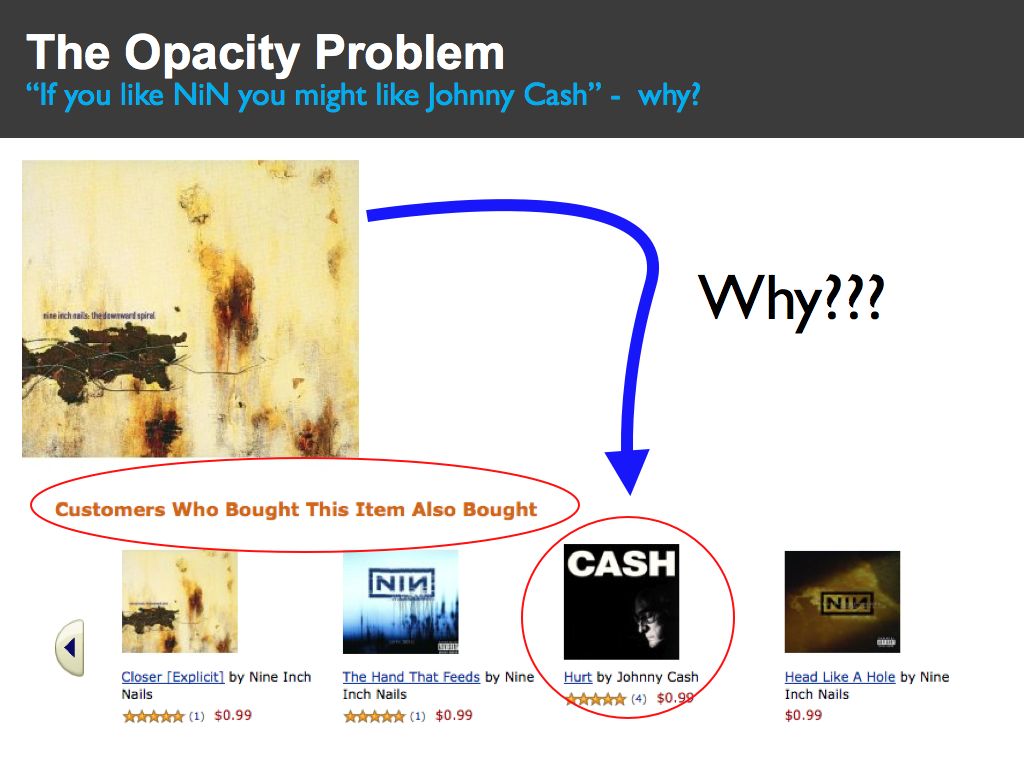
Here’s an Amazon recommendation that suggests that if I like Nine Inch Nails that I might like Johnny Cash. Since NiN is an industrial band and Johnny Cash is a country/western singer, at first blush this seems like a bad recommendation, and if you didn’t know any better you may write this off as just another broken recommender. It would be really helpful if the CF recommender could explain why it is recommending Johnny Cash, but all it can really tell you is that ‘Other people who listened to NiN also listened to Johnny Cash’ which isn’t very helpful. If the recommender could give you a better explanation of why it was recommending something – perhaps something like “Johnny Cash has an absolutely stunning cover of the NiN song ‘hurt’ that will make you cry.” – then you would have a much better understanding of the recommendation. The explanation would turn what seems like a very bad recommendation into a phenomenal one – one that perhaps introduces you to whole new genre of music – a recommendation that may have you listening ‘Folsom Prison’ in a few weeks.
Hacking the Recommender
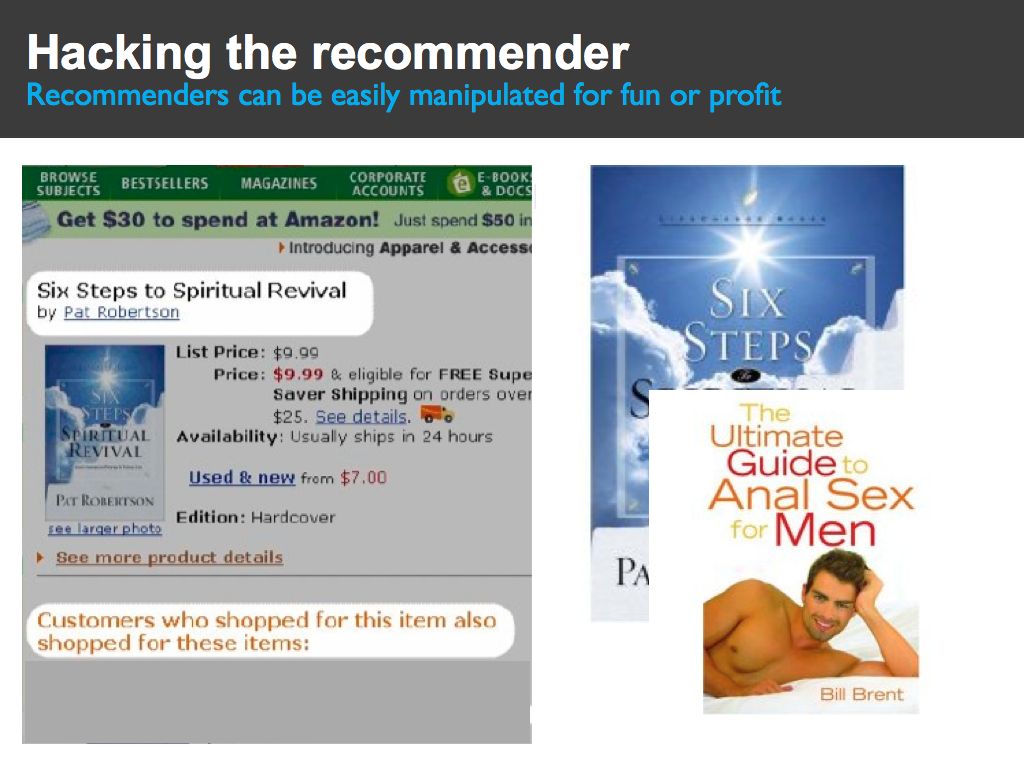
Here’s a recommendation based on a book by Pat Robertson called Six Steps to Spiritual Revival (courtesy of Bamshad Mobasher). This is a book by notorious televangelist Pat Roberston that promises to reveal “Gods’s Awesome Power in your life.” Amazon offers a recommendation suggesting that ‘Customers who shopped for this item also shopped for ‘The Ultimate Guide to Anal Sex for Men’. Clearly this is not a good recommendation. This bad recommendation is the result of a loosely organized group who didn’t like Pat Roberston, so they managed to trick the Amazon recommender into recommending a rather inappropriate book just by visiting the Amazon page for Robertson’s book and then visiting the Amazon page for the sex guide.
This manipulation of the Amazon recommender was easy to spot and can be classified as a prank, but it is not hard to image that an artist or a label may use similar techniques, but in a more subtle fashion to manipulate a recommender to promote their tracks (or to demote the competition). We already live in a world where search engine optimization is an industry. It won’t be long before recommender engine optimization will be an equally profitable (and destructive) industry.
Wrapping up
This is the first part of a two part post. In this post I’ve highlighted some of the issues in traditional music recommendation. Next post is all about how to fix these problems. For an alternative view be sure to visit Anthony Volodkin’s blog where he presents a rather different viewpoint about music recommendation.
sxsw music discovery chaos?
Posted by Paul in Music, recommendation on March 18, 2009
The very last panel I attended at SXSW Interactive was a panel called “Music 2.0 = Music Discovery Chaos?” This was a roundtable discussion as opposed to a more traditional panel where ‘experts’ do most of the talking. Elliot and Sandy Hurst of Supernova.com guided a conversation about the state of music discovery.
To tell the truth, I had low expectations for this panel. These things often devolve into (a) discussion about business models, (b) people pimping their new site, (c) some self-proclaimed expert dominating the discussion. But instead of a trainwreck, this panel turned into one my highlights of SXSW.
There was a wide range of people with a wide range of views that participated in the discussion. There were music fans (of course) that touted their favorite discovery mechanisms (friends, last.fm, hype machine). There were music critics who reminded us of the role of the expert in filtering music, but who also admitted that there’s just too much music for them to deal with, so they need their own filters. There were music programmers who talked about the different levels of listening adventurousness based on demographics (us old people apparently are less adventurous). And there was the gadfly in the back of the room, who wondered why we cared so much about this – he had no problems finding music – and if people want to listen to American Idol, so what?
Early on in the discussion Elliot took a poll of the room that seemed to indicate that for many the primary way people found music was through friends. After this poll he ask me “why, since it seemed that most people found new music through their friends do we need machines to help us find music?”. I got to paraphrase the line from Mike McGuire: “music recommendation is for people that don’t have friends”. That got a bit of a laugh.
Of course, for a discussion like this, there’s never an ultimate agreement on anything. But it was fantastic to listen to the debate – especially by so many really smart people who are very passionate about music. Awesome panel! Good job Elliot and Sandy.
On the ferry
Posted by Paul in Uncategorized on March 14, 2009
I’m on the ferry between Vermont and upstate NY blogging with my iphone on my way to picking up my son from school for his spring break. I was able to use the 4 hour drive here to practice my sxsw talk: “help! My iPod thinks I’m emo”.
Here’s a shot out the window. There’s still ice on the lake. I suspect there will be less ice in Austin TX.

sched.org support added to SXSW Artist Catalog
Posted by Paul in search, The Echo Nest on March 1, 2009
I’ve just pushed out a new version of my SXSW Artist Catalog that lets you add any artist to your SXSW schedule (via sched.org). Each artist now has a ‘schedule at sched.org’ link which brings you directly to the sched.org page for the artist where you can select the artist event that you are interested in and then add it to your schedule. It is pretty handy.
By the way, the integration with sched.org could not have been easier. Taylor McKnight added a search url of the form:
http://sxsw2009.sched.org/?searchword=DEVO
that brings you to the DEVO page at sched.org. Very nice.
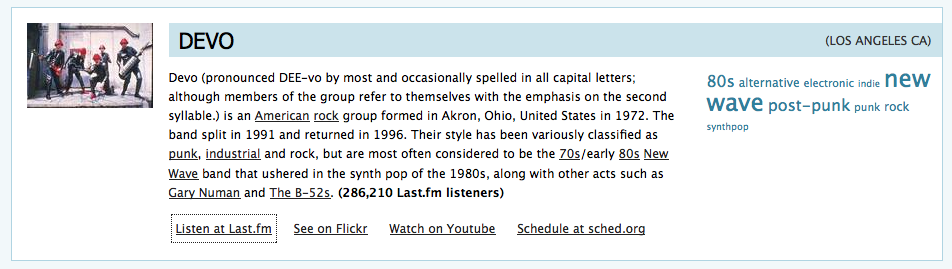
While adding the sched support, I also did a recrawl of all the artist info, so the data should be pretty fresh.
Thanks to Steve for fixing things for me after I had botched things up on the deploy, and thanks in general to Sun for continuing to host the catalog.
By the way, doing this update was a bit of a nightmare. The key data for the guide is the artist list that is crawled from the SXSW site – but the SXSW folks have recently changed the format of the artist list (spreading it out over multiple pages, adding more context, etc ). I didn’t want to have to rewrite the parsing code (when working on a spare time project, just the thought of working with regular expressions makes me close the IDE and fire up Team Fortress 2). Luckily, I had anticipated this event – my SXSW crawler had diligently been creating archives of every SXSW crawl, so if they did change formats, I could fall back on a previous crawl without needing to work on the parser. I’m so smart. Except that I had a bug. Here’s the archive code:
 public void createArchive(URL url) throws IOException {
   createArchiveDir();
   File file = new File(getArchiveName());
   if (!file.exists()) {
     URLConnection connection = url.openConnection();
     BufferedReader in = new BufferedReader(
          newInputStreamReader(connection.getInputStream()));
     PrintWriter out = new PrintWriter(getArchiveName());
     String line = null;
     try {
       while ((line = in.readLine()) != null) {
          out.println(line);
       }
     } finally {
        in.close();
     }
  }
See the bug? Yep, I forgot to close the output file – which means that all of my many archive files were missing the last block of data, making them useless. My pennance for this code-and-test sin was that I had to go and rewrite the SXSW parser to support the new format. But this turned out to be a good thing, since SXSW has been adding more artists. So this push has a new fresh crawl, with the absolute latest artists, fresh data from all of the sites like Youtube, Flicker, Last.fm and The Echo Nest. My bug makes more work for me, but a better catalog for you.
The Father Theresa of the Badge People
There’s a nifty writeup on the SXSW Artist Catalog at Austin 360: A smorgasbord for music festival-goers.
 Music Machinery