Posts Tagged recommendation
The Free Music Archive
Posted by Paul in Music, recommendation, startup on April 20, 2009
 Last week The Free Music Archive opened its virtual doors offering thousands of free tracks for streaming or download. Yes, there are tons of sites on the web that offer new music for free, but the FMA is different. The music on the FMA is curated by music experts (radio programmers, webcasters, venues, labels, collectives and so on) – so that instead of a slush pile dominated by bad music typical of other free music sites, the music at the FMA is really good (or at least one human expert thinks it is good). Most of the music on the FMA is released under some form of a Creative Commons license that allows for free non-commercial use making it suitable for you to use in your podcast, remix, video game or MIR research.
For free-music aggregation sites like the FMA, music discovery has always been a big challenge. Without any well-known artists to use as starting points into the collection, it is hard for a visitor to find music that they might like. The FMA does have and advantage over other free-music aggregators – with the human curator in the loop, you’ll spend less time wading through bad music trying to find the music gems. But the FMA and and other free-music sites need to do whole lot better if they are going to really become sources of new music for people. It would be great if I could go to a site like FMA and tell them about my music tastes (perhaps by giving them a link to my APML, or itunesLibrary.xml or last.fm name) and have them point me to the music in their collection that best matches my music taste. If they could give me a weekly customized music podcast with their newest music that best matches my music taste, I’d be in new-music heaven.
The FMA is pretty neat. I like the human-in-the-loop approach that leads to a high-quality music catalog.
Precision Hacking
Posted by Paul in recommendation on April 13, 2009
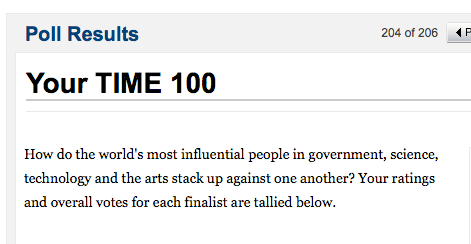
I’ve seen a few examples where recommenders, polls and top-ten lists have been manipulated. Generally a central coordinator sends a message to the hoard that descend on the to-be-hacked site. Ron Paul’s sheeple, or pharyngula‘s followers are prime examples of the type of group that can turn a poll upside down in a matter of minutes.
It has always seemed to me that such coordinating manipulation was a blunt instrument. The commanded horde could push a specific item to the top of a poll faster than a Kansas school board could lose Darwin’s notebook, but the horde lacked any subtlety or finesse. Sure you could promote or demote an individual or issue, but fine tuned manipulation would just be too difficult. Well, I’ve been proved wrong. Take a look at this Time Poll.

Not only has the poll been swamped to promote Moot (the pseudonym of the creator of 4chan, an image board and the birthplace for many internet memes) as the most influential of people, the poll crashers have manipulated the order of all the other nominees so that the first letter of each line spells out ‘marble cake, also the game’ (marble cake is not really a kind of cake btw). This is pretty phenomenal, precision hacking. Precision hacking of an extremely high profile poll run by a top notch media company. Now, imagine if the same energy was put into getting that latest Lordi album to the top of the pop 100 charts. I’m sure it could be done (and I’m already wondering if perhaps it has already been done, and we just don’t know it).
Polls, top-N lists, and recommenders based upon the wisdom of the crowds are susceptible to this type of manipulation. Better defenses are going to be needed otherwise we will all be listening to whatever 4chan wants us to listen to. (via reddit)
Music Recommendation and Discovery in the Long Tail
Posted by Paul in Music, music information retrieval, recommendation on February 12, 2009
Over the last couple of years, I’ve been lucky enough to get to know Music Information Retrieval researcher Oscar Celma. Oscar and I collaborated on a tutorial on music information retrieval that we presented at ISMIR 2007. We spent many, many hours on phone, email and IM sifting through every aspect of music recommendation.
This fall, Oscar completed his PhD Thesis. Oscar asked me to be the ‘external reader’ so I spent a good part of my Christmas break reading and re-reading the 230 page thesis. Oscar really has done a phenomenal job at looking at the issues and problems in music recommendation and in particular how they (or more accurately, how they don’t) help you find music in the long tail. Oscar’s analysis of how far different types of recommenders can push you deep into the tail.
Oscar has just published he’s thesis along with some supplementary info and code on the web site: Oscar Celma PhD. If you are involved in Music 2.0, I highly recommend reading it.
Some cool plots:
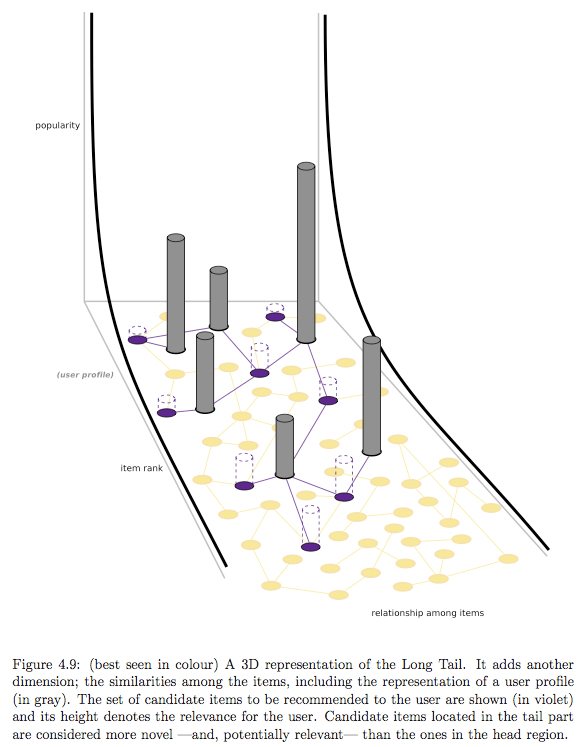
3D Representation of the long tail
And the abstract …
ABSTRACT
Music consumption is biased towards a few popular artists. For instance, in 2007 only 1% of all digital tracks accounted for 80% of all sales. Similarly, 1,000 albums accounted for 50% of all album sales, and 80% of all albums sold were purchased less than 100 times. There is a need to assist people to filter, discover, personalise and recommend from the huge amount of music content available along the Long Tail.
Current music recommendation algorithms try to accurately predict what people demand to listen to. However, quite often these algorithms tend to recommend popular -or well-known to the user- music, decreasing the effectiveness of the recommendations. These approaches focus on improving the accuracy of the recommendations. That is, try to make accurate predictions about what a user could listen to, or buy next, independently of how useful to the user could be the provided recommendations.
In this Thesis we stress the importance of the user’s perceived quality of the recommendations. We model the Long Tail curve of artist popularity to predict -potentially- interesting and unknown music, hidden in the tail of the popularity curve. Effective recommendation systems should promote novel and relevant material (non-obvious recommendations), taken primarily from the tail of a popularity distribution.
The main contributions of this Thesis are: (i) a novel network-based approach for recommender systems, based on the analysis of the item (or user) similarity graph, and the popularity of the items, (ii) a user-centric evaluation that measures the user’s relevance and novelty of the recommendations, and (iii) two prototype systems that implement the ideas derived from the theoretical work. Our findings have significant implications for recommender systems that assist users to explore the Long Tail, digging for content they might like.
 Music Machinery