Posts Tagged Music
Twisten.fm – Music gone viral.
Posted by Paul in Music, recommendation on February 13, 2009
 The fine folks over at Grooveshark have just released Twisten.fm. Like Blip.fm, Twisten.fm combines micro-blogging and music, and like Blip.fm, instead of creating an entirely new microblogging network, Twisten.fm piggybacks on top of the existing Twitter network.
With twisten, you can make tweets with just about any song in the world (Grooveshark has millions of tracks in its catalog) – twisten will automatically generate a twisten tiny url to the song, and if any of your twitter followers click on the link, they are taken directly to the song page on Grooveshark where they can listen to the song.
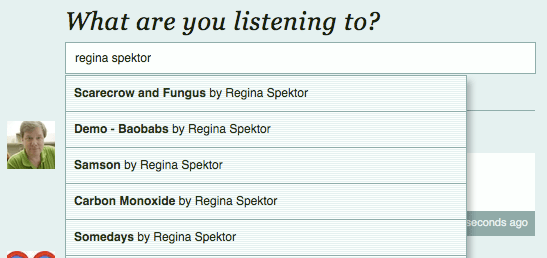
twisten a song
Here’s what the song tweet looks like on twitter:
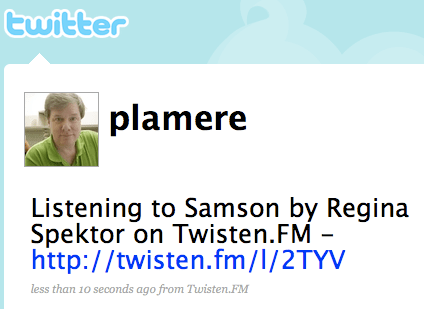
Twisten makes it easy for you to tell your twitter followers that you like a song – with Twisten, you just type the name of the song, and twisten does all of the hard work of finding the song in the catalog, generating a tiny URL for the song and posting it to Twitter.
Twisten also makes it easy to listen to music posted by others. If you use the Twisten web app, you can easily listen and browse all of the twisten tweets of your followees or the world at large.
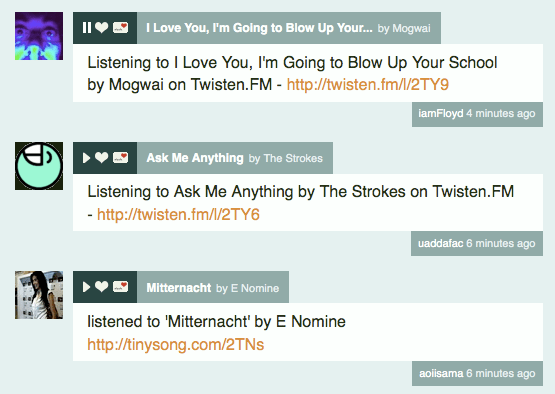
Listening to Twisten tweets
With the twisten app, you just see the Twisten tweets, which makes it a perfect app for browsing through new music. It is easy to listen, since the player is embedded right in the page. You can also listen to the music that is being posted by everyone.
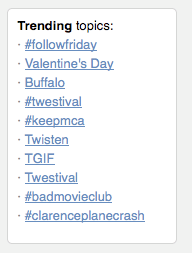
I suspect that Twisten.fm is going to be a really big deal. First and foremost, it is an incredibly viral app. Just by using Twisten, you are telling all the world about it. 18 hours after it’s release, Twisten is #6 on the list of Twitter trending topics.
 Second, it doesn’t re-invent the wheel. Instead of building a whole new social network, it sits on top of Twitter, one of the largest existing social networks – it doesn’t have to build up a network from scratch.
Twisten is really neat, I like it a lot – still, there are a few places where it could be improved.
First of all, when listening to music on the Twisten site, the music should never stop when I navigate to a different part of the site. Right now, if I’m listening to a particular tweet, and decide to check out what ‘everybody is listening to’, the music stops. The main Grooveshark app does a much better job of keeping the music playing all the time whilst one navigates through the site.
Currently, when I click on a twisten tiny url in twitter to listen to a song, instead of taking me to Twisten, the URL takes me to Grooveshark. I understand that Grooveshark is hosting all of the music, but it seems to me that if you want to really make Twisten go viral, the links should bring listeners straight to Twisten, where they can listen to the music, and while there, start Twisten their own tweets.
The listening experience on Twisten is a hunt-and-peck style. I see a song, I click on it, I listening to it, and then I go and find the next song. That’s fine when I am exploring for new music, but if I just want to listen to music, I’d like to be able to turn Twisten into a radio station, where I listen to the music that my friends have been twittering. Ideally, I should be able to listen to tweets all day without having to click a mouse button. TheSixtyOne does a great job of keeping the music flowing. Twisten should follow their model.
I wish Twisten.fm would scrobble all my tweets and listens – it’d be great if every music app in the world scrobbled my listening behavior.
Twisten is able to collect all sorts of interesting information about who is listening to what music. I hope they do some interesting things with this data. For instance, they could create a Twitter Music Zeitgest that shows the songs and artists that are rising, popular, or falling. Since Twisten knows what I’ve been listening to, and what I like (because I can ‘favorite’ twisten songs), Twisten should be able to connect me up with other Twisten listeners that have similar tastes so I can use their twitters and listens to guide my own listening. Twisten is going to be able to collect lots and lots of user listener data, so it should be interesting to see what they do with it all.
Twisten has the potential to be the real breakout music application of 2009. It has all the ingredients – a huge catalog of free music, and a viral model that leverages one of the largest and most active social networks. When iLike released it’s facebook app, iLike became the fastest growing music app ever, adding 3 million users in two weeks. Twisten has a good chance to do the same thing.
Music Recommendation and Discovery in the Long Tail
Posted by Paul in Music, music information retrieval, recommendation on February 12, 2009
Over the last couple of years, I’ve been lucky enough to get to know Music Information Retrieval researcher Oscar Celma. Oscar and I collaborated on a tutorial on music information retrieval that we presented at ISMIR 2007. We spent many, many hours on phone, email and IM sifting through every aspect of music recommendation.
This fall, Oscar completed his PhD Thesis. Oscar asked me to be the ‘external reader’ so I spent a good part of my Christmas break reading and re-reading the 230 page thesis. Oscar really has done a phenomenal job at looking at the issues and problems in music recommendation and in particular how they (or more accurately, how they don’t) help you find music in the long tail. Oscar’s analysis of how far different types of recommenders can push you deep into the tail.
Oscar has just published he’s thesis along with some supplementary info and code on the web site: Oscar Celma PhD. If you are involved in Music 2.0, I highly recommend reading it.
Some cool plots:
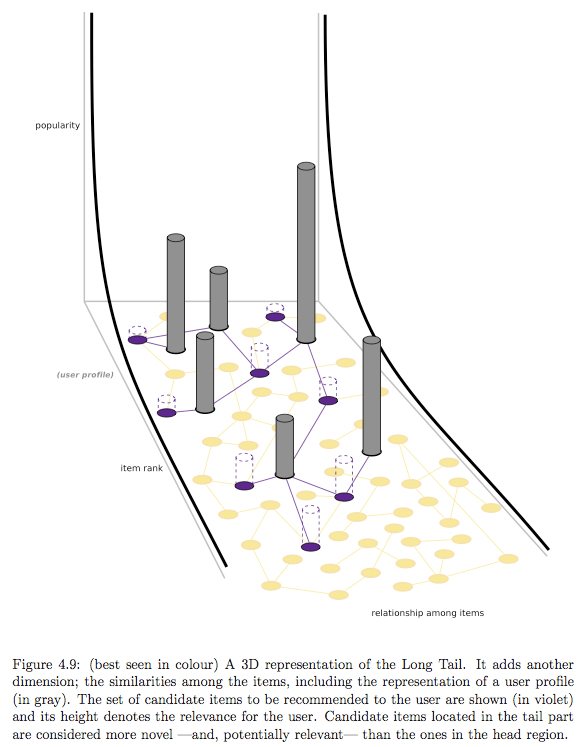
3D Representation of the long tail
And the abstract …
ABSTRACT
Music consumption is biased towards a few popular artists. For instance, in 2007 only 1% of all digital tracks accounted for 80% of all sales. Similarly, 1,000 albums accounted for 50% of all album sales, and 80% of all albums sold were purchased less than 100 times. There is a need to assist people to filter, discover, personalise and recommend from the huge amount of music content available along the Long Tail.
Current music recommendation algorithms try to accurately predict what people demand to listen to. However, quite often these algorithms tend to recommend popular -or well-known to the user- music, decreasing the effectiveness of the recommendations. These approaches focus on improving the accuracy of the recommendations. That is, try to make accurate predictions about what a user could listen to, or buy next, independently of how useful to the user could be the provided recommendations.
In this Thesis we stress the importance of the user’s perceived quality of the recommendations. We model the Long Tail curve of artist popularity to predict -potentially- interesting and unknown music, hidden in the tail of the popularity curve. Effective recommendation systems should promote novel and relevant material (non-obvious recommendations), taken primarily from the tail of a popularity distribution.
The main contributions of this Thesis are: (i) a novel network-based approach for recommender systems, based on the analysis of the item (or user) similarity graph, and the popularity of the items, (ii) a user-centric evaluation that measures the user’s relevance and novelty of the recommendations, and (iii) two prototype systems that implement the ideas derived from the theoretical work. Our findings have significant implications for recommender systems that assist users to explore the Long Tail, digging for content they might like.
The Blip.fm API
Posted by Paul in Music, web services on February 10, 2009
 Blip.fm is often described as a twitter for music. Blip users post ‘blips’ to tracks – and as with Twitter, others can follow your Blips and listen to what you’ve posted. It’s micro-music-blogging. Now that Twitter has become so popular, there is a whole micro-economy built around Twitter – with multiple companies providing every different style of twitter client that you could possibly want, for just about any platform. Twitter has enabled this economy by providing a rich set of web services around their system that any client can tap into. Blip is hoping to do the same thing. They are providing a rich set of web services around their core that allows any third party to interact with the Blip service.
The current Blip web services are in private beta – and are likely to be extended and modified as the service matures. To use the web services you need to get an API key from blip.fm (via email). Despite the private beta nature of the API – there’s already quite a bit a functionality in the API. Here’s a quick rundown of what you can already do with the API:
- Post a blip
- Delete a blip
- Get a blip by ID
- Get all public blips that occurred over a range of time
- Search for by song or artist name
- User Related Blips
- Get blips for a user ordered by recency
- Get blips for users that a user is following
- Get a user’s playlist blips
- Get blips that have replies
- Get a user by name
- Get a user’s listeners
- Get a user’s preferences
- Get a user’s stats
- Give a user ‘props’
- Save a user’s preferences
- Sign up a new user
- Favorites
- Add a user as a ‘favorite’ dj
- add a blip to a user’s playlist
- remove a user as a a ‘favorite’ dj
- remove a blip from a user’s playlist
- Get a user’s favorite DJs
These services seem to be pretty all inclusive, covering every thing that any 3rd party client would want to do with the blip service.
The Blip services provide output in XML, JSON or serialized PHP. There’s a sample return for a getUserProfile request that returns my most recent blips at the end of this post.
Authentication – In general, any of the Blip web services that are related to a specific user require the call to be authenticated. Creating an authenticated call involves taking a hash of your blip secret key along with a few other fields (such as the timestamp) to create a signature that is appended to the request. (Does anyone else have problems trying to manage these secret keys in an open source project?, they really belong with the code, but if you check them into your open source code repository, they are not secret anymore!).
Terms-of-service – As far as I can tell, the Blip folks haven’t published a terms-of-service for the API. Not surprising since the API is still in private beta. Still, I like to know the rules of the road before I invest too much in an API. In particular, I’d like to know whether or not commercial use of the API is allowed. Blip does have rate limits – no more than one call every 30 seconds per API key for authenticated calls (there are some calls that are excluded from this rate limit).
Documentation – the documentation for the blip service is quite good for a private beta. I especially like the API Tool that lets you play with the API in the browser. They could improve the documentation a bit around what happens with failures – all they say for right now is Error message on failure – which is really not that helpful. In particular, it would be nice if they published a set of status codes that one could expect on error – so I can programmatically tell the difference between an authentication error (a user gave me the wrong password) and a rate limit exceeded error.
Summary – For a private beta, I’m quite impressed at how full featured the Blip.fm API is. They have a wide range of web services already built around their core system. They have figured out a good way to authenticate calls that manipulate user data. The documentation combined with the nifty API tool lets you easily explore the nooks and crannies of the API. They have API client libraries for PHP, Actionscript and Javascript (no Java or Python, sniff!). There’s lots of good stuff here.
Sample Blip return XML

<?xml version="1.0" encoding="UTF-8"?>
<BlipApiResponse>
  <status>
    <code>200</code>
    <message>OK</message>
    <requestTime>1234265571</requestTime>
    <responseTime>1234265571</responseTime>
    <rateLimit>0</rateLimit>
  </status>
  <result>
    <total>2</total>
    <offset>0</offset>
    <limit>25</limit>
    <count>2</count>
    <collection>
      <Blip>
        <id>16946</id>
        <url>http://centralvillage.blogs.com/cv/files/vampireweekend_oxford_comma.mp3</url>
        <ownerId>37237</ownerId>
        <artist>Vampire Weekend</artist>
        <title>Oxford Comma</title>
        <insTime>2008-06-17 12:12:38</insTime>
        <message>vw</message>
        <unixTime>1213704758</unixTime>
        <toId />
        <type>songUrl</type>
        <status>active</status>
        <reblipId />
        <thumbplayLink />
        <via />
        <viaUrl />
        <owner>
          <id>37237</id>
          <urlName>plamere</urlName>
          <profilePic>http://blip.fm/_/images/nousericon.gif</profilePic>
          <status>active</status>
          <propsCount>0</propsCount>
          <countryAbbr>us</countryAbbr>
          <name />
          <website />
          <timeZone>US/Pacific</timeZone>
          <lastBlipTime>0000-00-00 00:00:00</lastBlipTime>
          <insTime>2008-06-17 09:18:28</insTime>
          <updateTime>2009-02-05 12:40:39</updateTime>
        </owner>
      </Blip>
      <Blip>
        <id>16919</id>
        <url>http://www.notontheguestlist.com/MynameIsjonas.mp3</url>
        <ownerId>37237</ownerId>
        <artist>Weezer</artist>
        <title>My Name Is Jonas</title>
        <insTime>2008-06-17 09:19:26</insTime>
        <message>weezer in the morning</message>
        <unixTime>1213694366</unixTime>
        <toId />
        <type>songUrl</type>
        <status>active</status>
        <reblipId />
        <thumbplayLink />
        <via />
        <viaUrl />
        <owner>
          <id>37237</id>
          <urlName>plamere</urlName>
          <profilePic>http://blip.fm/_/images/nousericon.gif</profilePic>
          <status>active</status>
          <propsCount>0</propsCount>
          <countryAbbr>us</countryAbbr>
          <name />
          <website />
          <timeZone>US/Pacific</timeZone>
          <lastBlipTime>0000-00-00 00:00:00</lastBlipTime>
          <insTime>2008-06-17 09:18:28</insTime>
          <updateTime>2009-02-05 12:40:39</updateTime>
        </owner>
      </Blip>
    </collection>
  </result>
</BlipApiResponse>
 Music Machinery