Archive for category recommendation
The Echo Nest Fanalytics
Posted by Paul in Music, recommendation, The Echo Nest on June 25, 2009
 At the core of just about everything we do here at the Echo Nest is what we call “The Knowledge”. This is big pile of data that represents everything we know about music. To build ‘The Knowledge’ we crawl the web looking for every bit of info about music. We find music blogs, artist news, album reviews, biographies, audio, images, videos, fan activity and on and on. This gives us a huge set of raw data that represents the global conversation about music. Next, we apply a set of statistical and natural language processing algorithms to this raw data to give us a deeper understanding of what all this data means. For instance, one fundamental algorithm tells us whether a particular web document is about a particular artist. This might be easy for an artist with a distinctive name like Metallica, but may not be so easy for The Rolling Stones (is it the band or the magazine?), and can be hard for bands with ambiguous names like Air and Yes, and can be extremely difficult for artists such as Torsten Pröfrock who tragically has chosen the stage name ‘Various Artists‘ (what was he thinking?). Another algorithm that we apply to music reviews is sentiment analysis. This helps us decide whether or not a reviewer has a positive opinion about the music being reviewed. We can take a review like this one written by Jennie, my 14 year old daughter, and learn whether or not she likes the new album by Beyoncé and whether or not she tends to like R&B and pop music.
In addition to analyzing what people are writing about music, we also try to extract as much meaning as we can from the music itself. We apply digital signal processing and machine learning algorithms to audio allowing us to extract information such as tempo, key, song structure, loudness, energy, harmonic content and timbre from every song.
 Traditionally, “The Knowledge” has helped us build tools to help music fans explore and discover music – using all this data helps us predict what type of music a listener might like. For the last year, we’ve offered artist similarity and music recommendation web services around this data. But now we are going to turn this all upside down. Instead of using this data to help listeners find new music, we are going to use this data to help artists find new fans. That is what Fanalytics is all about.
For example, music blogs and review sites are becoming increasingly important way for an artist to build buzz around a new release. However, there are thousands of music blogs – each with its own specialty. This becomes a problem for the artist. How can she decide which blogs she should target for promoting her new album? This is one of the problems that Fanalytics tries to solve. With ‘The Knowledge’ we know quite a bit about thousands of music blogs. We know the reputation and the reach of a blog. We know what types of a music a particular author tends to write about, and we know what kinds of music they tend to like. With this knowledge we can make what is essentially a recommendation engine for music promotion. For any artist we can recommend a set blogs and writers that would most likely be interested in writing about the artist.
In addition to this recommendation engine tailored to music promotion, Fanalytics also provides a set of analytics tools that use ‘The Knowledge’ to help artists better understand their audience. For instance, an artist can track everything that is being said online about them – every blog post, news item, music review, video, as well as their online ‘buzz’ – a quantitative measure of how much attention the artist is receiving from reviewers, bloggers, fans, etc.
We have just launched Fanalytics, but apparently we are already seeing strong interest from the labels. (According the press release Interscope, Independent Label Group (WMG), RCA Music Group (Sony) and The Orchard are already on board). That’s not too surprising, the labels are looking for new ways to reach out to fans. As we continue to grow “The Knowledge” here at the Echo Nest I’m sure we will be creating more interesting tools like Fanalytics that are built around the data .
The Passion Index
Posted by Paul in data, fun, Music, recommendation, research, The Echo Nest on June 18, 2009
One of the ways that Music 2.0 has changed how we think about music is that there is so much interesting data available about how people are listening to music. Sites like Last.fm automatically track all sorts of interesting data that just was not available before. Forty years ago, a music label like Capitol would know how many copies the album Abbey Road sold in the U.S., but the label wouldn’t know how many times people actually listened to the album. Today, however, our iPods and desktop music players keep careful track of how many times we play each song, album and artist – giving us a whole new way to look at artist popularity. 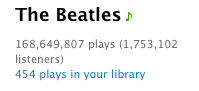 It’s not just sales figures anymore, its how often are people actually listening to an artist. If you go to Last.fm you can see that The Beatles have over 1.75 million listeners and 168 million plays. It makes it easy for us to see how popular the Beatles are compared to another band (the monkees, for instance have 2.5m plays and 285K listeners).
With all of this new data available, there are some new ways we can look at artists. Instead of just looking at artists in terms of popularity and sales rank, I think it is interesting to see which artists generate the most passionate listeners. These are artists that dominate the playlists of their fans. I think this ‘passion index’ may be an interesting metric to use to help people explore for and discovery music. Artists that attract passionate fans may be longer lived and worth a listeners investment in time and money.
How can we calculate a passion index? There are probably a number of indicators: the number of edits to the bands wikipedia page, the average distance a fan travels to attend a show by the artist, the number of fan sites for an artist. All of these may be a bit difficult to collect, especially for a large set of artists. One simple passion metric is just the average number of artist plays per listener. Presumably if an artist’s listeners are playing an artist’s songs more than average they are more passionate about the artist. One thing that I like about this approach to the passion index is that it is extremely easy to calculate – just divide the total artist plays by the total number of artist listeners and you have the passion index. Yes, there are many confounding factors – for instance, artists with longer songs are penalized – still I think it is a pretty good measure.
I calculated the passion index for a large collection of artists. I started with about a million artists (it is really nice to have all this data at the Echo Nest;), and filtered these down to the 50K most popular artists. I plotted the number of artist plays vs. the number of artist listeners for each of the 50 K listeners. The plot shows that most artists fall into the central band (normal passion), but some (the green points) are high passion artists and some (the blue points) are low passion artists.
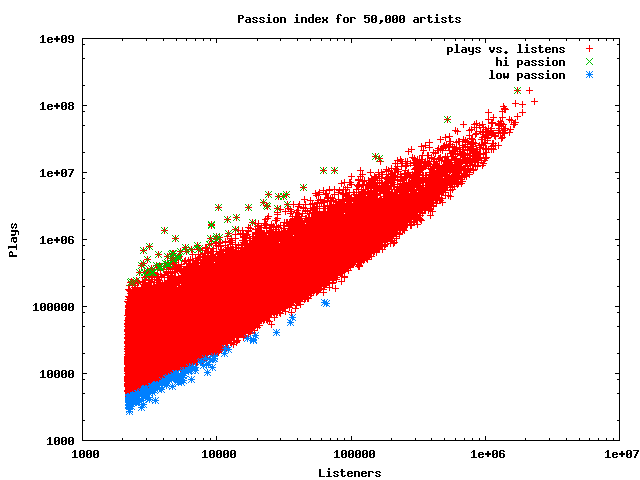
For the 50K artists, the average track plays per artist/listener is just 11 plays (with a std deviation of about 11.5). Considering that there are a substantial number of artists in my iTunes collection that I’ve played only once, this seems pretty resaonable.
So who are the artists with the highest passion index? Here are the top ten:
| Passion | Listeners | Plays | Artist |
|---|---|---|---|
| 332 | 4065 | 1352719 | 上海アリス幻樂団 |
| 292 | 10374 | 3032373 | Belo |
| 245 | 3147 | 773959 | Petos |
| 241 | 2829 | 683191 | Reilukerho |
| 208 | 4887 | 1020538 | Sound Horizon |
| 190 | 24422 | 4652968 | 동방신기 |
| 185 | 9133 | 1691866 | 岡崎律子 |
| 175 | 9171 | 1611106 | Kollegah |
| 173 | 17279 | 3004410 | Super Junior |
| 170 | 62592 | 10662940 | Böhse Onkelz |
I didn’t recognize any of these artists (and I’m not even sure if 上海アリス幻樂団 is really an artist – according to the Japanese wikipedia it is a fan club in Japan  to produce a music game coterie – whatever that means). Belo is a Brazilian pop artist that does indeed seem to have some rather passionate fans.
It is not surprising that it is hard for popular artists to rank at the very top of the passion index. Popular artists are exposed to many, many listeners which can easily reduce the passion index. Here are the top passion-ranked artists drawn from the top-1000 most popular artists:
| Passion | Listeners | Plays | Artist |
|---|---|---|---|
| 115 | 527653 | 60978053 | In Flames |
| 95 | 1748159 | 167765187 | The Beatles |
| 79 | 2140659 | 170106143 | Radiohead |
| 78 | 282308 | 22071498 | Die Ärzte |
| 75 | 269052 | 20293399 | Mindless Self Indulgence |
| 75 | 691100 | 52217023 | Nightwish |
| 74 | 332658 | 24645786 | Porcupine Tree |
| 74 | 1056834 | 79135038 | Nine Inch Nails |
| 72 | 384574 | 27901385 | Opeth |
| 70 | 601587 | 42563097 | Rise Against |
| 69 | 357317 | 24911669 | Sonata Arctica |
| 69 | 1364096 | 95399150 | Metallica |
| 66 | 460518 | 30625121 | Children of Bodom |
| 66 | 619396 | 41440369 | Paramore |
| 65 | 504464 | 33271871 | Dream Theater |
| 65 | 1391809 | 90888046 | Pink Floyd |
| 64 | 540184 | 34635084 | Brand New |
| 62 | 862468 | 54094977 | Iron Maiden |
| 62 | 1681914 | 105935202 | Muse |
| 61 | 381942 | 23478290 | Beirut |
I find it interesting to see all of the heavy metal bands in the top 20. Metal fans are indeed true fans.
Going to the other end of passion, we find the 20 popular artists that have the least passionate fans:
| Passion | Listeners | Plays | Artist |
|---|---|---|---|
| 6 | 270692 | 1767977 | Julie London |
| 6 | 284087 | 1964292 | Smoke City |
| 6 | 294100 | 1784358 | Dinah Washington |
| 6 | 295200 | 1799303 | The Bangles |
| 6 | 295990 | 1832771 | Donna Summer |
| 6 | 306018 | 1905285 | Bonnie Tyler |
| 6 | 307407 | 2123599 | Buffalo Springfield |
| 6 | 311543 | 2085085 | Franz Schubert |
| 6 | 312078 | 1909769 | The Hollies |
| 6 | 313732 | 2190008 | Tom Jones |
| 6 | 325454 | 2025366 | Eric Prydz |
| 6 | 331837 | 2259892 | Sarah Vaughan |
| 6 | 332072 | 2016898 | Soft Cell |
| 6 | 407622 | 2622570 | Steppenwolf |
| 5 | 275770 | 1605268 | Diana Ross |
| 5 | 281037 | 1615125 | Isaac Hayes |
| 5 | 282095 | 1685959 | The Isley Brothers |
| 5 | 283467 | 1666824 | Survivor |
| 5 | 311867 | 1694947 | Peggy Lee |
| 5 | 333437 | 1925611 | Wham! |
| 5 | 388183 | 2244878 | Kool & The Gang |
I guess people are not too passionate about Soft Cell.
Here’s a passion chart for the top 100 most popular artists. Even the artists at the bottom of this chart are way above average on the passion index.
| Passion | Listeners | Plays | Artist |
|---|---|---|---|
| 95 | 1748159 | 167765187 | The Beatles |
| 79 | 2140659 | 170106143 | Radiohead |
| 74 | 1056834 | 79135038 | Nine Inch Nails |
| 69 | 1364096 | 95399150 | Metallica |
| 65 | 1391809 | 90888046 | Pink Floyd |
| 62 | 1681914 | 105935202 | Muse |
| 61 | 1397442 | 85685015 | System of a Down |
| 61 | 1403951 | 86849524 | Linkin Park |
| 60 | 1346298 | 81762621 | Death Cab for Cutie |
| 57 | 1060269 | 61127025 | Fall Out Boy |
| 56 | 1155877 | 65324424 | Arctic Monkeys |
| 55 | 1897332 | 104932225 | Red Hot Chili Peppers |
| 54 | 950416 | 52019102 | My Chemical Romance |
| 50 | 1131952 | 56622835 | blink-182 |
| 49 | 2313815 | 115653456 | Coldplay |
| 48 | 964970 | 47102550 | Sigur Rós |
| 48 | 1108397 | 53260614 | Modest Mouse |
| 48 | 1350931 | 65865988 | Placebo |
| 47 | 1129004 | 53771343 | Jack Johnson |
| 44 | 1297020 | 57111763 | Led Zeppelin |
| 43 | 1011131 | 43930085 | Kings of Leon |
| 42 | 947904 | 39970477 | Marilyn Manson |
| 42 | 1065375 | 45459226 | Britney Spears |
| 42 | 1246213 | 52656343 | Incubus |
| 42 | 1256717 | 53610102 | Bob Dylan |
| 41 | 1527721 | 62654675 | Green Day |
| 41 | 1881718 | 78473290 | The Killers |
| 40 | 1023666 | 41288978 | Queens of the Stone Age |
| 40 | 1057539 | 42472755 | Kanye West |
| 40 | 1108044 | 44845176 | Interpol |
| 40 | 1247838 | 49914554 | Depeche Mode |
| 40 | 1318140 | 53594021 | Bloc Party |
| 39 | 1266502 | 49492511 | The White Stripes |
| 38 | 1048025 | 40174997 | Evanescence |
| 38 | 1091324 | 42195854 | Pearl Jam |
| 38 | 1734180 | 67541885 | Nirvana |
| 37 | 978342 | 36561552 | The Kooks |
| 37 | 1097968 | 41046538 | The Shins |
| 37 | 1114190 | 42051787 | The Offspring |
| 37 | 1379096 | 51313607 | The Cure |
| 37 | 1566660 | 58923515 | Foo Fighters |
| 36 | 1326946 | 48738588 | The Smashing Pumpkins |
| 35 | 1091278 | 39194471 | Björk |
| 35 | 1271334 | 45619688 | The Strokes |
| 34 | 955876 | 33376744 | Jimmy Eat World |
| 34 | 1251461 | 42949597 | Daft Punk |
| 33 | 989230 | 33257150 | Pixies |
| 33 | 1012060 | 34225186 | Eminem |
| 33 | 1051836 | 35529878 | Avril Lavigne |
| 33 | 1110087 | 36785736 | Johnny Cash |
| 33 | 1121138 | 37645208 | AC/DC |
| 33 | 1161536 | 38615571 | Air |
| 32 | 961327 | 31286528 | The Prodigy |
| 32 | 1038491 | 33270172 | Amy Winehouse |
| 32 | 1410438 | 45614720 | David Bowie |
| 32 | 1641475 | 52612972 | Oasis |
| 32 | 1693023 | 54971351 | U2 |
| 31 | 1258854 | 39598249 | Madonna |
| 31 | 1622198 | 51669720 | Queen |
| 30 | 1032223 | 31750683 | Portishead |
| 30 | 1178755 | 35600916 | Rage Against the Machine |
| 30 | 1249417 | 38284572 | The Doors |
| 30 | 1393406 | 42717325 | Beck |
| 29 | 1030982 | 30044419 | Yeah Yeah Yeahs |
| 29 | 1187160 | 34712193 | Massive Attack |
| 29 | 1348662 | 39131095 | Weezer |
| 29 | 1361510 | 39753640 | Snow Patrol |
| 28 | 985715 | 28485679 | The Postal Service |
| 28 | 1045205 | 30105531 | The Clash |
| 28 | 1305984 | 37807059 | Guns N’ Roses |
| 28 | 1532003 | 43998517 | Franz Ferdinand |
| 27 | 1000950 | 27262441 | Nickelback |
| 27 | 1395278 | 37856776 | Gorillaz |
| 26 | 1503035 | 40161219 | The Rolling Stones |
| 25 | 1345571 | 33741254 | R.E.M. |
| 24 | 1311410 | 32588864 | Moby |
| 23 | 973319 | 22962953 | Audioslave |
| 23 | 976745 | 22557111 | 3 Doors Down |
| 23 | 1123549 | 26696878 | Keane |
| 22 | 998933 | 21995497 | Justin Timberlake |
| 22 | 1025990 | 23145062 | Rihanna |
| 22 | 1109529 | 24687603 | Maroon 5 |
| 22 | 1120968 | 24796436 | Jimi Hendrix |
| 22 | 1160410 | 26641513 | [unknown] |
| 21 | 1151225 | 25081110 | The Who |
| 20 | 1057288 | 22084785 | The Chemical Brothers |
| 20 | 1105159 | 22925198 | Kaiser Chiefs |
| 20 | 1117306 | 22390847 | Nelly Furtado |
| 20 | 1201937 | 25019675 | Aerosmith |
| 20 | 1253613 | 25582503 | Blur |
| 19 | 968885 | 19219364 | Simon & Garfunkel |
| 19 | 974687 | 18528890 | Christina Aguilera |
| 19 | 1025305 | 20157209 | The Cranberries |
| 19 | 1144816 | 22252304 | Michael Jackson |
| 16 | 996649 | 16234996 | Black Eyed Peas |
| 16 | 1019886 | 16618386 | Eric Clapton |
| 15 | 980141 | 15317182 | The Police |
| 15 | 981451 | 15289554 | Dido |
| 14 | 973520 | 13781896 | Elton John |
| 13 | 949742 | 12624027 | The Verve |
I think it would be really interesting to incorporate the passion index into a recommender, so instead of just recommending artists that are similar to artists that a listener already likes, filter the similar artists with a passion filter and offer up the artists that listeners are most passionate about. I think these recommendations would be more valuable to the listener.
Music Explorer FX
Posted by Paul in java, Music, recommendation, The Echo Nest, visualization on June 11, 2009
Sten has posted a link to his super nifty Music Explorer FX. Music Explorer FX is a Java Fx application for exploring and discovering music. In some ways, the application is like a much slicker version of Music Plasma or Musicovery. You can explore a particular neighborhood in the music world – looking at artist photos and videos, listening to music, reading reviews and blog posts, and following paths to similar artists. It’s a very engaging application that makes it easy to learn about new bands. I especially like the image gallery mode – when I find a band that I think might be interesting, I hit the play button to listen to their music, and then enter the image gallery to get a slide show of the band playing. Here’s an example of ‘Pull Tiger Tail’ – a band that I just learned about today while exploring with MEFX.
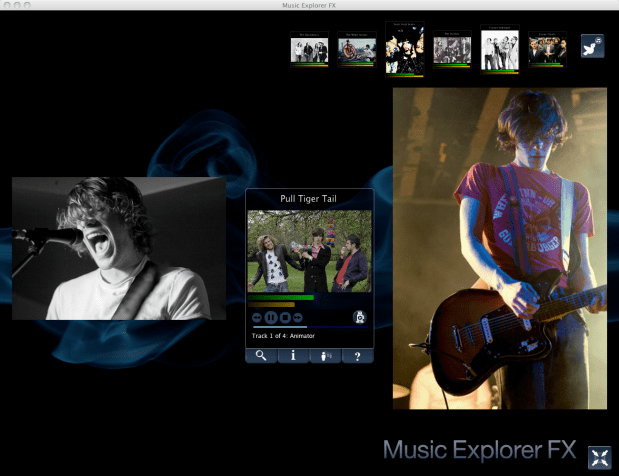
Sten uses a number of APIs to make MEFX happen. He uses the Echo Nest for artist search and to get all sorts of info including artist familiarity, hotness, artist similarity, blogs, news, reviews and audio. He gets artist images from Flickr and Last.fm – and just to make sure he’s relevant in this Twitter-centric world, he uses the Twitter API to let you tweet about any interesting paths you’ve taken through the music space.
We are living in a remarkable world now – there’s such an incredible amount of music available. There are millions of artists creating music in all styles. The challenge for today’s music listener is to find a way to navigate through this music space to find music that they will like. Traditional music recommenders can help, but I really think that applications like the MEFX that enable exploration of the music space are going to be important tools for the adventurous music listener
Help! My iPod thinks I’m EMO – the Podcast
Posted by Paul in Music, recommendation, The Echo Nest on June 3, 2009
I notice that the audio for the panel session “Help! My iPod thinks I’m emo” that Anthony (of the Hype Machine) and I gave at SXSW is online. You can listen to it here
And follow along with the slides on slide share here.
Artist similarity, familiarity and hotness
Posted by Paul in Music, recommendation, The Echo Nest, visualization, web services on May 25, 2009
 The Echo Nest developer web services offer a number of interesting pieces of data about an artist, including similar artists, artist familiarity and artist hotness. Familiarity is an indication of how well known the artist is, while hotness (which we spell as the zoolanderish ‘hotttnesss’) is an indication of how much buzz the artist is getting right now. Top familiar artists are band like Led Zeppelin, Coldplay, and The Beatles, while top ‘hottt’ artists are artists like Katy Perry, The Boy Least Likely to, and Mastodon.
I was interested in understanding how familiarity, hotness and similarity interact with each other, so I spent my Memorial day morning creating a couple of plots to help me explore this. First, I was interested in learning how the familiarity of an artist relates to the familiarity of that artists’s similar artists. When you get the similar artists for an artist, is there any relationship between the familiarity of these similar artists and the seed artist? Since ‘similar artists’ are often used for music discovery, it seems to me that on average, the similar artists should be less familiar than the seed artist. If you like the very familiar Beatles, I may recommend that you listen to ‘Bon Iver’, but if you like the less familiar ‘Bon Iver’ I wouldn’t recommend ‘The Beatles’. I assume that you already know about them. To look at this, I plotted the average familiarity for the top 15 most similar artists for each artist along with the seed artist’s familiarity. Here’s the plot:
 In this plot, I’ve take the top 18,000 most familiar artists, ordered them by familiarity. The red line is the familiarity of the seed artist, and the green cloud shows the average familiarity of the similar artists. In the plot we can see that there’s a correlation between artist familiarity and the average familiarity of similar artists. We can also see that similar artists tend to be less familiar than the seed artist. This is exactly the behavior I was hoping to see. Our similar artist function yields similar artists that, in general, have an average famililarity that is less than the seed artist.
This plot can help us q/a our artist similarity function. If we see the average familiarity for similar artists deviates from the standard curve, there may be a problem with that particular artist. For instance, T-Pain has a familiarity of 0.869, while the average familiarity of T-Pain’s similar artists is 0.340. This is quite a bit lower than we’d expect – so there may be something wrong with our data for T-Pain. We can look at the similars for T-Pain and fix the problem.
For hotness, the desired behavior is less clear. If a listener starting from a medium hot artist is looking for new music, it is unclear whether or not they’d like a hotter or colder artist. To see what we actually do, I looked at how the average hotness for similar artists compare to the hotness of the seed artist. Here’s the plot:
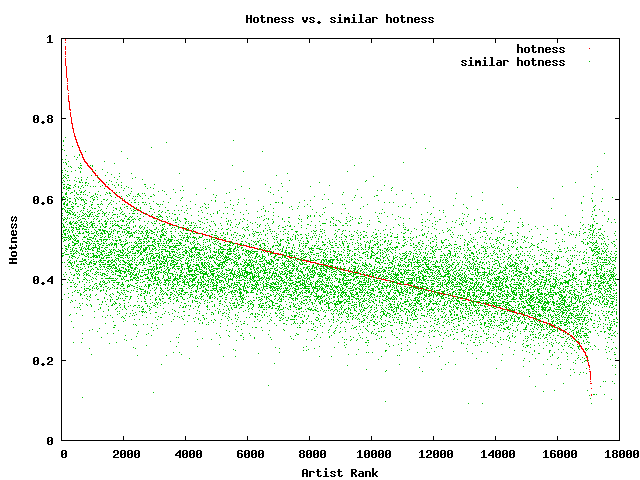 In this plot, the red curve is showing the hotness of the top 18,000 most familiar artists. It is interesting to see the shape of the curve, there are very few ultra-hot artists (artists with a hotness about .8) and very few familiar, ice cold artists (with a hotness of less than 0.2). The average hotness of the similar artists seems to be somewhat correlated with the hotness of the seed artist. But markedly less than with the familiarity curve. For hotness if your seed artist is hot, you are likely to get less hot similar artists, while if the seed artist is not hot, you are likely to get hotter artists. That seems like reasonable behavior to me.
Well, there you have it. Some Monday morning explorations of familiarity, similarity and hotness. Why should you care? If you are building a music recommender, familiarity and hotness are really interesting pieces of data to have access to. There’s a subtle game a recommender has to play, it has to give a certain amount of familiar recommendations to gain trust, while also giving a certain number of novel recommendations in order to enable music discovery.
SanFran Music Tech summit
Posted by Paul in recommendation, The Echo Nest, web services on May 13, 2009
This weekend I’ll be heading out to San Francisco to attend the SanFran MusicTech Summit. The summit is a gathering of musicians, suits, lawyers, and techies with a focus on the convergence of music, business, technology and the law. There’s quite a set of music tech luminaries that will be in attendance, and the schedule of panels looks fantastic.
I’ll be moderating a panel on Music Recommendation Services. There are some really interesting folks on the panel: Stephen White from Gracenote, Alex Lascos from BMAT, James Miao from the Sixty One and Michael Papish from Media Unbound. I’ve been on a number of panels in the last few years. Some have been really good, some have been total train wrecks. The train wrecks occur when (1) panelists have an opportunity to show powerpoint slides, (2) a business-oriented panelist decides that the panel is just another sales call, (3) the moderator loses control and the panel veers down a rat hole of irrelevance. As moderator, I’ll try to make sure the panel doesn’t suck .. but already I can tell from our email exchanges that this crew will be relevant, interesting and funny. I think the panel will be worth attending.
We are already know some of the things that we want to talk about in the panel:
- Does anyone really have a problem finding new music? Is this a problem that needs to be solved?
- What makes a good music recommendation?
- What’s better – a human or a machine recommender?
- Problems in high stakes evaluations
And some things that we definitely do not want to talk about:
- Business models
- Music industry crisis
If you are attending the summit, I hope you’ll attend the panel.
Last.fm’s new player
Posted by Paul in Music, recommendation, tags on May 6, 2009
Last.fm pushed out a new web-based music player that has some nifty new features including an artist slideshow, multi-tag radio and multi-artist radio. It is pretty nice.

I like the new artist slide show (it is very Snapp Radio like), but they seem to run out of unique artist images rather quickly – and what’s with the grid? It looks like I am looking at the artists through a screen window.
I really like the multi-tag radio, but it is not 100% clear to me whether it is finding music that has been tagged with all the tags or whether it just alternates between the tags. Hopefully it is the former. Update: It is the former.

It is nice to see Multi-tag radio come out of the playground and into the main Last.fm player. It is a great way to get a much more fined-tuned listening experience. I do worry that Last.fm is de-emphasizing tags though. They only show a couple of tags in the player and it is hard to tell whether these are artist, album or track tags. Last.fm’s biggest treasure trove is their tag data, so they should be very careful to avoid any interface tweaks that may reduce the number of tags they collect.
#recsplease – the Blip.fm Recommender bot
Posted by Paul in Music, recommendation, The Echo Nest, web services on May 5, 2009
 Jason has put together a mashup (ah, that term seems so old and dated now) that combines twitter, blip.fm, and the Echo Nest. When you Blip a song, just add the tag #recsplease to the twitter blip and you’ll get a reply with some artists that you might like to listen to.

This is similar to recomme developed by Adam Lindsay but recomme has been down for a few weeks, so clearly there was a twitter-music-recommendation gap that needed to be filled.
Check out Jason’s Blip.fm/twitter recommender bot.
libre.fm – what’s the point?
Posted by Paul in code, data, Music, recommendation, web services on April 24, 2009
 Libre.fm is essentially an open source clone of Last.fm’s audioscrobbler. With Libre.fm you can scrobble your music play behavior to a central server, where your data is aggregated with all of the other scrobbles and can be used to create charts, recommendations, playlists – all the sorts of things we see at Last.fm. As the name implies, everything about Libre.fm is free. All the Libre.fm code is released under the GNU AGPL. You can run your own server. You own your own data.
The Libre project is just getting underway. Not only is paint is not dry, they’ve only just put down the drop cloth, got the brushes ready and opened the can. Right now there’s a minimal scrobbler server (called GNUkebox) that will take anyone’s scrobbles and adds them to a postgres database. This server is compatible with Last.fm’s so nearly all scrobbling clients will scrobble to Libre.fm. (Note that to get many clients to work you actually have to modify your /etc/hosts file to redirect outgoing connections that would normally go to post.audioscrobbler.com so that they go to the libre.fm scrobbling machine. It is a clever way to get instant support for Libre.fm by lots of clients, but I must admit I feel a bit dirty lying to my computer about where to send the scrobbles.)
Another component of Libre.fm is the web front end (called nixtape) that shows what people are playing, what is popular, artist charts and clouds. (Imagine what Audioscrobbler.com looked like in 2005). Here’s my Libre.fm page:
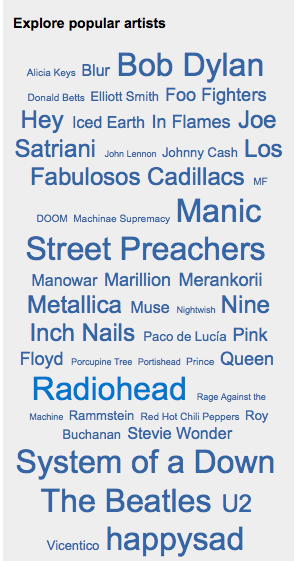
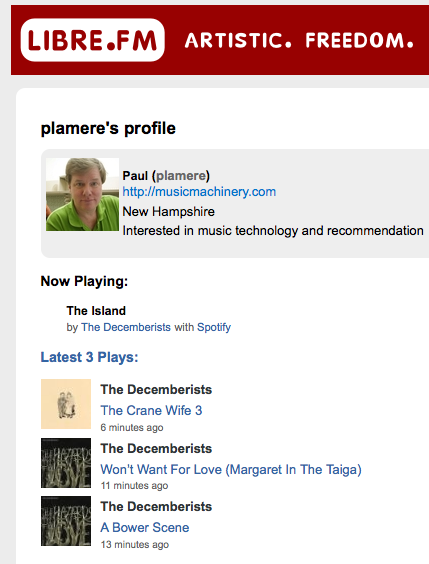 There is already quite a lot of functionality on the web front end – there are (at least minimal) user, artist, album and track pages. However, there are some critical missing bits – perhaps most significant of these is the lack of a recommender. The only discovery tool so far at Libre.fm is the clickable ‘Explore popular artist’ cloud:
Libre.fm has only been live for a few week – but it is already closing in on its millionth scrobble. As I write this, about 340K tracks have been scrobbled by 2011 users with a total of 920052 plays. (Note that since Libre.fm lets you import your Last.fm listening history, many of these plays have been previously scrobbled at Last.fm).
When you compare these numbers to Last.fm’s, Libre.fm’s numbers are very small – but if you consider the very short time that it has been live, these numbers start to look pretty good. What is even more important is that Libre.fm has already built a core team of over two dozen developers. Two dozen developers can write a crazy amount of code in a short time – so I’m expecting to see the gaps in Libre.fm functionality to be filled rather quickly. And as the gaps in functionality are eliminated, more users will come (especially those users who’ve recently abandoned Last.fm when Last.fm started to charge users that don’t live in the U.S., U.K. or Germany).
I remember way back in 1985 reading this article in Byte magazine about this seemingly crazy guy named Richard Stallman who was creating his own operating system called GNU. I couldn’t understand why he was doing it. We already had MS-DOS and Unix (I was using DEC’s Ultrix at the time which was a mighty fine OS). I didn’t think we needed anything else. But Stallman was on a mission – that mission was to create free software. Software that you were free to run, free to modify, free to distribute. I was wrong about Stallman. His set of tools became key parts of Linux and his ideas about ‘CopyLeft’ enabled the open source movement.
When I first heard about Libre.fm, my reaction was very similar to my reaction back in 1985 to Stallman – what’s the point? Last.fm already provides all these services and much more. Last.fm lets you get access to your data via their web services. Last.fm already has billions of scrobbles from millions of users. Why do we need another Last.fm? But this time I’m prepared to be wrong. Perhaps we don’t really want our data held by one company. Perhaps a community of passionate developers can take the core concept of the audioscrobbler to somewhere new. Just as Stallman’s crazy idea has changed the way we think about developing software, perhaps Libre.fm is the begining of the next revolution in music discovery.
Update – I asked mattl, founder of libre.fm, what his motivation for creating libre.fm is. He says there are two prime motivations:
- Artistic – “I wants to support libre musicians. To give them a platform where they are the ruling class.”
- freedom – “give everyone access to their data, so even if they don’t like what we’re doing with libre music, the software is still free (to them and us)”
The Free Music Archive
Posted by Paul in Music, recommendation, startup on April 20, 2009
 Last week The Free Music Archive opened its virtual doors offering thousands of free tracks for streaming or download. Yes, there are tons of sites on the web that offer new music for free, but the FMA is different. The music on the FMA is curated by music experts (radio programmers, webcasters, venues, labels, collectives and so on) – so that instead of a slush pile dominated by bad music typical of other free music sites, the music at the FMA is really good (or at least one human expert thinks it is good). Most of the music on the FMA is released under some form of a Creative Commons license that allows for free non-commercial use making it suitable for you to use in your podcast, remix, video game or MIR research.
For free-music aggregation sites like the FMA, music discovery has always been a big challenge. Without any well-known artists to use as starting points into the collection, it is hard for a visitor to find music that they might like. The FMA does have and advantage over other free-music aggregators – with the human curator in the loop, you’ll spend less time wading through bad music trying to find the music gems. But the FMA and and other free-music sites need to do whole lot better if they are going to really become sources of new music for people. It would be great if I could go to a site like FMA and tell them about my music tastes (perhaps by giving them a link to my APML, or itunesLibrary.xml or last.fm name) and have them point me to the music in their collection that best matches my music taste. If they could give me a weekly customized music podcast with their newest music that best matches my music taste, I’d be in new-music heaven.
The FMA is pretty neat. I like the human-in-the-loop approach that leads to a high-quality music catalog.
 Music Machinery