Archive for category Music
We are the Earth Destroyers
Posted by Paul in Music, The Echo Nest, web services on September 5, 2010
For my London Music Hackday hack I built a web app called ‘Earth Destroyers’. Give Earth Destroyers a band name and it will show you how eco-friendly the band’s touring schedule is. Earth Destroyers calculates the total distance traveled from the first gig to the last along with the average distance between shows. If an artist has an average inter-show distance of greater than a 1,000 km I consider it an ‘Earth Destroyer’. The app also shows you a Google map so you can see just how inefficient the tour is. To build the app I used event data from Bandsintown.
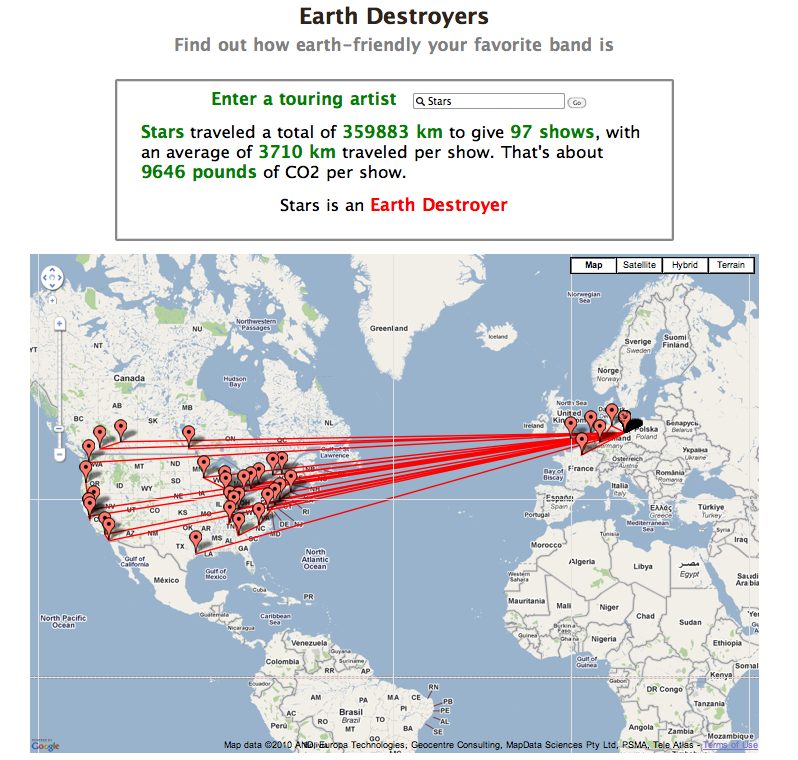
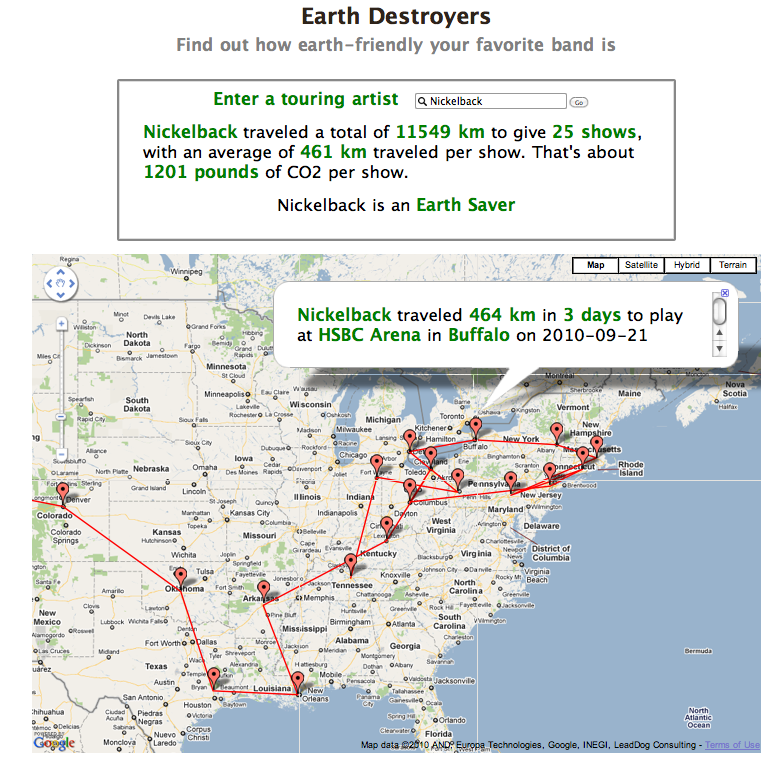
Check out Earth Destroyers
Is that a million songs in your pocket, or are you just glad to see me?
Posted by Paul in Music, playlist, research, The Echo Nest, web services on September 2, 2010
Yesterday, Steve Jobs reminded us that it was less than 10 years ago when Apple announced the first iPod which could put a thousand songs in your pocket. With the emergence of cloud-based music services like Spotify and Rhapsody, we can now have a virtually endless supply of music in our pocket. The ‘bottomless iPod’ will have as big an effect on how we listen to music as the original iPod had back in 2001. But with millions of songs to chose from, we will need help finding music that we want to hear. Shuffle play won’t work when we have a million songs to chose from. We will need new tools that help us manage our listening experience. I’m convinced that one of these tools will be intelligent automatic playlisting.
This weekend at the Music Hack Day London, The Echo Nest is releasing the first version of our new Playlisting API. The Playlisting API lets developers construct playlists based on a flexible set of artist/song selection and sorting rules. The Echo Nest has deep data about millions of artists and songs. We know how popular Lady Gaga is, we know the tempo of every one of her songs, we know other artists that sound similar to her, we know where she’s from, we know what words people use to describe her music (‘dance pop’, ‘club’, ‘party music’, ‘female’, ‘diva’ ). With the Playlisting API we can use this data to select music and arrange it in all sorts of flexible ways – from very simple Pandora radio style playlists of similar sounding songs to elaborate playlists drawing on a wide range of parameters. Here are some examples of the types of playlists you can construct with the API:
- Similar artist radio – generate a playlist of songs by similar artists
- Jogging playlist – generate a playlist of 80s power pop with a tempo between 120 and 130 BPM, but never ever play Bon Jovi
- London Music Hack Day Playlist -generate a playlist of electronic and techno music by unknown artists near London, order the tracks by tempo from slow to fast
- Tomorrow’s top 40 – play the hottest songs by pop artists with low familiarity that are starting to get hottt
- Heavy Metal Radio – A DMCA-Compliant radio stream of nothing but heavy metal
We have also provide a dynamic playlisting API that will allow for the creation of playlists that adapt based upon skipping and rating behavior of the listener.
I’m about to jump on a plane for the Music Hackday London where we will be demonstrating this new API and some cool apps that have already been built upon it. I’m hoping to see a few apps emerge from this Music Hack Day that use the new API. More info about the APIs and how you can use it to do all sorts of fun things will be forthcoming. For the motivated dive into the APIs right now.
Cool music panels at SXSW 2011
 I was going to write a post describing all of the cool looking music-oriented panels that have been proposed for SXSW 2011, but debcha at zed equals zee beat me to it. Be sure to read Deb’s SXSWi 2011 panel proposals in music and tech post. Some of the panels I’m looking to the most are:
Digital Music Smackdown: The Best Digital Music Service – In what is expected to be a heated and fiercely competitive discussion, C and VP-level executives from four digital music companies (MOG, Spotify, Pandora and Rhapsody) battle it out over the title of “Best Digital Music Service. This could be fun if it is really a smackdown, but I suspect that the execs will be very polite and complimentary of each other’s services leading to a boring panel. I hope I’m wrong. Also, where’s Last.fm? – they should be on the panel too.
We Built this App on RocknRoll: Style Matters – For an inherently auditory medium, music is ingrained with style. From 12″ artwork and niche mp3 blogs to the latest design on your sweatshirt or skate deck, music has always been analogous with visual culture. So what happens when you overlay this complex fabric of cultural values and personal identities on what is already a thorny process: building and launching a music app. – Hannah of Last.fm and Anthony of Hype Machine talk about the design of music apps. These two know their stuff. Should be really interesting.
Music & Metadata: Do Songs Remain the Same? Metadata may be an afterthought when it comes to most people’s digital music collections, but when it comes to finding, buying, selling, rating, sharing, or describing music, little matters more. Metadata defines how we interact and talk about music—from discreet bits like titles, styles, artists, genres to its broader context and history. Metadata builds communities and industries, from the local fan base to the online social network. Its value is immense. But who owns it? This panel is on my Must See list.
Expressing yourself musically with Mobile Technology – This is a panel with Ge Wang, founder/CTO of Smule talking about creating music on mobile devices. Ge is an awesome speaker and gives great demo. Don’t miss this one.
Music APIs – A Choreographed Dance with Devices? – This panel discussion focuses on real-world examples beyond the fundamentals or technical aspects of an API. Attend this panel and review success stories from the pros that demonstrate how an API brings content, software, and hardware together. Looks like a good Music APIs 101 for biz types.
I would be remiss if I didn’t pimp my own panels. Be sure to consider (and maybe even comment on / vote for ) these panels:
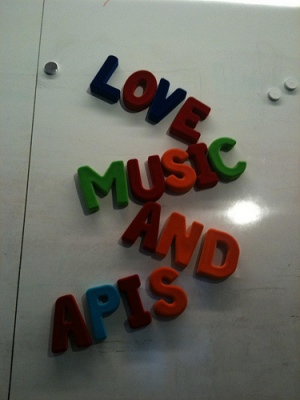
Love, Music & APIs. – Consider this to be the Music Hack Day panel. Dave Haynes (SoundCloud) and I will talk about the impact that Music APIs are having on the world of music and how programmers will soon be the new music gamekeeper.
Finding Music With Pictures: Data Visualization for Discovery: In this panel I’ll look at how visualizations can be used to help people explore the music space and discover new, interesting music that they will like. We will look at a wide range of visualizations, from hand drawn artist maps, to highly interactive, immersive 3D environments.
The folks at SXSW are looking for input on these panels to help decide what makes it onto the schedule, so if any of these strike your fancy, head on over to the panel descriptions and add your comments.
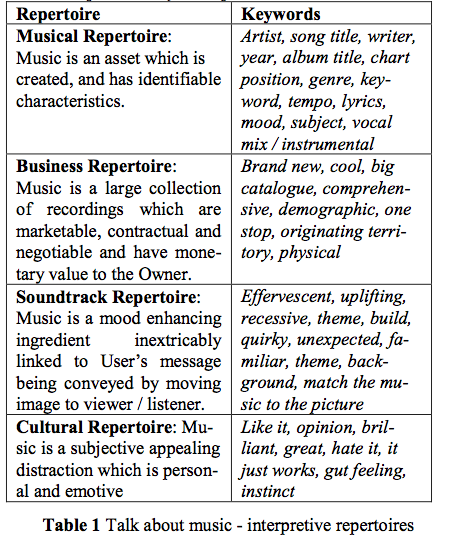
Upbeat and Quirky, With a Bit of a Build: Interpretive Repertoires in Creative Music Search
Posted by Paul in events, Music, music information retrieval, research on August 13, 2010
Upbeat and Quirky, With a Bit of a Build: Interpretive Repertoires in Creative Music Search
Charlie Inskip, Andy MacFarlane and Pauline Rafferty
ABSTRACT Pre-existing commercial music is widely used to accompany moving images in films, TV commercials and computer games. This process is known as music synchronisation. Professionals are employed by rights holders and film makers to perform creative music searches on large catalogues to find appropriate pieces of music for syn- chronisation. This paper discusses a Discourse Analysis of thirty interview texts related to the process. Coded examples are presented and discussed. Four interpretive re- pertoires are identified: the Musical Repertoire, the Soundtrack Repertoire, the Business Repertoire and the Cultural Repertoire. These ways of talking about music are adopted by all of the community regardless of their interest as Music Owner or Music User.
Music is shown to have multi-variate and sometimes conflicting meanings within this community which are dynamic and negotiated. This is related to a theoretical feedback model of communication and meaning making which proposes that Owners and Users employ their own and shared ways of talking and thinking about music and its context to determine musical meaning. The value to the music information retrieval community is to inform system design from a user information needs perspective.
Music21: A Toolkit for Computer-Aided Musicology and Symbolic Music Data
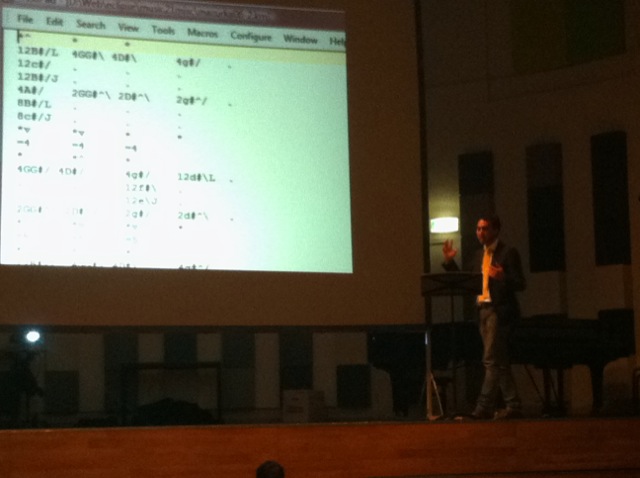
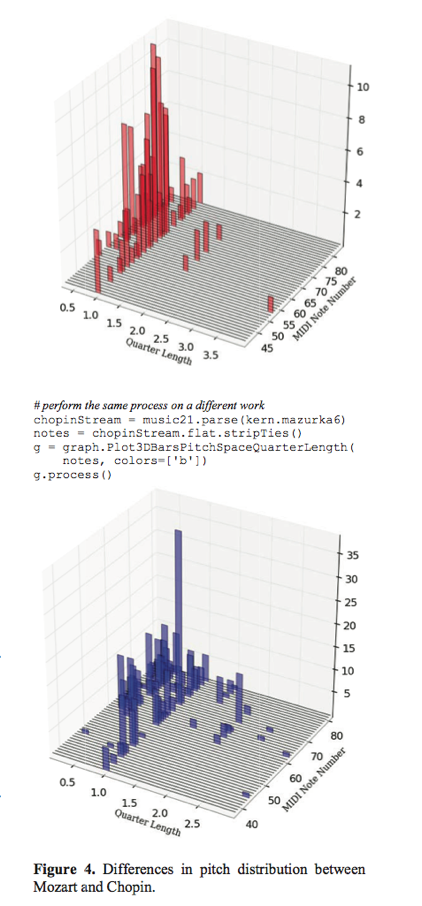
Music21: A Toolkit for Computer-Aided Musicology and Symbolic Music Data
Michael Scott Cuthbert and Christopher Ariza
ABSTRACT – Music21 is an object-oriented toolkit for analyzing, searching, and transforming music in symbolic (score- based) forms. The modular approach of the project allows musicians and researchers to write simple scripts rapidly and reuse them in other projects. The toolkit aims to pro- vide powerful software tools integrated with sophisticated musical knowledge to both musicians with little pro- gramming experience (especially musicologists) and to programmers with only modest music theory skills.
Music21 looks to be a pretty neat toolkit for analyzing and manipulating symbolic music. It’s like Echo Nest Remix for MIDI. The blog has lots more info: music21 blog. You can get the toolkit here: music21
f(MIR) industrial panel
Posted by Paul in ismir, Music, music information retrieval, research on August 12, 2010

- Douglas Eck (Google)
- Greg Mead (Musicmetric)
- Martin Roth (RjDj)
- Ricardo Tarrasch (Meemix)
- moderator: Rebecca Fiebrink (Princeton)

- rjdj – music making apps on devices like iphones
- musicmetric tracks 3 areas: Social networks, network analysis (influential fans), text via focused crawlers, p2p networks
- memix – music recommendation, artist radio, artist similarity, playlists. Pandora-like human analysis on 150K songs – then they learn these tags with machine learning. Look at which features best predict the tags. Important question is ‘what is important for the listeners’. Their aim is to find best parameters for taste prediction.
- google – goal is organize the world’s information. Doug would like to see an open API for companies to collaborate
Rebecca is the moderator.
What do you think is the next big thing? How is tech going to change things in the near future?
- Doug (Google) thinks that ‘music recommendation is solved’ – he’s excited about the cellphone. Also excited about programs like chuck to make it easier for people to create music (nice pandering to the moderator, doug!)
- Ricardo (MeeMix) – the laid back position is the future – reach the specific taste of a user. Personalized advertisements.
- Greg (MusicMetric) – Cloudbased services will help us understand what people want which will yield to playlisting, recommendation, novel players.
- Martin (RjDJ) – Thinks that the phone is really exciting – having all this power in the phone lets you do neat thing. He’s excited about how people will be able to create music – using sensory inputs, ambient audio.
How will tech revolutionize music?
- Doug – being able to collaborate with Arcade Fire on online
- Martin – musically illiterate should be able to make music
- Ricardo – we can help new artists reach the right fans
- Greg – services for helping artists, merchandising, ticket sales etc.
What are the most interesting problems or technical questions?
- Greg – interested in understanding the behavior of the fans. Especially by those on P2P networks. Huge amount of geographic-specific listener data
- Ricardo – more research around taste and recommendation
- Doug – a rant – he had a paper rejected because the paper had something to do with music generation.
- Rebecca – has a MIR for music google group :MIR4Music
- Martin – engineering:increase performance in portable devices – research:how to extract music features from music cheaply
- Ricardo – drumming style is hard to extract – but actually not that important for taste prediction
How would you characterize the relationship between biz and academia
- Greg – there is lots of ‘advanced research’ in academia, while in industry there look at much more applied problems
- Doug – suggests that the leader of an academic lab is key to bridging the gap between biz and academia. Grad students should be active in looking for the internships in industry to get a better understanding of what is needed in industry. It is all about getting grad students jobs in industry.
Audience Q/A
- what tools can we create to help producers of music? – Answer: Youtube. Martin talks about understanding how people use music creation tools. Doug: “Don’t build things that people don’t want.” – to do this you need to try this on real data.
Hmmm … only one audience q/a. sigh …
Good panel, lots of interesting ideas. Here is the future of music:
A Multi-pass Algorithm for Accurate Audio-to-Score Alignment
Posted by Paul in ismir, Music, music information retrieval, research on August 11, 2010
A Multi-pass Algorithm for Accurate Audio-to-Score Alignment
Bernhard Niedermayer and Gerhard Widmer
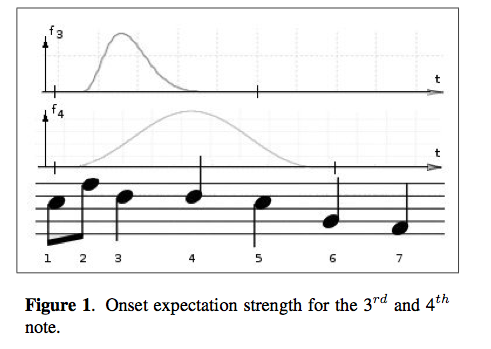
ABSTRACT – Most current audio-to-score alignment algorithms work on the level of score time frames; i.e., they cannot differentiate between several notes occurring at the same discrete time within the score. This level of accuracy is sufficient for a variety of applications. However, for those that deal with, for example, musical expression analysis such micro timings might also be of interest. Therefore, we propose a method that estimates the onset times of individual notes in a post-processing step. Based on the initial alignment and a feature obtained by matrix factorization, those notes for which the confidence in the alignment is high are chosen as anchor notes. The remaining notes in between are revised, taking into account the additional information about these anchors and the temporal relations given by the score. We show that this method clearly outperforms a reference method that uses the same features but does not differenti- ate between anchor and non-anchor notes.
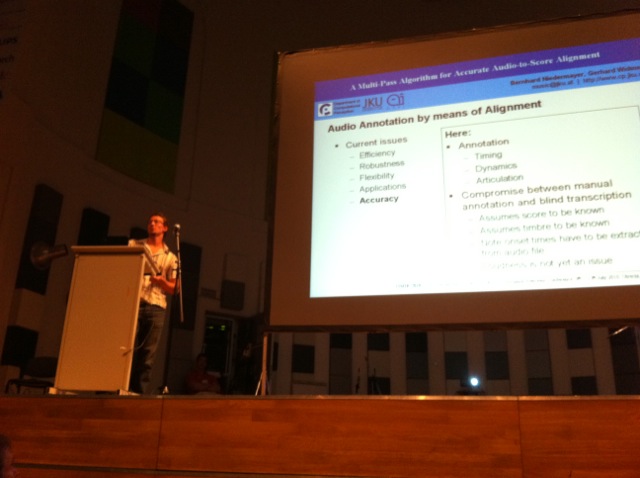
The main contribution is the introduction of an expectation strength function modeling the expected onset time of a note between two anchors. Although results are encouraging, there are specific circumstances where the algorithm fails, i.e., temporal displacement of notes is large.
Predicting High-level Music Semantics Using Social Tags via Ontology-based Reasoning
Predicting High-level Music Semantics Using Social Tags via Ontology-based Reasoning
Jun Wang, Xiaoou Chen, Yajie Hu and Tao Feng
ABSTRACT – High-level semantics such as “mood” and “usage” are very useful in music retrieval and recommendation but they are normally hard to acquire. Can we predict them from a cloud of social tags? We propose a semantic iden- tification and reasoning method: Given a music taxonomy system, we map it to an ontology’s terminology, map its finite set of terms to the ontology’s assertional axioms, and then map tags to the closest conceptual level of the referenced terms in WordNet to enrich the knowledge base, then we predict richer high-level semantic informa- tion with a set of reasoning rules. We find this method predicts mood annotations for music with higher accuracy, as well as giving richer semantic association information, than alternative SVM-based methods do.
In this paper, the authors use word-net to map social tags to a professional taxonomy and then use these for traditional tagging tasks such as classification and mood identification.
A Cartesian Ensemble of Feature Subspace Classifiers for Music Categorization
Posted by Paul in ismir, Music, music information retrieval, research on August 11, 2010
A Cartesian Ensemble of Feature Subspace Classifiers for Music Categorization (pdf)
Thomas Lidy, Rudolf Mayer, Andreas Rauber, Pedro J. Ponce de León, Antonio Pertusa, and Jose Manuel Iñesta
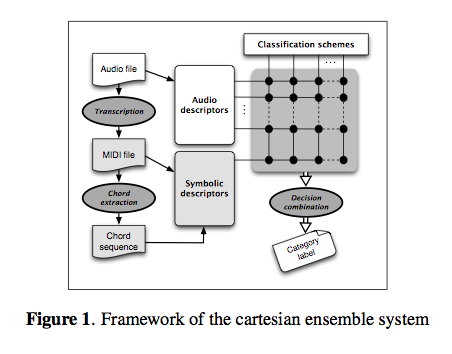
Abstract: We present a cartesian ensemble classification system that is based on the principle of late fusion and feature sub- spaces. These feature subspaces describe different aspects of the same data set. The framework is built on the Weka machine learning toolkit and able to combine arbitrary fea- ture sets and learning schemes. In our scenario, we use it for the ensemble classification of multiple feature sets from the audio and symbolic domains. We present an extensive set of experiments in the context of music genre classifi- cation, based on numerous Music IR benchmark datasets, and evaluate a set of combination/voting rules. The results show that the approach is superior to the best choice of a single algorithm on a single feature set. Moreover, it also releases the user from making this choice explicitly.
An ensemble classification system built on top of Weka:
 Results, using different datasets, classifiers and feature sets:
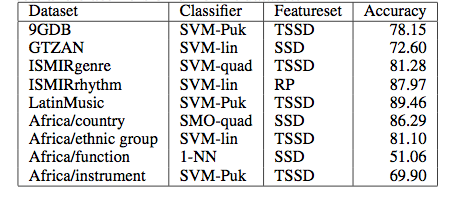
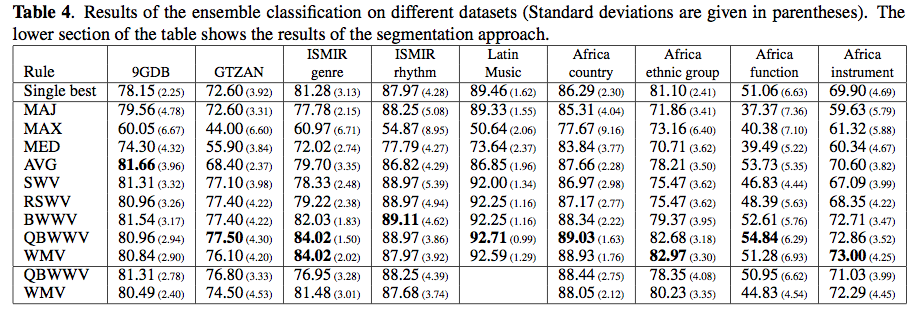
Execution times were about 10 seconds per song, so rather slow for large collections.
The ensemble approach delivered superior results through adding a reasonable amount of feature sets and classifiers. However, they did not discover a combination rule that always outperforms all the others.
ON THE APPLICABILITY OF PEER-TO-PEER DATA IN MUSIC INFORMATION RETRIEVAL RESEARCH
Posted by Paul in ismir, Music, music information retrieval, research on August 11, 2010
ON THE APPLICABILITY OF PEER-TO-PEER DATA IN MUSIC INFORMATION RETRIEVAL RESEARCH (pdf)
Noam Koenigstein, Yuval Shavitt, Ela Weinsberg, and Udi Weinsberg
abstract:Peer-to-Peer (p2p) networks are being increasingly adopted as an invaluable resource for various music information re- trieval (MIR) tasks, including music similarity, recommen- dation and trend prediction. However, these networks are usually extremely large and noisy, which raises doubts re- garding the ability to actually extract sufficiently accurate information.
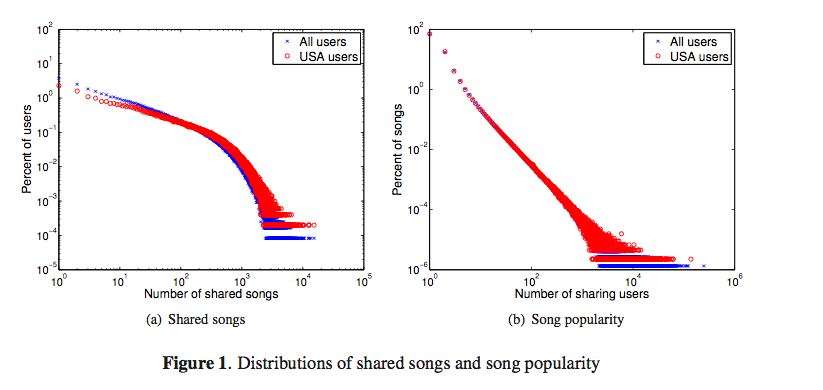
This paper evaluates the applicability of using data orig- inating from p2p networks for MIR research, focusing on partial crawling, inherent noise and localization of songs and search queries. These aspects are quantified using songs collected from the Gnutella p2p network. We show that the power-law nature of the network makes it relatively easy to capture an accurate view of the main-streams using relatively little effort. However, some applications, like trend prediction, mandate collection of the data from the “long tail”, hence a much more exhaustive crawl is needed. Furthermore, we present techniques for overcoming noise originating from user generated content and for filtering non informative data, while minimizing information loss
 Observation – CF systems tend to outperform content-based systems until you get in the long tail – so to improved CF systems, you need more long tail data. This work explores how to get more long tail data by mining p2p networks.
P2P systems have some problems – privacy concerns, data collection is hard. High user churn, very noisy data, some users delete content from shared folders right away, sparsity
P2P mining Shared folders are useful for similarity, search queries are useful for trends.
Lots of p2p challenges and steps – getting IP addresses for p2p nodes, filtering out non-musical content, geo-identification, anonymization.
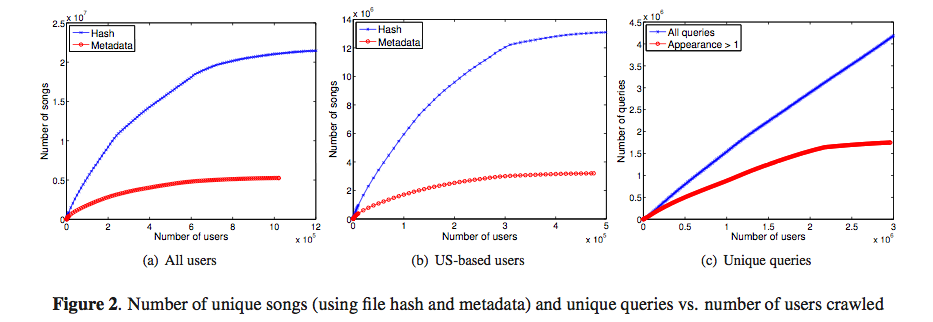
Dealing with sparsity: 1.2 million users, but average of 1 artist/song data point for each artist/song relation. These graphs show song popularity in shared folders. They use this data to help filter out non-typical users.
Identifying songs: Use the hash file – but of course many songs have many different digital copies – so they also look at the (noisy) metadata.
Songs Discovery Rate
Once you reach about 1/3 of the network you’ve found most of the tracks if you use metadata for resolving. If you use the hashes, you need to crawl 70% of the network.
Using shared folders for similarity
There’s a preferential attachment model for popular songs
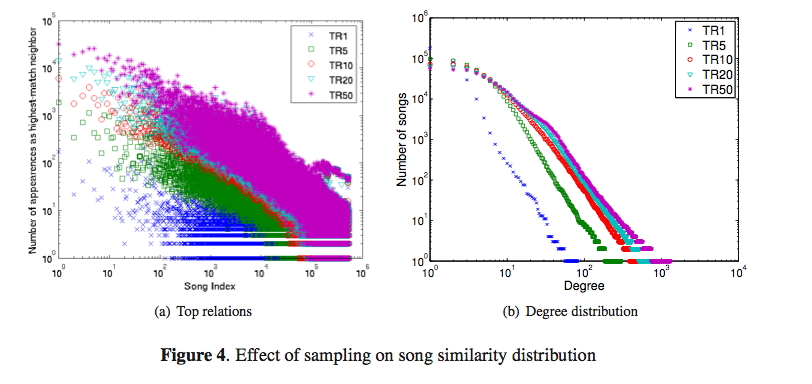
Conclusion: P2P data is good source of long tail data, but dealing with the noisy data is hard. The p2p data is especially good for building similarity models localized to countries. A good talk with from someone with lots of experience with p2p stuff.
 Music Machinery