Archive for category events
New Echo Nest APIs demoed at the Stockholm Music Hackday
Posted by Paul in events, Music, The Echo Nest, web services on January 30, 2010
photo by by Jon Åslund
Today at the Stockholm Music Hack Day, Echo Nest co-founder Brian Whitman demoed the alpha version of a new set of Echo Nest APIs . There are 3 new public methods and hints about a fourth API method.
- search_tracks: This is IMHO the most awesomest method in the Echo Nest API. This method lets you search through the millions of tracks that the Echo Nest knows about. You can search for tracks based on artist and track title of course, but you can also search based upon how people describe the artist or track (‘funky jazz’, ‘punk cabaret’, ‘screamo’. You can constrain the return results based upon musical attributes (range of tempo, range of loudness, the key/mode), you can even constrain the results based upon the geo-location of the artist. Finally, you can specify how you want the search results ordered. You can sort the results by tempo, loudness, key, mode, and even lat/long.This new method lets you fashion all sorts of interesting queries like:
- Find the slowest songs by Radiohead
- Find the loudest romantic songs
- Find the northernmost rendition of a reggae track
The index of tracks for this API is already quite large, and will continue to grow as we add more music to the Echo Nest. (but note, that this is an alpha version and thus it is subject to the whims of the alpha-god – even as I write this the index used to serve up these queries is being rebuilt so only a small fraction of our set of tracks are currently visible). And BTW if you are at the Stockholm Music Hack Day, look for Brian and ask him about the secret parameter that will give you some special search_tracks goodness!
One of the things you get back from the search_tracks method is a track ID. You can use this track ID to get the analysis for any track using the new get_analysis method. No longer do you need to upload a track to get the analysis for it. Just search for it and we are likely to have the analysis already. This search_tracks method has been the most frequently requested method by our developers, so I’m excited to see this method be released.
- get_analysis – this method will give you the full track analysis for any track, given its track ID. The method couldn’t be simpler, give it a track ID and you get back a big wad-o-json. All of the track analysis, with one call. (Note that for this alpha release, we have a separate track ID space from the main APIs, so IDs for tracks that you’ve analyzed with the released/supported APIs won’t necessarily be available with this method).
- capsule – this is an API that supports this-is-my-jam functionality. Give the API a URL to an XSPF playlist and you’ll get back some json that points you to both a flashplayer url and an mp3 url to a capsulized version of the playlist. In the capsulized version, the song transitions are aligned and beatmatched like an old style DJ would.
Brian also describes a new identify_track method that returns metadata for a track given the Echo Nest a set of musical fingerprint hashcodes. This is a method that you use in conjunction with the new Echo Nest audio fingerprinter (woah!). If you are at the Stockholm music hackday and you are interested in solving the track resolution problem talk to Brian about getting access to the new and nifty audio fingerprinter.
These new APIs are still in alpha – so lots of caveats surround them. To quote Brian: we may pull or throttle access to alpha APIs at a different rate from the supported ones. Please be warned that these are not production ready, we will be making enhancements and restarting servers, there will be guaranteed downtime.
The new APIs hint at the direction we are going here at the Echo Nest. We want to continue to open up our huge quantities of data for developers, making as much of it available as we can to anyone who wants to build music apps. These new APIs return JSON – XML is so old fashioned. All the cool developers are using JSON as the data transport mechanism nowadays: its easy to generate, easy to parse and makes for a very nimble way to work with web-services. We’ll be adding JSON support to all of our released APIs soon.
I’m also really excited about the new fingerprinting technology. Here at the Echo Nest we know how hard it is to deal with artist and track resolution – and we want to solve this problem once and for all, for everybody – so we will soon be releasing an audio fingerprinting system. We want to make this system as open as we can, so we’ll make all the FP data available to anyone. No secret hash-to-ID algorithms, and no private datasets. The Fingerprinter is fast, uses state-of-the-art audio analysis and will be backed by a dataset of fingerprint hashcodes for millions of tracks. I’ll be writing more about the new fingerprinter soon.
These new APIs should give those lucky enough to be in Stockholm this weekend something fun to play with. If you are at the Stockholm Hack Day and you build something cool with these new APIs you may find yourself going home with the much coveted Echo Nest sweatsedo:
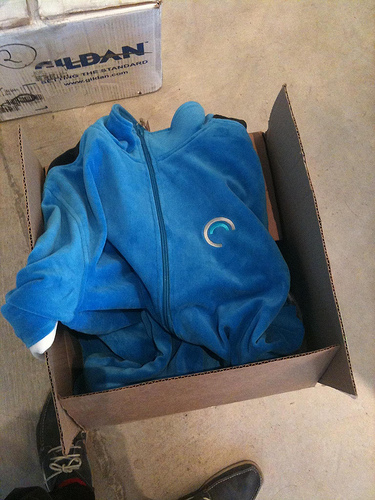
Best ever Echo Nest prize at the Stockholm Music Hackday
Posted by Paul in events, fun, The Echo Nest on January 26, 2010
Yep, the Sweatsedos have arrived in Stockholm. 4 lucky users of the Echo Nest API will get to wear the official Echo Nest uniform home as a prize for their efforts.
Visualizing the Artist Space
Posted by Paul in events, research, The Echo Nest, visualization on November 26, 2009
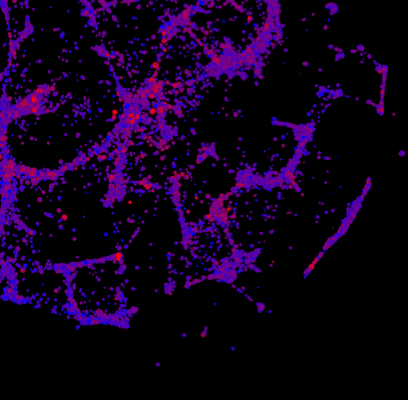
Take a look at Kurt’s weekend hack to make a visualization of the Echo Nest artist similarity space. Very nice. Can’t wait for Kurt to make it interactive and show artist info. Neat!
Hypeify – a music tech company name generator
BennetK‘s 30 minute hack from the Boston Music Hack Day is a music company name generator:
I want a company named CloudCore.
Things I learned about organizing a hack day
Posted by Paul in events, Music, The Echo Nest on November 24, 2009
Boston Music Hack Day is in the can. I learned a lot over the last few days about what happens when you have 200+ programmers gather for a weekend. Here’s some of the things I want to remember for next time:
- Plan for no-shows – when the event is free, there will be some people who sign up, but then, for whatever reason will not show up. We had lots of people on the waiting list that could have attended if we had anticipated the no-shows.

No-shows should be sitting in these empty seats
- Buy Less Food – When people are up all night coding, they tend to skip breakfast. We had breakfast for 250 on Sunday, we probably only needed breakfast for 100.

- Late-night hacking with beer and music can be quite productive

Late-night hacking at the Hack Nest
- Have dueling projectors – when you have 35 demos to show, plug in time can add a half hour to a 2 hour demo session. (By the way, thanks to the good Samaritan ubergeek who volunteered to help the presenters get the video (someone tell me who it was)).

- Work with awesome people – Working Jon and Dave was great, but there was also an incredible behind-the-scenes team making the Hack Day possible. We had an awesome set of volunteers who gave their weekend to making the hack day possible. Here are some of them:

See the guy in the back with the cap? That’s Matthew Santiago – he was a non-stop hack day machine – from moving food for 300, organizing registration, handling and chauffeuring the Echo Nestival talent. He worked from 7AM Saturday morning to 7PM Sunday evening with about an hour of sleep.
The secret weapon of the hack day was Elissa – Director of Stuff at the Echo Nest- she managed so many details from booking the Echo Nestival, renting vans, carting food, finding volunteers, photoshopping badges, getting tee-shirts made, dealing with press, photographers, CEOs, and Founders, ordering tables and chairs for the Hack nest, wrangling sponsors, picking menus, ordering food, getting swag, making extra bathroom keys, hand delivering the excess food to the local homeless shelter and so much more. Elissa quietly managed all of the big and little details that I never would have thought of. If you attended the hack day, be sure to give her some twitter love.
I learned a lot over the weekend about events and organizing. I hope I get to be involved in more hack days in the future so I can use my new knowledge.
Photos by Dave Haynes
Searching for beauty and surprise in popular music
Posted by Paul in events, Music, The Echo Nest on November 23, 2009
During the Boston Music Hack Day, 30 or 40 music hacks were produced. One phenomenal hack was Rob Ochshorn’s Outlier FM. Rob’s goal for the weekend was to utilize technology to search for beauty and surprise in even the most overproduced popular music. He approached this problem by searching musical content for the audio that “exists outside of a song’s constructed and statistical conventions”.
With Outlier FM rob can deconstruct a song into musical atoms, filter away the most common elements, leaving behind the non-conformist bits of music. This yields strange, unpredictable minimal techno-sounding music.
So how does it work? Well, first Outlier FM uses the Echo Nest analyzer to break a song down into the smallest segments. You can then visualize these segments using numerous filters and layout schemes to give you an idea of what the unusual audio segments are:
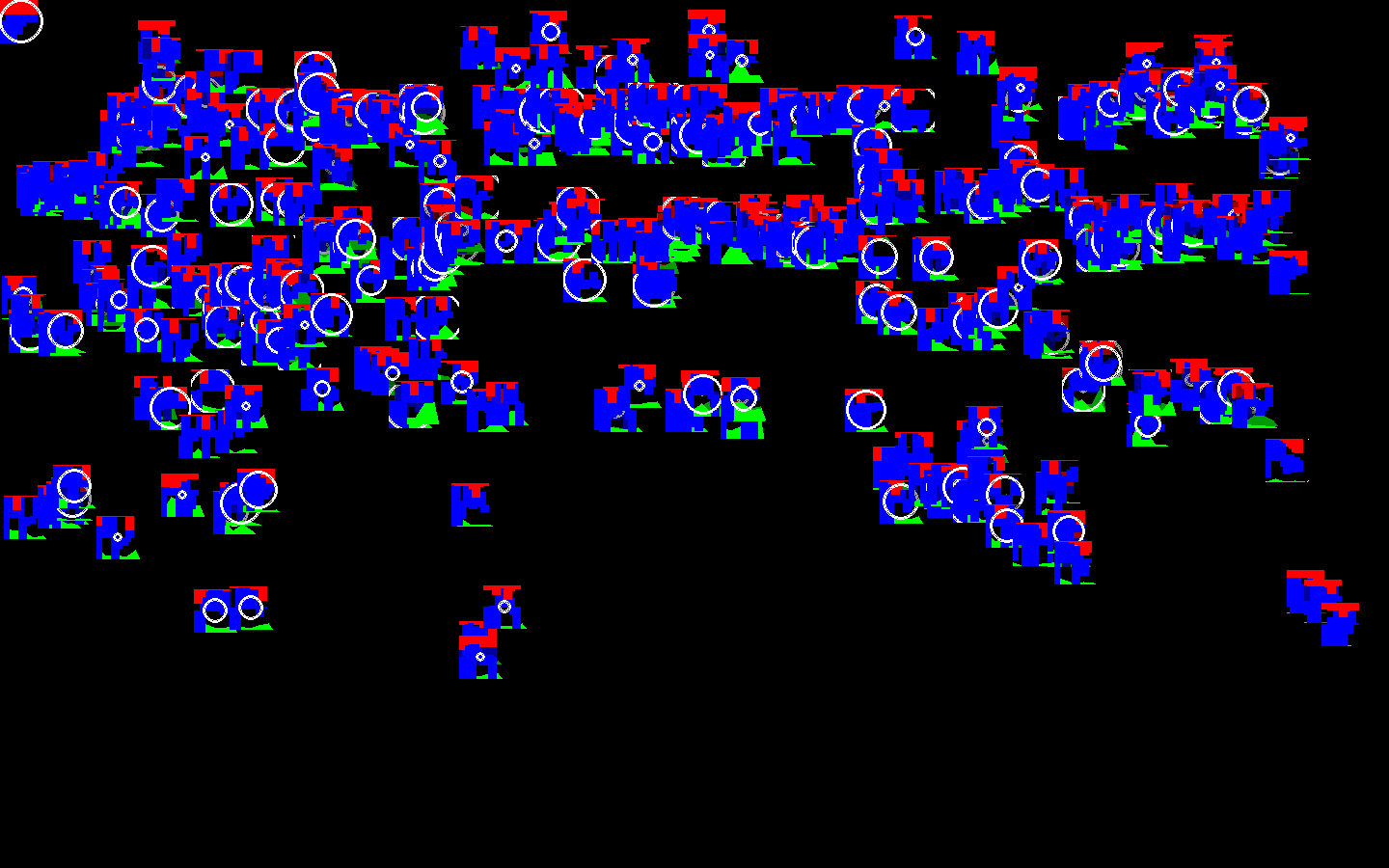
Next, you can filter out clusters of self-similar segments, leaving just the outliers:

Finally you can order, visualize and render that segments to yield interesting music:
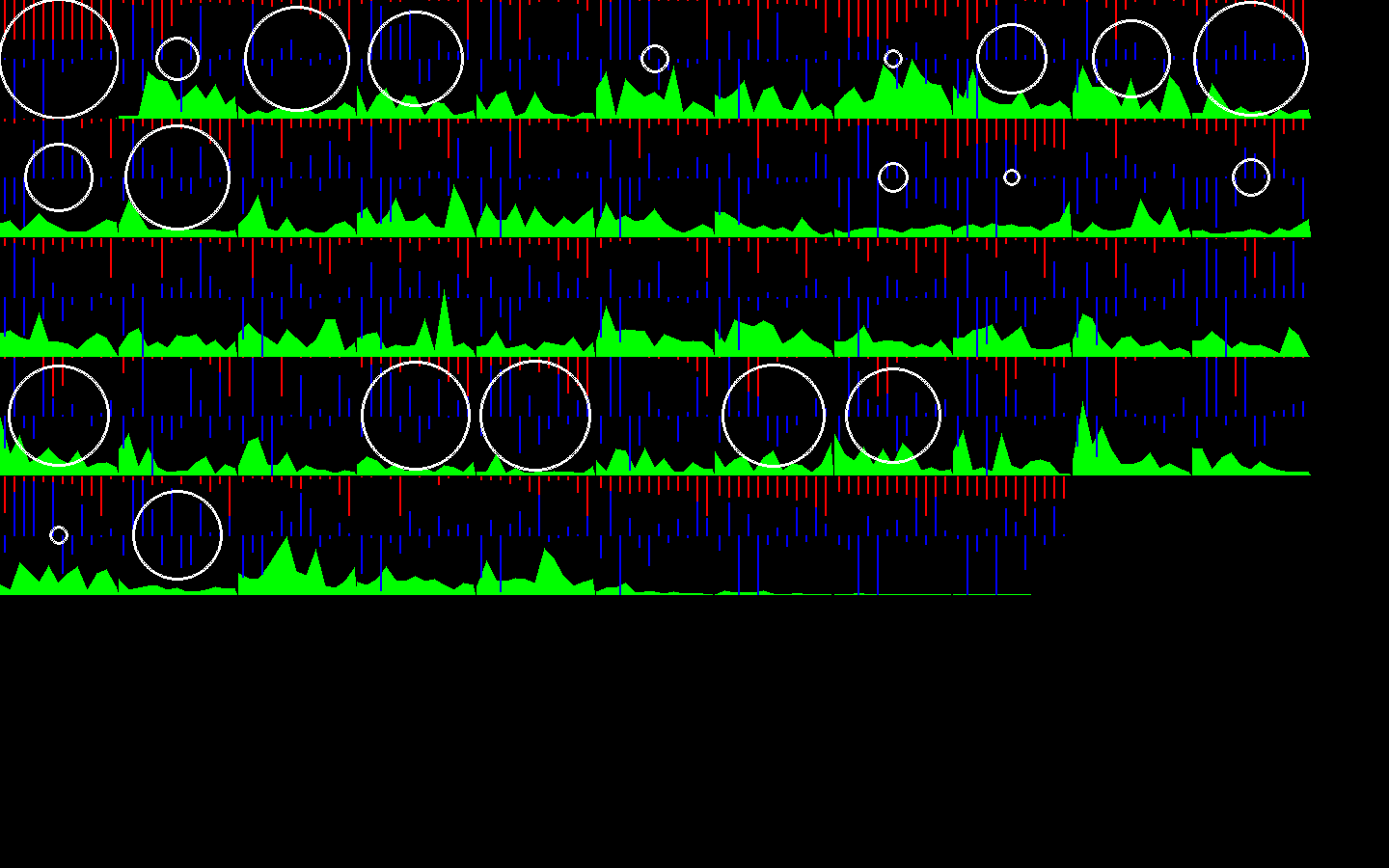
Here’s an example of Outlier FM applied to Here’ Comes the Sun:
Rob’s hack was an amazing weekend effort, he combined music analysis and visualization into a tool that can be used to make interesting sounds. Outlier.fm was voted the best hack for the music hack day weekend. Rob chose as his prize the Sun Ultra 24 workstation with flat panel display donated by Sun Microsystems Startup Essentials. Here’s Rob receiving his prize from Sun.
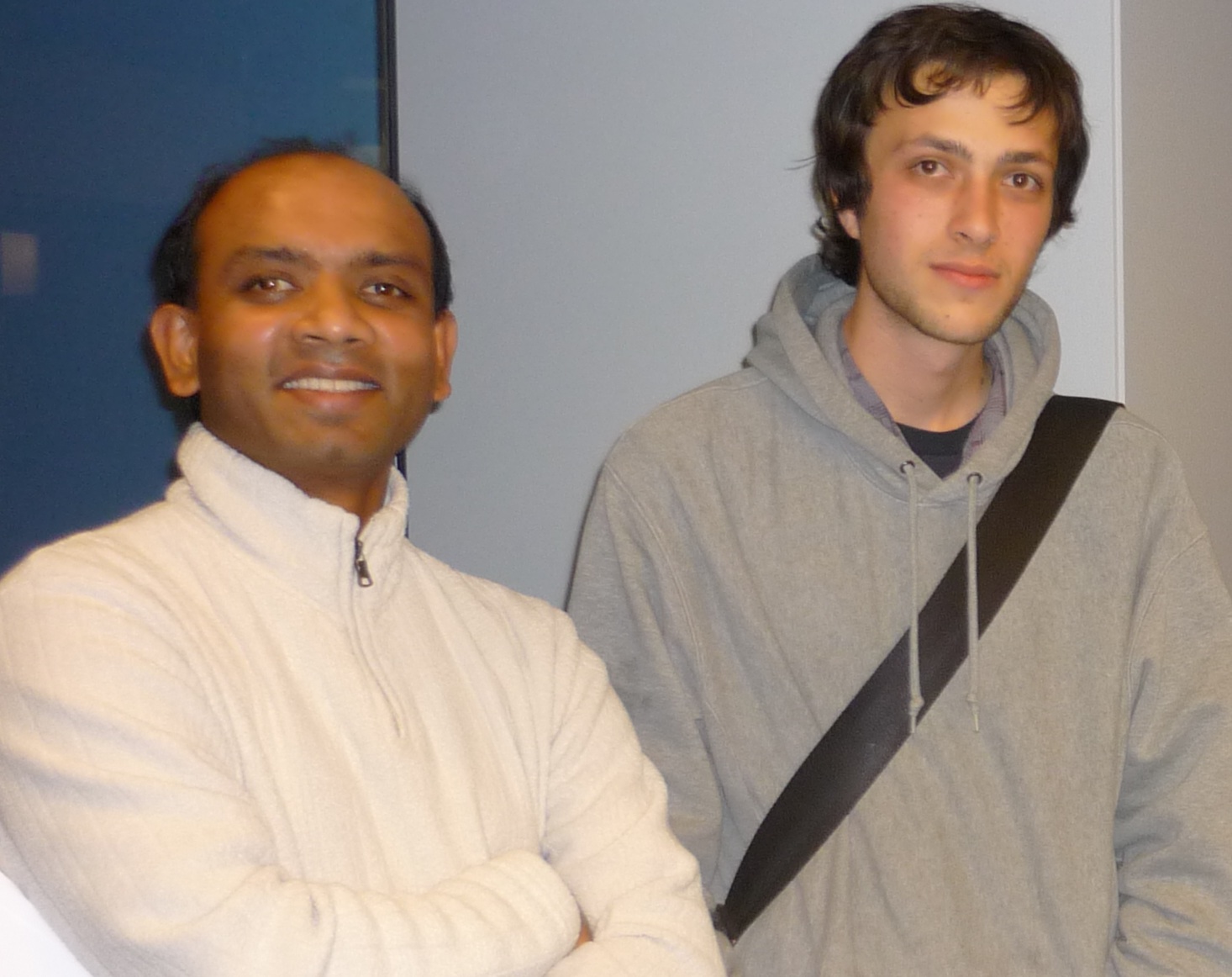
Congrats to Rob for a well done hack!
Paul’s Music Wreckommender
Posted by Paul in events, Music, playlist, The Echo Nest on November 22, 2009
I just posted my music hack day hack. It is called Paul’s Music Wreckommender. Use this Wreckommender to find anti-recommendations. Give the wreckommender an artist that you like and it will give you a playlist of tracks from artists that are very different from the seed artist. Some obvious use cases:
- Your 14 year old daughter’s slumber party is getting too loud. Send the girls home by putting on the Hannah Montana Wreckommender – which yields a playlist with tracks by Glenn Gould, Dream Theater and Al Hirt.
- It’s time to break up with your girl friend. Give her the ‘You are the wind beneath my wings‘ wrecklist and your intentions will be clear.
- If you like ‘everything but country’ then Garth Williams will guide the way: Garth Williams Wreckommendations
You can try it out at Wreckommender.com.
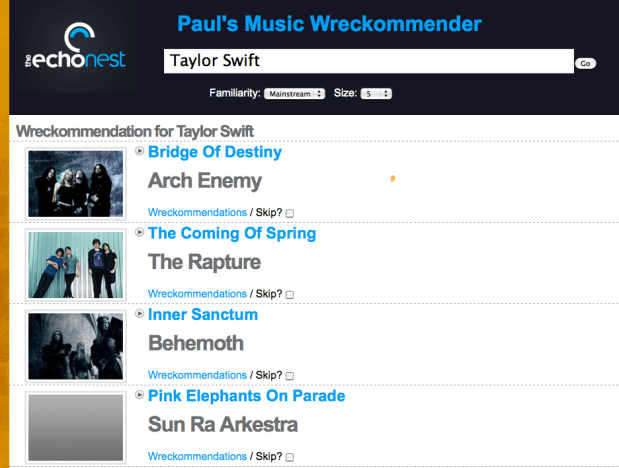
How it works:
This was a pretty easy hack. I already had a playlister engine with some neat properties. It maintains a complete artist graph using Echo Nest artist similarities, so I can make make routes through the artist space for making smooth artist/song transitions. Adapting this playlister engine to create wreckommendations was really easy. To create the recommendations, I find the seed node in the graph and then from this node I find the set of artists that have the longest ‘shortest path’ to the seed artist. These are the artists that are furthest away from the seed artists. I then select songs from this set to make my ‘wrecklist’. However, this list isn’t the best list. There are a small set of artists that are far away from everything. These artists become frequent wrecommendations for many many artists, which is bad. To avoid this problem I adapted the algorithm to find far away artist clusters and then draw artists from that cluster. This gives yields a playlist with much more variety.
This hack is primarily for fun, but I think there’s something in the wreckommendations that is worth persuing. When asked to describe their taste in music, many people will use a negative – such as “Anything but country and rap”. If this is really the case, then using the wreckommender to literally find ‘anything but country and rap’ – whether it is J-Pop or crabcore might actually be useful.
Inspiration
A couple of sources of inspiration for this hack. First, the name. A word like ‘wreckommendation’ clearly deserves an application. Second, a coffee pot conversation with Reid, and finally, the LibraryThing Unsuggester, which does a similar thing for books (but in a very different way).
I hope you like the wreckommender, let me know if you find any interesting wreckommendations.
Boston Music Hack Day
Posted by Paul in events, The Echo Nest on November 21, 2009

Boston at dawn -ready for the hack day

Breakfast at the music hack day
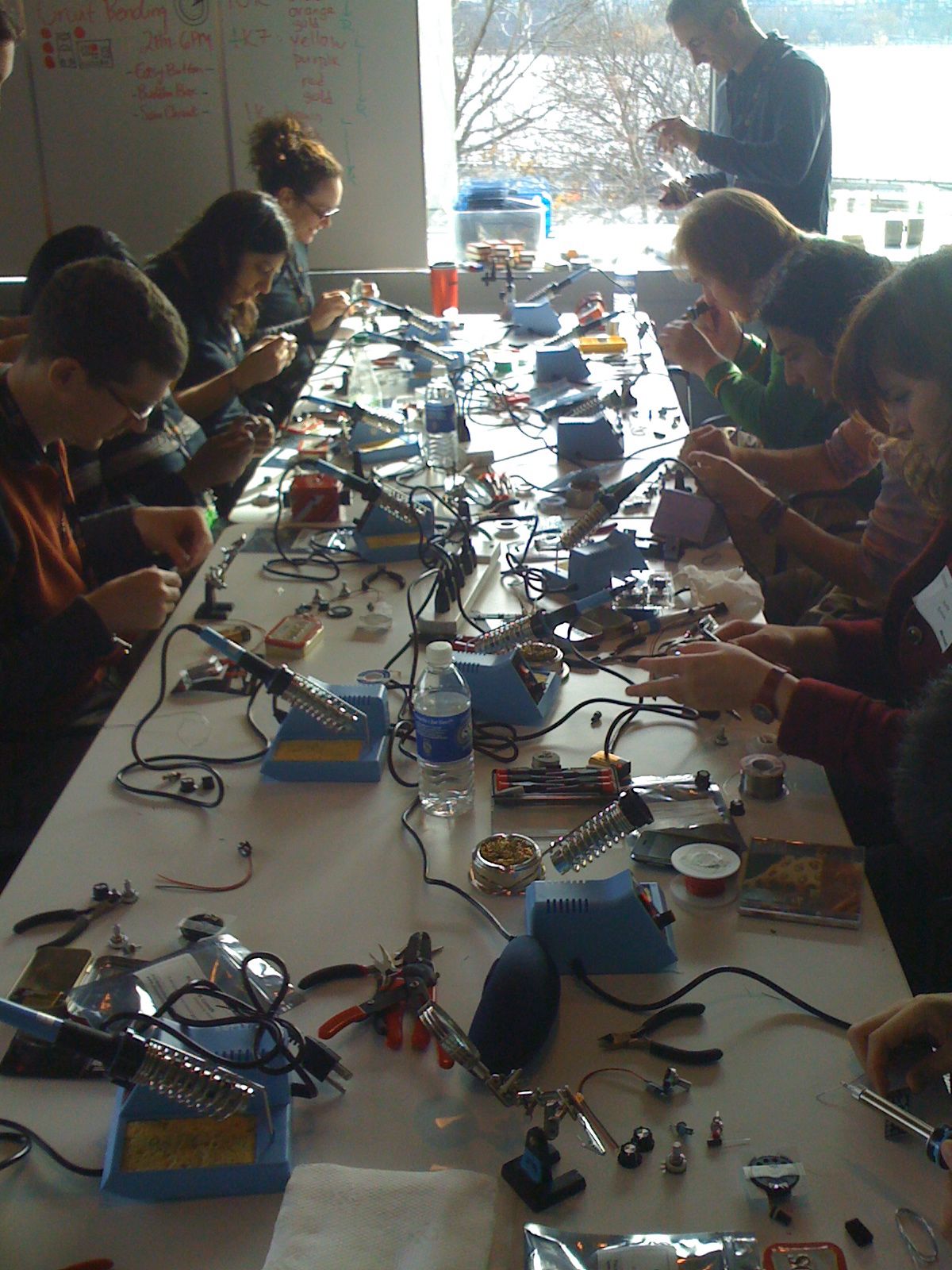
Hardware hacking at the Boston Music Hack Day
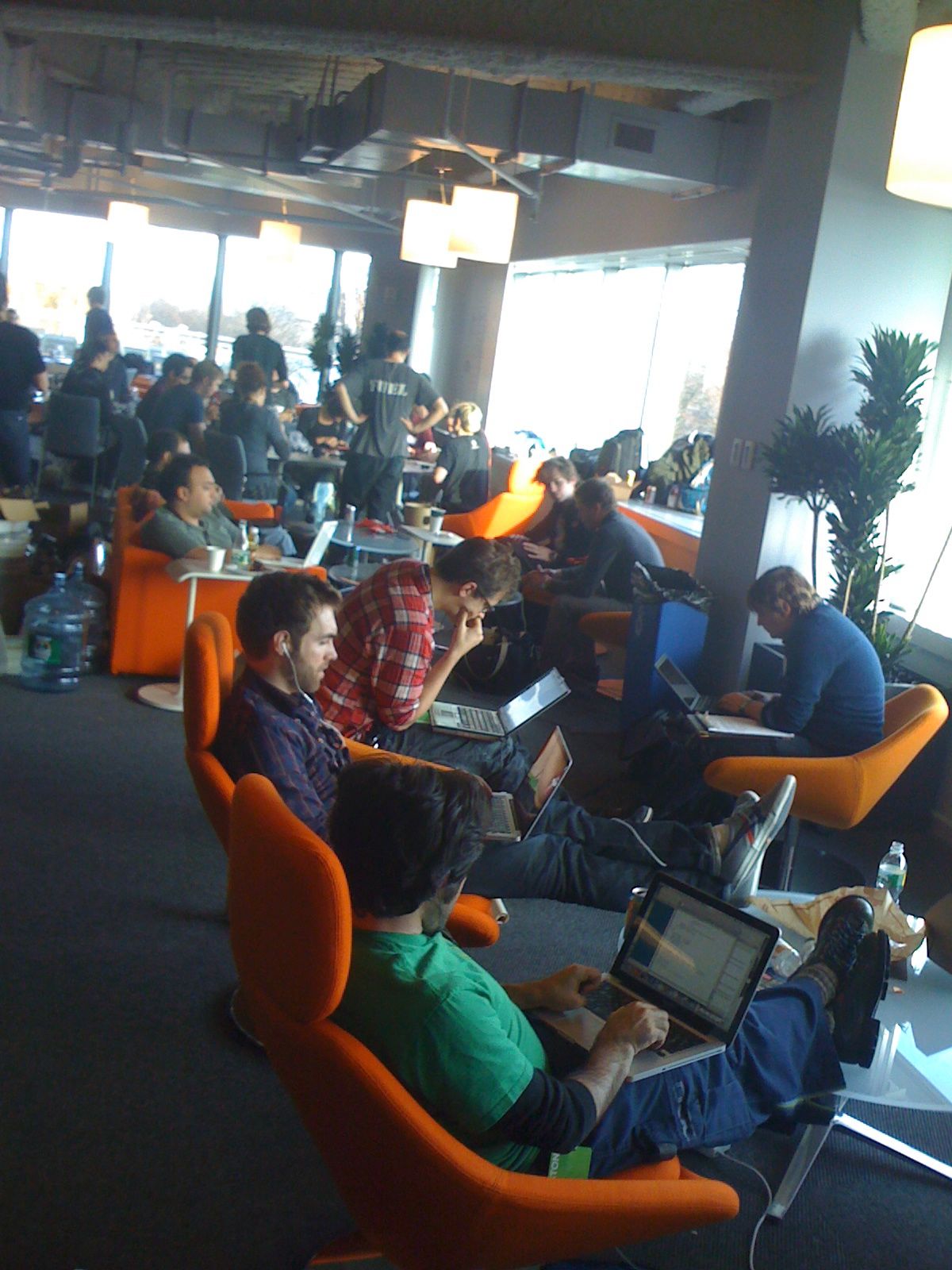
Hardcore hacking at the Boston Music Hack day

The two faces of music discovery

Turning an altoids can into a musical instrumentation
 Music Machinery