Archive for category Music
“What do I do with those 10,000,000 songs in my pocket?”
References to Mae West aside, I’m really looking forward to the Industrial Panel being held during the Workshop on Music Recommendation and Discovery. Great set of attendees:
- Amélie Anglade (Soundcloud, GE) moderator
- Eric Bieschke (Pandora, US)
- Douglas Eck (Google Music, US)
- Justin Sinkovich (Epitonic, US)
- Evan Stein (Decibel, UK)
Search for music by drawing a picture of it
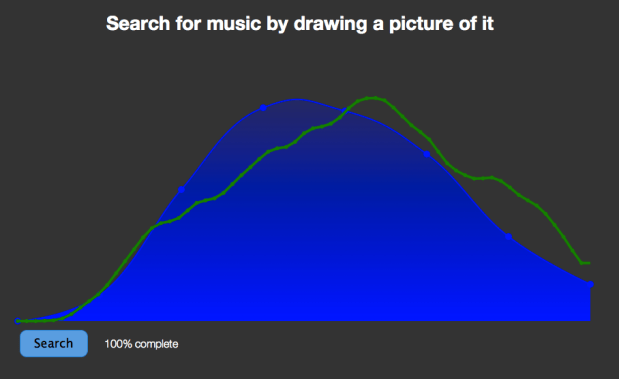
I’ve spent the weekend hacking on a project at Music Hack Day Montreal. For my hack I created an application with the catchy title “Search for music by drawing a picture of it”. The hack lets you draw the loudness profile for a song and the app will search through the Million Song Data Set to find the closest match. You can then listen to the song in Spotify (if the song is in the Spotify collection).
Coding a project in 24 hours is all about compromise. I had some ideas that I wanted to explore to make the matching better (dynamic time warping) and the lookup faster (LSH). But since I actually wanted to finish my hack I’ve saved those improvements for another day. The simple matching approach (Euclidean distance between normalized vectors) works surprisingly well. The linear search through a million loudness vectors takes about 20 seconds, too long for a web app, this can be made palatable with a little Ajax .
The hack day has been great fun, kudos to the Montreal team for putting it all together.
Looking for the Slow Build
This is the second in a series of posts exploring the Million Song Dataset.

Every few months you’ll see a query like this on Reddit – someone is looking for songs that slowly build in intensity. It’s an interesting music query since it is primarily focused on what the music sounds like. Since we’ve analyzed the audio of millions and millions of tracks here at The Echo Nest we should be able to automate this type of query. One would expect that Slow Build songs will have a steady increase in volume over the course of a song, so lets look at the loudness data for a few Slow Build songs to confirm this intuition. First, here’s the canonical slow builder: Stairway to Heaven:
 The green line is the raw loudness data, the blue line is a smoothed version of the data. Clearly we see a rise in the volume over the course of the song. Let’s look at another classic Slow Build – The Hall Of the Mountain King – again our intuition is confirmed:

Looking at a non-Slow Build song like Katy Perry’s California Gurls we see that the loudness curve is quite flat by comparison:

Of course there are other aspects beyond loudness that a musician may use to build a song to a climax – tempo, timbre and harmony are all useful, but to keep things simple I’m going to focus only on loudness.
Looking at these plots it is easy to see which songs have a Slow Build. To algorithmically identify songs that have a slow build, we can use a technique similar to the one I described in The Stairway Detector. It is a simple algorithm that compares the average loudness of the first half of the song to the average loudness of the second half of the song. Songs with the biggest increase in average loudness rank the highest. For example, take a look at a loudness plot for Stairway to Heaven. You can see that there is a distinct rise in scores from the first half to the second half of the song (the horizontal dashed lines show the average loudness for the first and second half of the song). Calculating the ramp factor we see that Stairway to Heaven scores an 11.36 meaning that there is an increase in average loudness of 11.36 decibels between the first and the second half of the song.
This algorithm has some flaws – for instance it will give very high scores to ‘hidden track’ songs. Artists will sometimes ‘hide’ a track at the end of a CD by padding the beginning of the track with a few minutes of silence. For example, this track by ‘Fudge Tunnel’ has about five minutes of silence before the band comes in.

Clearly this song isn’t a Slow Build, our simple algorithm is fooled. To fix this we need to introduce a measure of how straight the ramp is. One way to measure the straightness of a line is to calculate the Pearson correlation for the loudness data as a function of time. XY Data with correlation that approaches one (or negative one) is by definition, linear. This nifty wikipedia visualization of the correlation of different datasets shows the correlation for various datasets:
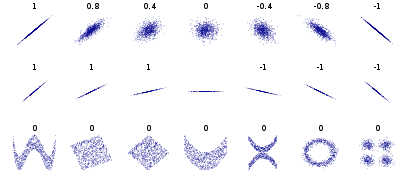 We can combine the correlation with our ramp factors to generate an overall score that takes into account the ramp of the song as well as the straightness of the ramp. The overall score serves as our Slow Build detector. Songs with a high score are Slow Build songs. I suspect that there are better algorithms for this so if you are a math-oriented reader who is cringing at my naivete please set me and my algorithm straight.
Armed with our Slow Build Detector, I built a little web app that lets you explore for Slow Build songs. The app – Looking For The Slow Build – looks like this:
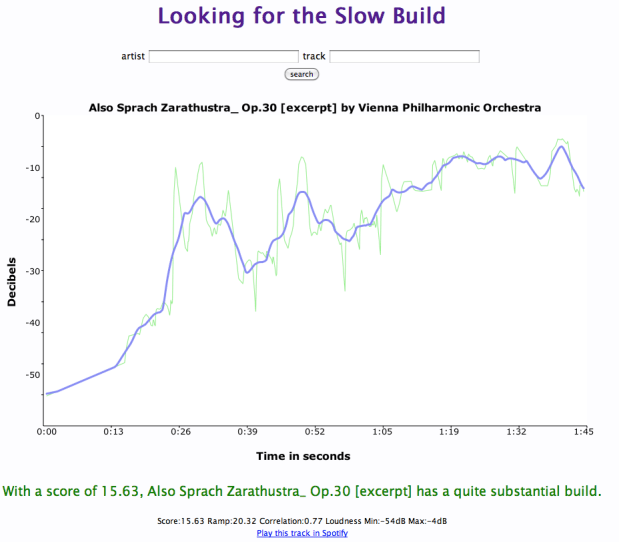
The application lets you type in the name of your favorite song and will give you a plot of the loudness over the course of the song, and calculates the overall Slow Build score along with the ramp and correlation. If you find a song with an exceptionally high Slow Build score it will be added to the gallery. I challenge you to get at least one song in the gallery.
You may find that some songs that you think should get a high Slow Build score don’t score as high as you would expect. For instance, take the song Hoppipolla by Sigur Ros. It seems to have a good build, but it scores low:

It has an early build but after a minute it has reached it’s zenith. The ending is symmetrical with the beginning with a minute of fade. This explains the low score.
Another song that builds but has a low score is Weezer’s The Angel and the One.

This song has a 4 minute power ballad build – but fails to qualify a a slow build because the last 2 minutes of the song are nearly silent.
Finding Slow Build songs in the Million Song Dataset
Now that we have an algorithm that finds Slow Build songs, lets apply it to the Million Song Dataset. I can create a simple MapReduce job in Python that will go through all of the million tracks and calculate the Slow Build score for each of them to help us find the songs with the biggest Slow Build. I’m using the same framework that I described in the post “How to Process a Million Songs in 20 minutes“. I use the S3 hosted version of the Million Song Dataset and process it via Amazon’s Elastic MapReduce using mrjob – a Python MapReduce library. Here’s the mapper that does almost all of the work, the full code is on github in cramp.py:
    def mapper(self, _, line):
        """ The mapper loads a track and yields its ramp factor """
        t = track.load_track(line)
        if t and t['duration'] > 60 and len(t['segments']) > 20:
            segments = t['segments']
            half_track = t['duration'] / 2
            first_half = 0
            second_half = 0
            first_count = 0
            second_count = 0

            xdata = []
            ydata = []
            for i in xrange(len(segments)):
                seg = segments[i]
                seg_loudness = seg['loudness_max'] * seg['duration']

                if seg['start'] + seg['duration'] <= half_track:
                    seg_loudness = seg['loudness_max'] * seg['duration']
                    first_half += seg_loudness
                    first_count += 1
                elif seg['start'] < half_track and seg['start'] + seg['duration'] > half_track:
                    # this is the nasty segment that spans the song midpoint.
                    # apportion the loudness appropriately
                    first_seg_loudness = seg['loudness_max'] * (half_track - seg['start'])
                    first_half += first_seg_loudness
                    first_count += 1

                    second_seg_loudness = seg['loudness_max'] * (seg['duration'] - (half_track - seg['start']))
                    second_half += second_seg_loudness
                    second_count += 1
                else:
                    seg_loudness = seg['loudness_max'] * seg['duration']
                    second_half += seg_loudness
                    second_count += 1

                xdata.append( seg['start'] )
                ydata.append( seg['loudness_max'] )

            correlation = pearsonr(xdata, ydata)
            ramp_factor = second_half / half_track - first_half / half_track
            if YIELD_ALL or ramp_factor > 10 and correlation > .5:
                yield (t['artist_name'], t['title'], t['track_id'], correlation), ramp_factor
This code takes less than a half hour to run on 50 small EC2 instances and finds a bucketload of Slow Build songs. I’ve created a page of plots of the top 500 or so Slow Build songs found by this job. There are all sorts of hidden gems in there. Go check it out:
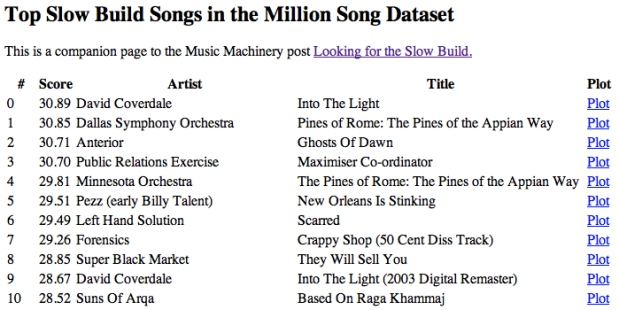
Looking for the Slow Build in the Million Song Dataset
The page has 500 plots all linked to Spotify so you can listen to any song that strikes your fancy. Here are some my favorite discoveries:
Respighi’s The Pines of the Appian Way
I remember playing this in the orchestra back in high school. It really is sublime. Click the plot to listen in Spotify.

Maria Friedman’s Play The Song Again
So very theatrical

Mandy Patinkin’s Rock-A-Bye Your Baby With A Dixie Melody
Another song that seems to be right off of Broadway – it has an awesome slow build.

- The Million Song Dataset – deep data about a million songs
- The Stairway Index – my first look at this stuff about 2 years ago
- How to process a million songs in 20 minutes – a blog post about how to process the MSD with mrjob and Elastic Map Reduce
- Looking for the Slow Build – a simple web app that calculates the Slow Build score and loudness plot for just about any song
- cramp.py – the MapReduce code for calculating Slow Build scores for the MSD
- Looking for the Slow Build in the Million Song Dataset – 500 loudness plots of the top Slow Builders
- Top Slow Build songs in the Million Song Dataset – the top 6K songs with a Slow Build score of 10 and above
- A Spotify collaborative playlist with a bunch of Slow Build songs in it. Feel free to add more.
How to process a million songs in 20 minutes
The recently released Million Song Dataset (MSD), a collaborative project between The Echo Nest and Columbia’s LabROSA is a fantastic resource for music researchers. It contains detailed acoustic and contextual data for a million songs. However, getting started with the dataset can be a bit daunting. First of all, the dataset is huge (around 300 gb) which is more than most people want to download. Second, it is such a big dataset that processing it in a traditional fashion, one track at a time, is going to take a long time. Even if you can process a track in 100 milliseconds, it is still going to take over a day to process all of the tracks in the dataset. Luckily there are some techniques such as Map/Reduce that make processing big data scalable over multiple CPUs. In this post I shall describe how we can use Amazon’s Elastic Map Reduce to easily process the million song dataset.
The Problem

From 'Creating Music by Listening' by Tristan Jehan
For this first experiment in processing the million song data set I want to do something fairly simple and yet still interesting. One easy calculation is to determine each song’s density – where the density is defined as the average number of notes or atomic sounds (called segments) per second in a song. To calculate the density we just divide the number of segments in a song by the song’s duration. The set of segments for a track is already calculated in the MSD. An onset detector is used to identify atomic units of sound such as individual notes, chords, drum sounds, etc. Each segment represents a rich and complex and usually short polyphonic sound. In the above graph the audio signal (in blue) is divided into about 18 segments (marked by the red lines). The resulting segments vary in duration. We should expect that high density songs will have lots of activity (as an Emperor once said “too many notes”), while low density songs won’t have very much going on. For this experiment I’ll calculate the density of all 1 million songs and find the most dense and the least dense songs.
MapReduce
A traditional approach to processing a set of tracks would be to iterate through each track, process the track, and report the result. This approach, although simple, will not scale very well as the number of tracks or the complexity of the per track calculation increases. Luckily, a number of scalable programming models have emerged in the last decade to make tackling this type of problem more tractable. One such approach is MapReduce.
MapReduce is a programming model developed by researchers at Google for processing and generating large data sets. With MapReduce you specify a map function that processes a key/value pair to generate a set of intermediate key/value pairs, and a reduce function that merges all intermediate values associated with the same intermediate key. There are a number of implementations of MapReduce including the popular open sourced Hadoop and Amazon’s Elastic MapReduce.
There’s a nifty MapReduce Python library developed by the folks at Yelp called mrjob. With mrjob you can write a MapReduce task in Python and run it as a standalone app while you test and debug it. When your mrjob is ready, you can then launch it on a Hadoop cluster (if you have one), or run the job on 10s or even 100s of CPUs using Amazon’s Elastic MapReduce. Writing an mrjob MapReduce task couldn’t be easier. Here’s the classic word counter example written with mrjob:
from mrjob.job import MRJob

class MRWordCounter(MRJob):
    def mapper(self, key, line):
        for word in line.split():
            yield word, 1

    def reducer(self, word, occurrences):
        yield word, sum(occurrences)

if __name__ == '__main__':
    MRWordCounter.run()
The input is presented to the mapper function, one line at a time. The mapper breaks the line into a set of words and emits a word count of 1 for each word that it finds. The reducer is called with a list of the emitted counts for each word, it sums up the counts and emits them.
When you run your job in standalone mode, it runs in a single thread, but when you run it on Hadoop or Amazon (which you can do by adding a few command-line switches), the job is spread out over all of the available CPUs.
MapReduce job to calculate density
We can calculate the density of each track with this very simple mrjob – in fact, we don’t even need a reducer step:
class MRDensity(MRJob):
    """ A  map-reduce job that calculates the density """

    def mapper(self, _, line):
        """ The mapper loads a track and yields its density """
        t = track.load_track(line)
        if t:
            if t['tempo'] > 0:
                density = len(t['segments']) / t['duration']
                yield (t['artist_name'], t['title'], t['song_id']), density
(see the full code on github)
The mapper loads a line and parses it into a track dictionary (more on this in a bit), and if we have a good track that has a tempo then we calculate the density by dividing the number of segments by the song’s duration.
Parsing the Million Song Dataset
We want to be able to process the MSD with code running on Amazon’s Elastic MapReduce. Since the easiest way to get data to Elastic MapReduce is via Amazon’s Simple Storage Service (S3), we’ve loaded the entire MSD into a single S3 bucket at http://tbmmsd.s3.amazonaws.com/. (The ‘tbm’ stands for Thierry Bertin-Mahieux, the man behind the MSD). This bucket contains around 300 files each with data on about 3,000 tracks. Each file is formatted with one track per line following the format described in the MSD field list. You can see a small subset of this data for just 20 tracks in this file on github: tiny.dat. I’ve written track.py that will parse this track data and return a dictionary containing all the data.
You are welcome to use this S3 version of the MSD for your Elastic MapReduce experiments. But note that we are making the S3 bucket containing the MSD available as an experiment. If you run your MapReduce jobs in the “US Standard Region” of Amazon, it should cost us little or no money to make this S3 data available. If you want to download the MSD, please don’t download it from the S3 bucket, instead go to one of the other sources of MSD data such as Infochimps. We’ll keep the S3 MSD data live as long as people don’t abuse it.
Running the Density MapReduce job
You can run the density MapReduce job on a local file to make sure that it works:
% python density.py tiny.dat
This creates output like this:
["Planet P Project", "Pink World", "SOIAZJW12AB01853F1"]	3.3800521773317689
["Gleave", "Come With Me", "SOKBZHG12A81C21426"]	7.0173630509232234
["Chokebore", "Popular Modern Themes", "SOGVJUR12A8C13485C"]	2.7012807851495166
["Casual", "I Didn't Mean To", "SOMZWCG12A8C13C480"]	4.4351713380683542
["Minni the Moocher", "Rosi_ das M\u00e4dchen aus dem Chat", "SODFMEL12AC4689D8C"]	3.7249476012698159
["Rated R", "Keepin It Real (Skit)", "SOMJBYD12A6D4F8557"]	4.1905674943168156
["F.L.Y. (Fast Life Yungstaz)", "Bands", "SOYKDDB12AB017EA7A"]	4.2953929132587785
Where each ‘yield’ from the mapper is represented by a single line in the output, showing the track ID info and the calculated density.
Running on Amazon’s Elastic MapReduce
When you are ready to run the job on a million songs, you can run it the on Elastic Map Reduce. First you will need to set up your AWS system. To get setup for Elastic MapReduce follow these steps:
- create an Amazon Web Services account: <http://aws.amazon.com/>
- sign up for Elastic MapReduce: <http://aws.amazon.com/elasticmapreduce/>
- Get your access and secret keys (go to <http://aws.amazon.com/account/> and click on “Security Credentials”)
- Set the environment variables $AWS_ACCESS_KEY_ID and $AWS_SECRET_ACCESS_KEY accordingly for mrjob.
Once you’ve set things up, you can run your job on Amazon using the entire MSD as input by adding a few command switches like so:
% python density.py --num-ec2-instances 100 --python-archive t.tar.gz -r emr 's3://tbmmsd/*.tsv.*' > out.dat
The ‘-r emr’ says to run the job on Elastic Map Reduce, and the ‘–num-ec2-instances 100’ says to run the job on 100 small EC2 instances. A small instance currently costs about ten cents an hour billed in one hour increments, so this job will cost about $10 to run if it finishes in less than an hour, and in fact this job takes about 20 minutes to run. If you run it on only 10 instances it will cost 1 or 2 dollars. Note that the t.tar.gz file simply contains any supporting python code needed to run the job. In this case it contains the file track.py. See the mrjob docs for all the details on running your job on EC2.
The Results
The output of this job is a million calculated densities, one for each track in the MSD. We can sort this data to find the most and least dense tracks in the dataset. Here are some high density examples:
Ichigo Ichie by Ryuji Takeuchi has a density of 9.2 segments/second

Ichigo Ichie by Ryuji Takeuchi
129 by Strojovna 07 has a density of 9.2 segments/second

129 by Strojovna 07
The Feeding Circle by Makaton with a density of 9.1 segments per segment

The Feeding Circle by Makaton
Indeed, these pass the audio test, they are indeed high density tracks. Now lets look at some of the lowest density tracks.
Deviation by Biosphere with a density of .014 segments per second

Deviation by Biosphere
The Wire IV by Alvin Lucier with a density of 0.014 segments per second

The Wire IV by Alvin Lucier
improvisiation_122904b by Richard Chartier with a density of .02 segments per second

improvisation by Richard Chartier
Wrapping up
The ‘density’ MapReduce task is about as simple a task for processing the MSD that you’ll find. Consider this the ‘hello, world’ of the MSD. Over the next few weeks, I’ll be creating some more complex and hopefully interesting tasks that show some of the really interesting knowledge about music that can be gleaned from the MSD.
(Thanks to Thierry Bertin-Mahieux for his work in creating the MSD and setting up the S3 buckets. Thanks to 7Digital for providing the audio samples)
How do you discover music?
Posted by Paul in Music, recommendation, research on August 18, 2011
I’m interested in learning more about how people are discovering new music. I hope that you will spend 2 mins and take this 3 question poll. I’ll publish the results in a few weeks.
Searching for chilled metal
It seems like every heavy metal band has at least one chill-out song – from Metallica’s Nothing Else Matters to Led Zeppelin’s That’s the Way. These tracks give some relief from the otherwise relentless pounding of the hammer of the gods. It’d be nice to be able to collect up a bunch of these chilled-metal songs into a playlist – perfect for when your mom’s visiting (she tells me that she doesn’t like pounding metal).

ChilLed Zeppelin - Some rights (by-nc-sa) reserved by Heinrich Klaffs
To find chilled metal, we can use The Echo Nest API. The Echo Nest has calculated a wide range of acoustic and musical attributes for millions of songs. One such attribute is energy . We can make a simple song/search query for heavy metal songs that have low energy. These will be our chilled-metal songs that your mom enjoys so much. Here’s the API query:
http://developer.echonest.com/api/v4/song/search?&style=heavy+metal&sort=energy-asc
This query searches for songs by heavy metal artists, and sorts the results in order of ascending energy (so the lowest energy tracks will be returned first). The query does a really good job of finding chilled metal. Here’s a sampling of the results:

Sphinx (The Guardian) by Black Sabbath
[audio http://previews.7digital.com/clips/34/645345.clip.mp3]
Sphinx (The Guardian) by Black Sabbath – energy: 0.0003

Demon Driver reprise by Gillan
[audio http://previews.7digital.com/clips/34/4179195.clip.mp3]
Demon Drive by Gillan – energy: 0.010

The Return by Saxon
[audio http://previews.7digital.com/clips/34/5318312.clip.mp3]
The Return by Saxon – energy: 0.013

Solitude by Judas Priest
[audio http://previews.7digital.com/clips/34/3544312.clip.mp3]
Solitude by Judas Priest – energy: 0.049

Joan of Arc by UFO
[audio http://previews.7digital.com/clips/34/7952114.clip.mp3]
Joan of Arc by UFO – Energy: 0.05

Fear by Black Label Society
[audio http://previews.7digital.com/clips/34/5768332.clip.mp3]
Fear by Black Label Society – Energy – 0.119
You can also use the Echo Nest Playlist API to generate a chilled metal playlist. Here’s a call to create a playlist of chilled metal in XSPF format.
You can toss this playlist into a player like VLC or Songbird that supports XSPF and start listening to chilled metal right away (30 second samples only) like this:
% curl 'http://developer.echonest.com/api/v4/playlist/static?api_key=N6E4NIOVYMTHNDM8J\
   &style=heavy+metal&max_energy=.1\
   &type=artist-description&bucket=id:7digital&bucket=tracks&limit=true\
   &format=xspf' > chilled-metal.xspf
% open chilled-metal.xspf
There you go, you now have all the tools you need to keep your chilled metal queue filled and fresh, almost everything you need to keep your mom happy.
Thanks much to 7Digital for providing audio clips and album art.
Loudest songs in the world
Posted by Paul in fun, Music, The Echo Nest on August 17, 2011
Lots of ink has been spilled about the Loudness war and how modern recordings keep getting louder as a cheap method of grabbing a listener’s attention. We know that, in general, music is getting louder. But what are the loudest songs? We can use The Echo Nest API to answer this question. Since the Echo Nest has analyzed millions and millions of songs, we can make a simple API query that will return the set of loudest songs known to man. (For the hardcore geeks, here’s the API query that I used). Note that I’ve restricted the results to those in the 7Digital-US catalog in order to guarantee that I’ll have a 30 second preview for each song.
So without further adieu, here are the loudest songs

Topping and Core by Grimalkin555
The song Topping and Core by Grmalking555 has a whopping loudness of 4.428 dB.

Modifications by Micron
The song Modifications by Micron has a loudness of 4.318 dB.

Hey You Fuxxx! by Kylie Minoise
The song Hey You Fuxxx! by Kylie Minoise with a loudness of 4.231 dB
Here’s a little taste of Kylie Minoise live (you may want to turn down your volume)

War Memorial Exit by Noma
The song War Memorial Exit by Noma with a loudness of 4.166 dB

Hello Dirty 10 by Massimo
The song Hello Dirty 10 by Massimo with a loudness of 4.121 dB.
These songs are pretty niche. So I thought it might be interesting to look the loudest songs culled from the most popular songs. Here’s the query to do that. The loudest popular song is:

Welcome to the Jungle by Guns 'N Roses
The loudest popular song is Welcome to the Jungle by Guns ‘N Roses with a loudness of -1.931 dB.
You may be wondering how a loudness value can be greater than 0dB. Loudness is a complex measurement that is both a function of time and frequency. Unlike traditional loudness measures, The Echo Nest analysis models loudness via a human model of listening, instead of directly mapping loudness from the recorded signal. For instance, with a traditional dB model a simple sinusoidal function would be measured as having the same exact “amplitude” (in dB) whether at 3KHz or 12KHz. But with The Echo Nest model, the loudness is lower at 12KHz than it is at 3KHz because you actually perceive those signals differently.
Thanks to the always awesome 7Digital for providing album art and 30 second previews in this post.
25 SXSW Music Panels worth voting for
Posted by Paul in events, Music, The Echo Nest on August 16, 2011
Yesterday, SXSW opened up the 2012 Panel Picker allowing you to vote up (or down) your favorite panels. The SXSW organizers will use the voting info to help whittle the nearly 3,600 proposals down to 500. I took a tour through the list of music related panel proposals and selected a few that I think are worth voting for. Talks in green are on my “can’t miss this talk” list. Note that I work with or have collaborated with many of the speakers on my list, so my list can not be construed as objective in any way.
There are many recurring themes. Turnatable.fm is everywhere. Everyone wants to talk about the role of the curator in this new world of algorithmic music recommendations. And Spotify is not to be found anywhere!
I’ve broken my list down into a few categories:
Social Music – there must be a twenty panels related to social music. (Eleven(!) have something to do with Turntable.fm) My favorites are:
- Social Music Strategies: Viral & the Power of Free – with folks from MOG, Turntable, Sirius XM, Facebook and Fred Wilson. I’m not a big fan of big panels (by the time you get done with the introductions, it is time for Q&A), but this panel seems stacked with people with an interesting perspective on the social music scene. I’m particularly interested in hearing the different perspectives from Turntable vs. Sirius XM.
- Can Social Music Save the Music Industry? – Rdio, Turntable, Gartner, Rootmusic, Songkick – Another good lineup of speakers (Turntable.fm is everywhere at SXSW this year) exploring social music. Curiously, there’s no Spotify here (or as far as I can tell on any talks at SXSW).
- Turntable.fm the Future of Music is Social – Turntable.fm – This is the turntable.fm story.
- Reinventing Tribal Music in the land of Earbuds – AT&T – this talk explores how music consumption changes with new social services and the technical/sociological issues that arise when people are once again free to choose and listen to music together.
Man vs. Machine – what is the role of the human curator in this age of algorithmic recommendation and music. Curiously, there are at least 5 panel proposals on this topic.
- Music Discovery:Man Vs. Machine – MOG, KCRW, Turntable.fm, Heather Browne
- Music/Radio Content: Tastemakers vs. Automation – Slacker
- Editor vs. Algorithm in the Music Discovery Space – SPIN, Hype Machine, Echo Nest, 7Digital
- Curation in the age of mechanical recommendations – Matt Ogle / Echo Nest – This is my pick for the Man vs. Machine talk. Matt is *the* man when it comes to understanding what is going on in the world of music listening experience.
- Crowding out the Experts – Social Taste Formation – Last.fm, Via, Rolling Stone – Is social media reducing the importance of reviewers and traditional cultural gatekeepers? Are Yelp, Twitter, Last.fm and other platforms creating a new class of tastemakers?
Music Discovery – A half dozen panels on music recommendation and discovery. Favs include:
- YouKnowYouWantIt: Recommendation Engines that Rock – Netflix, Pandora, Match.com – this panel is filled with recommendation rock stars
- The Dark Art of Digital Music Recommendations – Rovi – Michael Papish of Rovi promises to dive under the hood of music recommendation.
- No Points for Style: Genre vs. Music Networks – SceneMachine – Any talk proposal with statements like “Genre uses a 19th-century tool — a Darwinian tree — to solve a 21st-century problem. And unlike evolutionary science, it’s subjective. By the time a genre branch has been labeled (viz. “grunge”), the scene it describes is as dead as Australopithecus.” is worth checking out.
Mobile Music – Is that a million songs in your pocket or are you just glad to see me?
- Music Everywhere: Are we there yet? – Soundcloud, Songkick, Jawbone – Have we arrived at the proverbial celestial jukebox? What are the challenges?
Big Data – exploring big data sets to learn about music
- Data Mining Music – Paul Lamere – Shameless self promotion. What can we learn if we have really deep data about millions of songs?
- The Wisdom of Thieves: Meaning in P2P Behavior – Ben Fields – Don’t miss Ben’s talk about what we can learn about music (and other media) from mining P2P behavior. This talk is on my must see list.
- Big data for Everyman: Help liberate the data serf – Splunk – webifying and exploiting big data
Echo Nesty panels – proposals from folks from the nest. Of course, I recommend all of these fine talks.
- Active Listening – Tristan Jehan – Tristan takes a look at how the music experience is changing now that the listener can take much more active control of the listening experience. There’s no one who understands music analysis and understanding better than Tristan.
- Data Mining Music – Paul Lamere – This is my awesome talk about extracting info from big data sets like the Million Song Dataset. If you are a regular reader of this blog, you’ll know that I’ll be looking at things like click track detectors, passion indexes, loudness wars and son on.
- What’s a music fan worth? – Jim Lucchese – Echo Nest CEO takes a look at the economics of music, from iOS apps to musicians. Jim knows this stuff better than anyone.
- Music Apps Gone Wild – Eliot Van Buskirk – Eliot takes a tour of the most advanced, wackiest music apps that exist — or are on their way to existing.
- Curation in the age of mechanical recommendations – Matt Ogle – Matt is a phenomenal speaker and thinker in the music space. His take on the role of the curator in this world of algorithms is at the top of my SXSW panel list.
- Editor vs. Algorithm in the Music Discovery Space – SPIN, Hype Machine, Echo Nest (Jim Lucchese), 7Digital
- Defining Music Discovery through Listening – Echo Nest (Tristan Jehan), Hunted Media – This session will examine “true” music discovery through listening and how technology is the facilitator.
Miscellaneous topics
- Designing Future Music Experiences – Rdio, Turntable, Mary Fagot – A look at the user experience for next generation music apps.
- Music at the App Store: Lessons from Eno and Björk – Are albums as apps gimmicks or do they provide real value?
- Participatory Culture: The Discourse of Pitchfork – An analysis of ten years of music writing to extract themes.
Data Mining Music – a SXSW 2012 Panel Proposal
Posted by Paul in data, events, Music, music information retrieval, The Echo Nest on August 15, 2011

I’ve submitted a proposal for a SXSW 2012 panel called Data Mining Music. The PanelPicker page for the talk is here: Data Mining Music. If you feel so inclined feel free to comment and/or vote for the talk. I promise to fill the talk with all sorts of fun info that you can extract from datasets like the Million Song Dataset.
Here’s the abstract:
Data mining is the process of extracting patterns and knowledge from large data sets. It has already helped revolutionized fields as diverse as advertising and medicine. In this talk we dive into mega-scale music data such as the Million Song Dataset (a recently released, freely-available collection of detailed audio features and metadata for a million contemporary popular music tracks) to help us get a better understanding of the music and the artists that perform the music.
We explore how we can use music data mining for tasks such as automatic genre detection, song similarity for music recommendation, and data visualization for music exploration and discovery. We use these techniques to try to answers questions about music such as: Which drummers use click tracks to help set the tempo? or Is music really faster and louder than it used to be? Finally, we look at techniques and challenges in processing these extremely large datasets.
Questions answered:
- What large music datasets are available for data mining?
- What insights about music can we gain from mining acoustic music data?
- What can we learn from mining music listener behavior data?
- Who is a better drummer: Buddy Rich or Neil Peart?
- What are some of the challenges in processing these extremely large datasets?
Flickr photo CC by tristanf
Amazon strikes back
Last month we saw how Amazon had to change its Kindle iOS app to comply with Apple’s TOS. Amazon eliminated the ‘Kindle Store’ button making it harder for Kindle readers to purchase books. Today, Amazon has fought back by releasing the Amazon Kindle Cloud Reader – A pure HTML5 web application for reading books. The cloud reader lets you do anything that the native Kindle app does, including offline reading. And, since HTML5 apps are not subject to Apple’s TOS, the Kindle Cloud Reader brings back integration with the Kinde Store.
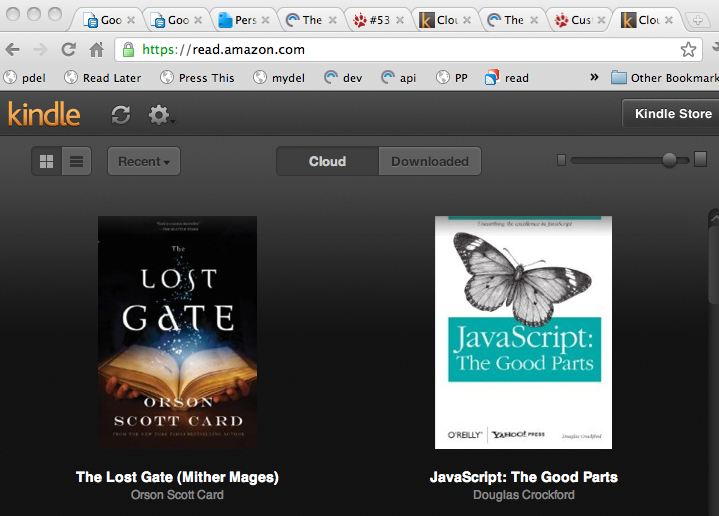
This may ultimately become the most viable route for music subscription services as well. Instead of creating native iOS apps, music services may look to create rich web apps instead. HTML5 is certainly capable enough, and soon audio support and local caching will be mature enough to support even the most sophisticated music listening app. MOG has already converted their main application to HTML5. I suspect more will follow suit. As HTML5 improves, we may see an exodus away from iOS. The more you tighten your grip, Apple, the more applications will slip through your fingers.
 Music Machinery