Archive for 2009
The Tagatune Dataset
Edith L.M. Law has just released the long-awaited Tagatune Dataset.
From the README:
The Tagatune dataset consist of 31383 music clips that are 29 seconds long, created from songs downloadable from Magnatune.com. The genres include classical, new age, electronica, rock, pop, world, jazz, blues, metal, punk etc. The dataset is optimized for training machine learning algorithms — i.e. it includes tags that are associated with more than fifty songs, and each song is associated with a tag only if that tag has been generated by more than two players independently.
The data is collected from a two-player online game called Tagatune, deployed on the GWAP.com game portal. In this game, two players are given either the same song or different songs, and are asked to enter descriptions appropriate for their given song. After reviewing each other’s descriptions, the players then guess whether they are given the same song or not.
This is great data, useful for all sorts of things, especially research around autotagging and query-by-description. It is quite complimentary to a dataset that we are about to release from the Echo Nest (stay tuned for that).
On the ferry
Posted by Paul in Uncategorized on March 14, 2009
I’m on the ferry between Vermont and upstate NY blogging with my iphone on my way to picking up my son from school for his spring break. I was able to use the 4 hour drive here to practice my sxsw talk: “help! My iPod thinks I’m emo”.
Here’s a shot out the window. There’s still ice on the lake. I suspect there will be less ice in Austin TX.

128kbs or 320 kbs …
… only your mp3 encoder knows for sure.
Take the test at mp3ornot.com to see if you can tell the difference between an MP3 encoded at 128KBS and one encoded at 320kbs. I couldn’t tell the difference (but I was listening via my laptop speakers). I hope the author will post statistics on how many people could tell.
A little more music in Davis square today
I like to think of The Echo Nest as the musical center of Davis Square in Somerville. However, today I think the musical center of mass is shifting slightly north and west (by about 100 yards) – to accommodate the arrival of U2.
Here’s the map. Point C is the Echo Nest, and Point A is the Somerville theater where the U2 concert will be held.

Here’s a photo from about 10:30 AM this morning … the satellite trucks are already in place:


The ultimate Spotify blog
 If you use Spotify, you should check out The Pansentient League, where blogger Jer White blogs about all things spotify. For instance, Jer recently compared 10 different Spotify playlist sites listing their pluses and minuses. He’s also maintaing a complete list of Spotify Resources. Pansentient is a pretty handy site.
More on click tracks …
Posted by Paul in fun, Music, The Echo Nest on March 9, 2009
I’ve just been astounded by the number of and quality of the comments that I’ve received on my recent ‘searching for click track’ posts. I’ve learned a lot about modern music production, drumming, the power of Waxy, Slashdot, Reddit, Stumbleupon, Metafilter and BoingBoing and a bit more about python. I was surprised and heartened by the fact that even those who thought I was wrong, or thought that my analysis was off beat (snicker), offered their criticism in a very civil fashion – is this really the Internet?
Many have suggested other drummers to analyze and I’ve taken a quick look at some but I haven’t had time to do anything (I’ve got this SXSW talk to prepare, plus my regular job to do as well, sigh). Luckily enough, some others have already started to do some analyses. I shall try to post the analysis that people add to the comments or send to me here, so we can build a nice directory of click plots for various drummers.
Rush – The Enemy Within
Plot by Arren Lex
It looks to me like Neil Pert is using a click track on this song.
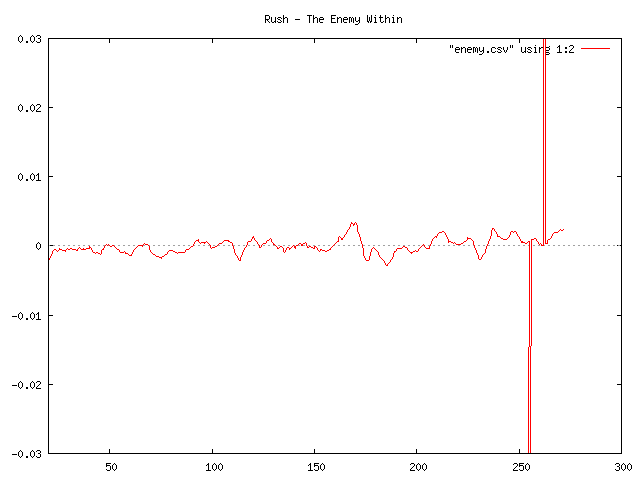
Rush - The Enemy within
Elton John – A word in spanish
Plot by Arren Lex
Looks like a click track

Elton John - A Word In Spanish
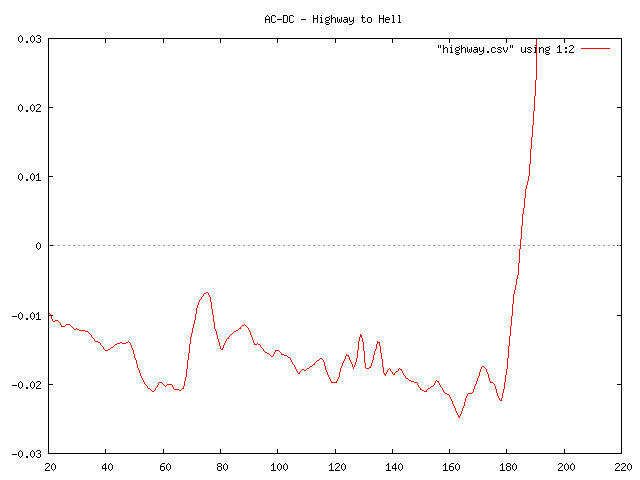
AC / DC – Highway to hell
Plot by Arren Lex
Looks like no click track for Phil Rudd.
Roundtrip tagging
Posted by Paul in Music, recommendation on March 5, 2009
Over the last 5 years, Last.fm has built an incredible database of social tags around music. They have collected millions of short text descriptions of artists, albums and tracks. These tags are a great way to explore for new music, and Last.fm exploits these tags on their site to great effect. But what if you want to use the tags to help you play music from your own collection? Until now you were out of luck – you had to resort to the iTunes style of exploring your personal music collection – resulting in lots of playlists from artists in proper alphabetical order but with no musical cohesiveness. Now, Last.fm has just released a prototype, called Boffin that allows you to use the great body of last.fm social tags to play music in your own collection. The program is called Boffin – I took it for a quick spin and I really like it.
When you run Boffin for the first time, it enrolls your music collection. For me, with about 10K tracks, this took less than 5 minutes. During this time, Boffin is ‘phoning home’ to last.fm to get the tags that have been applied to your artists and tracks. I call this Round Trip Tagging – we give some tags to last.fm when we tag music, and they give lots of tags back to us to let us label our own collection. Once enrolled, Boffin gives you a tag cloud interface to your music collection. Select a few tags, hit the play button and you are listening to your own music. Here’s what my Boffin tag cloud looks like:
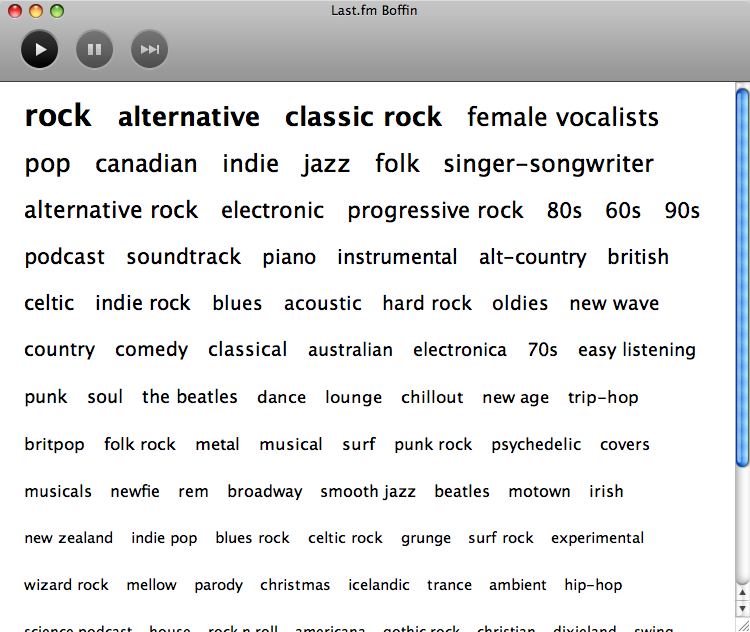
Of course, the listening experience is going to be good, because I’m listening to my own music and, presumably, I like that music already.
For a prototype application, Boffin is really well polished (at least the mac version is). While enrolling my music collection, Boffin shows images of all the artists in my collection that it is finding. I was rather amazed at how fast they were able to enroll my collection (I guess Boffin isn’t subject to the rate limits that users of the Last.fm developer API are subjected to). I did find a few times that I thought Boffin had hung up, because I couldn’t select tags anymore, but it turns out that Boffin disables tag selection when it is actually playing music. Once I hit the stop button, I could select tags with no worries. Boffin will even make it easy to generate the popular wordle tag cloud of my personal collection:

Good job to the folks at Last.fm, Boffin is pretty neat!
the sound of a million passwords changing
A bad day for my friends at Spotify. First the news of a security breach that compromised the personal information of their one million users – followed by the outage of the Spotify.com website as a million people all tried to change their passwords at once. But despite all of this trouble, the Spotify player kept playing music.
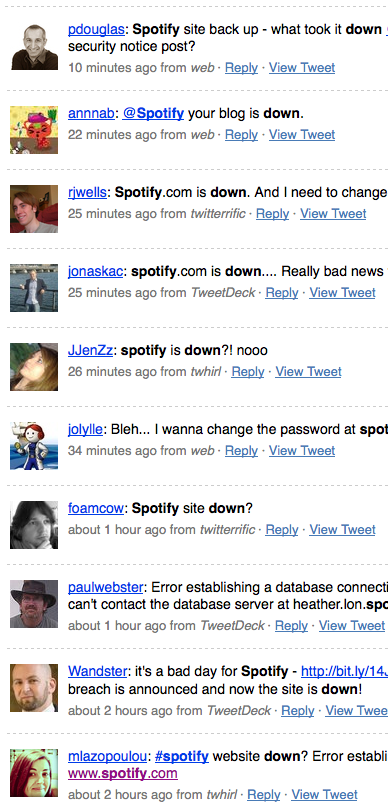
It is interesting to see how Spotify is handling their first big crises. So far, they seem to be doing most things right – they are being open about what the problem was and they have already fixed the problem that has caused the breach. Looks like they may need to be a bigger web server though.
In search of the click track
Posted by Paul in code, fun, Music, The Echo Nest on March 2, 2009
Sometime in the last 10 or 20 years, rock drumming has changed. Many drummers will now don headphones in the studio (and sometimes even for live performances) and synchronize their playing to an electronic metronome – the click track. This allows for easier digital editing of the recording. Since all of the measures are of equal duration, it is easy to move measures or phrases around without worry that the timing may be off. The click track has a down side – some say that songs recorded against a click track sound sterile, that the missing tempo deviations added life to a song.
I’ve always been curious about which drummers use a click track and which don’t, so I thought it might be fun to try to build a click track detector using the Echo Nest remix SDK ( remix is a Python library that allows you to analyze and manipulate music). In my first attempt, I used remix to analyze a track and then I just printed out the duration of each beat in a song and used gnuplot to plot the data. The results weren’t so good – the plot was rather noisy. It turns out there’s quite a bit of variation from beat to beat. In my second attempt I averaged the beat durations over a short window, and the resulting plot was quite good.
Now to see if we can use the plots as a click track detector. I started with a track where I knew the drummer didn’t use a click track. I’m pretty sure that Ringo never used one – so I started with the old Beatle’s track – Dizzy Miss Lizzie. Here’s the resulting plot:
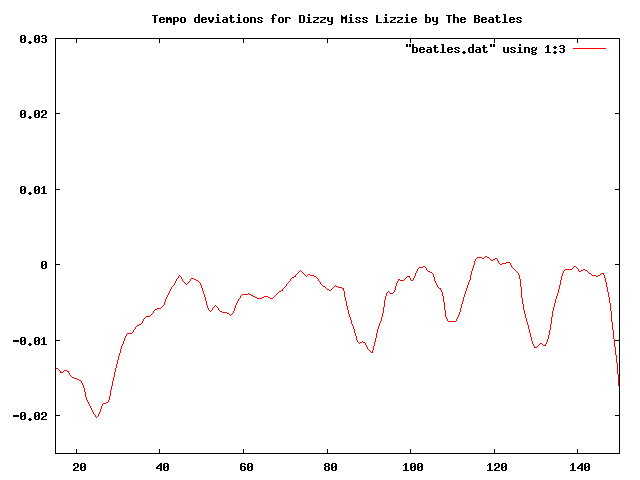 This plot shows the beat duration variation (in seconds) from the average beat duration over the course of about two minutes of the song (I trimmed off the first 10 seconds, since many songs take a few seconds to get going). In this plot you can clearly see the beat duration vary over time. The 3 dips at about 90, 110 and 130 correspond to the end of a 12 bar verse, where Ringo would slightly speed up.
Now lets compare this to a computer generated drum track. I created a track in GarageBand with a looping drum and ran the same analysis. Here’s the resulting plot:
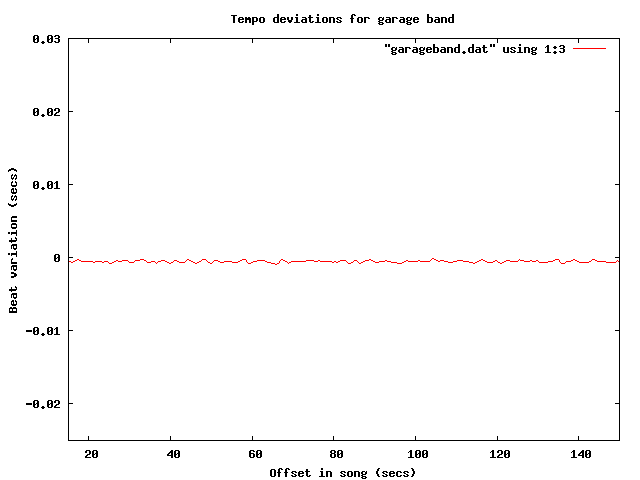
Tempo deviations for a computer generated track
The difference is quite obvious, and stark. The computer gives a nice steady, sterile beat, compared to Ringo’s.
Now let’s try some real music that we suspect is recorded to a click track. It seems that most pop music nowadays is overproduced, so my suspicion is that an artist like Britney Spears will record against a click track. I ran the analysis on “Hit me baby one more time” (believe it or not, the song was not in my collection, so I had to go and find it on the internet, did you know that it is pretty easy to find music on the internet?). Here’s the plot:
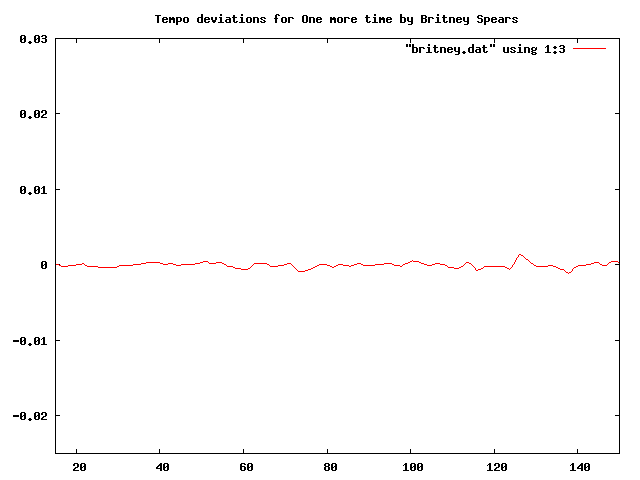
Britney is as flat as a computer
I think it is pretty clear from the plot that “Hit me baby one more time” was recorded with a click track. And it is pretty clear that these plots make a pretty good click track detector. Flat lines correspond to tracks with little variation in beat duration. So lets explore some artists to see if they use click tracks.
First up: Weezer:

Troublemaker by weezer
Nope, no click track for Weezer. This was a bit of a surprise for me.
How about Green Day?
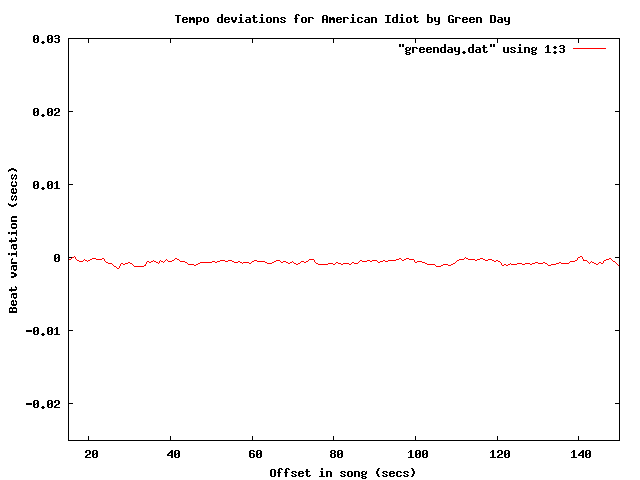
Yep – clearly a click track there. How about Metallica?

No click track for Lars! Nickeback?
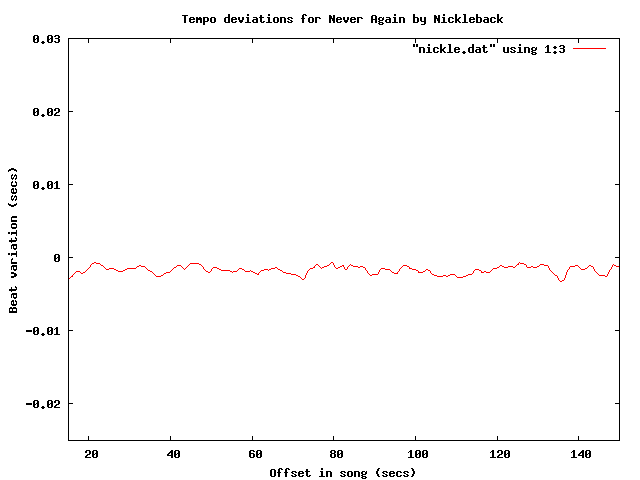 update: fixed nickleback plot labels (thanks tedder)
No surprise there – Nickleback uses a click track. Another numetal band (one that I rather like alot) is Breaking Benjamin:
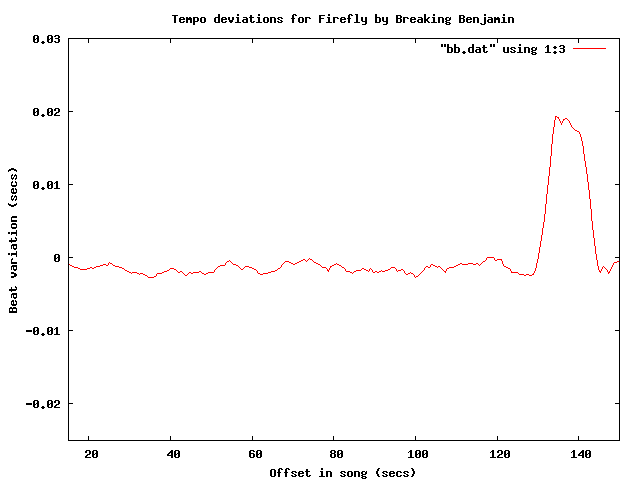 It is clear that they use a click track too – but what is interesting here is that you can see the bridge – the hump that starts at about 130 seconds into the song.
Of course John Bonham never used a click track – but lets check for fun:

So there you have it, using the Echo Nest remix SDK, gnuplot and some human analysis of the generated plots it is pretty easy to see which tracks are recorded against a click track. To make it really clear, I’ve overlayed a few of the plots:

One final plot … the venerable stairway to heaven is noted for its gradual increase in intensity – part of that is from the volume and part comes from in increase in tempo. Jimmy Page stated that the song “speeds up like an adrenaline flow”. Let’s see if we can see this:

The steady downward slope shows shorter beat durations over the course of the song (meaning a faster song). That’s something you just can’t do with a click track. Update – as a number of commenters have pointed out, yes you can do this with a click track.
The code to generate the data for the plots is very simple:
def main(inputFile):
    audiofile = audio.LocalAudioFile(inputFile)
    beats = audiofile.analysis.beats
    avgList = []
    time = 0;
    output = []
    sum = 0
    for beat in beats:
        time += beat.duration
        avg = runningAverage(avgList, beat.duration)
        sum += avg
        output.append((time, avg))
    base = sum / len(output)
    for d in output:
        print d[0], d[1] - base

def runningAverage(list, dur):
   max = 16
   list.append(dur)
   if len(list) > max:
        list.pop(0)
   return sum(list) / len(list)
I’m still a poor python programmer, so no doubt there are better Pythonic ways to do things – so let me know how to improve my Python code.
If any readers are particularly curious about whether an artist uses a click track let me know and I’ll generate the plots – or better yet, just get your own API key and run the code for yourself.
Update: If you live in the NYC area, and want to see/hear some more about remix, you might want to attend dorkbot-nyc tomorrow (Wednesday, March 4) where Brian will be talking about and demoing remix.
Update – Sten wondered (in the comments) how his band Hungry Fathers would plot given that their drummer uses a click track. Here’s an analysis of their crowd pleaser “A day without orange juice” that seems to indicate that they do indeed use a click track:
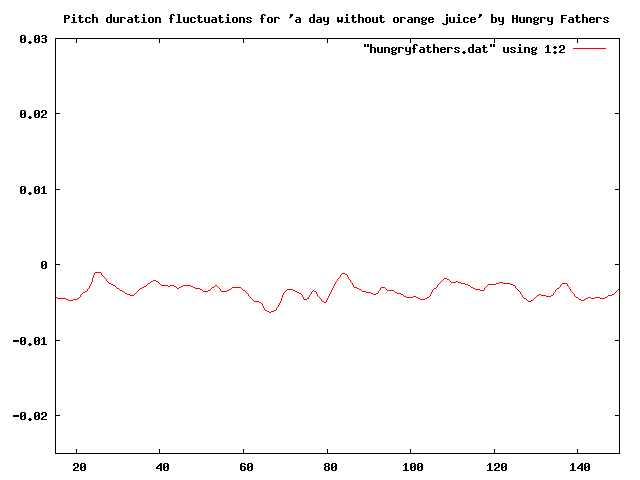
Update: More reader contributed click plots are here: More on click tracks ….
Update 2: I’ve written an application that lets you generate your own interactive click plots: The Echo Nest BPM Explorer
 Music Machinery