Archive for 2009
ISMIR Oral Session 5 – Tags
Oral Session 5 – Tags
Session Chair: Paul Lamere
I’m the session chair for this session, so I can’t keep notes. So instead I offer the abstracts.
TAG INTEGRATED MULTI-LABEL MUSIC STYLE CLASSIFICATION WITH HYPERGRAPH
Fei Wang, Xin Wang, Bo Shao, Tao Li Mitsunori Ogihara
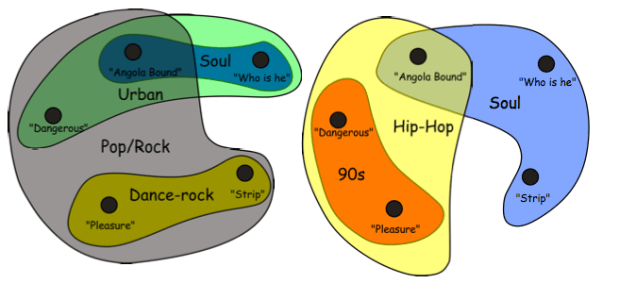
Abstract: Automatic music style classification is an important, but challenging problem in music information retrieval. It has a number of applications, such as indexing of and search- ing in musical databases. Traditional music style classifi- cation approaches usually assume that each piece of music has a unique style and they make use of the music con- tents to construct a classifier for classifying each piece into its unique style. However, in reality, a piece may match more than one, even several different styles. Also, in this modern Web 2.0 era, it is easy to get a hold of additional, indirect information (e.g., music tags) about music. This paper proposes a multi-label music style classification ap- proach, called Hypergraph integrated Support Vector Ma- chine (HiSVM), which can integrate both music contents and music tags for automatic music style classification. Experimental results based on a real world data set are pre- sented to demonstrate the effectiveness of the method.
EASY AS CBA: A SIMPLE PROBABILISTIC MODEL FOR TAGGING MUSIC
Matthew D. Hoffman, David M. Blei, Perry R. Cook
ABSTRACT Many songs in large music databases are not labeled with semantic tags that could help users sort out the songs they want to listen to from those they do not. If the words that apply to a song can be predicted from audio, then those predictions can be used both to automatically annotate a song with tags, allowing users to get a sense of what qualities characterize a song at a glance. Automatic tag prediction can also drive retrieval by allowing users to search for the songs most strongly characterized by a particular word. We present a probabilistic model that learns to predict the probability that a word applies to a song from audio. Our model is simple to implement, fast to train, predicts tags for new songs quickly, and achieves state-of-the-art performance on annotation and retrieval tasks.

USING ARTIST SIMILARITY TO PROPAGATE SEMANTIC INFORMATION
Joon Hee Kim, Brian Tomasik, Douglas Turnbull
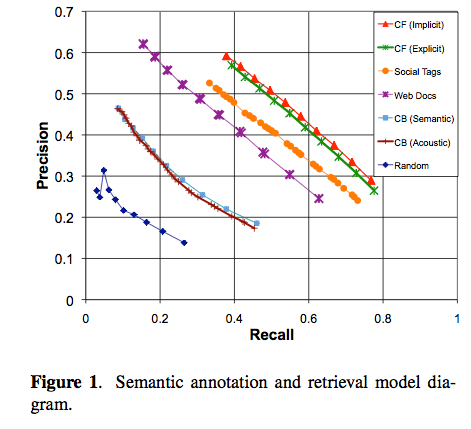
ABSTRACT Tags are useful text-based labels that encode semantic information about music (instrumentation, genres, emotions, geographic origins). While there are a number of ways to collect and generate tags, there is generally a data sparsity problem in which very few songs and artists have been accurately annotated with a sufficiently large set of relevant tags. We explore the idea of tag propagation to help alleviate the data sparsity problem. Tag propagation, originally proposed by Sordo et al., involves annotating a novel artist with tags that have been frequently associated with other similar artists. In this paper, we explore four approaches for computing artists similarity based on dif- ferent sources of music information (user preference data, social tags, web documents, and audio content). We com- pare these approaches in terms of their ability to accurately propagate three different types of tags (genres, acoustic de- scriptors, social tags). We find that the approach based on collaborative filtering performs best. This is somewhat surprising considering that it is the only approach that is not explicitly based on notions of semantic similarity. We also find that tag propagation based on content-based mu- sic analysis results in relatively poor performance.
 MUSIC MOOD REPRESENTATIONS FROM SOCIAL TAGS
Cyril Laurier, Mohamed Sordo, Joan Serra, Perfecto Herrera
ABSTRACT This paper presents findings about mood representations. We aim to analyze how do people tag music by mood, to create representations based on this data and to study the agreement between experts and a large community. For this purpose, we create a semantic mood space from last.fm tags using Latent Semantic Analysis. With an unsuper- vised clustering approach, we derive from this space an ideal categorical representation. We compare our commu- nity based semantic space with expert representations from Hevner and the clusters from the MIREX Audio Mood Classification task. Using dimensional reduction with a Self-Organizing Map, we obtain a 2D representation that we compare with the dimensional model from Russell. We present as well a tree diagram of the mood tags obtained with a hierarchical clustering approach. All these results show a consistency between the community and the ex- perts as well as some limitations of current expert models. This study demonstrates a particular relevancy of the basic emotions model with four mood clusters that can be sum- marized as: happy, sad, angry and tender. This outcome can help to create better ground truth and to provide more realistic mood classification algorithms. Furthermore, this method can be applied to other types of representations to build better computational models.
EVALUATION OF ALGORITHMS USING GAMES: THE CASE OF MUSIC TAGGING
Edith Law, Kris West, Michael Mandel, Mert Bay, J. Stephen Downie
Abstract Search by keyword is an extremely popular method for retrieving music. To support this, novel algorithms that automatically tag music are being developed. The conventional way to evaluate audio tagging algorithms is to com- pute measures of agreement between the output and the ground truth set. In this work, we introduce a new method for evaluating audio tagging algorithms on a large scale by collecting set-level judgments from players of a human computation game called TagATune. We present the de- sign and preliminary results of an experiment comparing five algorithms using this new evaluation metric, and con- trast the results with those obtained by applying several conventional agreement-based evaluation metrics.

ISMIR Poster Madness #3
- (PS3-1) Automatic Identification for Singing Style based on Sung Melodic Contour Characterized in Phase Plane
Tatsuya Kako, Yasunori Ohishi, Hirokazu Kameoka, Kunio Kashino and Kazuya Takeda - (PS3-2) Automatic Identification of Instrument Classes in Polyphonic and Poly-Instrument Audio
Philippe Hamel, Sean Wood and Douglas Eck
Looks very interesting - (PS3-3) Using Regression to Combine Data Sources for Semantic Music Discovery
Brian Tomasik, Joon Hee Kim, Margaret Ladlow, Malcolm Augat, Derek Tingle, Rich Wicentowski and Douglas Turnbull - (PS3-4) Lyric Text Mining in Music Mood Classification
Xiao Hu, J. Stephen Downie and Andreas Ehmann
lyrics and modod – surprising results! - (PS3-5) Robust and Fast Lyric Search based on Phonetic Confusion Matrix
Xin Xu, Masaki Naito, Tsuneo Kato and Hisashi Kawai
Phonetic confusion – misheard lyrics! KDDI – must see this. - (PS3-6) Using Harmonic and Melodic Analyses to Automate the Initial Stages of Schenkerian Analysis
Phillip Kirlin
Schenkerian analysis – what is this really? - (PS3-7) Hierarchical Sequential Memory for Music: A Cognitive Model
James Maxwell, Philippe Pasquier and Arne Eigenfeldt
Cognitive model for online learning. - (PS3-8) Additions and Improvements in the ACE 2.0 Music Classifier
Jessica Thompson, Cory McKay, J. Ashley Burgoyne and Ichiro Fujinaga
Open source MIR in java - (PS3-9) A Probabilistic Topic Model for Unsupervised Learning of Musical Key-Profiles
Diane Hu and Lawrence Saul
topic mode for key finding - (PS3-10) Publishing Music Similarity Features on the Semantic Web
Dan Tidhar, György Fazekas, Sefki Kolozali and Mark Sandler
SoundBite – distributed feature collection - (PS3-11) Genre Classification Using Bass-Related High-Level Features and Playing Styles
Jakob Abesser, Hanna Lukashevich, Christian Dittmar and Gerald Schuller
semantic features - (PS3-12) From Multi-Labeling to Multi-Domain-Labeling: A Novel Two-Dimensional Approach to Music Genre Classification
Hanna Lukashevich, Jakob Abeßer, Christian Dittmar and Holger Großmann
Fraunhofer – autotagging - (PS3-13) 21st Century Electronica: MIR Techniques for Classification and Performance
Dimitri Diakopoulos, Owen Vallis, Jordan Hochenbaum, Jim Murphy and Ajay Kapur
Automated ISHKURS with multitouch – woot - (PS3-14) Relationships Between Lyrics and Melody in Popular Music
Eric Nichols, Dan Morris, Sumit Basu and Chris Raphael
Text features vs melodic features – where do the stressed syllables fall - (PS3-15) RhythMiXearch: Searching for Unknown Music by Mixing Known Music
Makoto P. Kato
Looks like an echo nest remix: AutoDJ - (PS3-16) Musical Structure Retrieval by Aligning Self-Similarity Matrices
Benjamin Martin, Matthias Robine and Pierre Hanna
` - (PS3-17) Exploring African Tone Scales
Dirk Moelants, Olmo Cornelis and Marc Leman
No standardized scales – how do you deal with that? - (PS3-18) A Discrete Filter Bank Approach to Audio to Score Matching for Polyphonic Music
Nicola Montecchio and Nicola Orio - (PS3-19) Accelerating Non-Negative Matrix Factorization for Audio Source Separation on Multi-Core and Many-Core Architectures
Eric Battenberg and David Wessel
Runs NMF on GPUs and openMP - (PS3-20) Musical Models for Melody Alignment
Peter van Kranenburg, Anja Volk, Frans Wiering and Remco C. Veltkamp
alignment of folks songs - (PS3-21) Heterogeneous Embedding for Subjective Artist Similarity
Brian McFee and Gert Lanckriet
Crazy ass features! - (PS3-22) The Intersection of Computational Analysis and Music Manuscripts: A New Model for Bach Source Studies of the 21st Century
Masahiro Niitsuma, Tsutomu Fujinami and Yo Tomita
ISMIR Oral Session 4 – Music Recommendation and playlisting
Music Recommendation and playlisting
Session Chair: Douglas Turnbull
CONTINUOUS PLSI AND SMOOTHING TECHNIQUES FOR HYBRID MUSIC RECOMMENDATION
by Kazuyoshi Yoshii and Masataka Goto
- Unexpected encounters with unknown songs is increasingly important.
- Want accurate and diversifed recommendations
- Use a probabilistic approach suitable to deal with uncertainty of rating histories
- Compares CF vs. content-based and his Hybrid filtering system
Approach: Use PLSI to create a 3-way aspect model: user-song-feature – the unobservable category regading genre, tempo, vocal age, popularity etc. – pLSI typical patterns are given by relationships between users, songs and a limited number of topics. Some drawbacks: PLSI needs discrete features, multinomial distributions are assumed. To deal with this formulate continuous pLSI, use gaussian mixture models and can assume continuous distributions. A drawback of continuous pLSI – local minimum problem and the hub problem. Popular songs are recommended often because of the hubs. How to deal with this: Gaussian parameter tying – this reduces the number of free parameters. Only the mixture weights vary. Artist-based song clustering: Train an artist-based model and update it to a song-based model by an incremental training method (from 2007).
Here’s the system model:
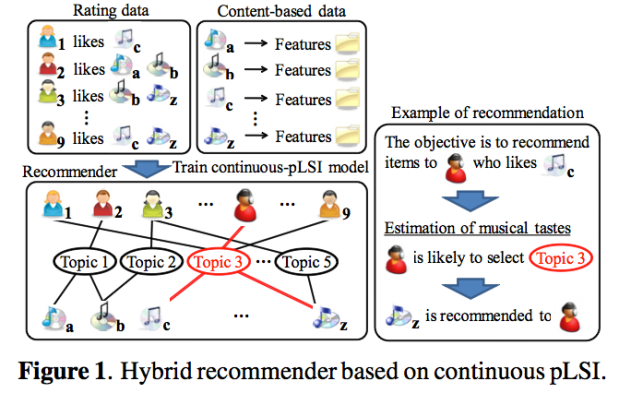
Evaluation: They found that using the techniques to adjust model complexity significantly improved the accuracy of recommendations and that the second technique could also reduce hubness.
STEERABLE PLAYLIST GENERATION BY LEARNING SONG SIMILARITY FROM RADIO STATION PLAYLISTS
François Maillet, Douglas Eck, Guillaume Desjardins, Paul Lamere
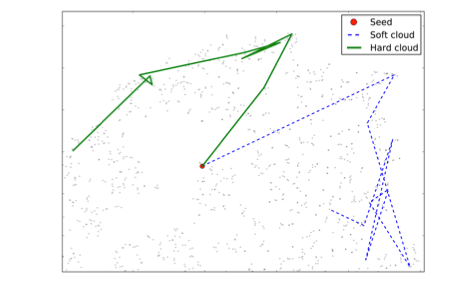
This paper presents an approach to generating steerable playlists. They first demonstrate a method for learning song transition probabilities from audio features extracted from songs played in professional radio station playlists and then show that by using this learnt similarity function as a prior, they are able to generate steerable playlists by choosing the next song to play not simply based on that prior, but on a tag cloud that the user is able to manipulate to express the high-level characteristics of the music he wishes to listen to.
- Learn a similarity space from commercial radion staion playlists
- generate steerable playlists
Francois defines a playlist. Data sources: Radio Paradise and Yes.com’s API. 7million tracks,
Problem: They had positive examples but didn’t have an explicit set of negative examples. Chose them at random.
Learning the song space: Trained a binary classifier to determine if a song sequence is real.
Features: Timbre, Rhythmic/dancability, loudness
Eval:
EVALUATING AND ANALYSING DYNAMIC PLAYLIST GENERATION HEURISTICS USING RADIO LOGS AND FUZZY SET THEORY
Klaas Bosteels, Elias Pampalk, Etienne Kerr
Abstract: In this paper, we analyse and evaluate several heuristics for adding songs to a dynamically generated playlist. We explain how radio logs can be used for evaluating such heuristics, and show that formalizing the heuristics using fuzzy set theory simplifies the analysis. More concretely, we verify previous results by means of a large scale evaluation based on 1.26 million listening patterns extracted from radio logs, and explain why some heuristics perform better than others by analysing their formal definitions and conducting additional evaluations.
Notes:
- Dynamic playlist generation
- Formalization using fuzzy sets. Sets of accepted songs and sets of rejected songs
- Why last two songs not accepted? To make sure the listener is still paying attention?
- Interesting observation that the thing that matters most is membership in the fuzzy set of rejected songs. Why? Inconsistent skipping behavior.

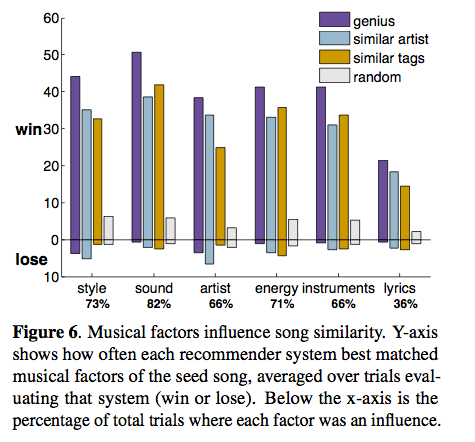
SMARTER THAN GENIUS? HUMAN EVALUATION OF MUSIC RECOMMENDER SYSTEMS.
Luke Barrington, Reid Oda, Gert Lanckriet
Abstract: Genius is a popular commercial music recommender sys- tem that is based on collaborative filtering of huge amounts of user data. To understand the aspects of music similarity that collaborative filtering can capture, we compare Genius to two canonical music recommender systems: one based purely on artist similarity, the other purely on similarity of acoustic content. We evaluate this comparison with a user study of 185 subjects. Overall, Genius produces the best recommendations. We demonstrate that collaborative filter- ing can actually capture similarities between the acoustic content of songs. However, when evaluators can see the names of the recommended songs and artists, we find that artist similarity can account for the performance of Genius. A system that combines these musical cues could generate music recommendations that are as good as Genius, even when collaborative filtering data is unavailable.
Great talk, lots of things to think about.
My worst ISMIR moment
I’ve been invited to be a session chair for the Oral Session on Tags that runs this morning. This brings back memories of my worst ISMIR moment which I wrote about in my old Duke Listens blog:
It was in my role as session chair that I had my worst ISMIR moment. I was doing fine making sure that the speakers ended on time (even when we had to swap speakers around when one chap couldn’t get his slides to appear on the projector). However there was one speaker who gave a talk about a topic that I just didn’t understand. I didn’t grasp the goal of the research, the methods, the conclusions or the applicability of the research. All the way through the talk I was wracking my brains trying to eek out an appropriate, salient question about the research. A question that wouldn’t mark me as the idiot that I clearly was. By the end of the talk I was regretting my decision to accept the position as session chair. I could only pray that someone else would ask the required question and save me from humiliating myself and insulting the speaker. The speaker concluded the talk, I stood up and thanked the speaker, offered a silent prayer to the God of Curiosity and then asked the assembled for questions. Silence. Long Silence. Really long silence. My worst nightmare. I was going to ask a question, but by this point I couldn’t even remember what the talk was about. It was going to be a bad question, something like “Why do you find this topic interesting?” or “Isn’t Victoria nice?”. Just microseconds before I uttered my feeble query, a hand went up, I was saved. Someone asked a question. I don’t remember the question, I just remember the relief. My job as session chair was complete, every speaker had their question.
This year, I think I’ll be a bit more comfortable as a session chair. I know the topic of the session pretty well, and I know most of the speakers too, but still, please don’t be offended if I ask you “How do you like Kobe?”
ISMIR Day 1 Posters

Click for slide show
Lots of very interesting posters, you can see some of my favorites in this Flickr slide show.
ISMIR Oral Session 3 – Musical Instrument Recognition and Multipitch Detection
Session Chair: Juan Pablo Bello
SCALABILITY, GENERALITY AND TEMPORAL ASPECTS IN AUTOMATIC RECOGNITION OF PREDOMINANT MUSICAL INSTRUMENTS IN POLYPHONIC MUSIC
By Ferdinand Fuhrmann, Martín Haro, Perfecto Herrera
- Automatic recognition of music instruments
- Polyphonic music
- Predominate
Research Questions
- scale existing methods to higlh ployphonci muci
- generalize in respect to used intstruments
- model temporal information for recognition
Goals:
- Unifed framework
- Pitched and unpitched …
- (more goals but I couldn’t keep up_
Neat presentation of survey of related work, plotting on simple vs. complex
Ferdinand was going too fast for me (or perhaps jetlag was kicking in), so I include the conclusion from his paper here to summarize the work:
Conclusions: In this paper we addressed three open gaps in automatic recognition of instruments from polyphonic audio. First we showed that by providing extensive, well designed data- sets, statistical models are scalable to commercially avail- able polyphonic music. Second, to account for instrument generality, we presented a consistent methodology for the recognition of 11 pitched and 3 percussive instruments in the main western genres classical, jazz and pop/rock. Fi- nally, we examined the importance and modeling accuracy of temporal characteristics in combination with statistical models. Thereby we showed that modelling the temporal behaviour of raw audio features improves recognition per- formance, even though a detailed modelling is not possible. Results showed an average classification accuracy of 63% and 78% for the pitched and percussive recognition task, respectively. Although no complete system was presented, the developed algorithms could be easily incorporated into a robust recognition tool, able to index unseen data or label query songs according to the instrumentation.
MUSICAL INSTRUMENT RECOGNITION IN POLYPHONIC AUDIO USING SOURCE-FILTER MODEL FOR SOUND SEPARATION
by Toni Heittola, Anssi Klapuri and Tuomas Virtanen
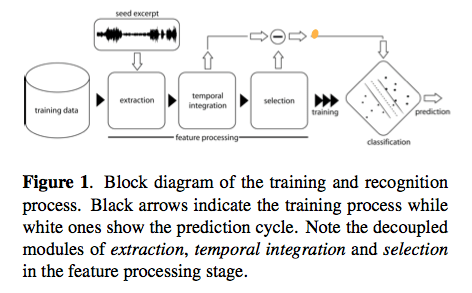
Quick summary: A novel approach to musical instrument recognition in polyphonic audio signals by using a source-filter model and an augmented non-negative matrix factorization algorithm for sound separation. The mixture signal is decomposed into a sum of spectral bases modeled as a product of excitations and filters. The excitations are restricted to harmonic spectra and their fundamental frequencies are estimated in advance using a multipitch estimator, whereas the filters are restricted to have smooth frequency responses by modeling them as a sum of elementary functions on the Mel-frequency scale. The pitch and timbre information are used in organizing individual notes into sound sources. The method is evaluated with polyphonic signals, randomly generated from 19 instrument classes.
Source separation into various sources. Typically uses non-negative matrix factorization. Problem: Each pitch needs its own function leading to many functions. The system overview:

The Examples are very interesting: www.cs.tut.fi/~heittolt/ismir09
HARMONICALLY INFORMED MULTI-PITCH TRACKING
by Zhiyao Duan, Jinyu Han and Bryan Pardo
A novel system for multipitch tracking, i.e. estimate the pitch trajectory of each monophonic source in a mixture of harmonic sounds. Current systems are not robust, since they use local time-frequencies, they tend to generate only short pitch trajectories. This system has two stages: multi-pitch estimation and pitch trajectory formation. In the first stage, they model spectral peaks and non-peak regions to estimate pitches and polyphony in each single frame. In the second stage, pitch trajectories are clustered following some constraints: global timbre consistency, local time-frequency locality.
Here’s the system overview:
 Good talk and paper. Nice results.
ISMIR Poster Madness part 2
Poster madness! Version 2 – even faster this time. I can’t keep up
- Singing Pitch Extraction – Taiwan
- Usability Evaluation of Visualization interfaces for content-based music retrieval – looks really cool! 3D
- Music Paste – concatenating music clipbs based on chroma and rhythm features
- Musical bass-line pattern clustering and its application aduio gener classification
- Detecting cover sets – looks nice – visualization – MTG
- Using Musical Structure to enhance automatic chord transcription –
- Visualizing Musical Structure from performance gesture – motion
- From low-level to song-level percussion descriptors of polyphonic music
- MTG – Query by symbolic example – use a DNA/Blast type approach
- sten – web-based approach to determine the origin of an artist – visualizations
- XML-format for any kind of time related symbolic data
- Erik Schmidt – FPGA feature extraction. MIR for devices
- Accelerating QBH – another hardware solution – 160 times faster
- Learning to control a reverberator using subjective perceptual descriptors – more boomy
- Interactive GTTM Analyzer –
- Estimating the error distribution of a tap sequence without ground Truth – Roger Dannenburg
- Cory McKay – ACE XML – Standard formats for features, metadata, labels and class ontologies
- An efficient multi-resolution spectral transform for music analysis
- Evaluation of multiple F0 estimation and tracking systems
BTW – Oscar informs me that this is not the first ever poster madness – there was one in Barcelona
ISMIR Oral Session 2 – Tempo and Rhythm
Posted by Paul in ismir, Music, music information retrieval, research on October 27, 2009
Session chair: Anssi Klapuri
IMPROVING RHYTHMIC SIMILARITY COMPUTATION BY BEAT HISTOGRAM TRANSFORMATIONS
By Marthias Gruhne, Christian Dittmar, and Daniel Gaertner
Marthias described their approach to generating beat histogram techniques, similar to those used by Burred, Gouyun, Foote and Tzanetakis. Problem: beat histogram can not be directly used as feature because of tempo dependency. Similar rhythms appear far apart in a Euclidean space because of this dependency. Challenge: reduce tempo dependence.
Solution: logarithmic Transformation. See the figure:

This leads to a histogram with a tempo independent part which can be separated from the tempo dependent part. This tempo independent part can then be used in a Euclidean space to find similar rhythms.
Evaluation: results 20% to 70%, and from 66% to 69% (Needs a significance test here I think)
USING SOURCE SEPARATION TO IMPROVE TEMPO DETECTION
By Parag Chordia and Alex Rae – presented by George Tzanetakis
Well, this is unusual that George will be presenting Para and Alex’s work. Anssi suggests that we can use the wisdom of the crowds to anser the questions.
Motivation: Tempo detection is often unreliable for complex music.
Humans often resolve rhythms by entraining to a rhythmical regular part.
Idea: Separate music into components, some components may be more reliable.
Method:
- Source separation
- track tempo for each source
- decide global tempo by either:
- Pick one with most regular structure
- Look for common tempo across all sources/layers
Here’s the system:

PLCA is a source separation method (Probablistic Latent Component Analysis). Issues: Number of components need to be specified in advance. Could merge sources or one source could be split into multiple layers.
Autocorrelation is used for tempo detection. Regular sources will have higher peaks.
Other approach – a machine learning approach – a supervised learning problem
Global Tempo using Clustering – merge all tempo candidates into single vector (and others within a 5% tolerance (and .5x and 2x), to give a peak histogram showing confidence for each tempo.
Evaluation
- IDM09 – http://paragchordia.com/data.html
- mirex06 (20 mixed genre exceprts)
Accuracy:
MIREX06: 0.50
THIS   : 0.60
Question: How many sources were specified to PLCA, Answer: 8. George thinks it doesn’t matter too much.
Question: Other papers show that similar techniques do not show improvement for larger datasets
A MID-LEVEL REPRESENTATION FOR CAPTURING DOMINANT TEMPO AND PULSE INFORMATION IN MUSIC RECORDINGS
By Peter Grosche and Meinard Müller
Example – a waltz – where the downbeat is not too strong compared to beats 2 & 3. It is hard to find onsets in the energy curves. Instead, use:
- Create a spectogram
- Log compression of the spectrogram
- Derivative
- Accumulation
This yields a novelty curve, which can be used for onset detection. Downbeats are missing. How to beat track this? compute tempogram – a spectrogram of the novelty curve. This yields a periodicity kernel. All kernels are combined to obtain a single kernel – rectified – this gives a predominate local pulse curve. The PLP curve is dynamic but can be constrained to track at the bar, beat or tatum level.
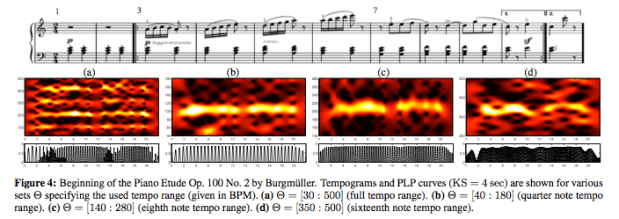
Issues: PLP likes to fill in the gaps – which is not always appropriate. Trouble with the Borodin String Quartet No. 2. But when tempo is tightly constrained, it works much better.
This was a very good talk. Meinard presented lots of examples including examples where the system did not work well.
Question: Realtime? Currently kernels are 4 to 6 seconds. With a latency of 4 to 6 seconds it should work in an online scenario.
Question: How different from DTW on the tempogram? Not connected to DTW in anyway.
Question: How important is the hopsize? Not that important since a sliding window is used.
ISMIR Poster Madness
A new feature of ISMIR this year – Poster Madness – poster presenters have 30 seconds to pitch their stuff. Closest thing to a researcher cage match that we’ll see here at ISMIR. Posters that caught my eye:
- An Analysis of ISMIR Proceedings by Jin Ha Lee – she had to carry a big poster. A visualization of the authorship space
- ISMIR Tag Cloud Browser – really cool – http://asp.cp.jku.at/ismircloud/
- Meinard Mueller on the spot – where’s Verena? Tempo curves for performance analysis
- Matija: Field recordings of folk music and interviews – automatic segmentation and labeling this data
- Thibault – musc classificatoin on timbral features – playlists- hmmm what’s new here?
- Frieder Stolzenburg – Harmony perception =
- Musical instrument detector – this looks really neat. Can detect prescence of 10 instruments – T
- Univeristy of Crete – Andre – rhytmic similary of turkish music
- Onset detection
- Dominkus – shades of music – dealing with heterogenous music similarity -subsong similarities – looks really neat
- NOrberto – onset detection – an ensemble technique
- Lyric emotion detection – NLP, fuzzy clustering, Yajiee HU
- Peter Knees – Browsing Music Recommndation Networks – content-based similarity – 40% songs are never recommended. Hubs!
- KDDI – Full-automatic DJ mixing system. Tempo adjustment – must see this.
- Hiding information in a music score? WTF?
- Improving Musical Concept detection – Taiwan University
- Laurent oudre – template based chord recognition – simple fast
- Tag-aware spectral clustering of music items. Ioannis Karydis. 3 way relationships. Good paper, will see this.
- Christ Santora, F0 estimation – MDCT –
- SOM of folksongs – a music visualization of folk music from 22 cultures
- Using XML-Formatted scores in real-time applications –
ISMIR Oral Session 1 – Knowledge on the Web
Oral Session 1A – Knowledge on the Web
Oral Session 1A – The first Oral Session of ISMIR 2009, chaired by Malcolm Slaney of Yahoo! Research
Integrating musicology’s heterogeneous data sources for better exploration
by David Bretherton, Daniel Alexander Smith, mc schraefel,
Richard Polfreman, Mark Everist, Jeanice Brooks, and Joe Lambert
Project Link: http://www.mspace.fm/projects/musicspace
Musicologists consult many data sources, musicspace tries to integrate these resources. Here’s a screenshot of what they are trying to build.
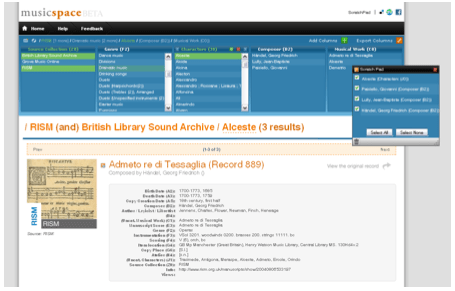
Wirking with many public and private organizations (From British Libary to Naxos).
Motivation: Many musicologist queries are just intractible because: Need to consult several resources, they are multipart queries (require *pen and paper*), insufficient granularity of metadata or serch options. Solution: Integrate sources, optimally interactive UI, increase granularity.
Difficulties: Many formats for data sources,
Strategies: Increase granularity of data by making annotations explicit. Generate metadata – fallback on human intelligence, inspired by Amazon turk – to clean and extract data.
User Interface – David demonstrated the faceted browser to satisfy a complex query (find all the composers that montiverdi’s scribe was also the scribe for). I liked the dragging columns.
There are issues with linked databases from multiple sources – when one source goes away (for instance, for licensing reason), the links break.
An Ecosystem for transparent music similarity in an open world
By Kurt Jacobson, Yves Raimond, Mark Sandler
Link http://classical.catfishsmooth.net/slides/
Kurt was really fast, was hard to take coherent notes, so my fragmented notes are here.
Assumption: you can use music similarity for recommendation. Music similarity:
Tversky’s suggested that you can’t really put similarity into a euclidean space. It is not symmetric. He suggests a contrast model basd on comparing features – analagous to ‘bag of features’.
What does music similarity realy mean? We can’t say! Means different things in different contexts. Context is important. Make similarity be a RDF concept. A hierarchy of similarity was too limiting. Similarity now has properties. We reify the simialriy, how, how much etc.
Association method with levels of transparency as follows:
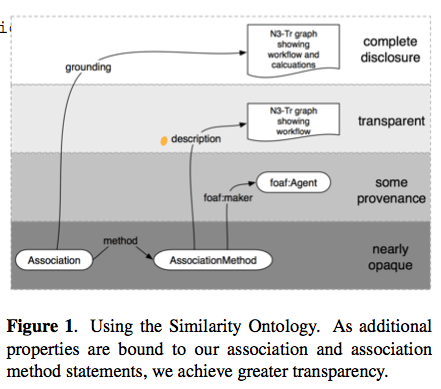
Example implementation: http://classical.catfishsmooth.net/about/
Kurt demoed the system showing how he can create a hybrid query for timbral, key and composer influence similarity. It was a nice demo.
Future work: digitally signed similarity statements – neat idea.
Kurt challenges the Last.fm, BMATs and the Echo Nests and anyone who provides similarity information: Why not publish MuSim?
Interfaces for document representation in digital music libraries
By Andrew Hankinson Laurent Pugin Ichiro Fujinaga
Goal: Designing user interfaces for displaying music scores
Part of the RISM project – music digitization and metadata
Bring together information for many resources.
Five Considerations
- Preservation of Document integrity – image gallery approach doesn’t give you a sense of the complete document
- Simultaneous viewing of parts – for example, the tenor and bass may be separated in the work without window juggling.
- Provide multiple page resolutions – zooming is important
- Optimized page loading
- Image + Metadata should be presented simultaneously
Current Work
Implemented a prototype viewer that takes the 5 considerations into account. Andy gave a demo of the prototype – seems to be quite an effective tool for displaying and browsing music scores:

A good talk,well organized and presented – nice demo.
Oral Session 1B – Performance Recognition
Oral Session 1B, chaired by Simon Dixon (Queen Mary)
Body movement in music information retrieval
by Rolf Inge Godøy and Alexander Refsum Jensenius
Abstract: We can see many and strong links between music and hu- man body movement in musical performance, in dance, and in the variety of movements that people make in lis- tening situations. There is evidence that sensations of hu- man body movement are integral to music as such, and that sensations of movement are efficient carriers of infor- mation about style, genre, expression, and emotions. The challenge now in MIR is to develop means for the extrac- tion and representation of movement-inducing cues from musical sound, as well as to develop possibilities for using body movement as input to search and navigation inter- faces in MIR.
Links between body movement and music everywhere. Performers, listeners, etc. Movement is integral to music experience. Suggest that studying music-related body movement can help our understanding of music.
One example: http://www.youtube.com/watch?v=MxCuXGCR8TE
Relate music sound to subject images.
Looking at performance of pianists – creates a motiongram – and a motion capture.
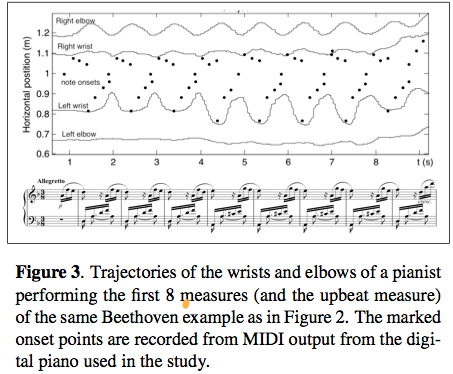
Listeners have lots of knowledge about sound producing motions/actions. These motions are integral to music perception. There’s a constant mental model of the sound/action. Example: Air guitar vs. Real Guitar
This was a thought provoking talk. wonder how the music-action model works when the music controller is no longer acoustic – do we model music motions when using a laptop as our instrument?
Who is who in the end? Recognizing pianists by their final ritardandi
by Raarten Grachten and Gerhrad Widmer
Some examples Harasiewicz, vs Ashkenazy – similar to how different people walk down the stairs.
Why? Structure asks for it or … they just feel like it. How much of this is specific to the performer? Fixed effects: transmitting moods, clarifying musical structure. Transient effects: Spontaneous deicsions, motor noise, performance errors.
Study – looking at piece specific vs. performance specific tempo variation. Results: Global tempo from the piece, local variation is performance specific.
Method:
- Define a performance norm
- Determine where performers significantly deviate
- Model the deviations
- Classify performances based on the model
In actuality, use the average performance as a norm. Note also there may be errors in annotations that have to be accounted for.
Here are the deviations from the performance norm for various performers.

Accuracy ranges from 65.31 to 43.53 – (50% is random baseline). Results are not overwhelming, but still interesting considering the simplistic model.
Interesting questions about students and schools and styles that may influence results.
All in all, an interesting talk and very clearly presented.
 Music Machinery